ER and golgi
A eukaryotic cell can be likened to a city. The cell membrane (and cell wall, if present) represents the border, with integral membrane proteins acting as checkpoints for cargo entering or exiting. The interior volume is organized into distinctive neighborhoods or districts known as organelles, each serving specialized functions:
Nucleus: Functions like the city hall or executive office, overseeing activities within the cell.
Mitochondria: Comparable to generators that provide power.
Vacuoles: Act like the warehouse district and water towers, storing materials and maintaining water balance.
Continuing with this analogy, the next organelles represent the industrial district, encompassing key structures involved in manufacturing and distribution:
Endoplasmic Reticulum (ER)
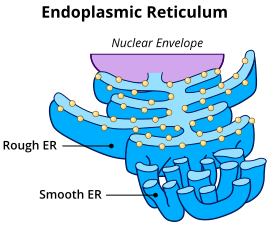
Commonly abbreviated to ER, this organelle's name derives from roots signifying "inside," "something formed or molded," and "net". The ER forms a network of tubules and sacs within the cell, originating at the nuclear envelope; parts of the ER membrane are continuous with the outer membrane of the nuclear envelope.
ER exists in two types:
Rough ER: Appears bumpy under high-powered microscopes due to ribosomes attached to its surface.
Smooth ER: Lacks ribosomes, giving it a smooth appearance.
Golgi Apparatus
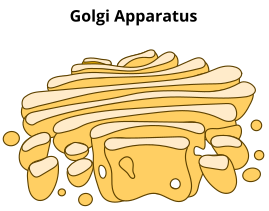
The Golgi apparatus (also known as Golgi body, Golgi complex, or simply Golgi), named after its discoverer, is typically positioned near the outermost part of the ER. It consists of a series of stacked sacs, although they are not physically connected.
The operation of the ER and Golgi begins with ribosomes, which are large machines made of RNA and proteins, facilitating the translation of mRNAs to link amino acids into proteins. Although ribosomes are not classified as organelles due to the absence of a surrounding membrane, some are associated with the ER while others are free in the cytoplasm.