Memory
Definition (#f7aeae)
Important (#edcae9)
Extra (#fffe9d)
Memory:
The means by which we retain and draw on information from our past experiences to use in the present.
Dynamic mechanism associated with storing, retaining and retrieving information from the past.
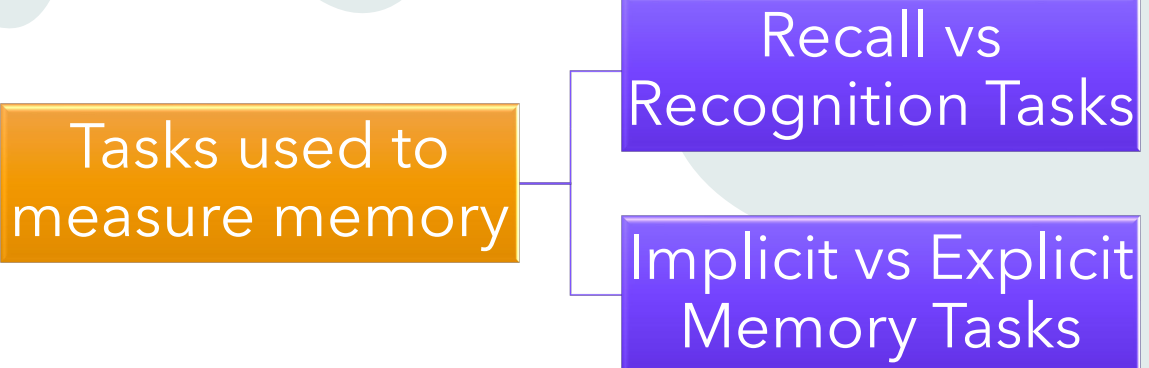
Recall vs Recognition task:
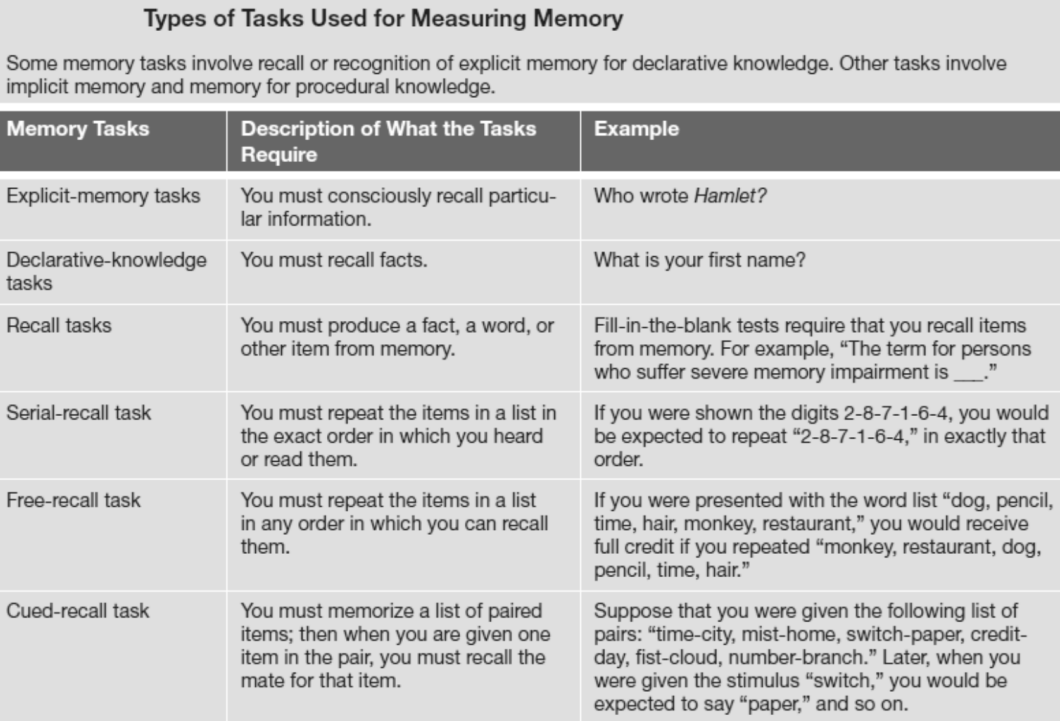
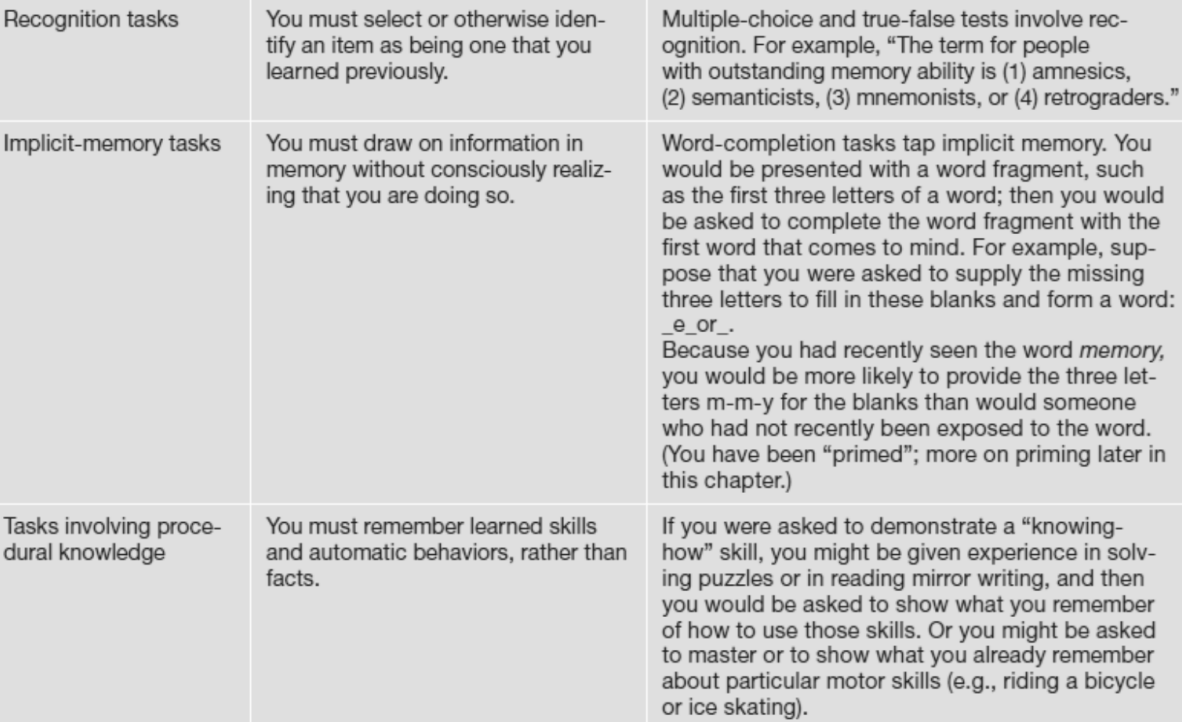
Recall: When you produce something from your memory.
Recognition: You select or identify an item which you have been previously exposed to.
Recognition is also known as tapping receptive knowledge.
In a recognition-memory task, you respond to stimuli presented to you and decide whether you have seen them before or not.
3 types of recall tasks are used:
Serial recall: You recall items in the exact order in which they were presented.
Free recall: You recall items in any order you choose.
Cued recall (paired-associates recall): You are first shown items in pairs, but during recall you are cued with only one member of each pair and are asked to recall each mate.
Implicit vs Explicit memory tasks:
Explicit memory: Participants engage in conscious recollection.
Implicit memory: We use information from memory but are not consciously aware that we are doing so.
Tasks that measure implicit & explicit memories:
Priming Task: Used to test implicit memory.
Priming is the facilitation of your ability to utilize missing information.
Procedural memory: Can be tested in implicit-memory tasks as well.
Procedural memory tasks:
Rotary pursuit task: Requires participants to maintain contact with the mouse and the red dot.
Mirror-tracing task
Process-dissociation model: Both implicit and explicit memory play a role in every responses.
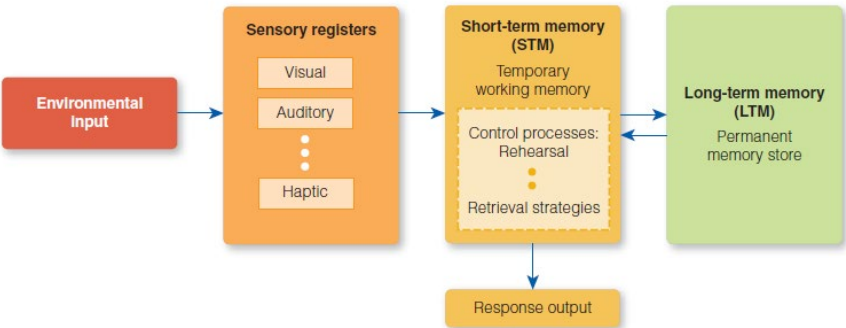
Models of Memory:
Atkinson & Shiffrin model:
Sensory Memory: Capable of storing relatively limited amounts of information for very brief periods.
The initial repository of much information that eventually enters the short and long-term stores.
Short-term Memory: Capable of storing information for somewhat longer periods but of relatively limited capacity as well.
Our immediate (short-term) memory capacity for a wide range of items appears to be about 7 items, ± 2.
Long-term Memory: Capable of very large capacity and of storing information for very long periods. At present, we have no proof even that there is an absolute outer limit to how long information can be stored.
Capacity of the short-term store of visual information:
Storage seems to depend on numbers of objects rather than numbers of features.
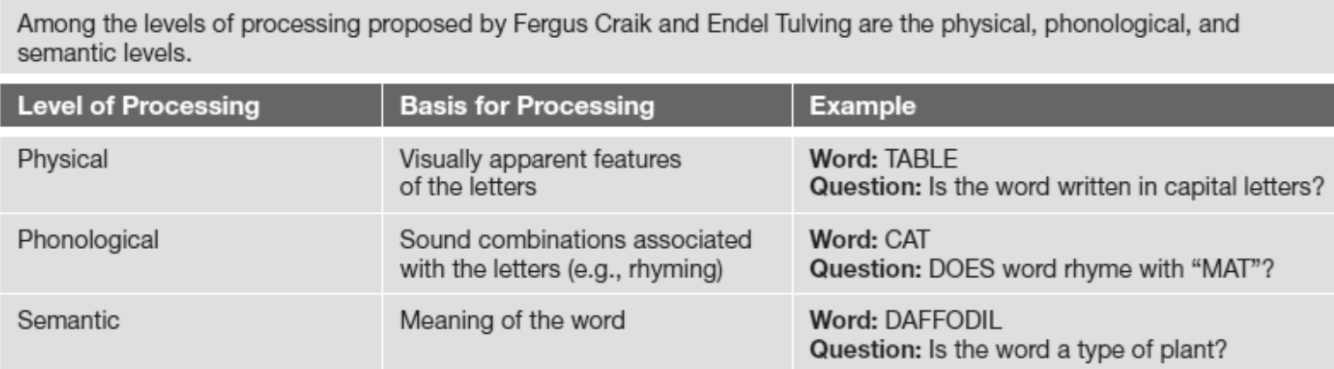
The levels of Processing Model (LOP):
LOP framework suggests that memory does not comprise 3 or any specific number of separate stores, but varies along a continuous dimension in terms of depth of encoding.
There are theoretically an infinite number of levels of processing (LOP) at which items can be encoded through elaboration—or successively deeper understanding of material to be learned.
No distinct boundaries between 1 level and the next.
This model emphasizes processing as the key to storage.
The deeper the level of processing encouraged by the question, the higher the level of recall achieved.
Working Memory Model:
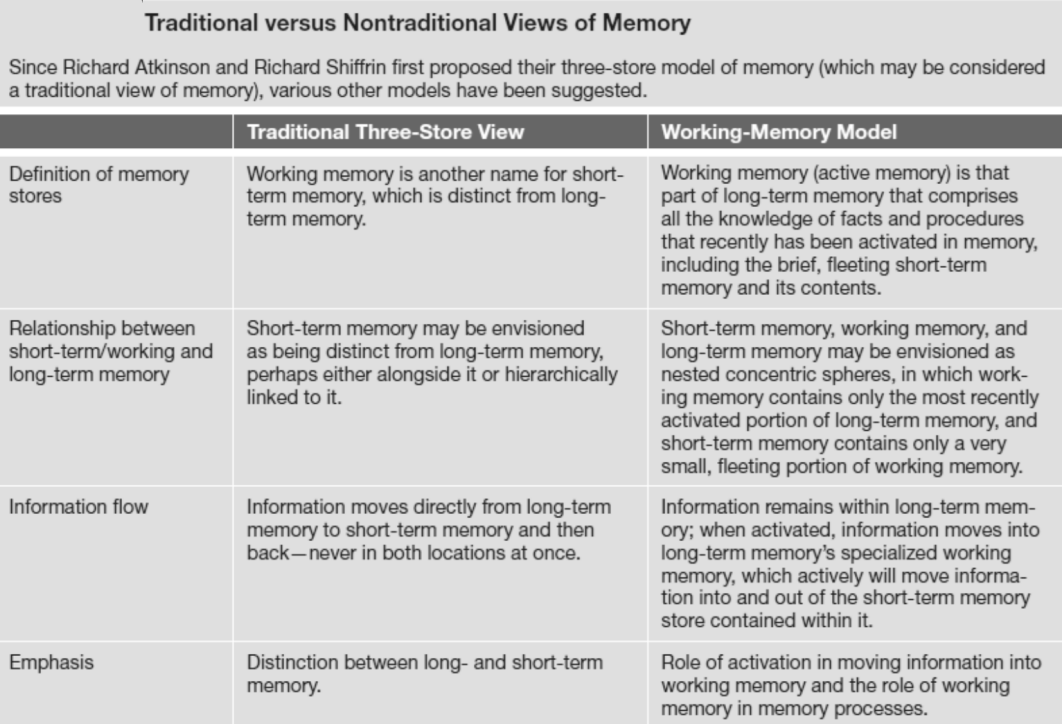
Most widely used and accepted model.
In traditional view, STM only stores information for a short time.
The working-memory concept, states working memory serves not only to hold information but also to process that information.
When processing language you hear or working on a math problem, you need to hold information in your memory, but also manipulate it.
Our working memory can hold more items, LTM contributes to the performance of working memory.
The border between working memory and LTM is a lot fuzzier than the distinction between STM and LTM in the 3-store model.
Components of Working Memory Model:
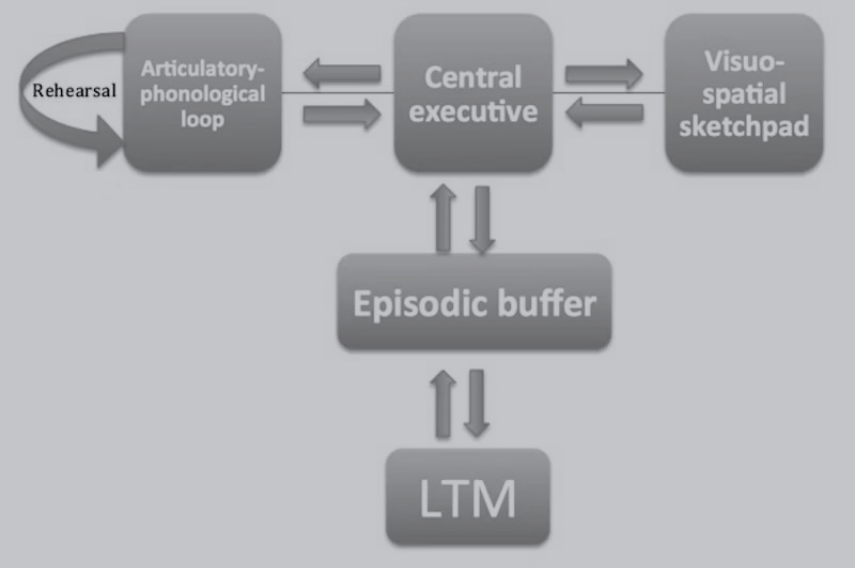
Visuo-spatial sketchpad:
Briefly holds some visual images.
Contains both spatial and visual information, but some evidence indicates that actually 2 separate mechanisms within the visuospatial sketchpad deal with spatial and visual information.
Information in the visuospatial sketchpad decays rapidly.
Phonological loop:
Briefly stores mainly verbal information for verbal comprehension and for acoustic rehearsal.
We use the phonological loop for a number of everyday tasks, including sounding out new and difficult words and solving word problems.
This loop has 2 critical components: phonological storage & subvocal rehearsal.
Phonological storage: Which holds information in memory.
Trace decay occurs quickly, we can store only about 2 seconds worth of speech-based information.
Subvocal rehearsal: Which holds information by nonverbally practicing it.
Information is rehearsed here to prevent its fading in the phonological store.
Trace decay: The fading of information in memory.
Central executive:
Allocates attention within working memory.
Decides how to divide attention between 2 or more tasks that need to be done at the same time, or how to switch attention back and forth between multiple tasks.
Baddeley believes different components may be responsible for focusing and dividing attention, but so far evidence is limited.
Critical to working memory because it’s the gating mechanism that decides what information to process further and how to process this information.
Decides what resources to allocate to memory and related tasks, and how to allocate them.
Also involved in higher-order reasoning and comprehension and is central to human intelligence
Episodic buffer:
A late addition to the working-memory model.
Explains how we integrate information in working memory, long-term memory, the visuospatial sketchpad, and the phonological loop.
Allows us to solve problems and reevaluate previous experiences with more recent knowledge.