7. Attitudes and Attitude Change
M Jan 6: Review core principles of TCPS 2, review feedback and discuss questions from REB applications with groups.
W Jan 8: Qualtrics tutorial, complete Qualtrics online survey for REB application submission.
M Jan 13 & 15: Lecture
M Jan 20: Lecture
W Jan 22: Lecture / Discussion of Fact-checking article / Group work
What are attitudes?
General evaluations of a person/ object/ idea
What are we evaluating?
Attitude objects - anything we can evaluate
people tend to evaluate what we see, what we interact with and based on observations and experiences we form attitudes
determines how we behave and make judgements
Attitude Components
ABCs of attitudes
Affective: emotional reactions
Behavioural: Actions
Cognitive: Thoughts and Beliefs
Where do attitudes come from?
Genetic origins?
Identical twins share more attitudes than fraternal
Even when they were raised apart and dont know each other
Temperament, personalities - predisposed and inherited traits
e.g.
Attitudes towards exercise, roller coasters
Social experiences and interactions
Our interactions with others in different environments can shape our attitudes.
e.g.
Engagement in political issues may influence our attitudes about Trudeau’s resignation
Attitudes may be based on one component or a combination of the ABCs
Cognitively based attitudes
An attitude based primarily on peoples beliefs about the properties of an attitude object
Sometimes our attitudes are based on the relevant facts
Cost/features of something
can quickly determine pros and cons and if we want to be associated with the object
Affectively based attitudes
attitude based on peoples feelings and values rather than the properties of an attitude object
sometimes we like an attitude object regardless of pros and cons
often related to sex, politics, and religion
Affectively based attitudes can come from:
Values
might be based on moral or religious beliefs
Sensory reaction
e.g., liking/disliking something because of how it feels or tastes
Aesthetic reaction
e.g., liking/disliking something because of how it looks
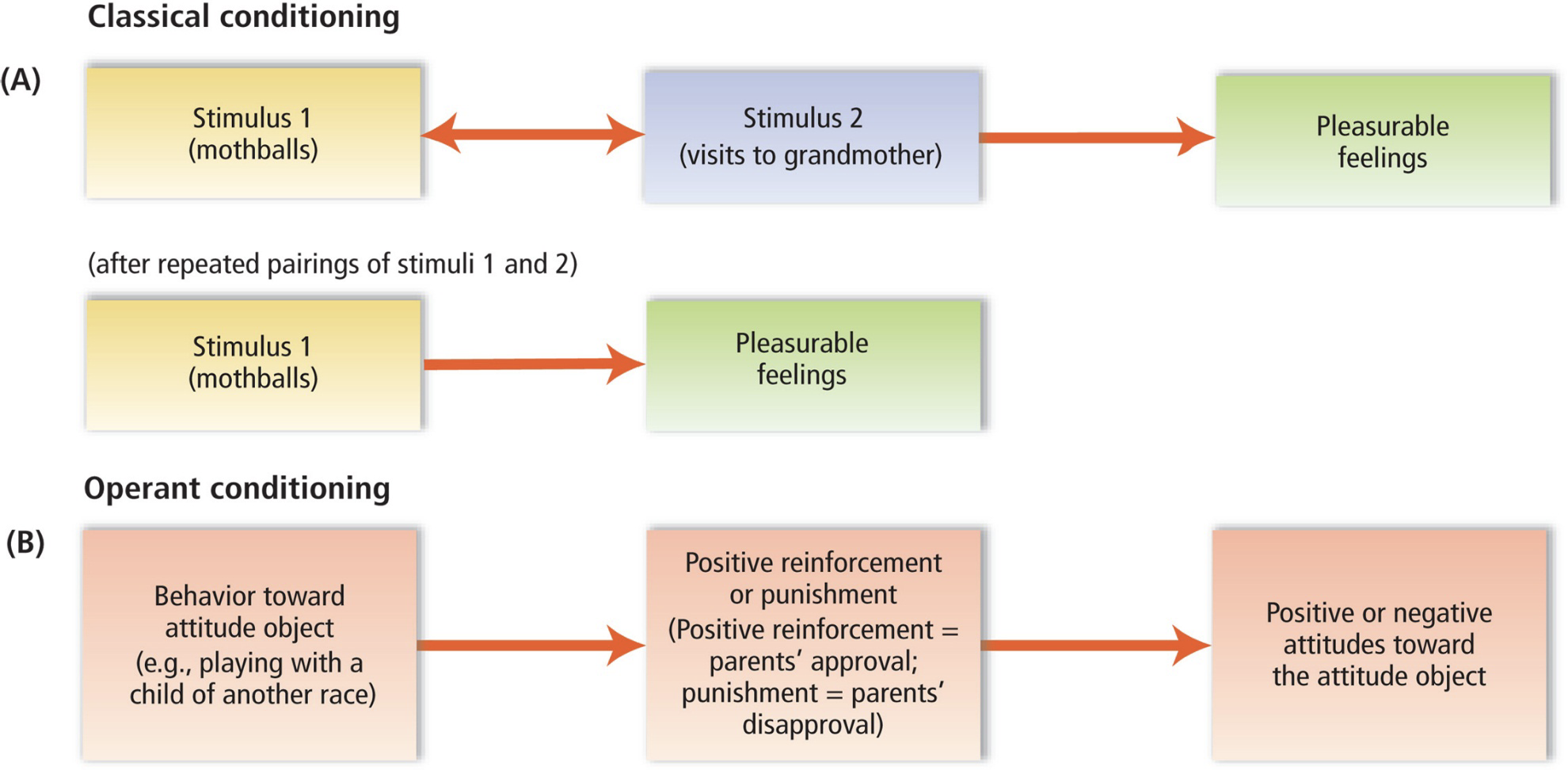
Affective attitudes tend to have 3 things in common:
They don’t come from a rational assessment of an issue, person, or object
They are not governed by logic
They are associated with people’s values
^ people tend to vote based on how they feel about a politician
Behaviourally based attitudes
Attitude based on observations of how one behaves toward an attitude object
→ Self-perception theory
Sometimes people do not know how they feel until they see how they behave
can form our attitudes based on our observations of our own behaviour
People infer their attitudes from their behavior only under certain conditions:
When initial attitude is weak or ambiguous
When no other plausible explanation for behavior
After an attitude forms…
Explicit attitudes
Attitudes that we consciously endorse and can easily report
Implicit attitudes
Attitudes that are involuntary, uncontrollable, and at times, unconscious
** cultural aspect is important as we can have prejudices
→ SUMMARY
Attitudes are general evaluations toward an attitude object
Attitudes have three components (affective, behavioural, and cognitive) and come from different factors
Once attitudes are formed, they can be explicit or implicit
Pt 2
Attitudes → Behaviour
Evidence suggesting that attitudes don’t always predict behaviour
Hospitality Study by LaPierre (1934)
Demonstrated an inconsistency between people’s attitudes and behaviour.
Couple wasn’t aware they were apart of a study
90% of establishments said they wouldnt serve Chinese people
in 251 requests Chinese couple was only refused service once
Discrepancy with attitudes and actions
Review by Wicker (1969)
Reviewed 42 experiments and found that the avg. correlation between attitudes and behaviour was only about .15
Linking attitudes and behaviour
Theory of planned behaviour
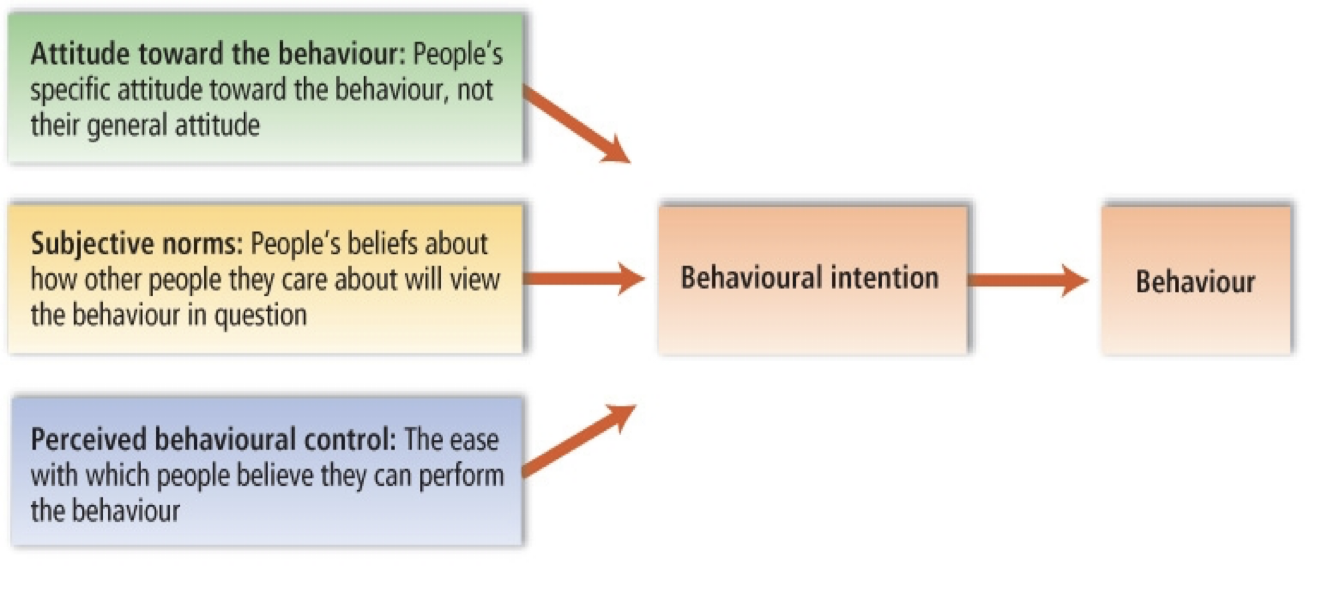
Moderators of the attitude-behaviour relationship
the presence of other influences on behaviour
competing pressures
multiple-act criteria (or principle of aggregation)
Mediator → what explains the link to attitudes from behaviour
moderator → changing the strength of it in some way
Presence of other influences on behaviour
e.g. safe sex
“attitude that safe sex is the choice for us”
but we may let go, “I don’t want to ruin the moment”
Competing pressure
Measuring attitudes
you can measure specific and general attitudes and use this to predict behaviours
Attitude towards birth control
More specific targeted question towards getting a specific attitude
Persuasive communication
Yale attitude change approach (Carl Hovland et al.)
What conditions are most likely to influence persuasive communication?
Who?
Source of communication
What?
Nature of the communication
To whom?
Nature of the audience
In general people:
Want to have “correct” attitudes and beliefs
People have to selectively pay more attention to some things than others
ELM - Elaboration Likelihood Model
→ When will people be persuaded by the central arguments and when they will be persuaded by superficial cues?
ELM: Wanting to be right vs. efficient
Central route:
Persuasion occurs when interested people focus on the arguments and respond with favourable thoughts
Peripheral route:
Persuasion occurs when people are influenced by incidental cues
e.g. attractiveness
-
Attitude resulting from the central route
Attitudes formed by the central route are more:
Accessible
Persistent and stable
Idea around routes of persuasion
Looking at this within the context of HIV prevention interventions
researchers wanted to increase awareness of HIV
Given scripts of people that were exposed to HIV
People would role play these
3 conditions
looked at how well people remembered information
role playing the most positive
by engaging in the role playing its a more central route to persuasion
DV is attitudes towards standardized test
Resisting persuasion
Forewarning and resistance
Jacks and Cameron (2003)
people are asked about resisting persuasion strategies
Freedman and sears
People are most likely to be pursuaided to different beliefs when its a sneak attack vs when they are given warning ahead of time
they stick more closely to their beliefs