Paying for State and Local Government
Paying for State and Local Government
American State and Local Government
State & Local Spending
• State and local government spending goes 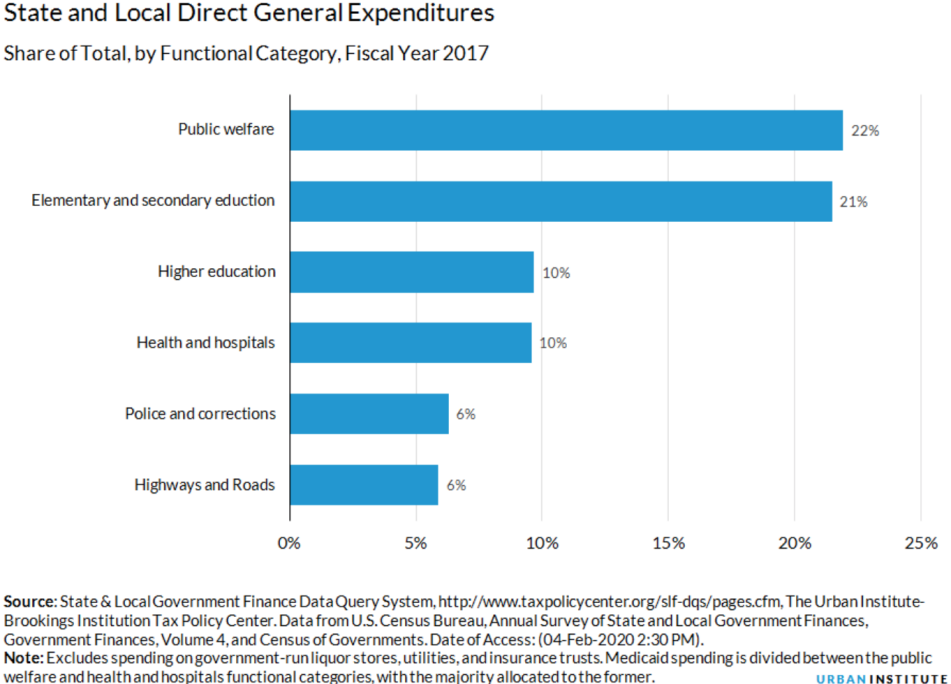
mostly towards:
• Education
• Social Services
• Public Safety
• Transportation
Caption
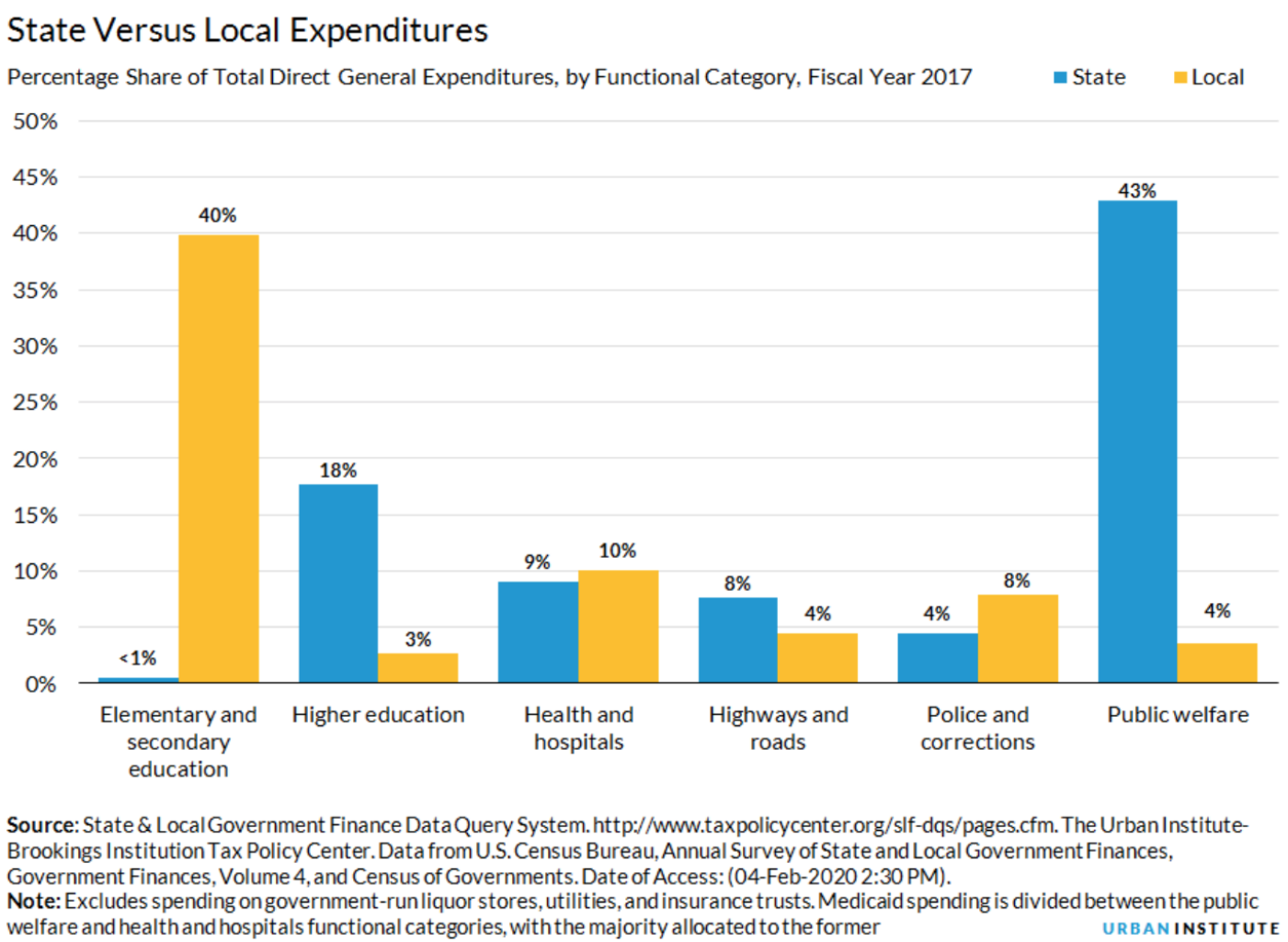
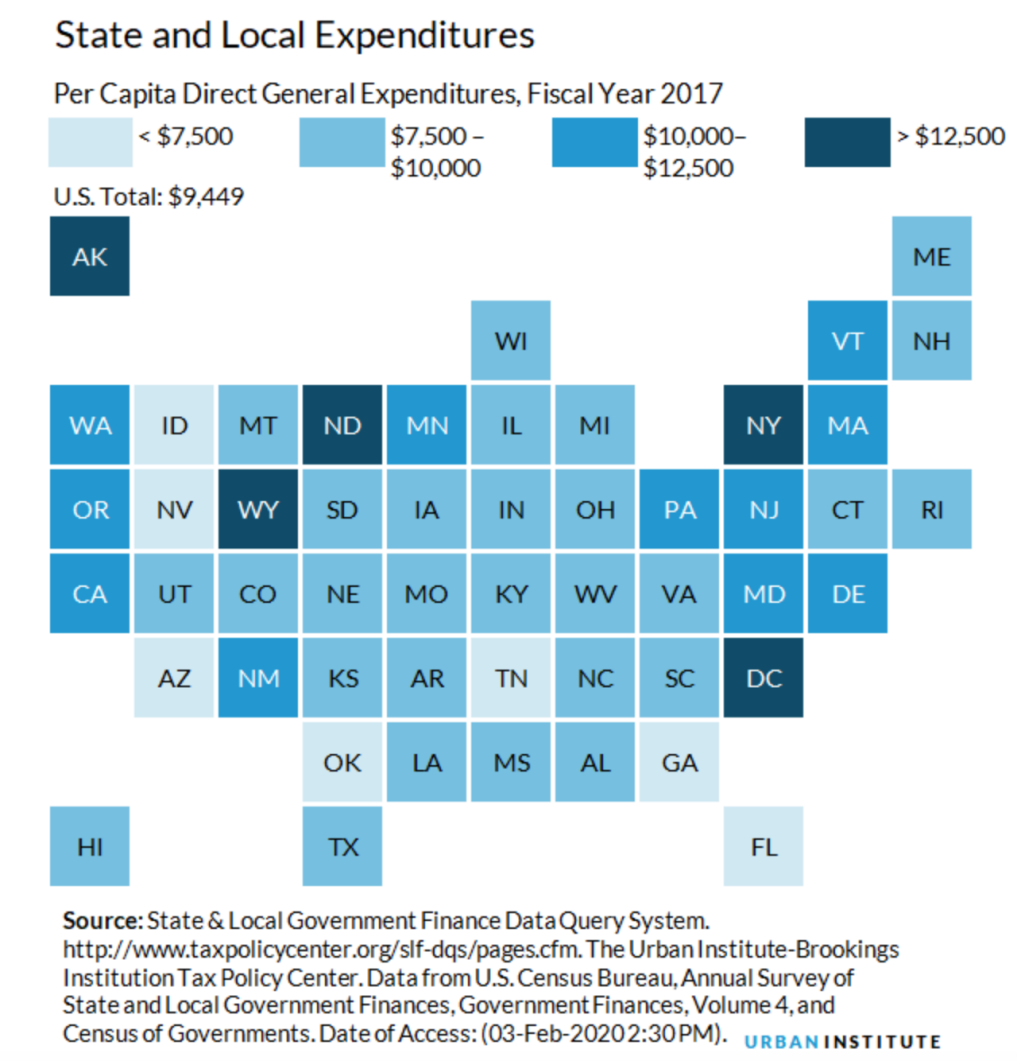
State & Local Expenditures
Taxation
• Taxes are the largest source of revenue for both state & local governments
• Tax policy differs from place to place, with different philosophies on who should pay taxes:
• Progressive - Higher-income earners pay the largest percentage of their income on taxes compared to low-income earners
• Regressive - Taxes that take a larger share of the income of low-income earners
• Proportional - Taxation at equal percentage rates regardless of income
Government Expenditure as a % of GDP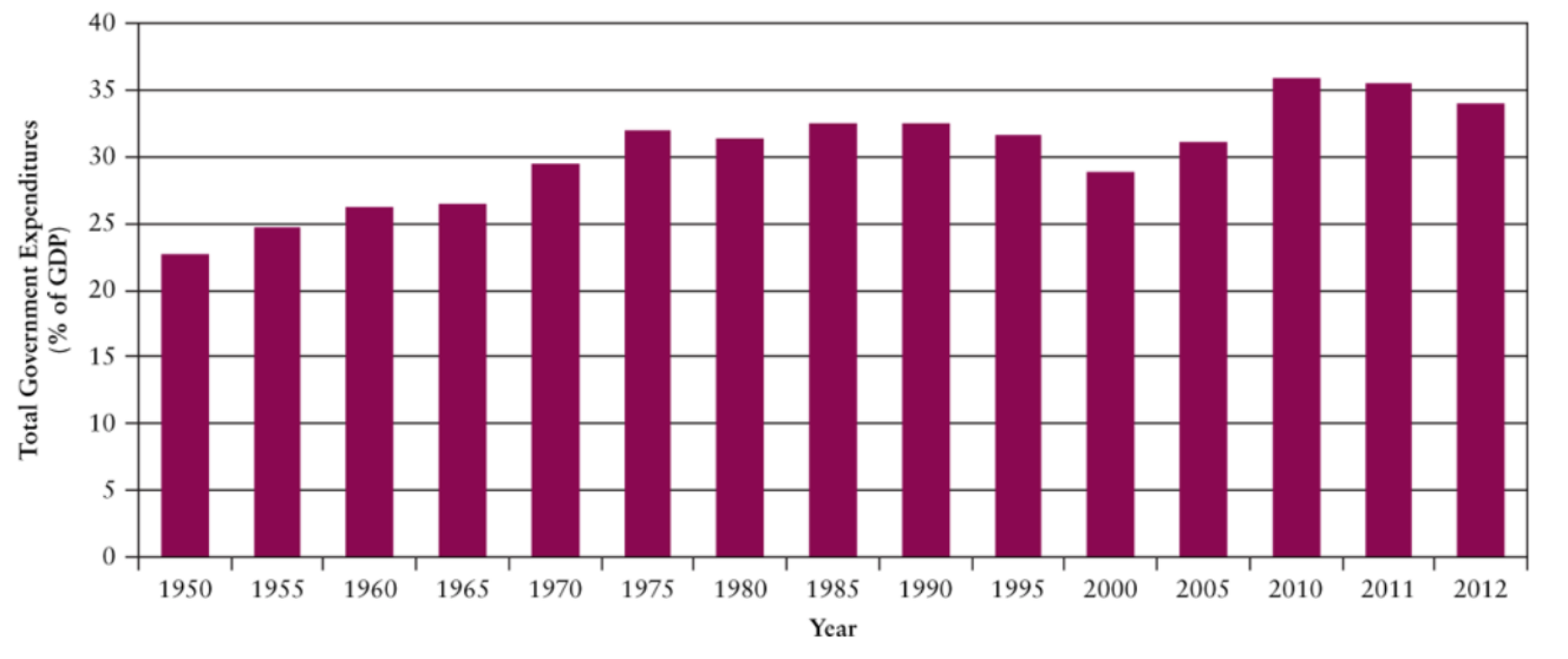

Where do State & Local Tax Dollars Come From?
Where do tax dollars come from?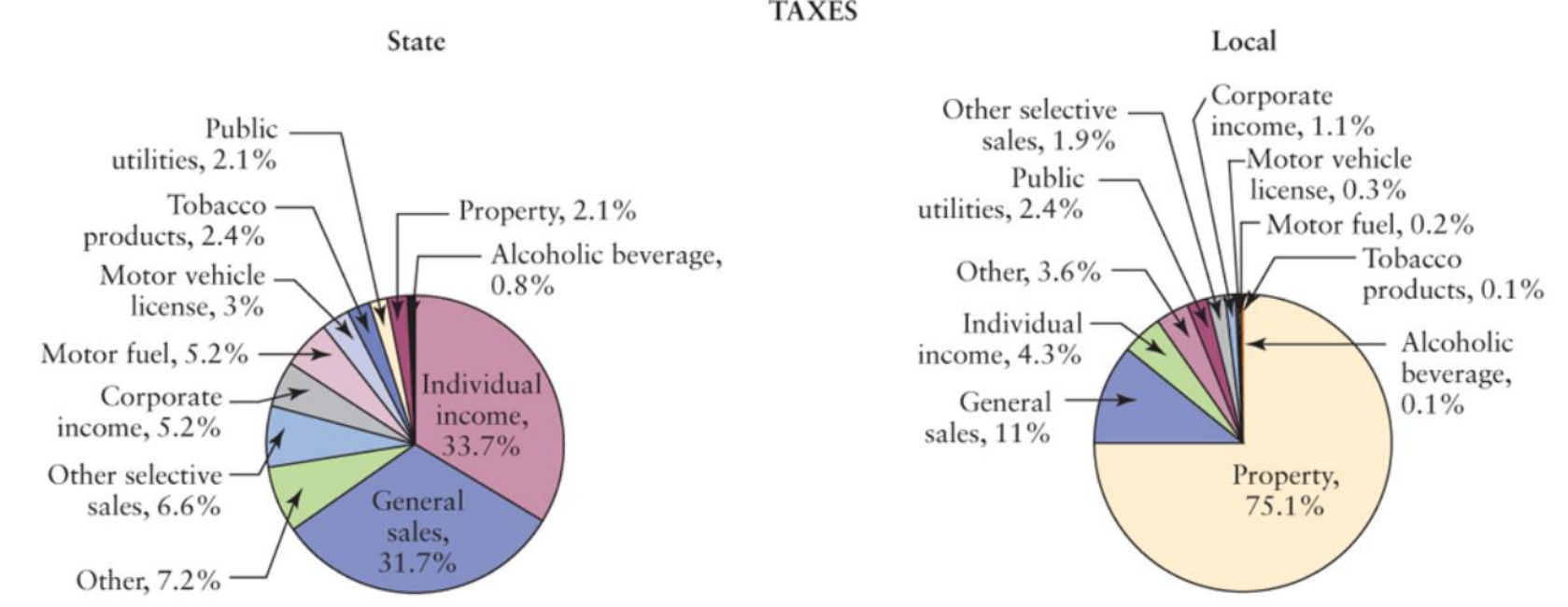

Property Taxes
• Property taxes are the largest source of revenue for local governments in the United States and definitely for Connecticut
• A regressive tax that impacts low-income folks significantly… • Easiest form of tax for local government to collect
• Weather communities are able to raise more in tax revenue with less burden on taxpayers
• Reliance on property tax revenue may result in inequalities between wealthier and poorer communities… Hello Connecticut!
How Property Taxes Work
• Property taxes are calculated by taking the mill rate and multiplying it by the assessed value of the property, divided by 1,000….
• Assessed Value - The dollar value placed on a property for tax purposes by the local government assessor. In Connecticut, that’s done by taking the market value and multiplying it by 70%
• Market Value - The estimated value of a property if sold on the open market • Mill Rate - A dollar per thousand dollars of assessed value of property
• In Connecticut, local tax assessors must revalue all property at least once every 5-years
Calculating Property Tax Bill in Connecticut on a $200,000 Residential Property in New Britain
New Britain has a Mill Rate of 50.50
Calculate assessed value by taking 70% of market value: $200,000 x 0.70 = $140,000
Multiply assessed value by the mill rate: $140,000 x 50.50
= $7,070,000
Divide by 1,000: $7,070,000 / 1,000
Total Property Tax Bill
= $7,070
Calculating Property Tax Bill in Connecticut on a $15,000 Automobile in New Britain
New Britain has a Mill Rate of 50.50 Connecticut (for 2020) caps motor vehicle mill rates to 45.00
Calculate assessed value by taking 70% of market value: $15,000 x 0.70 = $10,500
Multiply assessed value by the mill rate: $10,500 x 45.00 = $472,500
Divide by 1,000: $472,500 / 1,000
Total Property Tax Bill
= $475.50
Mill Rates in Connecticut 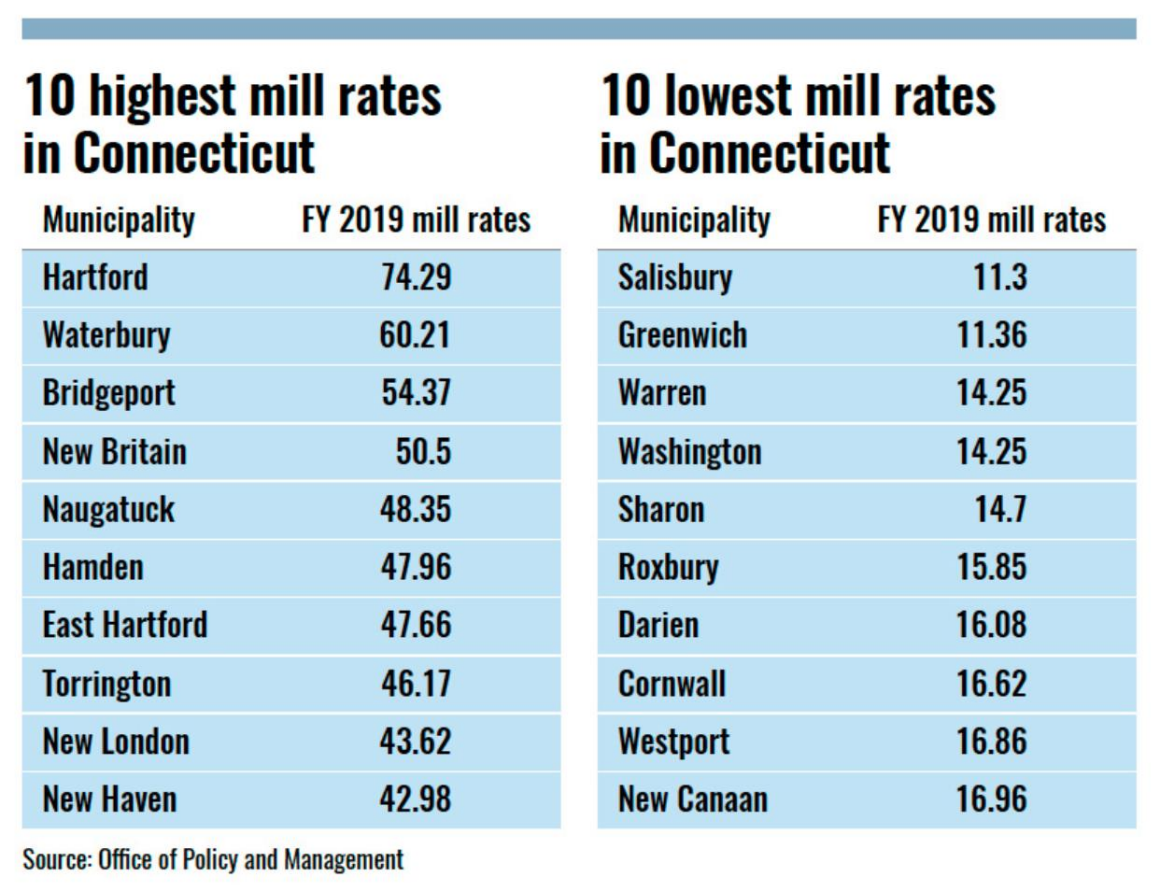
Hartford’s Property Tax Conundrum
• About 59% of the assessed real estate in Hartford is exempt from taxation
• Hartford has the highest mill rate in Connecticut and one of the highest in the United States
• Property values declined leading to a smaller grand list… A grand list is the aggregate valuation of taxable property within a given town
• Low income population with increased needs for services
• Only municipality in Connecticut with a bifurcated property tax system, intended to help homeowners but played the tax burden on commercial property
Other Forms of State & Local Taxes and Sources of Revenue
• State sales taxes are generally the most important source of tax revenue for most state governments (not Connecticut). Some states do not have a sales tax such as: Delaware, New Hampshire, & Oregon.
• Excise Taxes (often referred to as a sin tax) which is frequently levied on cigarettes, alcohol, and gasoline
• State income taxes - All but 7 states have an income tax… Connecticut was the most recent state to enact an income tax in 1991
• Corporate income tax - Tax on the net profits of corporations (All but 6 states) • Lottery and gambling
• User changes
Connecticut’s Revenue Sources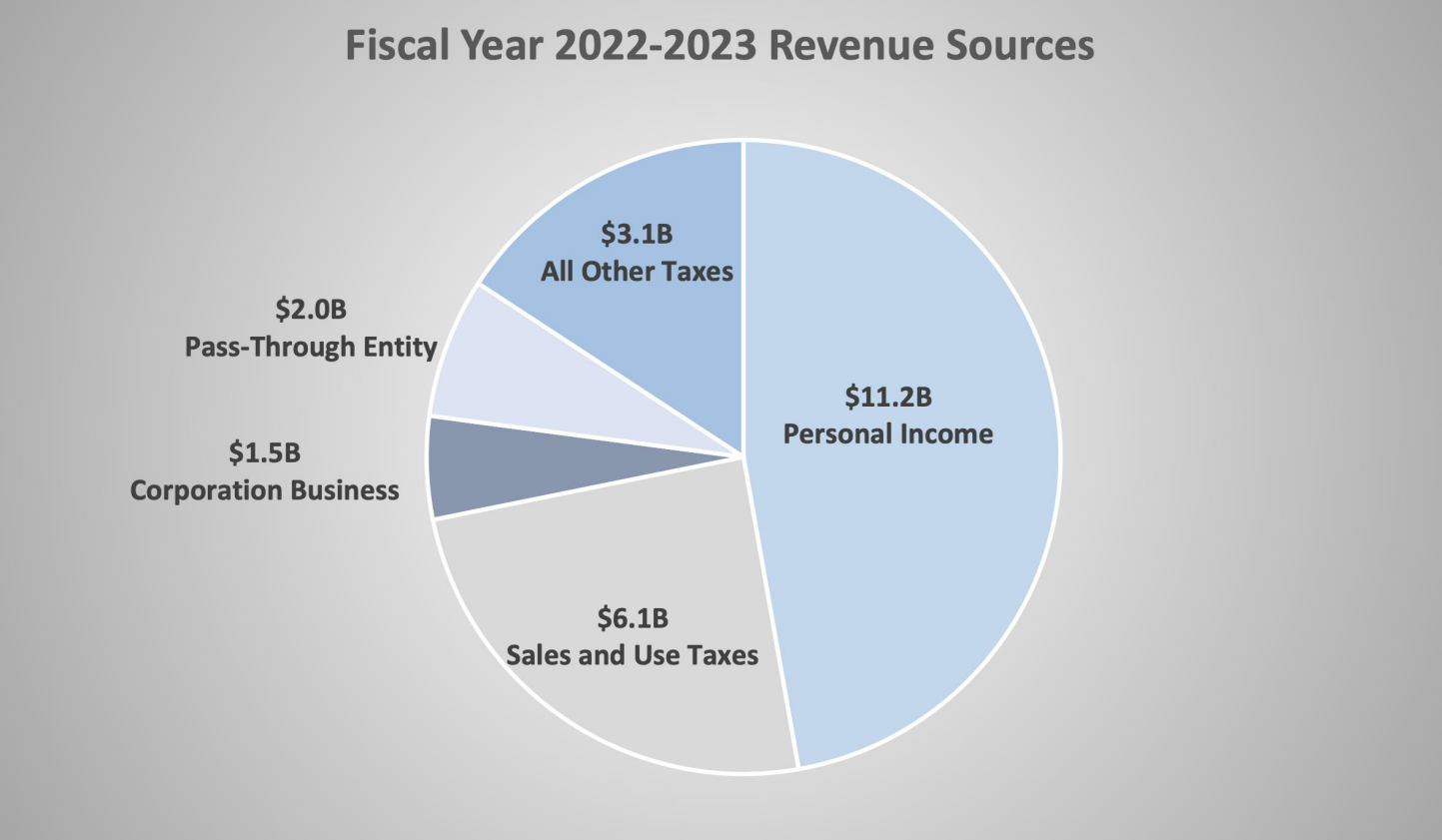
Balancing a Budget
• Most state constitutions require the operating budgets of the state government, and those of local governments, to be balanced
• Connecticut’s constitution requires a balanced state budget (went into effect in 1992).
• The Office of Fiscal Analysis - Reviews budget requests, analyzes the fiscal impact of proposed legislation by the legislature, project costs and revenue trends, and prepares various reports on the financial matters
• The Office of Policy and Management - The executive branch budget office
• An operating budget is a plan detailing how much money will be raised from specific revenue sources and what it will be spent on
• State constitutions generally permit state and local governments to borrow funds for capital improvements
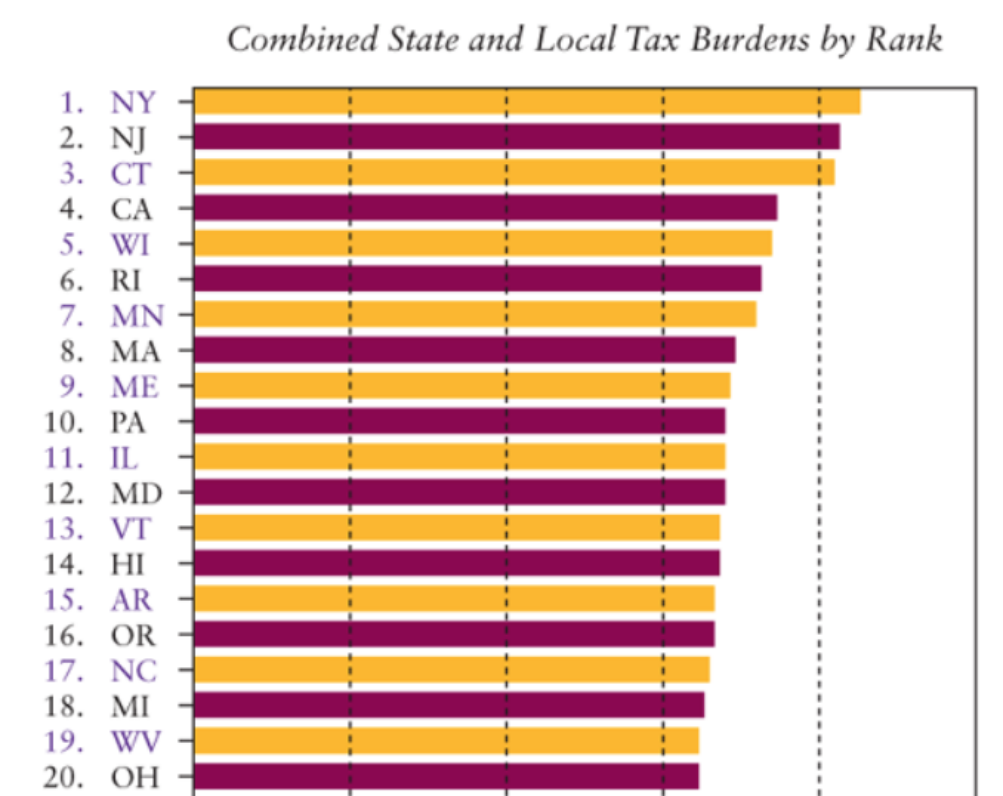
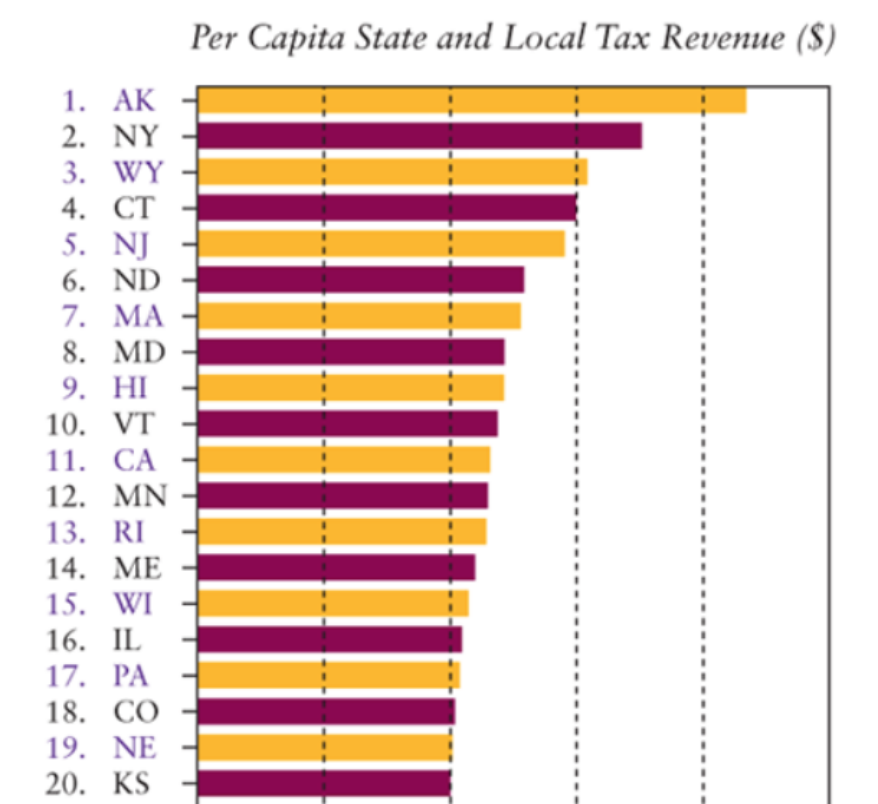
Rankings of the States and Local
Tax Revenues and Burdens
State & Local Borrowing
• State constitutions generally permit state and local governments to borrow funds for capital improvements. They generally will use proceeds from bond sales to fund the following:
• Essential Functions - Roads, schools, parks, libraries, prisons, and government office buildings
• Nonessential Functions - Water and sewage systems, airports, ports, mass transit facilities, waste disposal facilities, single- and multifamily housing projects, hospitals
• Private activities - Industrial development projects trade and convention centers, and sports arenas
Bond Financing
• Governments using bond proceeds must pay back the investors who purchase the bonds with interest. The amount of interest paid is based on market conditions & the governments credit rating
• Governments will hire a rating firm to rate their credit worthiness. The firm will analyze the local economy, debt already incurred, financial condition of the government, the demographic makeup of the community, and management practices.
• The state has seen some improvements in its credit rating over the last couple of years after years of decline. Connecticut still has one of the lowest credit rating in the country. Illinois has the lowest credit rating.
Bond Financing
• Bonds issued by a state or local government may be either general obligation bonds or revenue bonds:
• General obligation (GO) bonds are backed by the “full faith and credit” of the government issuing the them. This pledges the full taxing powers of the government to pay both principal and interest due on the bond
• Revenue bonds are not guaranteed by the issuing government but instead are backed by whatever revenues the project itself generates. The principal and interest on revenue bonds are paid from fees, charges on rents generated by the project, rather than tax revenues of the government
Public Bonds for Private Uses
• Frequently private businesses will ask state and municipalities to issue bond on their behalf
• They frequently be the only source of financing and may be the most affordable to get projects done
• This is generally controversial but is used frequently around the country including here in Connecticut… Think Dunkin’ Donuts Stadium
State Spending Cuts
• Fiscal stress - Financial conditions that impair borrowing ability, require the reaction of services, and may threaten public health and safety
• States will implement cost cutting measures including hiring freezes, travel cutbacks, and delays in capital spending
• “Across the board” cuts - Every agency or program is cut back by the same percentage during economic downturns
• Targeted cuts - Larger spending cuts in some agencies or programs than in others • Reduce staff
• Natural attrition - Elimination of jobs due to death, retirement, resignations, etc.
• “Last-in-first-out” - Last person hired is the first person that will be let go (frequently seen in union shops) • Privatization of services or selling assets
When Local Governments Can’t Make Ends Meet
• There have been a number of American cities that have run out of options to financially keep themselves going
• Some have gone bankrupt… Since 2010, over 30 municipalities and counties have had to declare bankruptcy.
• Frequently states will bailout cities and towns. States will generally require the city/town turn over control of its financial affairs to a control board
• Connecticut cities like Bridgeport, Waterbury, and Hartford have been “rescued” by the state…