Week 6 pre-work Newton's Laws of Motion
Force
An object at rest requires a force to initiate movement, while a moving object needs a force to alter its velocity.
Force is a vector quantity, possessing both magnitude and direction.
The magnitude of force can be measured using a spring scale.
Newton's First Law of Motion
Every object maintains its state of rest or uniform velocity in a straight line unless acted upon by a net force.
Reference Frames
Measurements of position, distance, or speed are relative to a reference frame.
Newton’s first law is not valid in every reference frame, especially those accelerating or rotating.
An inertial reference frame is one in which Newton’s first law holds true, excluding rotating and accelerating frames.
Newton's Second Law of Motion
Newton’s second law describes the relationship between acceleration and force.
A force is required to change an object's direction or speed.
More force results in greater acceleration; the same force exerted on a more massive object yields less acceleration.
Mass quantifies an object's inertia and is a measure of the quantity of matter in the object.
Mass is not weight; mass is an object's property, while weight is the force exerted on the object by gravity.
In the SI system, mass is measured in kilograms (kg).
In two and three dimensions, the equation is valid along each coordinate axis.
The unit of force in the SI system is the newton (N).
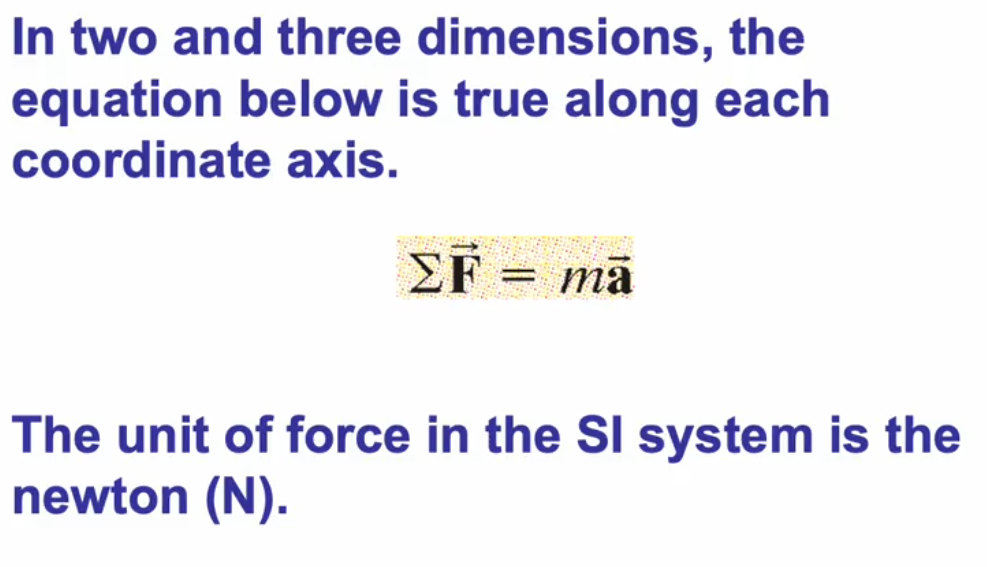
F=MA, where F represents force, M represents mass, and A represents acceleration, illustrating the fundamental relationship between these quantities.
Newton's Third Law of Motion
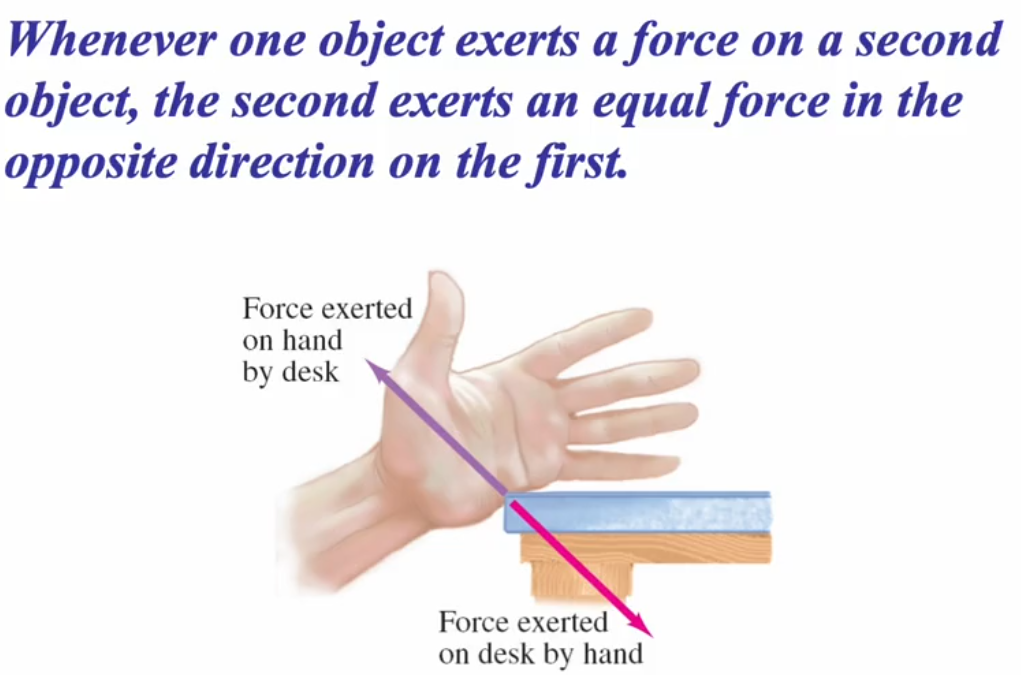
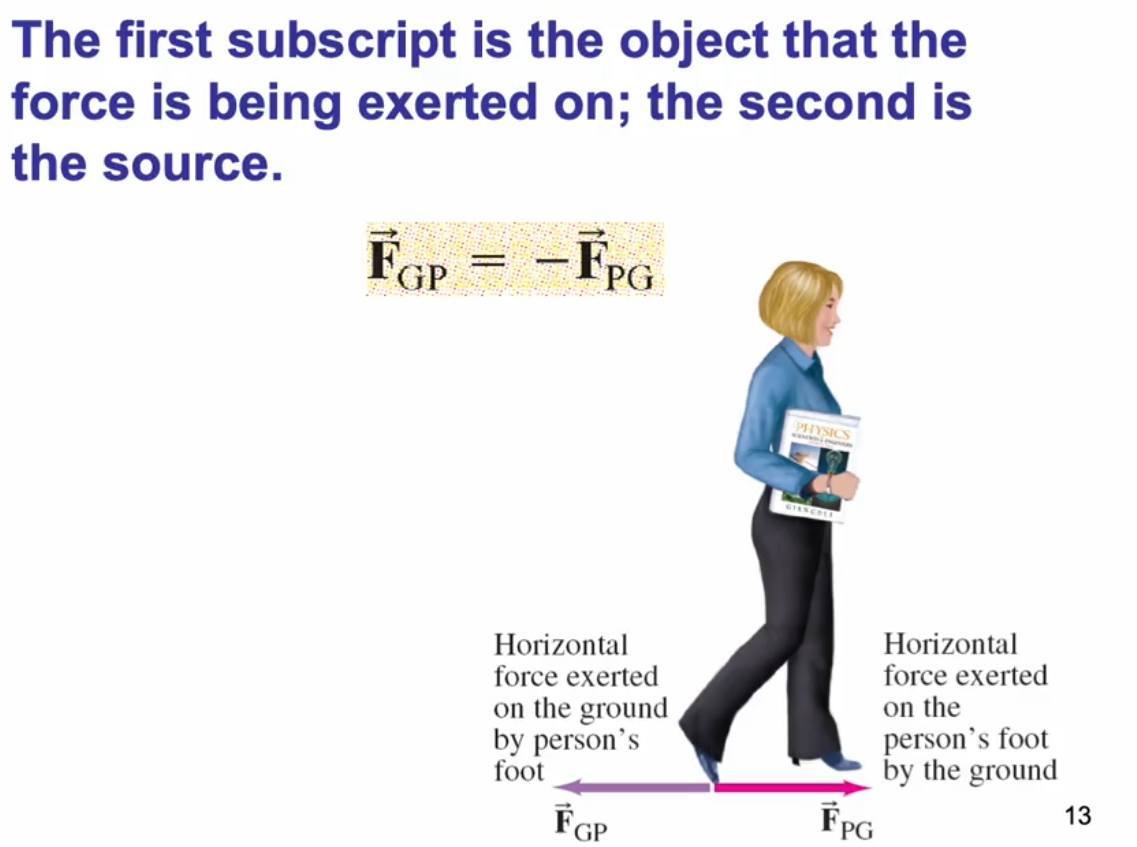
Whenever one object exerts a force on a second object, the second object exerts an equal force in the opposite direction on the first object.
A key aspect of the third law is that the forces are exerted on different objects.
The first subscript denotes the object upon which the force is exerted; the second indicates the source of the force.
Weight or the Force of Gravity
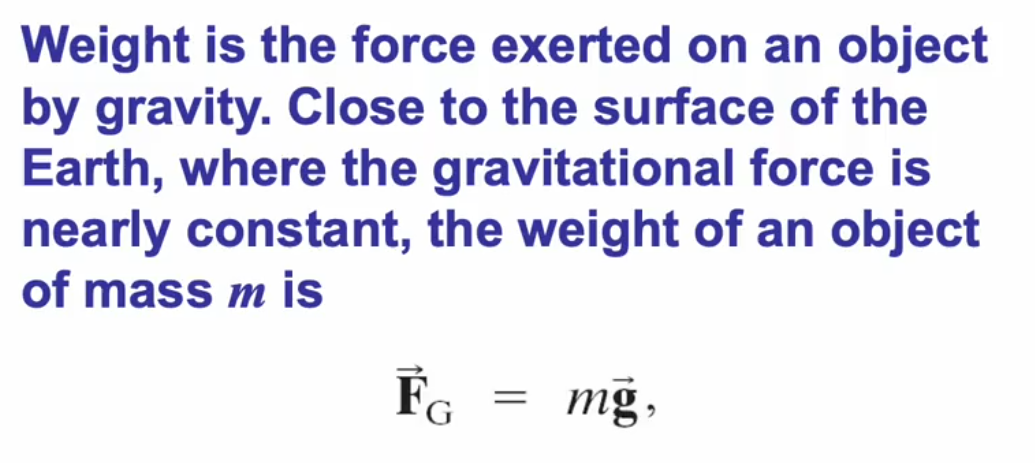
Weight is the force exerted on an object by gravity.
Near the Earth's surface, where gravitational force is nearly constant, the weight of an object of mass is calculated as:
The Normal Force
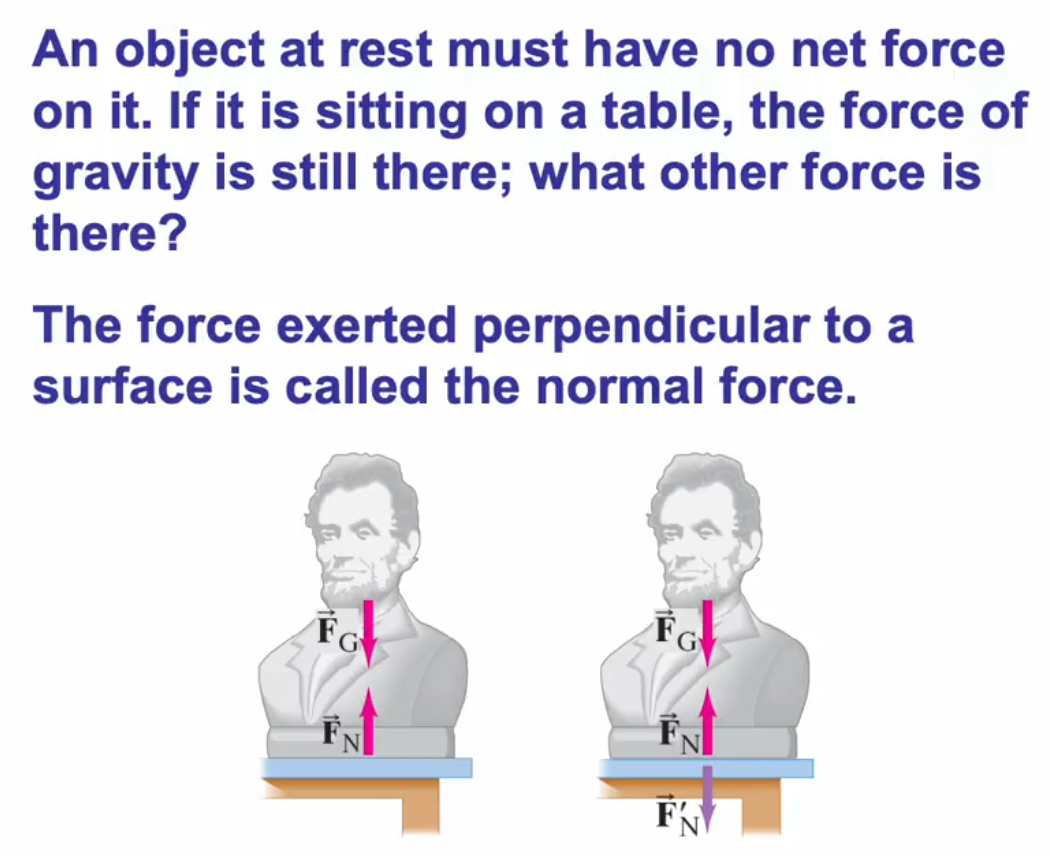
An object at rest must have no net force acting on it.
If an object is resting on a table, the force of gravity is present, but an additional force is required to counteract it.
The force exerted perpendicular to a surface is termed the normal force.