Biological explanations : Genetic and neural explanations
Key terms
Genetics - genes consist of DNA strands. DNA produces ‘instructions’ for general physical features of an organism (such as eye colour, height) and also specific physical features (such as neurotransmitter levels and size of brain structures) These may impact on psychological features (like intelligence and mental disorder) Genes are transmitted from parents to offspring, inherited.
Neural explanation - any explanation of behaviour (and its behaviour) in terms of (dys)function of the brain and nervous system. This includes the activity of brain structures such as hypothalamus and neurotransmitters such as serotonin and dopamine.
Genetic and neural explanations
Genetic explanations - for crime suggest that would be offenders inherit a gene, or combination of genes, that predispose them to commit gene.
Twin studies - the importance of genes is illustrated by twin studies. The first criminal twin study was conducted by Johannes Lange (1930) who investigated 13 identical (MZ) and 17 non-identical (DZ) twins where one of the twins in each pair had served time in prison.
Lange concluded that genetic factors must play a predominant part in offending behaviour.
Adoption studies - Crowe (1972) found that adopted children who had a biological approach with a criminal record had a 50% risk of having a criminal record by the age of 18, whereas adopted children who mother didn’t have a criminal record only had a 5% risk.
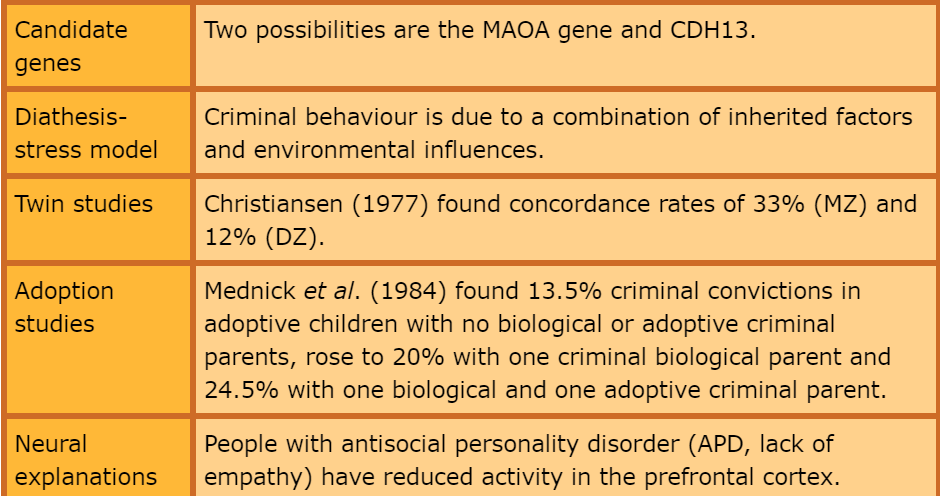
Candidate genes - A genetic analysis of almost 900 offender by Jari Tiihonen et al. (2014) revealed abnormalities on two genes that may be associated with violent crime - the MAOA gene (which control dopamine and serotonin in the brain and has been linked to aggressive behaviour) and CDH13 (that has been linked to substance abuse and attention deficit hyperactivity disorder) Within the Finnish sample, individuals with this high risk combination were 13 times more likely to have a history of violent behaviour. However, it must be emphasised that this research is in its infancy and has, so far, not been replicated.
Diathesis-stress model - If genetics do have some influence on offending, it seems likely that this is at least partly moderated by the effects of the environment. Elsewhere, we have seen how the diathesis-stress model has been applied to schizophrenia. A tendency towards criminal behaviour may come about through the combination of genetic predisposition and biological or psychological trigger - for example, being raised in a dysfunctional environment or having criminal role models.
Neural explanations
Evidence suggests there may be neural differences in the brains of criminals and non-criminals. Much of the evidence in this area has investigated individuals diagnosed with antisocial personality disorder. APD is associated with reduced emotional responses, a lack of empathy for the feelings of others, and is a condition that characterises many convicted criminals.
Prefrontal cortex - Adrian Raine has conducted many studies of the APD brain, reporting that there are several dozen brain-imaging studies demonstrating that individuals with antisocial personalities have reduced activity in the prefrontal cortex, the part of the brain that regulates emotional behaviour. Alongside this, Raine and his colleagues found an 11% reduction in the volume of grey matter in the prefrontal cortex of people with APD compared to controls.
Mirror neurons - Recent research suggests that criminals with APD can experience empathy but they do so more sporadically than the rest of us. Christian Keysers et al found that only when criminals were asked to empathise (with a person depicted on film experiencing pain) did their empathy reaction (controlled by mirror neurons in the brain) activate. This suggests that APD individuals are not totally without empathy, but may have a neural switch that can eb turned on and off, unlike the normal brain which has the empathy switch permanently on.

Evaluation
Problems with twin studies
Early twin studies of criminality such as Lange’s research were poorly controlled and judgements related to zygosity (whether they were MZ or DZ) were based on appearance rather than DNA testing. → as a result they may lack validity
Twin studies also often involve small sample sizes, they are also an unusual sample size and may not represent the rest of the population.
Twins are mostly reared in the same environment, therefore a major confounding variable as concordance rates may be due to shared learning experiences rather than genetics.
Support for the diathesis-stress model of crime
A major study of over 13,000 Danish adoptees was conducted by Sarnoff Mednick et al (1984) The researchers defined criminal behaviour as being in possession of at least on court conviction and this was checked against Danish police records for each of the adoptees. When neither the biological nor adoptive parents had convictions, the percentage of adoptees that did was 13.5. This figure rose to 20% when either of the biological parents had convictions, and 24.5% when both adoptive and biological parents had convictions.
This data suggests that although genetic inheritance plays an important role in offending, environmental influence cannot be disregarded - support for the diathesis-stress model of crime.
Problems with adoption studies
The presumed separation of genetic and environmental influences in adoption studies is complication by the fact that many children experience late adoption, which means much of their infancy and childhood may been spent with their biological parents. Similarly, lots of adoptees maintain regular contact with their biological parents following their adoption.
Both these points make it difficult to asses, from adoption studies, the environmental impact the biological parents might have had. As well as this, in Mednick et al study the figures quoted only applied to petty offences like burglary and not violent crime, This means that any conclusion drawn may not apply to more serious forms of crimes.
Extra
Biological reductionism
Criminality is complex, explanations that reduce offending behaviour to a genetic or neural level may be inappropriate and overly simplistic. Crime does appear to run in families, but so does emotional instability, mental disorder, social deprivation and poverty. (Katz et al 2007) This makes it difficult to disentangle the effects of genes and neural influences from other possible factors. It is also the case that, whilst there is often a difference in concordance rates between MZ and DZ twins, MZ do not show 100% concordance.
Low concordance rates in genetic studies suggest that genes play a minimal part in the development of that particular characteristic, e.g. criminal behaviour. If genes were solely responsible then the concordance rate for criminal behaviour for MZ twins should be 100% as they share 100% of genes. Low concordance rates suggest environmental factors may be responsible or at least partly responsible for criminal behaviour. The diathesis-stress model could be used to explain criminal behaviour where concordance rates for MZ twins are not 100%; genes create a vulnerability or predisposition towards criminal behaviour combined with stressors and experiences in the environment acting as a trigger for criminal behaviour.
Biological determinism
In field of criminality, the notion of a criminal gene presents something of a dilemma. Our legal system is based on the premise that criminals have personal and moral responsibility for their crimes and only in extreme cases, such as a diagnosis of mental disorder, can someone claim they were not acting under their own free will. This raises ethical questions about what society does with people who are expected of carrying criminal genes and what implications this may have for sentencing.