Lecture 18
Coenzymes in Metabolism
Coenzymes are compounds needed for an enzymatic reaction to occur.
Coenzymes are non-protein organic compounds.
They are considered “helper molecules”.
Coenzymes can gain and lose electrons, hydrogen, and oxygen and become oxidized or reduced
Coenzymes NAD+ and NADH
Nicotinamide adenine dinucleotide (NAD+) is a coenzyme that accepts electrons from other molecules to become NADH.
NAD+ is synthesized from vitamin B3
Coenzymes FAD and FADH2
Flavin Adenine Dinucleotide (FAD) is an oxidizing coenzyme that accepts electrons from other molecules to become the reduced FADH2 form.
FAD is synthesized from vitamin B2
Coenzyme A
Coenzyme A has a variety of cellular functions.
During metabolism, Coenzyme A facilitates the formation of Acetyl CoA.
Coenzyme A is synthesized from vitamin B5.
Introduction to Metabolism and Energy Production
Mitochondria are organelles where energy production takes place.
Mitochondria contain an outer and an inner membrane.
The area between the two spaces is called the\ intermembrane space.
Matrix is the area inside the inner membrane and that is where energy is produced
The Electron Transport Chain
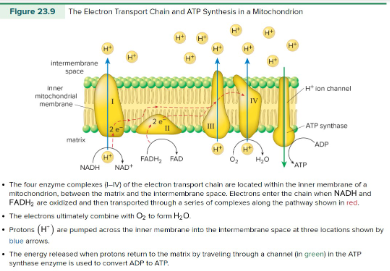
The electron transport chain is a series of proteins embedded in the inner mitochondrial membrane that shuttles electrons from NADH and FADH2 to oxygen.
In the process, protons are pumped from the mitochondrial matrix to the intermembrane space, and oxygen is reduced to form water.
ATP Synthesis by Oxidative Phosphorylation
As protons return back to the matrix, energy is generated that converts ADP to ATP through the process of oxidative phosphorylation.
General Features of ATP Hydrolysis and Formation
The breakdown of sugars, lipids, and proteins requires oxygen and produces energy and CO2.
Energy is stored by the synthesis of ATP from ADP.
Energy for all body functions such as breathing, thinking, walking, and running is supplied by the hydrolysis of ATP to ADP.
ADP-ATP Cycle
ATP and ADP are like the charged and uncharged
forms of a rechargeable battery.
ATP, the charged battery, has energy that can be
used to power cellular reactions.
Once the energy has been used up, the
uncharged battery (ADP) must be recharged from
energy generated by the breakdown of food.
Insulin-Mediated Transport of Glucose
Insulin binds to the receptor: Insulin binds to its receptor, which triggers a signaling cascade.
GLUT4 is recruited: Insulin causes GLUT4 proteins to move from intracellular vesicles to the plasma membrane.
Glucose is taken up: GLUT4 inserts into the plasma membrane, allowing glucose to enter the cell.
Glycolysis
Once in the cytoplasm of a tissue cell, glucose undergoes a breakdown process called glycolysis.
Glycolysis is a breakdown of glucose resulting in 2 pyruvate molecules, 2 ATP molecules, and 2 NADH molecules.
Under aerobic conditions (when O2 is plentiful), pyruvate enters the mitochondrion where it is broken down into CO2 and an acetyl group (CH3CO-).
NAD+ picks up two electrons and gets oxidized to NADH.
The acetyl group binds to Coenzyme A to form Acetyl CoA.
The Citric Acid Cycle
Acetyl CoA was generated from the breakdown of pyruvate.
The citric acid cycle begins when acetyl CoA reacts with oxaloacetate to form citric acid (citrate).
Two molecules of CO2 are removed from citric acid to form oxaloacetate.
Oxaloacetate re-enters the citric cycle.
Specific Steps of the Citric Cycle
One molecule of Acetyl CoA produces:
Two molecules of CO2
Three molecules of NADH
One molecule of FADH2
One molecule of GTP
NADH and FADH2 enter the electron transport chain.
GTP is equivalent to ATP
Conversion to Lactate
Under anaerobic conditions (when O2 is reduced) pyruvate is converted to lactate
During strenuous physical exercise muscle cells need more oxygen.
Respiration rate and pulse rate increase to supply
more oxygen.
In the absence of sufficient oxygen, muscles
convert glucose into lactate.
The pain felt during a heart attack is caused by an increase of lactic acid in the heart and areas near the heart cut off from oxygenated blood
Gluconeogenesis
Gluconeogenesis is the process of synthesis of glucose in the liver from lactate.
Gluconeogenesis is an anabolic pathway since it results in the synthesis of larger molecules from smaller ones.
Glycolysis
The process of breaking down glucose molecules to produce energy and biosynthetic intermediates. This process occurs in every cell and produces two molecules of adenosine triphosphate (ATP) and two molecules of pyruvate.
Useful Carbohydrate Derivatives
Glycosaminoglycans are a group of unbranched carbohydrates derived from alternating amino sugar and glucuronate units.
Glycosaminoglycans
Hyaluronate is a glycosaminoglycan major present in the vitreous humor at the back of the eye.
Heparin is a glycosaminoglycan stored in the mast cells, a type of white blood cell, in the liver.
The role of heparin is to help prevent blood clotting.
Chondroitin is a glycosaminoglycan that is a component of cartilage, ligaments and tendons.
Chondroitin and glucosamine are sold as dietary supplements for individuals suffering from osteoarthritis, a disease where there is a breakdown of the cartilage in joints.
Blood Type
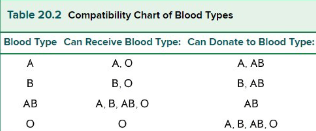
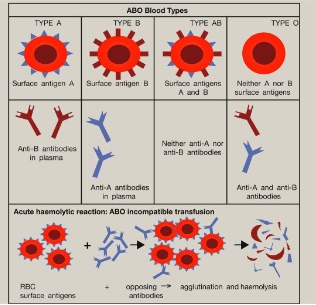
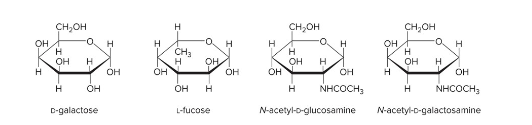
Blood type is based on 3 or 4 monosaccharides attached to a plasma membrane protein of red blood cells.
There are four blood types—A, B, AB, and O.
Each blood type has the monosaccharides below:
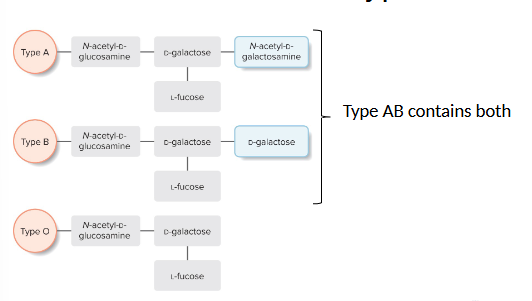
Individuals with type O blood are called universal donors because people with any other blood type have no antibodies to type O.
Those with type AB blood are universal recipients because their blood contains no
antibodies to A, B, or O.