WW2
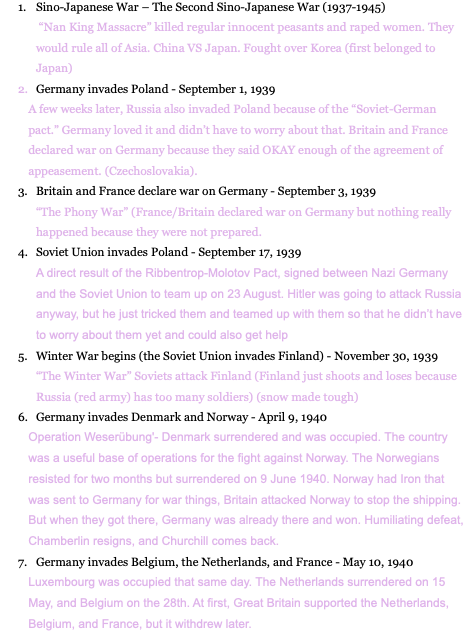
Sino-Japanese War – The Second Sino-Japanese War (1937-1945)
“Nan King Massacre” killed regular innocent peasants and raped women. They would rule all of Asia. China VS Japan. Fought over Korea (first belonged to Japan)
Germany invades Poland - September 1, 1939
A few weeks later, Russia also invaded Poland because of the “Soviet-German pact.” Germany loved it and didn’t have to worry about that. Britain and France declared war on Germany because they said OKAY enough of the agreement of appeasement. (Czechoslovakia).
3. Britain and France declare war on Germany - September 3, 1939
“The Phony War” (France/Britain declared war on Germany but nothing really happened because they were not prepared.
Soviet Union invades Poland - September 17, 1939
A direct result of the Ribbentrop-Molotov Pact, signed between Nazi Germany and the Soviet Union to team up on 23 August. Hitler was going to attack Russia anyway, but he just tricked them and teamed up with them so that he didn’t have to worry about them yet and could also get help
Winter War begins (the Soviet Union invades Finland) - November 30, 1939
“The Winter War” Soviets attack Finland (Finland just shoots and loses because Russia (red army) has too many soldiers) (snow made tough)
Germany invades Denmark and Norway - April 9, 1940
Operation Weserübung'- Denmark surrendered and was occupied. The country was a useful base of operations for the fight against Norway. The Norwegians resisted for two months but surrendered on 9 June 1940. Norway had Iron that was sent to Germany for war things, Britain attacked Norway to stop the shipping. But when they got there, Germany was already there and won. Humiliating defeat, Chamberlin resigns, and Churchill comes back.
Germany invades Belgium, the Netherlands, and France - May 10, 1940
Luxembourg was occupied that same day. The Netherlands surrendered on 15 May, and Belgium on the 28th. At first, Great Britain supported the Netherlands, Belgium, and France, but it withdrew later.
Evacuation of Dunkirk - May 27 to June 4, 1940
"Operation Dynamo " was the evacuation of more than 338,000 Allied soldiers from the beaches and harbour of Dunkirk, in the north of France. The British Royal Air Force saved them and the civilians who aided the Royal Navy.
France surrenders to Germany - June 22, 1940
France said let’s send airplanes to defeat Germany, Churchill said no because that’s the strongest thing they had, and once Germany was done with France they would come to England so they needed it.
Battle of Britain begins - July 10, 1940-oct 31 1940
Lend-Lease (FDR) America can lend equipment if, by doing so, it benefits the USA. So, the USA sends it to Britain. But the USA was isolationist, but they wanted to fight against the Nazis and Japan. So, Britain really needed things, but they didn’t want to join the war, so “Lend Lease.” Germany v.s Britain, lost a tun of aircraft. British victory.
11. The North Africa Campaign (September 1940 – May 1943)
Germany invades the Soviet Union (Operation Barbarossa) - June 22, 1941
Nazi invasion of Russia. Made a deal, but now, suddenly, they attacked, Hitler did not want to attack Russia. Hitler hated communism and put them on the same level as Jews- he wanted to erase them. Stalin said to the army, “Stand Firm against blitzkrieg,” which was a bad idea. So, Stalin figured out later to fight super hard and then retreat after, as you leave, destroy it all. Scortderf (Germany had to get its own food and fuel instead of using what Russia had to leave behind)
Japan attacks Pearl Harbor - December 7, 1941
Sunday morning, Japan attacked. Japan was very angry at the USA’s policies. Arcadia Conference- January 1942, right after Pearl Harbour.
14. The United States declares war on Japan - December 8, 1941
Because of Pearl Harbour from the day before.
Germany declares war on the United States - December 11, 1941
Hitler declared war and so FDR went alright were fighting you then. Germany did that in response to the USA declaring war on Japan.
16. Japanese Victories (December 1941-May 1942)
Japan attacked the USA in the Philippians, Hong Kong (got it), by march, they took the duties indies, Britain’s give away Berna, etc. China and the USA can’t help anymore.
Battle of Midway - June 4–7, 1942
It was a tiny island. In six months, Japan kept taking and wouldn’t lose. Until this battle, things changed, and the USA won. Japan lost four aircraft carriers, and the USA only lost one. Turning point for Japan (after going up all the time they went down and kept going down)
Battle of Stalingrad begins - August 23, 1942
Urban warfare (fighting in streets/buildings). The Russians pushed back, encircling German forces, and Russia won. Both sides suffered massive losses.
19. Allied invasion of North Africa (Operation Torch) - November 8, 1942
he invasion of west North Africa to prevent the Germans from taking control of the territories occupied by the French. American/allied victory.
Battle of El Alamein -- Second Battle: October 23 - November 11, 1942/oct 23
Another turning point.
Casablanca Conference – January 1943
Post-War Vision: The Allies would accept an unconditional Axis Surrender. Unconditional surrender. (gov is done, noting can be done abt it)
German surrender at Stalingrad - February 2, 1943
Germany was winning all up until then, then Russia won and defeated the German army- a turning point (just like in the Pacific in Japan) goes up up up and then goes down and stays going down for the Germans. The farthest that the German army got.
Allied Invasion of Sicily - July 9, 1943
during World War II, the invasion of the Italian island of Sicily by Allied forces. Led to fall of Benito
Italy surrenders to Allies - September 3, 1943
Mussolini's government 'practically evaporated
Tehran Conference- November 28-December 1. 1943
Post-War Europe: Germany would be divided into occupation zones, and the Soviets were promised land in Japan if they helped in the war.
D-Day (Allied invasion of Normandy) - June 6, 1944
The largest invasion in history was when parachute guys jumped out of an airplane and shot on the beach in Normandy, France. French Started bringing in tanks. Allied forces (Russian on the east) won against the Germans.
Liberation of Paris - August 25, 1944
28. Moscow Conference- October 9-19, 1944
Percentage Agreement: Informal agreement between Stalin and Churchill diving Eastern Europe into spheres of influence to prevent conflicts post WWII.
Battle of the Bulge begins - December 16, 1944
Last German hurrah against the Allies. Germans hoped that would be a turning point, but even tho they won it was not.
Yalta Conference - February 4–11, 1945
· Post-War Germany/Eastern Europe: Germany would be divided, and France would also govern it.
· The United Nations: The UN Security Council was finalized. The US, UK, USSR, China, and France have veto power over decisions.
· Big 30 (Churchill, FDR, Stalin): what will we do about the Axis powers? Let’s divide Germany into four parts (partition of Germany)- the British zone, the American zone, French Germany, and Russian Germany. (near each country) Berlin has been divided into 4 chunks also, a replica of the bigger map. Berlin is in the soviet zone. Poland takes German territory from the last war. Sets groundwork for Cold War.
· Zones/sphere of influence= row of countries that they want to control.
· Big 3 said we want free elections in places like Poland. (in the Cold War, that didn’t. happen)
Soviet forces capture Berlin - May 2, 1945
By throwing a million grenades
Germany surrenders (VE Day) - May 8, 1945
Potsdam Conference:
Post-War Germany and reparations: Stalin and Truman disagreed on the extent of Germany’s reparations. FINAL MEETING WITH THE BIG 3 (Churchill, FDR Stalin)
Atomic bombing of Hiroshima - August 6, 1945
“Little Boy” gun-type weaponry dropped in Japan.
USA said we have to bomb because Japan will never surrender because it’ll take a huge army to keep going
Atomic bombing of Nagasaki - August 9, 1945
“Fat Boy/Man” implosion-type device dropped in Japan.
USA said we have to bomb because Japan will never surrender because it take a huge army to keep going
Japan surrenders (VJ Day) - August 15, 1945
Japan never surrenders, would rather die.
Formal Japanese surrender - September 2, 1945
Names
1. Adolf Hitler
Nazi leader
2. Heinrich Himmler
SS Nazi leader
3. Joseph Goebbels
Minister of propaganda in Germany
4. Hermann Goering
Loved by Hitler, a German military guy who did great things for the Nazis
5. Joseph Stalin
Leader of Russia/soviet union
6. Winston Churchill
Prime minister of Britain
7. Franklin D. Roosevelt
USA president
8. Harry S. Truman
President after FDR (USA)
9. Emperor Hirohito
Emperor of Japan
10. Benito Mussolini
Fascist dictator in Italy
11. Chiang Kai-shek.
Leader of China
12. Charles de Gaulle
French military leader- tried to keep the French fighting when it was being taken/taken by Germany.
13. Tito
Revolutionist and leader of Yugoslavia
14. Rosie the Riveter
Symbolized woman in the workforce in the USA.
Concepts and Ideas
15. Axis Powers
Germany, Japan, Italy (main)
16. Allied Powers
USA, Britain, France, and later on the Soviet Union (main)
17. Blitzkrieg
“Lightning war” doesn’t stop and fight people you just go (tanks go fast) bombarded especially in the air. Motorized infantry fast
18. Einsatzgruppen
A special type of SS, so they would gather Jews and kill, bury themselves, nasty type of stuff. Extermination of Jews. Came up with a concentration camp.
19. Collaboration
those who aided the Nazis
20. Genocide
Removal or erase of a nation/group.
21. Appeasement
To appease someone, give them what they want (France and Britain for Germany)
22. Total War
Everything war war war
23. War Crimes
Holocaust, imperial Japan, Italy taking Ethiopia.
24. Propaganda
Derogatory messages
25. SS
Armed- (waffen) fought alongside Germany.
General -(Allgemeine) policing, propaganda, racial policies
26. White Rose Society
Proffers and students did anti-Nazi activity and they got executed.
27. V1 and V2 Rockets
Nazis invented rockets. Into France and London
28. The Manhattan Project
Top secret USA government program to develop and deploy the world’s first atomic weapons before Germany.
29. The Doolittle Raid
They didn’t have enough fuel. Had to land in Japan instead of Japan. Some got to drop bombs. The plan was to get to China and jump out of an airplane. Bombs mess with Japan’s heads.
30. Scorched Earth Policy
Russia’s military strategy of destroying everything that allows an enemy military force to be able to fight a war, including the deprivation and destruction of water, food, humans, animals, plants and any kind of tools and infrastructure.
31. Nuremberg
The 5-day battle between USA and Nazi.
Trail- held some of the craziest Nazis accountable
32. Decolonization
Example: Britain owned Egypt but it decolonized. Or German Empire ect ect
33. Soviet Sphere of Influence.
Sorta resulted in the Cold War. Where the Soviets wanted to take power
34. Cold War Origins
Aftermath of WW2