Viruses
Genetic material of viruses is either DNA or RNA
DNA viruses
RNA viruses
Retroviruses (RNA as genetic material once inside the cell an enzyme called reverse transcriptase (RT) converts the RNA into DNA, and then the virus DNA integrates into the host cell DNA))
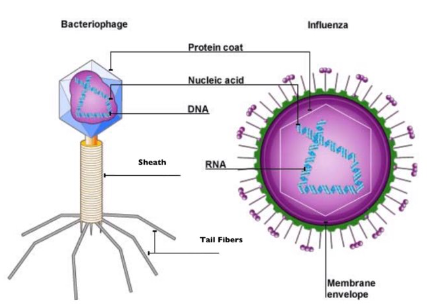
Genetic material of viruses is surrounded by a protein coat called a capsid.
Some viruses also have an envelope that surrounds the capsid that is composed of proteins and lipids
These envelopes through their “spike proteins” matching up to receptor proteins on the host cell can enter the cell through endocytosis
Structure:
Lytic Cycle:
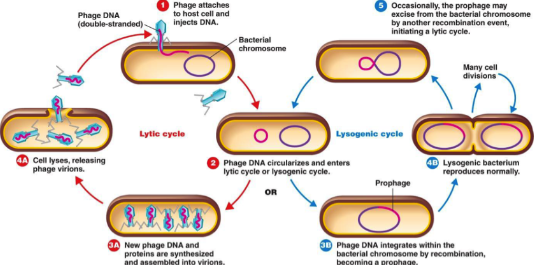
Bacteriophage attaches to host cell and injects its DNA inside the cell
Bacteriophage using host cell machinery (host cell ribosomes, amino acids, tRNA, DNA and RNA polymerase, etc.) through transcription and translation makes bacteriophage proteins and replicates its DNA.
As new Bacteriophages are being assembled inside the host cell, the bacteriophages will degrade the host cell DNA and randomly incorporate this degraded host cell DNA into the newly assembled bacteriophages
The newly assembled bacteriophages will now “lyse” the cell membrane of the host cell and infect different cells.
Lysogenic Cycle:
Bacteriophage attaches to host cell and injects its DNA inside the cell
Bacteriophage DNA integrates into host cell DNA
Bacteriophage is “dormant” meaning not causing harm and juts remaining integrated in the host DNA and the bacteriophage DNA is replicated with the DNA to leave the bacterial host DNA
The bacteriophage using host cell machinery (host cell ribosomes, amino acids, tRNA, DNA and RNA polymerase, etc.) through transcription and translation makes bacteriophage proteins and replicates its DNA
As new bacteriophages are being assembled inside the host cell, the bacteriophages will degrade the host cell DNA and randomly incorporate this degraded host cell DNA into the newly assembled bacteriophages
The newly assembled bacteriophages will now “lyse” the cell membrane of the host cell and infect different cells
Transduction:
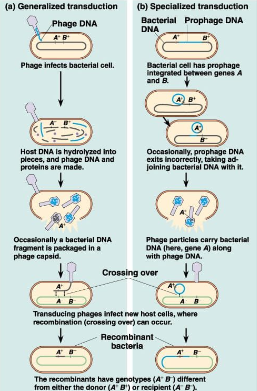
Transduction: is the transfer of bacterial DNA from a host bacterial cell through a recipient bacterial cell in which a virus transports the DNA from the host cell to the recipient cell
Generalized Transduction occurs during the lytic cycle which a random piece of host cell bacterial DNA is incorporated into the newly assembled bacteriophage that then when the bacteriophage infects a new cell (recipient cell) that piece of bacterial DNA from the host cell through homologous recombination will exchange with the bacterial DNA in the recipient cell
Specialized Transduction occurs during the lysogenic cycle in which a piece of bacterial DNA attached to bacteriophage DNA that had integrated into the host cell DNA is now linked to the bacteriophage DNA leaving the host cell bacterial DNA. When the bacteriophage infects a new cell (recipient cell) that piece of bacterial DNA from the host cell through homologous recombination will exchange with the bacterial DNA in the recipient cell
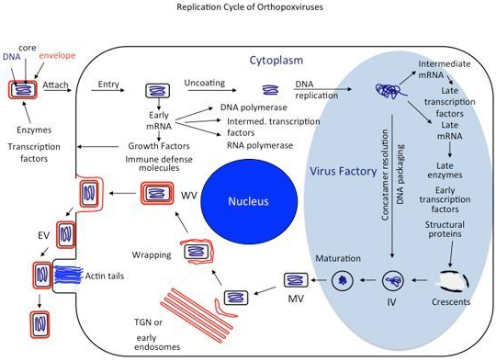
Life Cycle of DNA Viruses:
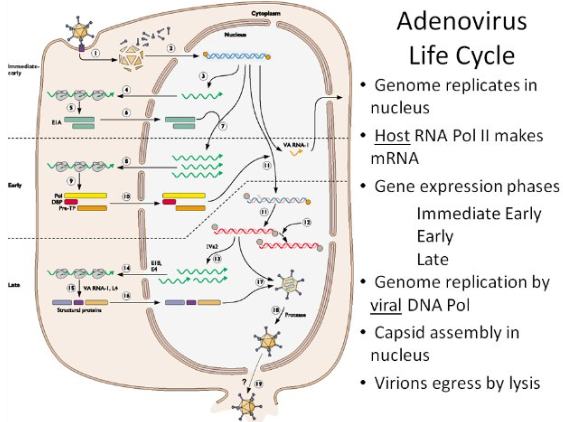
Most common DNA virus is the adenovirus, which can cause the common cold, or a gastrointestinal infection
Envelope protein on the virus binds to a complementarity protein on the cell membrane of the host cell
Through endocytosis the virus will enter the cell
The capsid will break down and release the DNA
The DNA will travel to the host cell nucleus and using host cell RNA polymerase will transcribe early virus proteins which include virus DNA polymerase, virus RNA polymerase, intermediate gene transcription factors
Using virus RNA polymerase intermediate genes are transcribed which include transcription factors for late genes
The virus late genes are transcribed using RNA polymerase which include capsid and envelope proteins
The newly produced viruses assembly and either leave the host cell through exocytosis or lyse the cell membrane resulting in cell death
Life Cycle of RNA Viruses:
Most common RNA viruses are influenza, and SARS-coV-2 (Covid 19)
Envelope protein on the virus binds to a complementarity protein on the host cell
Through endocytosis the virus will enter the cell
The capsid will break down and release the RNA
The RNA will be translated by ribosomes in the host cell to make viral proteins alone with make copies of the template RNA
The newly produced viruses assemble and either leave the host cell through exocytosis or lyse the cell membrane resulting in cell death
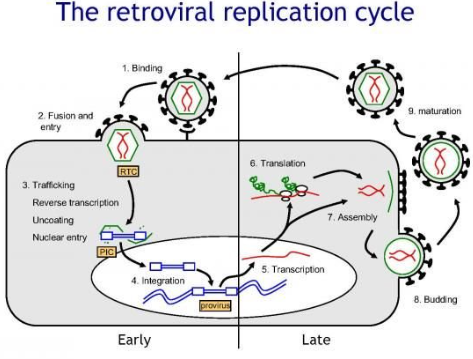
Life Cycle of Retroviruses:
Most common retro virus is HIV
Envelope protein on the virus binds to a complementarity protein on the cell membrane of the host cell
Through endocytosis the virus will enter the cell
The capsid will break down and release the RNA
The enzyme Reverse Transcriptase will convert the RNA into DNA
The DNA will go to the nucleus and with the help of the enzyme integrase, the virus DNA will integrate into the host cell DNA
Using the host cell RNA polymerase, virus will perform transcription to produce mRNA
The RNA will be translated by ribosomes in the host ell to make viral proteins along with make copies of the template RNA
Proteases will cleave these virus proteins to make them functional
The newly produced viruses assemble and either leave the host cell through exocytosis or lyse the cell membrane resulting in cell death
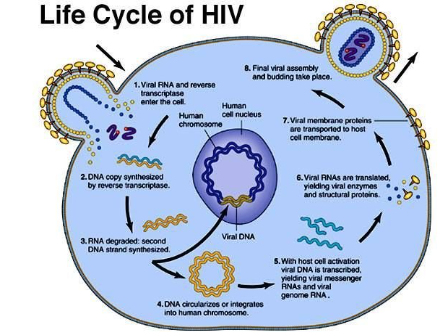
Life Cycle of HIV:
Most common retrovirus is HIV
Envelope protein gp-120 of HIV binds to CD4 receptor on a macrophage. In order for the virus to enter through endocytosis a second receptor ccr5 must bind to the CD4 receptor. The capsid will break down and release the RNA
The enzyme Reverse Transcriptase will convert the RNA into DNA
The DNA will go to the nucleus and with the help of the enzyme integrase, the virus DNA will integrate into the host cell DNA
Using the host cell RNA polymerase, virus will perform transcription to produce mRNA
The RNA will be translated by ribosomes in the host cell to make viral proteins along with make copies of the template RNA
Proteases will cleave these virus proteins to make them functional
The newly produced viruses assemble and leave the host cell through exocytosis which will cause no harm to the macrophage
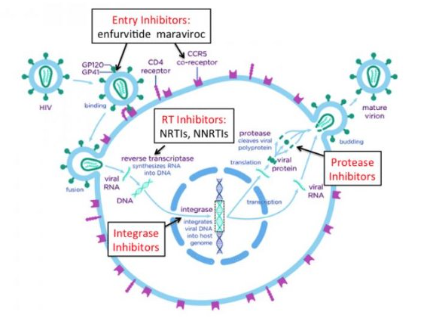
HIV Drugs:
Drugs that inhibit endocytosis that either target GP-120 on the virus or the CD4/CCR5 co-receptor on the host cell
Reverse transcriptase inhibitors that will prevent RNA being converted to DNA, therefore virus proteins will not be able to be produced, nor virus replication can occur
Integrase inhibitors will prevent the virus DNA from integrating into the host cell DNA
Protease inhibitors will prevent cleavage of virus proteins, therefore preventing the production of functional virus proteins
What viruses need from Host Cells:
Ribosomes
amino acids
T-RNA
host enzymes
nucleotides
What Makes Viruses Not Living?
Lysogenic is specialized transduction and the other one is generalized transduction
In a DNA virus the DNA goes to the nucleus
there are three different sets of genes
early uses host cell RNA polymerase: Viral DNA polymerase, virus RNA polymerase, IF transcription factors are made in the early stages
The virus RNA polymerase is used to transcribe the intermediate and late genes
in the intermediate phase makes late-stage transcription factor using intermediate transcription factors and the viral RNA polymerase
the late stage does something
the RNA leaves nucleus and goes to rough er, gets something, goes to golgi, they leave the cell through either exocytosis or something else
RNA viruses get translated right away
HIV treatments
reverse transcriptase
prevent virus translation with drug
block endocytosis
inhibit RT
block RNA from getting to nucleus
inhibit the
block the assembly of the proteins