Enzyme inhibition
Inhibitors are substances that bind to an enzyme and reduce its activity. They may be reversible, so they only bind temporarily to an enzyme via weak bonds, or irreversible, so they bind permanently to an enzyme via strong bonds. Reversible inhibitors may be competitive or non-competitive. Competitive inhibitors compete with the substrate to bind to the active site, while non-competitive inhibitors bind to an allosteric site on the enzyme which changes the shape of the active site.
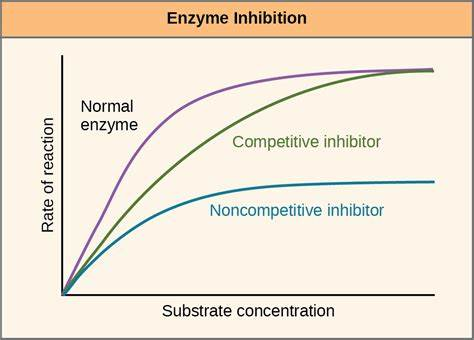
Competitive inhibitors are similar in shape to the substrate and bind to the active site to block it, preventing the substrate from binding. Increasing the substrate concentration can overcome competitive inhibition, as there will be more frequent collisions between the active site and substrate. Therefore, eventually the same Vmax is reached.
Non-competitive inhibitors do not bind to the active site, so they can be a different shape to the substrate. They bind to an allosteric site and change the shape of the active site. This means that the active site and substrate are no longer complementary in shape preventing them from binding, therefore increasing the concentration of substrate does not overcome non-competitive inhibition. Instead a lower Vmax reached.
Controlling metabolism
Reversible inhibitors are important in regulating enzyme activity inside the cell. The rate of a metabolic pathway can be adjusted to meet demand by regulating the activity of individual enzymes. One way this can be achieved is be end-product inhibition. End-product inhibition is when the final product in a metabolic pathway can act as a reversible inhibitor of an enzyme near the beginning of the pathway. This is an example of negative feedback as an increase in the concentration of the end product, will decrease the rate of reaction and so decreases its concentration. The end product is usually a reversible inhibitor so that it can be quickly reversed and the rate of reaction increased when the end product concentration decreases. An enzyme at the start of the metabolic pathway is inhibited to avoid wasting resources making unnecessary intermediates.
Other ways of controlling metabolism:
Covalent modification: Enzymes are synthesised in an inactive form, and are activated when needed.
Compartmentalisation: Membranes control which substances enter or leave cell or organelle.
Controlling the synthesis of enzymes
Multi-enzyme complexes are a way of increasing enzyme efficiency. They maintain the substrate in the vicinity of the next enzyme in the metabolic pathway and reduce diffusion time.
Irreversible inhibition
If an inhibitor binds permanently to an enzyme, that enzyme is inactivated and unable to form any more ESC. The Vmax of the reaction decreases over time as more enzymes become inactivated and increasing substrate concentration does not overcome the inhibition. A lot of poisons (ingested) and venoms (injected) are irreversible inhibitors, for example cyanide inhibits an enzyme involved in aerobic respiration preventing it from taking place.