8a: Memory and learning
Hippocampus & Spatial Memory
The hippocampus has been linked to the storage of spatial memories
but not linked to most memory storage
despite H.M. not having retrograde amnesia, indicating it's not involved in all types of memory storage.
Key points illustrating the hippocampus's role in spatial memory:
Tuning properties of specific cells in the hippocampus.
Existence of place and grid cells.
Evolutionary changes linked to behavior across different species.
Developmental changes in humans.
Place and Grid Cells
Place Cells:
Encode selective spatial locations.
Become active when a rat is in or moving towards the specific location associated with that place cell.
When placed in a new environment, these cells can "remap" to the new spatial layout.
Grid Cells:
latitude and longtitude cells
Fire when an animal crosses the intersection points of an abstract grid representing the local environment.
Function akin to encoding geographical coordinates (latitude and longitude).
Research has shown the presence of both cell types in humans.
Evolution and Hippocampus
Spatial View Cells:
Found in primates and respond to the visual field of the environment that the animal is observing, indicating the role of vision in spatial navigation.
Variation in Hippocampal Size:
Birds that cache food possess larger hippocampi compared to non-caching species, demonstrating the size's correlation with the importance of spatial memory retrieval.
Notably, homing pigeons exhibit larger hippocampal volumes than other pigeon species, highlighting behavioral relevance.
Changes Across the Lifespan
In humans, experience with spatial learning can induce changes in the hippocampal structure.
Example Case: London taxi drivers must memorize intricate road networks, leading to an increase in the size of their hippocampus due to enhanced grey matter (brain cell density).
Evidence supports neuroplasticity even in later life stages.
more learning → more brain cells for hippocampus
H.M.: Declarative vs. Nondeclarative Long-Term Memory (LTM)
H.M. exhibited anterograde amnesia affecting declarative long-term memories but not nondeclarative ones.
The effectiveness of testing these memory types can be demonstrated via tasks such as the mirror tracing task.
Mirror-Tracing Task
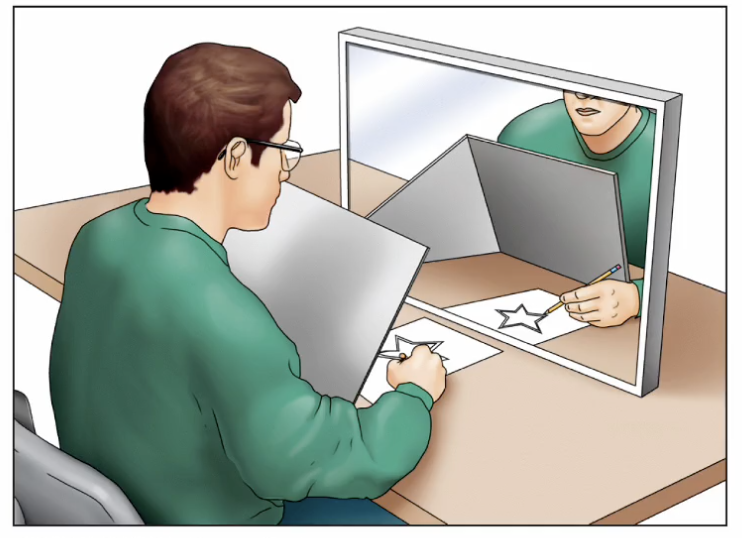
In this task, participants must trace an image while observing it through a mirror that reverses the spatial layout, making it considerably challenging.
Logic of the Study
The study needed to:
Assess memory of past task participation (episodic memory).
Evaluate improvement in tracing performance (procedural learning).
Task structure included ten trials per day over three days. Results:
Declarative episodic memory: H.M. did not remember completing the task on days 2 and 3.
Nondeclarative skill learning: marked improvement observed in tracing ability from day 1 through day 3.
Nondeclarative Learning
H.M. showed no impairment in nondeclarative learning, which indicates distinct brain processing mechanisms compared to declarative memory.
nondeclartive memory worked fine
declarative memory was impaired
Types explored:
Skill learning
Repetition priming
Conditioning
Aspects of Skill Learning
Skill learning can be categorized into three types:
Sensorimotor: Example - mirror tracing.
Perceptual: Example - reading mirror-reversed text.
Cognitive: Example - playing puzzles.
Regions Involved
Skill learning aspects are all affected by damage to the basal ganglia.
Additional damage to other areas, especially the motor cortex, also reduces task performance, notably in executing the task correctly.
Basal Ganglia
Definition: A collection of forebrain nuclei located deep within the cerebral hemispheres, integral for:
Control of voluntary movements.
Learning motor skills.
Complex Interaction of Areas
Imaging studies reveal that the basal ganglia, cerebellum, and motor cortex all contribute to sensorimotor skill learning. For example:
Learning specific motor sequences activates the motor cortex and basal ganglia, while the cerebellum may facilitate error correction throughout the learning process.
Cerebellum
Positioned at the rear of the brain, termed the "little brain."
Functions predominantly in the regulation of motor activity.
Repetition Priming
Defined as the change in stimulus processing resulting from prior exposure to the same or a related stimulus.
Not affected by basal ganglia damage.
Visual and Conceptual Priming
Visual Priming: Concerned with the visual form of words; results in reduced activation in the occipitotemporal cortex.
Conceptual Priming: Based on the meaning of words; exhibits reduced activity in the left frontal cortex.
Conditioning
Dependent on the type of conditioning, there are two main types:
Classical (Pavlovian) Conditioning
Instrumental (Operant) Conditioning
Classical Conditioning
Defined as the learning process where a neutral stimulus acquires the capacity to predict an important event.
Example: Pavlov's dogs learned to associate the sound of a bell (neutral stimulus) with the food (unconditioned stimulus), leading to salivation (unconditioned response upon food presentation) whenever the bell rang (conditioned stimulus).
Terminology
Unconditioned Stimulus (US): e.g., food, naturally evokes an Unconditioned Response (UR): e.g., salivation (production of saliva).
The Conditioned Stimulus (CS): e.g., the bell, becomes linked to the US, ultimately eliciting a Conditioned Response (CR): salivation to the bell before food is presented.
The adaptive advantage of classical conditioning is that it helps prepare organisms for events through anticipatory responses.
Eye-Blink Reflex
An example of classical conditioning where a tone is associated with a puff of air directed at rabbits’ eyes, leading to learned eye blinks in response to the tone.
The cerebellum plays a pivotal role in this learning process.
Instrumental/Operant Conditioning
Concerns a stimulus-response learning framework where the frequency of a behavior (instrumental response) depends on the consequences (reinforcing stimuli) that ensue.
Reinforcements or punishments following the responses dictate whether the behavior is repeated.
B.F. Skinner's research is central to operant conditioning, employing the Skinner box as a primary experimental apparatus for animal behavior studies.
Skinner Box
In this experimental setup, animals learn to press a lever for food or to avoid electric shocks, representing a simplified model of contemporary gambling machines.
Debate in Language Acquisition
The discourse between B.F. Skinner and Noam Chomsky on how language acquisition occurs reveals two contrasting perspectives:
Skinner: Argued from a behavioral conditioning angle, stating reinforcement led to language acquisition for children.
Chomsky: Posited that innate brain structures are also required for language development, reacting against the limitations of behaviorism.
Critical Periods in Language Development
The necessity for neural structures in language acquisition is accompanied by the concept of critical periods where language exposure is essential for normal development. For instance, lack of access to language exposure before roughly 10 years may hinder typical language skill development.
In bilingual individuals, brain area activation varies based on the timing of language acquisition, with words learned later activating distinct regions compared to those learned early.
Emotive Memories
Strong emotions significantly enhance memory formation and retrieval, fostering both positive and negative memories.
Example: Associating a song with a first kiss or recalling a traumatic accident.
Although such memories are vivid, their accuracy is not guaranteed; the amygdala is instrumental in the formation of these emotionally charged memories.
Olfaction and Memory (sense of smell)
The olfactory system (sense of smell) is integrated into the limbic system, with the olfactory bulb positioned adjacent to the amygdala. This proximity explains the evocative nature of certain aromas.
Post-Traumatic Stress Disorder (PTSD)
PTSD can occur following exposure to life-threatening scenarios, characterized by intrusive thoughts, nightmares, and flashbacks of the traumatic experience.
The memories formed during trauma are vivid yet can lack accuracy and are governed by neurotransmitters released by adrenal glands, enhancing memory consolidation via the amygdala.
Reducing PTSD Formation
Research suggests that injecting a blocker into the amygdala can inhibit memory-enhancing neurotransmitter effects, significantly reducing the memory of the traumatic event when tested months post-exposure.
Treatment Strategies for PTSD
Each instance of emotional memory recall may resurface stress signals that reinforce the memory, thus increasing its strength. A proposed intervention involves blockers to mitigate emotional responses while recalling traumatic memories, aimed at weakening those memories during reconsolidation.