PCM REVIEWER
LESSON 1: WHAT IS COMMUNICATION?
CHARACTERISTICS |
Dynamic - constantly changing
Continuous - ongoing exchange of meaning
Adaptive - adjusts to the changes that occur
Systematic - interacting in a cyclical order
Transactional - transmission and reception
FORMS |
Intrapersonal - the self
Interpersonal - dyad or small group
Public - audience communication, mass communication
Dynamic communication - two-person communication
Small group - 3-6 persons
Audience communication - talking to a large number of people gathered for a particular occasion
Mass communication - process whereby media organizations produce and transmit messages to large publics and the process by which those messages are sought, understood, and influenced by audience
VERBAL VS. NONVERBAL |
Verbal - exchange of ideas that occurs through words. This refers to written and oral.
Nonverbal - wordless exchange of information, feelings, or thoughts
Paralanguage (vocalics) - pitch, volume, rate, vocal quality
Action language (kinesics) - gesture, facial expression, eye contact, posture
Sign language - body movements that substitute letters, characters, or sentences
Object language (objectics) - things you use or wear
Tactile language (haptics) - touch, kiss, slap
Space/distance (proxemics) - distance zone for intimate, personal, social, or public
Time (chrometics) - concept of punctuality or willingness
Silence - what is not said
CAUSES OF MISUNDERSTANDING |
PROBLEMS IN DEVELOPING THE MESSAGE |
Indecision about the message content
Lack of familiarity with the situation or the receiver
Emotional conflicts
Difficulty in expressing ideas
PROBLEMS IN TRANSMITTING THE MESSAGE |
Environment
Poor printing quality
Uncertain misinterpretation
Many links that distort the message
PROBLEMS IN RECEIVING THE MESSAGE |
Physical distraction like hearing problem or poor eyesight
Lack of concentration
PROBLEMS IN UNDERSTANDING THE MESSAGE |
Cultural background
Different interpretation of words
Different emotional reaction
LESSON 2: THE VALUE OF COMMUNICATION
IT IS NECESSARY BECAUSE… |
It serves as a vehicle in building relationships
It improves working environment
It fosters strong team
It creates appropriate solutions
It builds greater respect
PRINCIPLES THAT GUIDE UNDERSTANDING COMMUNICATION |
Communication is transactional.
Communication has content.
Communication can be intentional and unintentional.
Communication is irreversible.
Communication is unrepeatable.
ETHICAL STANDARDS OF COMMUNICATION |
Truthfulness
Integrity
Fairness
Respect
Responsibility
PRINCIPLES OF ETHICAL COMMUNICATION |
Fact-based messages should be communicated with honesty and accuracy
Resources and facts should be accessible.
Messages should be made accessible.
Basic human needs should be given careful consideration.
LESSON 3: GLOBAL COMMUNICATION
GLOBAL COMMUNICATION |
A message sent from one person to another anywhere in the world.
Examples: E-mail, Webpage, Variety of applications
LANGUAGE BARRIERS IN THE GLOBAL BUSINESS COMMUNICATION |
Inaccesible Language - Language used in the product may not be understood by the consumer
Misleading Imagery - Images are sometimes left understood that may mislead the use of the product
CULTURAL BARRIERS |
Cultural Misunderstanding - Anxiety, uncertainty, stereotyping, and ethnocentrism resulted from inadequate cultural knowledge and the lack of intercultural communicative skills.
Adequate training in cross-cultural communication and exposure to other cultures will help in eliminating these barriers.
Behaviour and personality differences: body language, thinking, communication, manners, norms, beliefs, etc. - which leads to communication.
Example: ic some cultures, eye contact is important whereas in some it is rude and disrespectful
MANIFESTATION OF CULTURE |
Symbols - words, pictures, clothes, objects
Heroes - personas respected and admired
Rituals - greetings, religious practices, social ceremonies
Values - culture between right and wrong, good and bad, likes and dislikes, natural and unnatural
STRATEGIES OF INTERACTION WITHIN CULTURE |
Accommodation – denotes acquired modification in the behavior which helps individuals to adjust to their new environment (J.M. Baldwin).
Acculturation – a process through which a person or group from one culture come to adopt the practices and values of another culture while retaining their own distinct culture (N.L. Cole).
Assimilation – the process whereby individuals are able to adopt the cultural norms of the host culture over their original culture (Wikipedia).
Integration – when individuals are able to adopt the cultural norms of the dominant or host culture while maintaining their culture of origin (Wikipedia).
Separation – when individuals reject the dominant culture or host culture in favor of preserving their culture of origin (Wikipedia).
Marginalization – when individuals reject both their culture of origin and the dominant host culture where cultural exclusion is promoted (Wikipedia).
HOFSTEDE’S DIMENSION OF CULTURE: UNDERSTANDING CULTURAL SIMILARITIES AND DIFFERENCES |
POWER DISTANCE INDEX (PDI) |
measures the extent to which individuals within a society, culture, or organization accept and expect unequal distributions of power and authority.
Low PDI |
It reflects the population's attitude toward hierarchy and the degree to which they tolerate power imbalances.
Societies or organizations where power is shared equally and unequal power distribution is not accepted
Characteristics:
Collaborative decision-making.
Decentralized leadership.
Advantages:
Innovation: Open communication, less authority = more room for creativity.
Engagement: Opinions matter, people feel valued.
Inclusivity: Everyone involved in decision-making.
Growth: Open sharing = collective learning.
Disadvantages:
Slow decisions: Involving everyone = slower process.
Misunderstandings: Ideas may contradict each other.
Majority rule: Majority may suppress minority ideas.
Leadership gaps: Lack of authority = potential inefficiency.
High PDI |
Societies or organizations where power is concentrated in the hands of a few, with clear hierarchy.
Characteristics:
Centralized decision-making.
Unequal power distribution is accepted.
Advantages:
Respect for authority: Greater loyalty and respect for leaders.
Faster decisions: Leadership has the final say.
Clear boundaries: Defined roles = no overlap.
Minimize disagreement: Less room for conflicting views.
Disadvantages:
Low self-esteem: Lower-ranked individuals may feel undervalued.
Overdependence: People rely too much on leaders.
Inequality: Leaders may abuse power.
Reduced interaction: Hesitation to provide feedback to authority.
INDIVIDUALISM VERSUS COLLECTIVISM (IDV) |
Individualism |
A way of living that focuses on self-development, independence, and personal improvement.
Characteristics:
Prioritizes self-reliance and personal goals.
Loose social ties, direct communication.
Promotes freedom and self-confidence.
Advantages:
More freedom: Greater independence.
Confidence: Fosters self-sustainability.
Disadvantages:
Connection issues: Difficult to build strong relationships.
May lead to self-centeredness.
Collectivism |
A cultural way of life that emphasizes group cooperation and interdependence.
Characteristics:
Focuses on group harmony and well-being.
Strong social ties, indirect communication.
Shared responsibility and community support.
Advantages:
Community support: Stronger sense of belonging.
Shared responsibility: Cooperation and mutual help.
Disadvantages:
Limits personal growth: Individual desires are suppressed.
Comparison |
Individualism Collectivism |
Self-reliance, individual goals prioritized. Group harmony, shared goals. |
Direct communication. Indirect communication. |
Personal responsibility is key Group well-being over individual desires. |
Similarities |
Both value social connections. |
Shaped by societal norms. |
Both value achievements. |
Operate within a moral framework. |
Flexibility in behavior. |
MASCULINITY VERSUS FEMININITY (MAS) |
Masculinity |
From Latin "masculinus," meaning "worthy of a male." Refers to societal expectations for traits and behaviors considered appropriate for boys and men.
Characteristics:
Emphasizes ambition, acquisition of wealth, and distinct gender roles.
Prioritizes competition, achievement, and success.
Values assertiveness and material rewards.
Key Traits:
Strong work ethic.
Decisive leadership.
Competitive spirit.
High Masculinity:
Advantages Disadvantages |
Clear roles: Defined gender roles may streamline responsibilities. Heightened expectations: Pressure to meet social standards. |
Ambition-driven: Encourages success and achievement. Emotional repression: Less emphasis on emotional expression. |
High performance: Focus on material gain and goal-driven competition. Limited individual freedom: Strict gender roles can restrict personal expression. |
Pros Cons |
Clear roles, defined structure. Emotional repression and pressure to conform to gender roles. |
High achievement and goal orientation. Less focus on emotional well-being and work-life balance. |
Encourages ambition and competition. |
Femininity |
From Latin "femininus," meaning "relating to women." Refers to societal expectations for traits and behaviors considered appropriate for girls and women.
Characteristics:
Focuses on caring, nurturing behaviors, and sexual equality.
Emphasizes environmental awareness and fluid gender roles.
Prioritizes cooperation, quality of life, and well-being over personal achievement.
Key Traits:
Supporting each other.
Focus on open communication.
Decreased conflicts and open to change.
High Femininity:
Advantages Disadvantages |
Emotional priority: Greater focus on well-being and emotional health. Underperformance in business: Less focus on material success. |
Cooperation: Teamwork and support for others. Slower decision-making: Emphasis on discussion and consensus can delay actions. |
Flexibility: Gender roles are more fluid, allowing for individual expression. Less assertiveness: May reduce competitiveness in highly competitive environments. |
Pros Cons |
Emphasizes open communication and emotional health. Less competitive, may lead to underperformance in some business contexts. |
Promotes cooperation and teamwork. Slower decision-making due to inclusive processes. |
More adaptable, open to change |
UNCERTAINTY AVOIDANCE INDEX (UAI) |
The UAI measures a society’s tolerance for uncertainty and risk, ranging from high to low.
High UAI = Less open to risks, preference for stability, structured environments, and clear rules.
Low UAI = More open to risks, embracing risks, flexibility, and innovation.
Factors |
Technology
Religion and Cultural Heritage
Economic Factors & Political Systems
Social Values & Education
Globalization and exposure to diverse cultures
Low UAI Nations |
Advantages:
Embracing change fosters innovation and entrepreneurship.
Technological advancements and creativity thrive.
Individuals feel empowered, experience reduced anxiety in uncertain situations.
Opportunities for discovering new trends and ideas while conserving resources.
Disadvantages:
Instability and unpredictability can disrupt societal order.
Lack of clear guidelines may lead to inefficiencies and conflicts.
Increased personal responsibility for navigating uncertainty.
High UAI Nations |
Advantages:
Stability and predictability due to well-defined rules and regulations.
Enhanced social order and security, attracting investment.
Preparation for future uncertainties minimizes conflicts.
Structured environments reduce ambiguity and provide clarity.
Disadvantages:
Resistance to change and innovation, stifling creativity.
Bureaucratic inefficiencies and slower decision-making processes.
Higher anxiety in unfamiliar situations, promoting risk aversion.
Potential stress for individuals, especially children and the elderly.
LONG VS SHORT-TERM ORIENTATION |
Long-Term Orientation (LTO): Cultural values focusing on future success, emphasizing traditions, patience, planning, and perseverance.
Short-Term Orientation (STO): Cultural values prioritizing immediate outcomes and achievements, focusing on current results and traditional practices over long-term goals.
Long-Term Orientation (LTO) |
Key Characteristics:
Values: Tradition, Patience, Planning, Perseverance
Related to Confucian Dynamism: Thrift, Delayed Gratification
Advantages:
Perseverance in achieving goals
Stronger Relationships built over time
Economic Development through long-term investments
Disadvantages:
Over-Focus on Future, potentially sacrificing present happiness
Impact of Cultural Norms on success
Fear of Failure affecting decision-making
Short-Term Orientation (STO) |
Key Characteristics:
Emphasis on Immediate Outcomes
Focus on Current Results and Traditional Practices
Advantages:
Optimized Problem-Solving for immediate challenges
Encourages Goal-Oriented Behavior
Fosters Drive and Contentment in the present
Disadvantages:
Neglect of Future Planning can lead to long-term issues
Diminished Sense of Accomplishment over time
Sense of Stagnation if goals are not regularly reassessed
INDULGENCE VS RESTRAINT (IVR) |
Indulgence: A cultural phenomenon that allows the satisfaction of natural human desires, emphasizing joy and leisure. Societies that embrace indulgence believe that life’s best moments come from fun and enjoying life’s pleasures.
Restraint: A cultural dimension that emphasizes control and limits on individual expression and behavior, prioritizing social norms over personal desires. In restrained cultures, freedom and self-expression may be less valued.
Indulgence |
Key Characteristics:
Satisfaction of desires
Joy through leisure activities
Freedom and Self-Expression emphasized
Advantages:
Acceptance of Foreign Concepts: Openness to new ideas and experiences
Emphasis on Freedom and Self-Expression: Encourages individuality and creativity
Disadvantages:
Weakened Long-Term Planning: Focus on immediate gratification may hinder future considerations
Overindulgence: Risk of excess leading to negative consequences
Restraint |
Key Characteristics:
Control over individual desires
Social Norms prioritized over personal expression
Long-Term Focus emphasized
Advantages:
Social Order and Stability: Maintains a structured society
Cultural Values: Reinforces traditions and collective norms
Disadvantages:
Suppression of Individual Desires: Limits personal freedom and expression
Sense of Helplessness: Individuals may feel constrained by societal expectations
Resistance to Change: Difficulty adapting to new ideas or practices
CONCEPTS IN INTERCULTURAL COMMUNICATION |
Ethnocentrism – one believes that his/her culture is superior to the other.
Cultural relativism – believes that cultures are equal with one another despite their differences.
Melting pot philosophy – idea that different cultures will blend together and create one ultimate culture.
Pluralism – refers to the acknowledgment of cultural relativism and promotion of respect for the uniqueness of the diversity of cultures. Cultures are allowed to co-exist.
IMPROVING INTERCULTURAL COMMUNICATION |
Pay attention to words and action
Control assumptions
Empathize across cultures
Gain knowledge
Gain experience
LESSON 4: VARIETIES OF ENGLISH/WORLD ENGLISH
HOW DO WE KNOW THERE ARE VARIETIES? |
CHARACTERISTICS |
Identifiers of each english
Accent
Dialect
Vocabulary
Meaning/Context
Pronunciation
Grammar
Spelling
Syntax
ACCENTS |
Your accent is the way you say words when you speak. It’s all about pronunciation and has nothing to do with grammar or syntax.
With accents, two people may say precisely the same words, but make them sound completely different.
Accent is all about pronunciation. Two people may use the same grammar, the same syntax and the same vocabulary but pronounce the words in a different way. Effectively they have two accents.
For example:
people in the north of England tend to say the word path as:
pæːθ with a short vowel
whilst people in the south of England tend to say:
pɑːθ with a long vowel.
There are two different accents at work here.
DIALECT |
Dialects, on the other hand, have differences not only in pronunciation but also in grammar and syntax. Two people may both speak English but one might say:
A1: He did well!
A2: He done well!
B1: He’s talking.
B2: He’s a-mardlin’.
Here there are differences in vocabulary which separate standard British English from the Norfolk dialect.
VOCABULARY |
The following examples are in this format:
American english
British english
Meanings
Quite = intensifier
Quite = detensifier
Floors
First floor
Ground floor
More floors
Second floor
First floor
Semantic fields
PRONUNCIATION |
Received pronunciation is a form of pronunciation used in British English; is simply a particular accent of English.
Differs usually from region to region; people from one area will speak with a particular accent whilst people from another area speak with a different accent
There are special cases where different regions have similar accents - non-regional
It can be social, received pronunciation can be spoken by what used to be called “the upper classes” in Britain and it’s spoken by people who have attended expensive fee-paying schools, can suggest a privileged social and educational background.
GRAMMAR |
The following examples are in this format:
British english
American english
Present Perfect vs Past Simple
present perfect
past simple
Irregular verbs
Dive - dived - dived; dive - dove - dived
Get - got - got; get - got - gotten
Prepositions
Shall
Should
Question tags
Shall I?
Right?
Collective nouns
Team are (either singular or plural)
Team is (plural only)
Adverbs
Really (-ly)
Real
Double imperatives
Go and open
Go open (drops the ‘and’)
SPELLING |
Format: British/American
General rules
-our/ -or
-re/ -er
-ce/ -se
-ise/ -ice
-ogue/ -og
-t/ -ed
Greek origin = ae-
VARIETIES OF ENGLISH |
The different kinds of English used around the world. Often these are geographically based.
The varieties are more or less similar and while most English speakers can understand each other, there are occasional problems
Background
English was used as the lingua franca in many other places (often countries which formed part of the British Empire).
Language used in these different countries began to develop independently from the original language
There are many other varieties and virtually all countries where English is spoken has their own variety; each main variety of English has sub-varieties or regional variations
AMERICAN ENGLISH |
AmE – is a variant of the English language, spoken mainly in the United States. About two-thirds of the world’s native speakers of English live in America and speak this variant.
English was introduced to North America by British settlers during the colonization period (17th century)
AUSTRALIAN ENGLISH |
AuE – is a variant of the English language, spoken mainly in Australia.
Australian English began to diverge from British English shortly after Australia was settled in the late 18th century
BLACK ENGLISH |
A very broad term used to refer to British English and American English as spoken by the black communities in the US and the UK
Types
African American Vernacular English - a distinct dialect of English, sometimes classed as a variety of English. It is also known as Ebonics though this is not a term used by linguists and is sometimes used pejoratively.
roots in the slave trade
forced to create a pidgin or creole
language structure which has much in common with a number of African languages
British Black English - similar origins but is based on a Jamaican creole spoken by Caribbean communities, mainly in London but also in large cities such as Manchester, Bristol, Birmingham, Leeds and Nottingham.
British Black English speakers are finding their own voice in literature such as rap poetry and song
BRITISH ENGLISH |
British English - is a variant of the English language, spoken mainly in the United Kingdom
No single British English variation of English. Instead there are a considerable number of variations mainly found in different locations
Scottish English
Irish English
Welsh English
Northumbrian
Norfolk
Cornish
The Queen’s English
BBC English
RP or Received Pronunciation
LESSON 5: LANGUAGE REGISTERS
LANGUAGE REGISTERS |
Language register is the level of formality or informality with which people converse with one another
TYPES OF LANGUAGE REGISTERS |
FROZEN REGISTER |
Literally frozen
Often learned and repeated
Ritualic and may be archaic
Used in respectful or formal ceremonies
Examples: national anthems, alma mater song, marriage ceremonies, prayers
FORMAL REGISTER |
Language is standard
Avoids slang
Technical and academic vocabulary
Fewer contractions or no contractions
Examples: speeches, announcements, pronouncements of judges
CONSULTATIVE REGISTER |
Normal style for speaking to strangers or persons who are neither acquaintance or friends or relatives
Two-way process of communication; uses titles: Dr., Atty., etc.
Words are general rather than technical
Conversational in tone
Examples: a superior and a subordinate, a doctor and a patient, a lawyer and a client, a teacher and a student
CASUAL REGISTER |
Used among friends and acquaintances that does not require background information
No said barriers
Very relaxed in conversation, conversational tone
Uses informal language - slangs, vulgarities, colloquialisms are informal
Gets to know the someone on more personal travel
Examples: chat with buddies, emails or letters to friends, blogs, phrases like “I’m doin’ it my way”, lemme go”, wassup?”
INTIMATE REGISTER |
A non-public speech style
Used by family members or a very close friend/s
Meaning is more important than correct linguistic codes
Uses private vocabulary, endearment, name callings
Avoid in public and professional situations
Free and easy participation of both speaker and listener
TAKE AWAY |
By knowing what various registers are and how to differentiate between them and when to use them, will help increase your chance of being accepted by groups, and speakers in a variety of contexts without the feeling of anxiety or uneasiness.
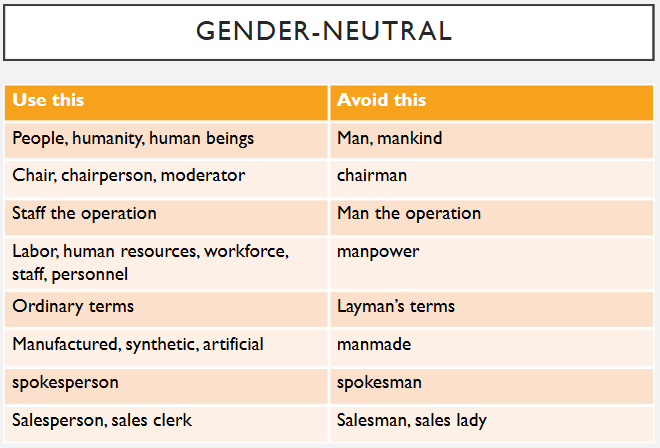
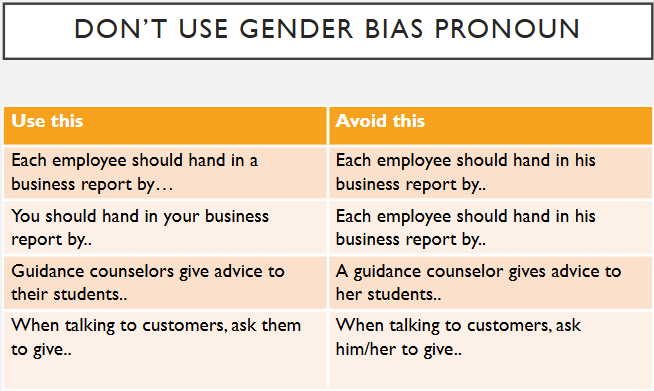
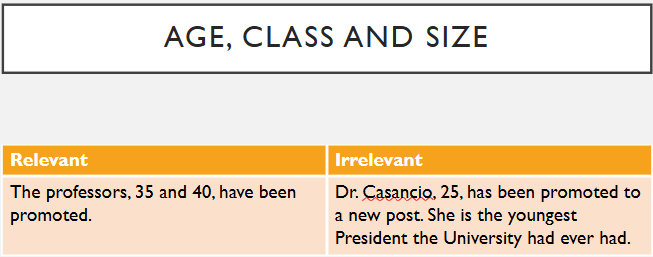
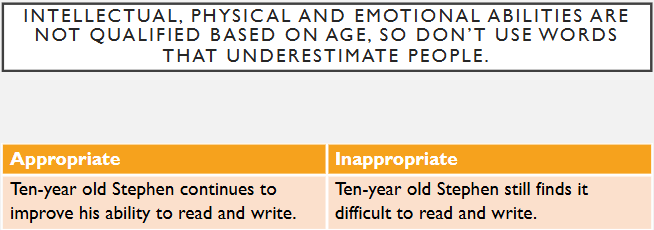
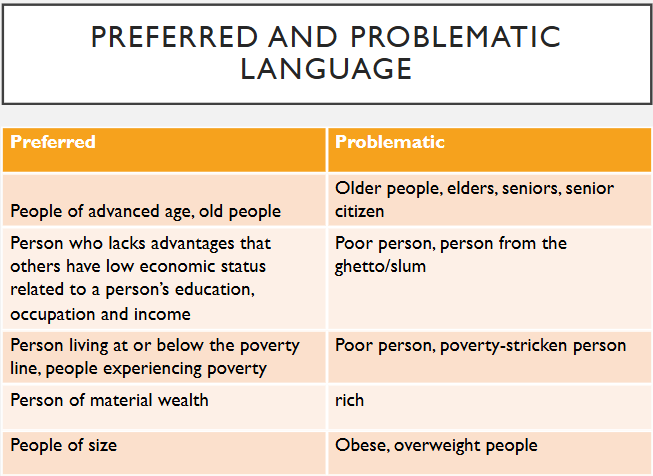
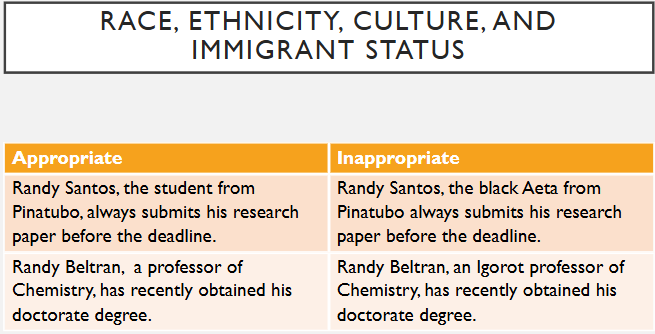
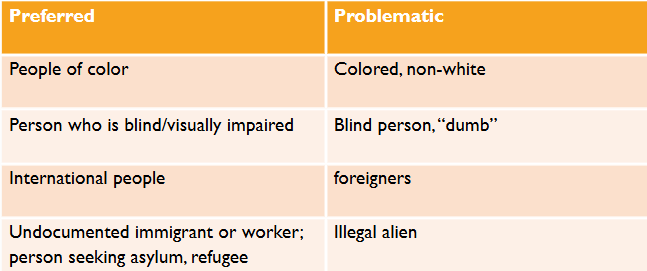
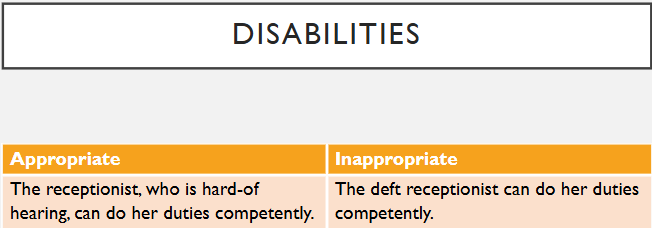
LESSON 6: BIAS-FREE LANGUAGE