Nerve Cell Electrical Signaling
Vocabulary:
Current (I): The flow of electrical charge, when inward positive charge (+) is entering the cell, or negative charge (-) is leaving the cell
Resistance (R): Opposition to current flow. This is the inverse of conductance (g)
Conductance: The actual movement of ions, used interchangeably with permeability, inverse of resistance, how many ions actually flow
Permeability: How easily ions can move across something, opportunity to flow
Membrane potential (V): The separation of charges across the membrane, V=IR
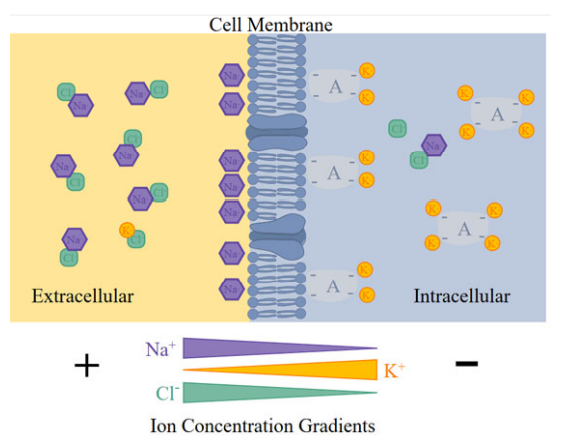
Resting membrane potential (RMP): The electrical potential difference across the plasma membrane, measured in millivolts. Typically -40 mV to -90 mV (average -65), the inside of a nerve cell is more negative than the outside. Requires a semipermeable membrane, unequal distribution of charged particles, and Na/K ATPase. Created by a small number of ions flowing down their passive concentration gradients, creating current. Has a nonuniform distribution of ions across the membrane, large anions are trapped intracellularly which attract cations like K+ (Na+ stopped). Inside - outside. Permeable to K+, not as much Na+. Permeability changes divert membrane potential from this
Bulk neutrality: The difference along the membrane
Depolarization: When the membrane potential is less negative than RMP
Hyperpolarization: When the membrane potential is more negative than RMP
Repolarization: A return towards RMP
Na+/K+ ATPase: Pumps out 3 Na+ and 2 K+ in, contributing to electrical charges in a small amount (like -5 mV contribution) Necessary to maintain RMP more so than create it. An example of an active transporter
Membrane: A phospholipid bilayer with proteins. Permeable to gases and lipophilic/hydrophobic molecules, impermeable to large or charged molecules. Contains specific protein channels to allow ions to pass through
Ion channel: Embedded within the membrane, make it semi-permeable. Some open at RMP, mostly K+, some Cl-, few Na+
Leak channel: A channel that is always open, typically K+
Active transporters: Transport things like ions against their concentration gradients, ions go back to original locations. They require metabolic input and work against channels
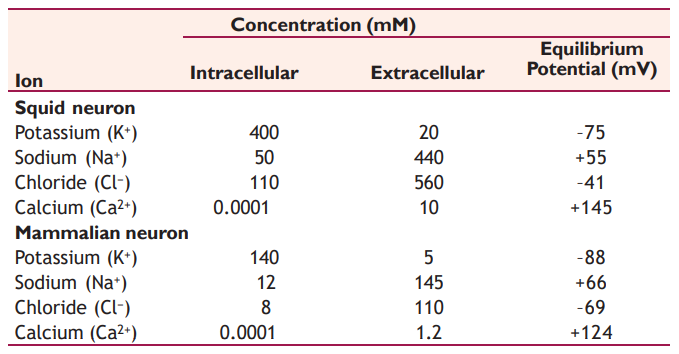
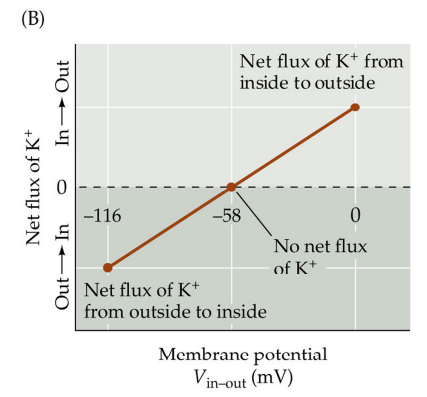
Equilibrium potential: For a particular ion, the membrane potential at which there is no net flow. Ex (where x is a given ion) is the equilibrium potential for ion X (no net flow), each ion ‘tried’ to individually reach this. Derived based on ion valence, concentration, kinetic energy, gas constant (R) 8.31 joules/degree Kelvin-mole, and Faraday constant (F), 9.65e4 coulomb/mole. This is where ion flow switches from one direction to another, therefore if graphed it crosses the X axis (of mV) if current is graphed at its equilibrium potential
Nernst equation: Ex = (RT/zF)ln([X]out/[X]in), simplified to Ex=(58/z)(log([X]out/[X]in)) at room temperature, Ex=(61/z)(log([X]out/[X]in)) at body temperature. When the ion X is negative, use the absolute value for the first term, and swap concentrations to [X]in/[X]out. Valence in the denominator, concentration in on the bottom
Reversal potential: The membrane potential at which current reverses direction. For a single ion X, this is Ex
Goldman equation: Each ion moves down its electrochemical gradient. Dependent on temperature, membrane permeability to each ion, concentration gradients for each ion, and the valence of each ion. If permeability for an ion increases, the membrane potential will move towards that ion’s Ex. Written, Vm = 58log{(Pk[K]out + Pna[Na]out + Pcl[Cl]in)/(Pk[K]in + Pna[Na]in + Pcl[Cl]out)}
Electrical signal: In nerves they arise from ion fluxes across the membrane. Require unequal distributions of ions in order for ions to flow down the electrical chemical gradient (maintained by active transporters), and changes in membrane permeability/opening of ion channels. Can be started by stimuli, such as chemicals/ligands binding to receptors (to open them), changes in the electrical environment (voltage changes), or mechanical/physical forces like light and heat, diminishes farther away from the stimulus
Graded potential: A localized change in membrane potential, reflects duration and strength of a stimulus, lower intensity the farther away something is, no signal reinforcement
Receptor potential: A change in resting membrane potential caused by a stimulus in a sensory neuron. Can come from a stimulus transduced into an electrical signal, typically depolarizing. Transient and reflects the intensity of the stimulus
Synaptic potential: A change in RMP caused by another neuron, chemical signals are transduced into electrical signals (and back into chemical if the signal is relayed like with that of interneurons). Last fractions of a second
Excitatory post synaptic potential (EPSP): A depolarizing synaptic potential (though sometimes exceptions)
Inhibitory post synaptic potential (IPSP): A hyperpolarizing synaptic potential
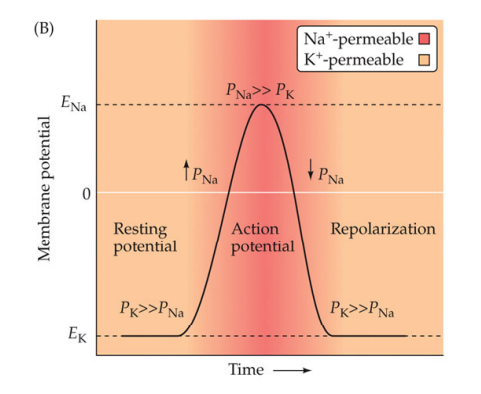
Action potential (AP): Rapid depolarization → Hyperpolarization → Repolarization. Triggered by membrane potential depolarizing to a given threshold. Always have the same magnitude and duration under the same ion concentrations. A strong stimulus will produce multiple of these. Follow all-or-none principle. Many exceptions to rules. Active, as it is reinforced and doesn’t require ATP to continue
Rising phase: Membrane potential spikes from RMP to 0, where there is Na+ permeability, caused by Na+ influx
Overshoot phase: Membrane potential is positive and still increasing
Falling phase: Membrane potential drops from positive to 0, caused by K+ efflux
Undershoot phase: Membrane potential is more negative than RMP and recovering back to RMP
Refractory period: Immediately follows an AP, when no AP can be sent or there is a reduced amplitude, due to K+ conductance being greater than RMP (also causing hyperpolarization)
Threshold: The point of depolarization at which a neuron will send an action potential, can vary between neurons
All-or-none principle: Either an AP is sent or not, there is no in between. Given ionic conditions, the same response will be produced once threshold is reached by graded potentials synapsing onto it. Travel throughout axons and across membranes without decrement
Tetrodotoxin (TTX): A chemical known to block many voltage-gated sodium channels
Tetraethylammonium (TEA): A chemical known to block many voltage-gated potassium channels
Hodgkin and Huxley mathematical model: Examined by time course of voltage and conductance changes related to timing of action potentials, found that the peak AP coincided with peak Na+ conductance, and that the rise of K+ conductance began later, with K+ conductance falling to resting values later than the end of the AP (which creates the refractory period)
Positive feedback loop: Describes AP generation, depolarization of the membrane opens voltage-gated Na+ channels, causing local current and Na+ influx passively, opening up adjacent voltage-gated Na+ channels
Negative feedback loop: Restores RMP, depolarization of the membrane slowly opens K+ channels, generating local current via K+ efflux, hyperpolarizing local membrane current
Action potential conduction: How an AP spreads down an axon, requires both active and passive current flow. Caused by local changes from nearby local currents
Myelin: Coats an axon, done by oligodendrocytes of Schwann cells. Reduced resistance of the membrane, allowing local currents to travel faster
Nodes of Ranvier: Unmyelinated sections of an axon, contain voltage-gated sodium channels
Saltatory conduction: Caused by myelin insulation, allowing local current to travel from node to node, AP ‘jumps’ from node to node, not as many channels need to open so faster than unmyelinated conduction. A larger diameter also decreases resistance
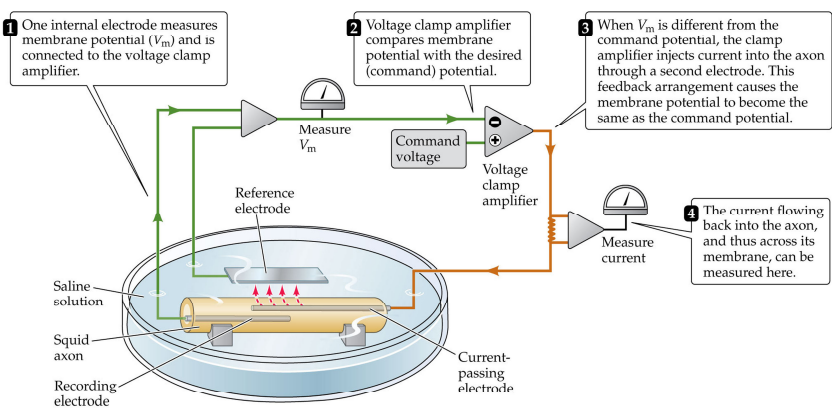
Voltage clamp method:
Determined the molecular basis of the action potential (conductance in an axon)
Prior knowledge included:
APs were generated when membrane potential reaches a threshold value
Permeability changes might be dependent on voltage
Magnitude of APs change rapidly overtime, independent of a stimulus
Maximum depolarization approaches the equilibrium potential for Na+
Challenges to examining APs
Permeability changes with voltage changes
Voltage changes over time independent of the stimulus
This method allows researchers to set the voltage for an axon (the clamped voltage), which was a change in voltage from the RMP, based on the current that is injected
Theorized that if voltage change caused permeability change, then a current will be generated, a current in the opposite direction could be injected to maintain the new voltage, the current could be measured, and changes could be monitored over time. A drawback is that the ions causing the current couldn’t be determined
Hodgkin + Huxley and the squid giant axon:
Hypothesis: Voltage dependent changes in sodium and potassium ion permeability are necessary and sufficient to generate an action potential
Wanted to determine if membranes have voltage dependent permeabilities (using the voltage-clamp method). Tried to figure out how the voltage clamp method could be set up and used to address this, how voltage would be manipulated in relation to the RMP, and how to predict what would happen to the permeability of the axon and the injected current.
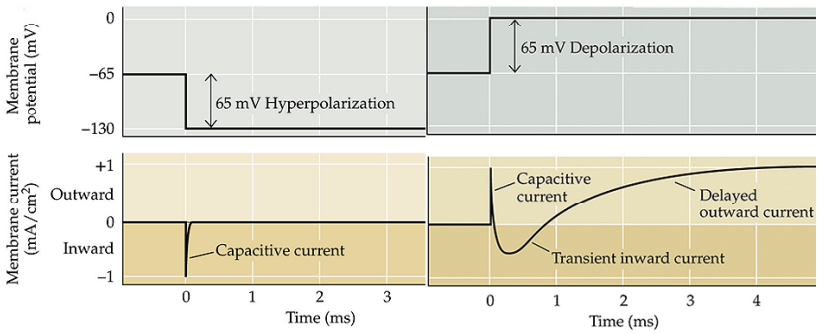
After injecting hyperpolarizing current (-65 mV → -130 mV), found no change in membrane permeability, only change in membrane potential
After injecting depolarizing current (-65 mV → 0 mV), found rapid change in permeability, with rapid inward flow ceasing even through membrane potential was at 0 mV. Originally cations flowed in, later they flowed out. Found permeability does not inactivate it
Hodgkin and Katz and the voltage-clamp method:
Wanted to identify which ions where causing changes
Hypothesis: Changes in sodium permeability generates early current, but not late current
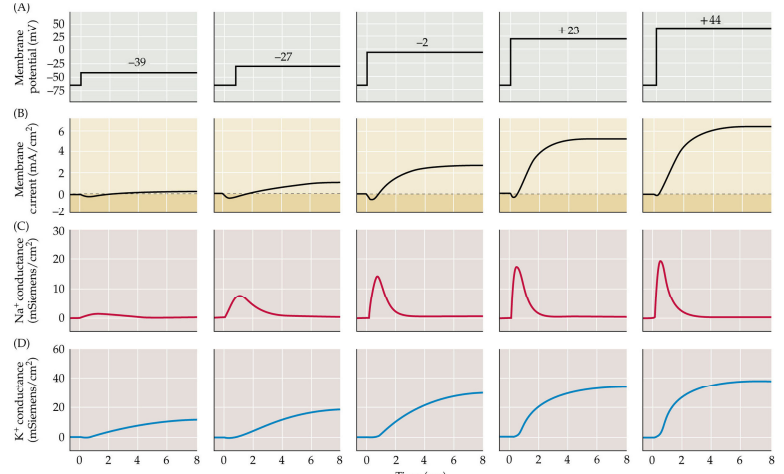
Examined currents at different membrane potentials. If the membrane potential clamped at Na+ equilibrium potential, no current would be injected. If the membrane potential clamped at below this instead, current would flow out instead of in
They noticed that the more depolarizing the membrane potential was, the higher the membrane current was as well, but this rose and stayed constantly higher
Found no time component/inactivation to membrane current
Removed extracellular Na+, in order to see how it impacted Na+ equilibrium potential (based on the Nernst Equation), and how early/late flow were impacted
Found that without Na+, ENa became negative. At a Vm = 0 mV, there was early current outward, and that sodium would flow outward to reach the negative ENa
Hypothesis: Potassium is causing late currents but not early currents
Loaded axoplasm with radioactive K+ before clamping the voltage at 0 mV. Tried to figure out what would happen to K+ permeability, and where the radioactive K+ would be found
Experiments overall concluded that both Na+ and K+ conductances require time to activate (K+ with a delay), Na+ starts rapidly but also quickly declines, depolarization causes Na+ to activate and inactivate over time. K+ doesn’t inactivate, timelines are both voltage dependent. The speed of inactivation increases as voltage is more negative
For membrane potential (Vm):
Cations:
Vm = Ex no net flow
Vm > Ex ions flow out
Vm < Ex Ions flow in
Anions:
Vm = Ex no net flow
Vm > Ex ions flow in
Vm < Ex Ions flow out
If the concentration of negative ions in increased inside the cell, the membrane potential becomes less negative. For positive ions, if the concentration is increased outside the cell, the membrane potential becomes less negative
When there is a lot of external K+, RMP is very different from Ek. At high values of external K+, RMP and Ek are similar. Na+ concentration doesn’t really have an effect on RMP
Conductances are voltage-dependent, as the membrane potential becomes less negative, conductance increases. This implies that permeability mechanisms are able to ‘sense’ voltage