Definitions
Development - change and expansion of ability and advancement in skill from a lower to a more advanced capability.
qualitative change, growth is quantitative
Happens in a set order (crawl → walk → run).
Physical (motor skills)
Thinking (cognitive)
Feelings/relationships (emotional, social)
Talking/communication (language)
Head grows the fastest, then trunk then arm and legs
Development Patterns:
1. Cephalocaudal, from head to toe; top-down sequence
Cephalo” = head
“Caudal” = tail or lower part of body
Example: Infants advance in neck and head control before controlling the movements of the extremities.
They can lift their head before they can sit, crawl, or walk.
2. Proximodistal, from midline to periphery; Growth that starts at the center of the body (the trunk) and moves outward toward the extremities (arms, hands, fingers).
“Proximo” = near/closer to the center
“Distal” = farther from the center
Example: A baby can control their shoulders and arms before they can control their hands and fingers.
3. Differentiation: simple to complex, and general to specific;
cells, organs, and skills become more specialized and distinct as a person develops.
Example: Infants use a whole-hand grasp before learning the finer control of the pincer grasp, and they coo or babble before they speak.
Growth Chart – Purpose:
Track growth over time → Shows if a child is growing normally.
Compare to standards → Compares child’s growth to other children of the same age/sex.
Find problems early → Helps detect growth issues (like undernutrition, obesity, or illness).
Cultural expectations can influence the age at which a child is expected to master certain developmental tasks.
Social expectations influence the age at which children are expected to master developmental tasks, varying by culture.
Quantitative growth and example:
Growth = measurable physical changes in the body.
Height (inches/cm)
Weight (lbs/kg)
Head circumference (cm, esp. in infants)
Chest circumference
BMI
Qualititative growth and example:
Changes in abilities or functions (not numbers)
Examples: Learning to talk, walking, problem-solving, making friends
Erickson Progression (already in flashcards):
Infancy
Toddler
Preschool
School Age
Adolescence
Young Adulthood
Middle Adulthood
Late Adulthood
Kohlberg’s Stages of Moral Development (Expanded)
Level
Stage
Main Idea
1. Preconventional
Stage 1:
Avoiding punishment – rules obeyed to avoid consequences.
Stage 2:
Gaining reward – do things for personal benefit.
2. Conventional
Stage 3:
Gaining approval – seek to please others, be “good.”
Stage 4:
Avoiding disapproval – follow laws/rules to maintain order.
3. Postconventional
Stage 5:
Agreeing upon rights – laws are flexible if they promote fairness.
Stage 6:
Establishing personal moral standards – guided by conscience, justice, equality.
Stage 7:
Achieving justice – moral reasoning grounded in universal love, justice, or even spiritual/ethical ideals.
2 Rapid Growth Periods:
1. Infancy – First year of life
Babies usually double their birth weight by 6 months and triple it by 1 year.
Height grows quickly too.
Adolescence (Puberty) – Ages 10–20
Big growth spurt in height and weight.
Triggered by hormones (like growth hormone and sex hormones).
Happens earlier in girls than boys.
Key Idea: The body doesn’t grow at a constant rate; there are bursts of rapid growth separated by slower periods.
Growth infants: birth weight doubles at 6 months, triples at 1 year
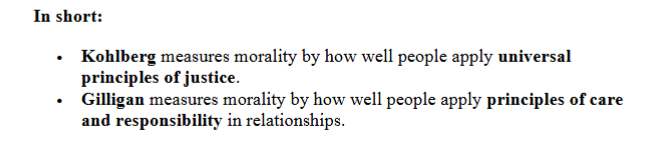
Kohlberg’s Theory of Moral Development
Justice, fairness, and abstract reasoning in moral decision-making
Kohlberg focused on the stages of moral reasoning and how people decide what is morally right.
Example Moral Dilemma Response: Focuses on "What is fair?" and "What rules or principles apply?”
Principle of Gilligan’s Theory
moral development is based on relationships and care, not just abstract rules or justice.
Moral decisions are guided by responsibility, empathy, and compassion.
Example Moral Dilemma Response: Focuses on "Who will behurt?" and "How can relationships be maintained or repaired?"
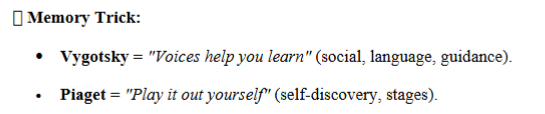
Vygotsky’s Sociocultural Theory
Cognition develops through social interaction and cultural tools, not just individual exploration ; Learning is social
Teacher Role: Active guide and collaborator\
Piaget’s Cognitive Development Theory
Learning is self-driven
society is supportive; teacher role: tools given for exploration, not guided