14.3 - Exercise And Weight Management
Energy Balance and Body Weight
The principle underlying eating well to maintain a healthy body weight is one of balance.
Stated simply, the energy (food) we take in each day should closely match the effort (energy output) we expend.
To some extent, this balance is specific to the individual at any given point in time.
The Energy Equation
This basic “energy in, energy out” relationship can be expressed in the form of a simple equation:
Energy storage = Energy intake – Energy output
In other words, the amount of excess energy stored by our body is the difference between the amount of energy taken in and the amount of energy expended.
What is a Food Calorie?
A calorie is the amount of energy needed to raise the temperature of 1 gram of pure water by 1°C.
In a dietary context, what we call a calorie (or a food calorie) is, in fact, a kilocalorie (1000 calories).
Calories are a measure of the amount of energy that food will produce as it is processed by the body.
Energy Nutrients and Calories
The three energy nutrients in the food supply calories in different amounts:
1 gram of carbohydrate provides 4 calories
1 gram of protein provides 4 calories
1 gram of fat provides 9 calories
Daily Caloric Need
The concept of daily caloric need refers to the amount of calories each of us needs to maintain an “energy balance” and, thus, our current body weight.
Our daily caloric need is shaped by:
Basal metabolic rate (the amount of energy we need to keep our bodies functioning).
The calories needed to fuel activity, according to our specific activity level.
The energy needed to digest, absorb, transport, and store the food we ingest.
How Many Calories Are Enough, But Not Too Many?
Each person’s energy needs are different.
A football lineman needs to take in more calories than an inactive person; a young person, more calories than an older person, and so on.
Nutritionists generally recommend that we get 45 to 65 percent of our calories from carbohydrates, 10 to 35 percent from protein, and 20 to 35 percent from fat.
However, again, proportions can vary.
Top-level athletes’ energy needs can vary significantly from those of an active person, depending on the needs of their sport.
Sustaining Bodily Functions
The energy that needs to be consumed to sustain essential bodily functions is known as one’s Metabolic Rate (MR).
Bodily functions include such things as heartbeat, breathing, nervous system activity, active transport, and secretion.
Age, gender, weight, lean muscle mass, and general level of physical fitness affect your metabolic rate.
Basal and Resting Metabolic Rate
Two terms are used, sometimes interchangeably, to refer to metabolic rate.
Basal Metabolic Rate (BMR) is the term used when MR is measured using rigorous (laboratory) conditions, typically 12 to 14 hours after the last meal, with the individual completely at rest (but not asleep), and a background temperature of 26 to 30°C.
Resting Metabolic Rate (RMR) is the term used to refer to an estimate of metabolic rate under less rigorous conditions.
The Harris-Benedict Equation
The Harris-Benedict equation, dating back to 1918, is still widely used to arrive at a reasonably accurate estimate of RMR.
The formula varies slightly for males and females:
Males
RMR = 66.5 + (5 x H) + (12.7 x W) - (6.8 x A)
Females
RMR = 66.5 + (1.9 x H) + (9.5 x W) - (4.7 x A)
In this equation, W equals a person’s weight in kilograms; H equals height in centimetres; and A equals age in years.
The result can then be multiplied by an “activity factor” to arrive at one’s daily caloric need.
A Quick Method for Calculating Daily Caloric Need
There is an easier way to calculate daily caloric need:
First, roughly estimate your RMR
Adult males can multiply their weight in kilograms by 24.2
Adult females can multiply their weight in kilograms by 22.0
This RMR figure can then be multiplied by an “activity factor” to estimate your daily caloric need requirements.
For example:
A person who is relatively sedentary could multiply his or her RMR by a factor of 1.4
A person who is relatively active could multiply hisor her RMR by a factor of 1.6
A person who is highly active could multiply RMR by a factor of 1.8
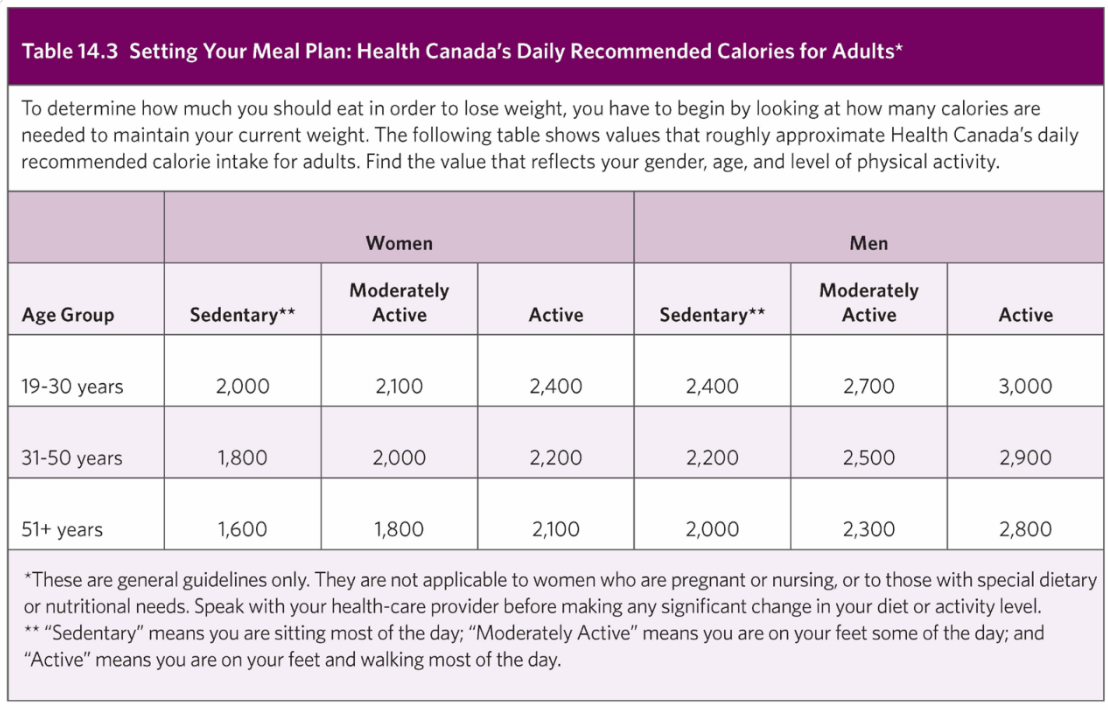
Health Canada’s Daily Recommended Calorie Intake at Varying Activity Levels