Introduction and Phonemes
Basic phonetics will be covered in this course.
- Phonetics is the study of the production and perception of speech sounds.
- Articulatory description of speech sounds using landmarks the vocal tract.
- Transcription using the International Phonetic Alphabet (IPA).
Phonetics provides a basic foundation for other areas of language study.
Phonetics vs. Phonology
Phonetics is the study of speech sounds “in the real world” (i.e., can be measured directly).
Phonetics is the most peripheral and concrete part of language (other parts include pragmatics, semantics, syntax, morphology, phonology).
Phonology is the study of sounds as part of a language system (or “grammar”) in the mind of the speaker and hearer.
Branches of phonetics
Acoustic phonetics: study of the acoustic properties of speech sounds.
Physiological phonetics: study of anatomy and physiology of speech production and perception.
Perceptual phonetics: study of listeners’ psychological response to speech sounds.
Clinical phonetics: study of speech perception or production that differs from norms for the language.
Sounds and spelling
Phonetic transcription is an attempt to record what was said as accurately as possible.
Transcription is subject to perceptual bias on the part of the transcriber.
- Biases include: transcriber’s pronunciation, knowledge of spelling, phonemes in transcriber’s language or dialect.
- In this class, you will train to overcome at least some of these biases.
In English, there are many cases where there is a no difference in sound when there is a difference in spelling, and many cases where there is no difference in spelling but there is a difference in sound.
- Different spellings of the same sound are called allographs (e.g., “ph, gh” and “f”)
- The allograph of a sound consists of one or more letters of graphemes (2-2-1 graphemes in above example).
In order to be able to write a phonetic transcription, you must be able to identify individual speech sounds or phonemes.
Phonetic transcription
The International Phonetic Alphabet (IPA) is a writing system where each symbol represents one speech sound only (in other words, there is only one grapheme for each sound).
- There are no groups of allographs (like in ordinary spelling).
- There are no symbols that have more than one sound associated (like in ordinary spelling).
The IPA was designed for a user to be able to write down the sounds of any language in the world.
To highlight that the IPA is being used, transcriptions of words and sounds are written between slashes (e.g. /fiz/ = “fees”) or brackets (e.g. [fiz]).
- A letter in quotation marks represents English spelling (e.g., “m” vs. /m/).
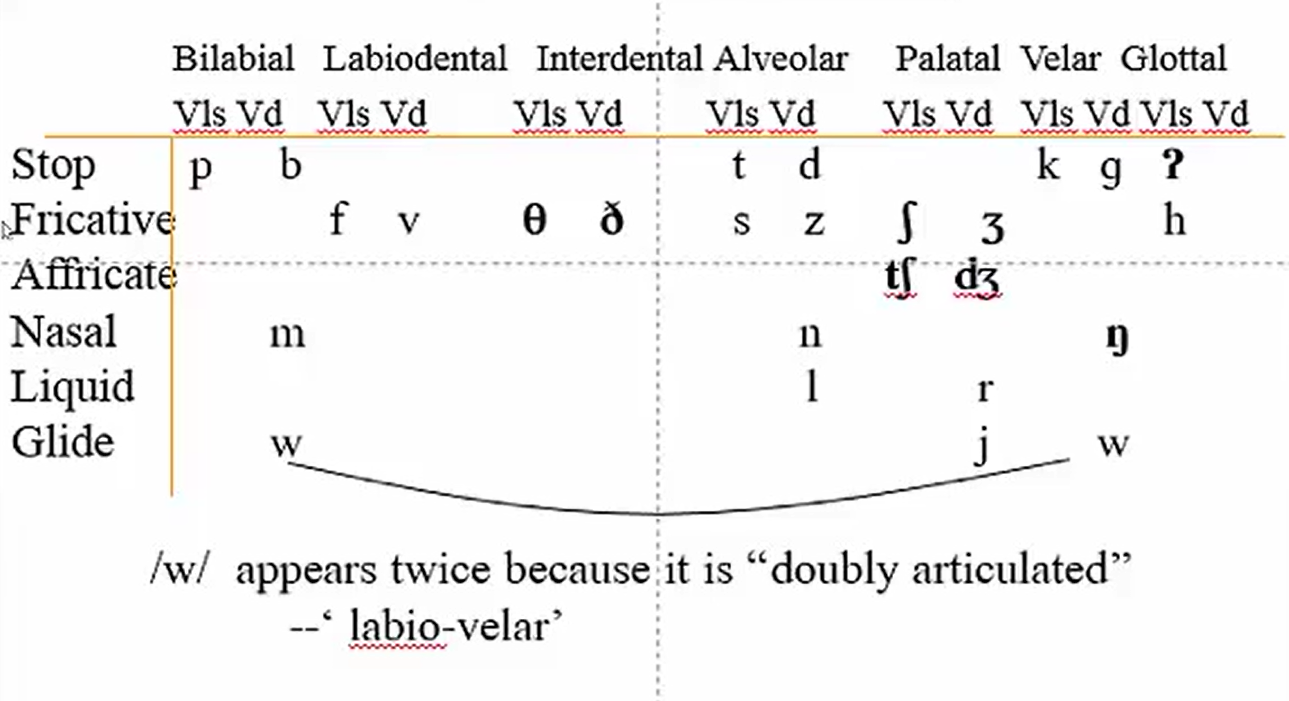
Some of the symbols are familiar from English spelling, mostly the consonants (e.g. /p, b, t, d, k, g, f, v, s, z, h, w, l/); many are new.
If you know Spanish or French, some of the IPA symbols may match spellings of sounds from that language (e.g., /i, e, u, o, a/).
Symbols for many sounds may be new to you, and will require extra effort to learn to make correctly.
It may seem picky but many common mistakes make other IPA sound symbols and could be misunderstood.

When transcribing, normal rules of capitalization and punctuation do not apply.
- No periods, commas, question marks, capital letters, etc..
- Instead, special characters are used to indicate the pauses and emphasis that punctuation is used to signal. But if the person doesn’t produce a pause (or other effect) at a location, then we don’t transcribe it.


Linguistic Description of Words
The spelling and sound of a word can be broken down into smaller pieces.
- The words “cats” has the graphemes c-a-t-s
- The words “cats” has the phonemes /k/, /æ/, /t/, /s/
The distinctive letters that make up a word are called graphemes.
The distinctive sounds that make up a word are called phonemes.
The distinctive “little meaningful bits” that make up a word are called morphemes.
Phonemes, phones, and allophones
A phoneme is a distinctive sound in a language.
Sometimes phonemes can be produced in more than one way, and these different (non-contrastive) variants are called allophones.
Sometimes, the term phone is used to refer to a speech sound when being careful about talking about the physical sound itself (phone) versus the distinctive sound that is part of the phonology of a language (phoneme).

The distinction between phoneme and allophone can be carried into the process of transcription, depending on how precise you need to be.
A phonemic transcription (aka broad transcription) is a rough approximation focusing on the distinctive sound contrasts (uses / /).
A phonetic transcription (aka narrow transcription) is a careful attempt to capture the actual sounds that were produced (uses [ ])
Most transcription in the real world is in between the two.
A phoneme in English has many different parts that you have to know in order to know it:
- What the phoneme sounds like, so that you can recognize it when you hear it (including all its allophones).
- How the phoneme is produced, so you can say the sound (including all its allophones).
- That the phoneme is different from other phonemes, so that you can perceive the differences between the words.
We know that two phones belong to different phonemes if replacing one with the other can make a meaning difference.
A minimal pair is a pair of words that differ by just one phone.
Articulatory Characteristics
Phonemes can be described in general terms using their articulatory characteristics.
- By analyzing phonemes in terms of articulation, we discover important similarities and differences between sounds.
- These similarities and differences group sounds into natural classes (= sets of sounds that share one or more particularity characteristics/features).
Individual consonants and vowels can be distinguished from every other consonant and vowel by the combination of articulatory features used to produce them.

On the exams and in your homework, you will be required to transcribe the monophthong vowels, diphthongs and consonants of English, writing the symbols CORRECTLY and with no missing features in the symbols.
