15_1 The Weimar Republic
The Weimar Republic (1918-1929)
Background
The Weimar Republic was established following the end of World War One, which concluded in November 1918 when Germany surrendered under pressure from the Allies.
The End of World War One
By autumn 1918, it was clear that Germany would lose World War One.
A series of events occurred from November onwards known as the German Revolution.
The Kiel Mutiny
Nov 3, 1918: German sailors mutinied at Kiel naval base.
Sparked widespread rebellions, collapsing the German government.
Kaiser Wilhelm II abdicated on Nov 9.
Friedrich Ebert (SPD) became Chancellor of Germany.
End of World War One - Germany Surrenders
On 11 November 1918, World War One ended with an armistice agreed with the Allies (Britain, France, and the USA), resulting in Germany's surrender.
Elections of 1919
In January 1919, elections gave the SPD party the most power.
Friedrich Ebert, leader of the SPD, became the first democratically chosen President.
Ebert and his party, which won a majority of seats, began drafting a new constitution for Germany.
Meetings were held in the town of Weimar due to safety concerns in Berlin after the Spartacist uprising earlier that month.
Constitution Approval
Despite considerable opposition from many deputies, the new constitution was eventually approved and signed in August 1919.
This government became known as the ‘Weimar Republic’.
Strengths of the Weimar Constitution
A genuine democracy: Elections for parliament and president took place every four years and all Germans over 20 could vote.
The power of Reichstag: The parliament had significant legislative power, contrasting with its impotence under the Kaiser. (The Reichstag had the power to choose the government and make important decisions.)
Bill of Rights: Guaranteed freedoms such as speech and religion.
Weaknesses of the Weimar Constitution
Proportional Representation: Seats in parliament matched party vote percentages, this led to fragmented politics with many small parties, making governance difficult.
Article 48: Allowed the President to bypass the parliament in emergencies, weakening democratic governance.
Many Germans despised the government for signing the November 1918 armistice, calling them 'November criminals', leading to the 'stab-in-the-back' theory that the army was betrayed by politicians.
The Allies forced Germany to sign the punitive Treaty of Versailles on 28 June 1919, which many Germans viewed as excessively harsh, resenting the government for agreeing under the threat of invasion.
Challenges Faced by the Weimar Republic:
→ Spartacist Uprising (January 5-12, 1919): 50,000 Spartacists, led by Luxemburg and Liebknecht, rebelled in Berlin. The government was saved when the Freikorps defeated them.
Aftermath: Communist councils took power, and a Communist government formed in Bavaria. Liebknecht and Luxemburg were killed, and her body was dumped in a canal.
By May 1919, the Freikorps had crushed all uprisings.
→ Kapp Putsch (March 13-17, 1920): Dr. Wolfgang Kapp, a right-wing nationalist, led a Freikorps takeover in Berlin.
The army refused to act, but Berlin workers went on strike, leading to Kapp’s defeat.
Other Violence
Nationalist terrorists assassinated 356 politicians, including Foreign Minister Walter Rathenau (June 1922) and Finance Minister Matthias Erzberger.
Judges, often sympathetic to the Kaiser, gave lighter sentences or released the terrorists entirely.
Hyperinflation Crisis (1923)
Background
The Weimar government's crisis in 1923 began after Germany missed a reparations payment in late 1922, leading to occupation, hyperinflation, and rebellions.
French and Belgian Occupation of the Ruhr
November 1922: Germany missed a reparations payment; France doubted Germany's claim of inability to pay.
France and Belgium occupied the Ruhr in 1923 to seize industrial goods as reparations.
German workers were ordered to resist but were still paid by the government.
French troops killed 132 workers, expelled 150,000 from the Ruhr.
The government printed money to pay wages, causing hyperinflation and political chaos.
Hyperinflation
Germany’s war debt had already caused high inflation.
Passive resistance cut production, deepening the economic crisis.
Printing money to pay workers led to hyperinflation: bread rose from 250 marks in January 1923 to 200 billion by November.
By autumn 1923, wages lost value so fast that workers were paid twice daily.
Hyperinflation Winners
Borrowers: Businessmen, landowners, and those with mortgages could easily repay loans with worthless money.
Wage Earners: People on wages could renegotiate daily, but their pay eventually couldn't keep up with rising prices.
Farmers: Farmers coped well, since their products remained in demand and they received more money for them as prices spiralled.
Hyperinflation Losers
Fixed Incomes: Students, pensioners, and the sick struggled as incomes couldn't keep pace with prices.
Savers and Creditors: Those with savings or loans, like to the government, were the most badly hit as their money became worthless.
Rebellions
The hardships of hyperinflation in 1923 led to uprisings as groups fought for power.
Black Reichswehr: Nationalist group rebellion in September.
Communists: In October, they took over the governments of Saxony and Thuringia.
They also declared the Rhineland independent in the same month.
Nazis: Attempted a putsch in Munich in November.
Gustav Stresemann and Economic Recovery
1923: The Weimar Republic faced a severe crisis with hyperinflation.
August 1923: Stresemann became Chancellor for three months and then continued as Foreign Minister.
1924-1929: Period of stability and economic recovery, with cultural flourishing.
October 1929: Stresemann died just weeks before the Wall Street Crash, ending prosperity.
End of Hyperinflation
Stresemann ended hyperinflation in three months.
Ruhr Strikes: Called off 'passive resistance', allowing production to resume and reducing the need to print money.
Reparations Agreement: Promised to restart reparations payments, ending the Ruhr occupation by 1925.
Rentenmark: Introduced a new currency that stabilized prices and restored confidence.
Government Spending Cuts: Reduced the workforce by 700,000 to lower the budget deficit.
Renegotiating reparations
Autumn 1923: Stresemann's actions gained Allied sympathy, leading to renegotiated reparations.
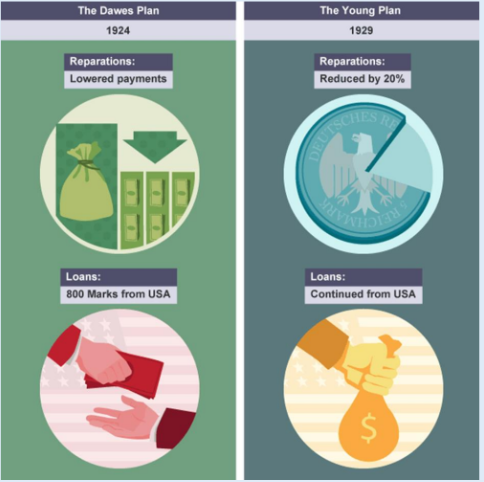
1924 (Dawes Plan) and 1929 (Young Plan): They agreed to renegotiate payments, and this led to two new repayment plans in the next 5 years:
Plan | Date | Reparations to be paid | amount of time in which they would be paid | Loans to Germany |
Dawes Plan | April 1924, Sept 1924 | 50 billion marks (1 billion for 5 years, then 2.5 billion/year) | Indefinite | 800 million marks loan from the USA |
Young Plan | August 1929, Jan 1930 | 20% less, 2 billion/year, with deferment if needed | 59 years, until 1988 | US banks, led by JP Morgan, continued loans |
Did the Weimar Republic economy really recover?
The years 1924-1929 are called Weimar's ‘Golden Years’, but historians debate how much the economy truly recovered from World War One and hyperinflation.
Signs of Recovery vs. Signs of Continued Weakness
Signs of Recovery | Signs of Continued Weakness |
By 1928, industrial production exceeded pre-WWI levels (1913). | Agricultural production remained below pre-war levels. |
Between 1925-1929, exports rose by 40% | Germany spent more on imports than it earned from exports, causing annual losses. |
Hourly wages rose every year from 1924-1929, with a 10% rise in 1928 | Unemployment never fell below 1.3 million, increasing to 1.9 million in 1929 |
IG Farben became Europe's largest industrial company. | German industry became reliant on loans from the USA. |
In 1927, generous pension, health, and unemployment insurance schemes were introduced. | From 1925 onward, the government ran deficits, spending more than it received in taxes. |
International relations
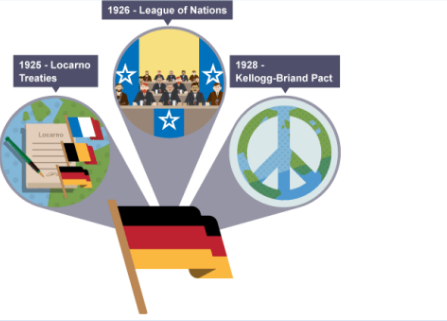
After WWI, Germany was isolated and bitter over the Treaty of Versailles. As Foreign Minister, Stresemann improved relations with Europe from 1925-1928, shown by three key events:
Germany's Acceptance into the International Community: Germany was welcomed into the 1920s international efforts to avoid war, restoring its global standing.
Internal Healing and Stability: The government took action to improve life for citizens and address the wrongs of the Treaty of Versailles, leading to political stability and reduced extremism.
End of Cooperation with the Great Depression: This period of collaboration ended with the Great Depression after the Wall Street Crash of October 1929.
Changes in society, 1924–29
Changes in the standard of living: Wages
Social Security
Government Subsidies
Challenges
Changes in the position of women:
Work
Politics
Politics (Limitations)
Leisure
Category | changes | stayed the same |
standard of living | - Wages rose above inflation. | - Higher unemployment due to growing working-age population. |
women in work | -Women entered factories, offices, and retail. | - Women still faced pressure to return to traditional roles post-WWI. |
Politic (gains) | -Women gained voting rights (1919) and election rights. | - Women’s political participation remained limited. |
Politics (Limitations) | - More women elected to local government (8% in Prussian Landtag). | - Only 4.6% of Reichstag members were women (1933). |
Leisure (Free time) | - The ‘New Woman’ lifestyle emerged (similar to ‘Flapper’). | - Many women still held traditional leisure roles, reflecting old and new. |
Conclusion
The Weimar Republic, marked by instability and conflict during its early years, managed to achieve a period of recovery and cultural flourishing by the late 1920s, largely facilitated by leaders like Gustav Stresemann. However, underlying challenges and societal tensions persisted, paving the way for future upheavals.