Chp 1 Body Cavities
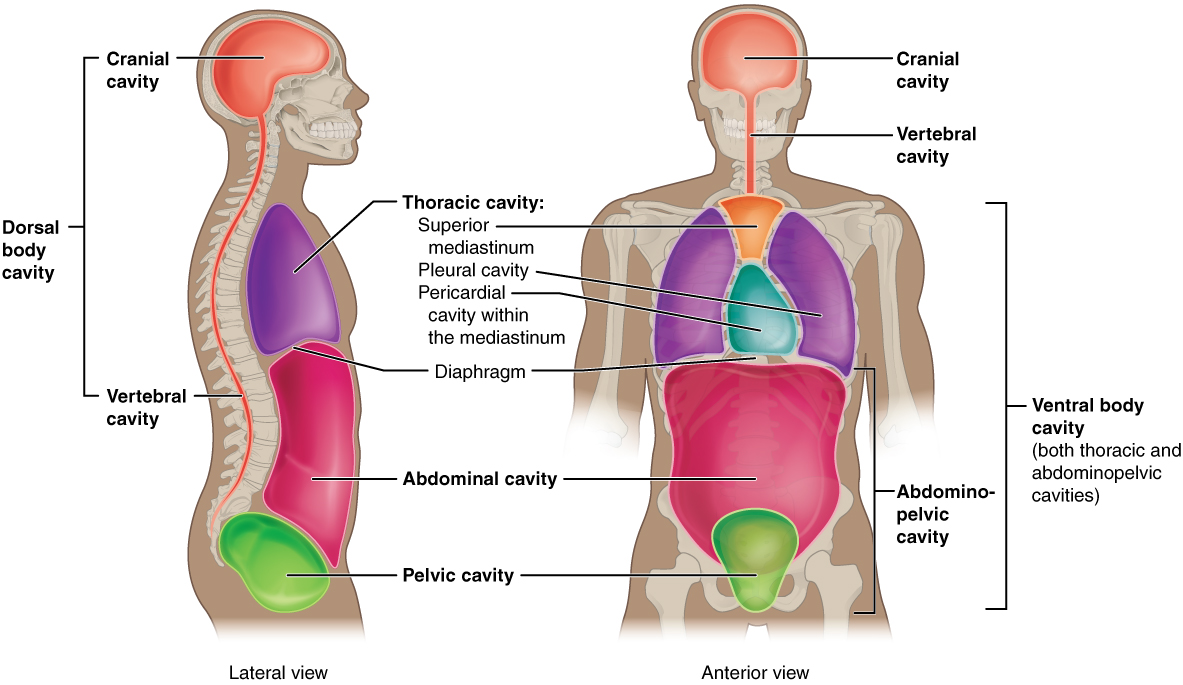
Body cavities are spaces within the body that help protect, separate, and support internal organs. They are classified into two main groups: Dorsal and Ventral.
1. Dorsal Cavity
This cavity is located on the posterior (back) side of the body and encloses the central nervous system. It is subdivided into two continuous parts:
1.1 Cranial Cavity
Key Points: Formed by the cranial bones and houses the brain.
Included Parts: Brain, meninges (protective membranes), cerebrospinal fluid.
1.2 Spinal (Vertebral) Cavity
Key Points: Formed by the vertebrae and extends from the cranial cavity down the vertebral column. It contains the spinal cord.
Included Parts: Spinal cord, meninges, cerebrospinal fluid, roots of spinal nerves.
2. Ventral Cavity
This cavity is located on the anterior (front) side of the body and is much larger than the dorsal cavity. It houses the internal organs (viscera) and is separated by the diaphragm into two main subdivisions:
2.1 Thoracic Cavity
Key Points: Superior portion of the ventral cavity, superior to the diaphragm, and encased by the ribs, sternum, and vertebral column. It contains the heart and lungs.
It is subdivided:
Pleural Cavities (2): Each surrounds a lung.
Right Pleural Cavity
Left Pleural Cavity
Included Parts: Lungs.
Mediastinum: Central compartment between the two pleural cavities.
Included Parts:
Esophagus, Trachea, and major blood vessels. Other components include: Heart, great vessels (aorta, vena cavae, pulmonary arteries/veins), thymus gland, lymph nodes.
Mediastinum also contains the:
Pericardial Cavity: Located within the mediastinum, surrounds the heart.
Included Parts: Heart.
2.2 Abdominopelvic Cavity
Key Points: Inferior portion of the ventral cavity, inferior to the diaphragm. It is not separated by a physical barrier between the abdominal and pelvic regions, but rather defined by anatomical landmarks. It contains organs of the digestive, urinary, and reproductive systems.
It is further subdivided:
Abdominal Cavity: Superior portion of the abdominopelvic cavity.
Included Parts: Stomach, spleen, liver, gallbladder, pancreas, small intestine, most of the large intestine, kidneys, adrenal glands.
Pelvic Cavity: Inferior portion of the abdominopelvic cavity, enclosed by the bones of the pelvis.
Included Parts: Urinary bladder, reproductive organs (uterus, ovaries, prostate), distal part of the large intestine (rectum), appendix.