Complete Guide to Digital SAT Reading and Writing
The Framework of the Digital SAT Reading and Writing Section
The Digital SAT (dSAT) represents a significant shift from the legacy paper test. The Reading and Writing sections are now combined into two distinct modules. Each module contains short passages (25–150 words) related to a single question. This study guide breaks down the four core content domains evaluated by the College Board.
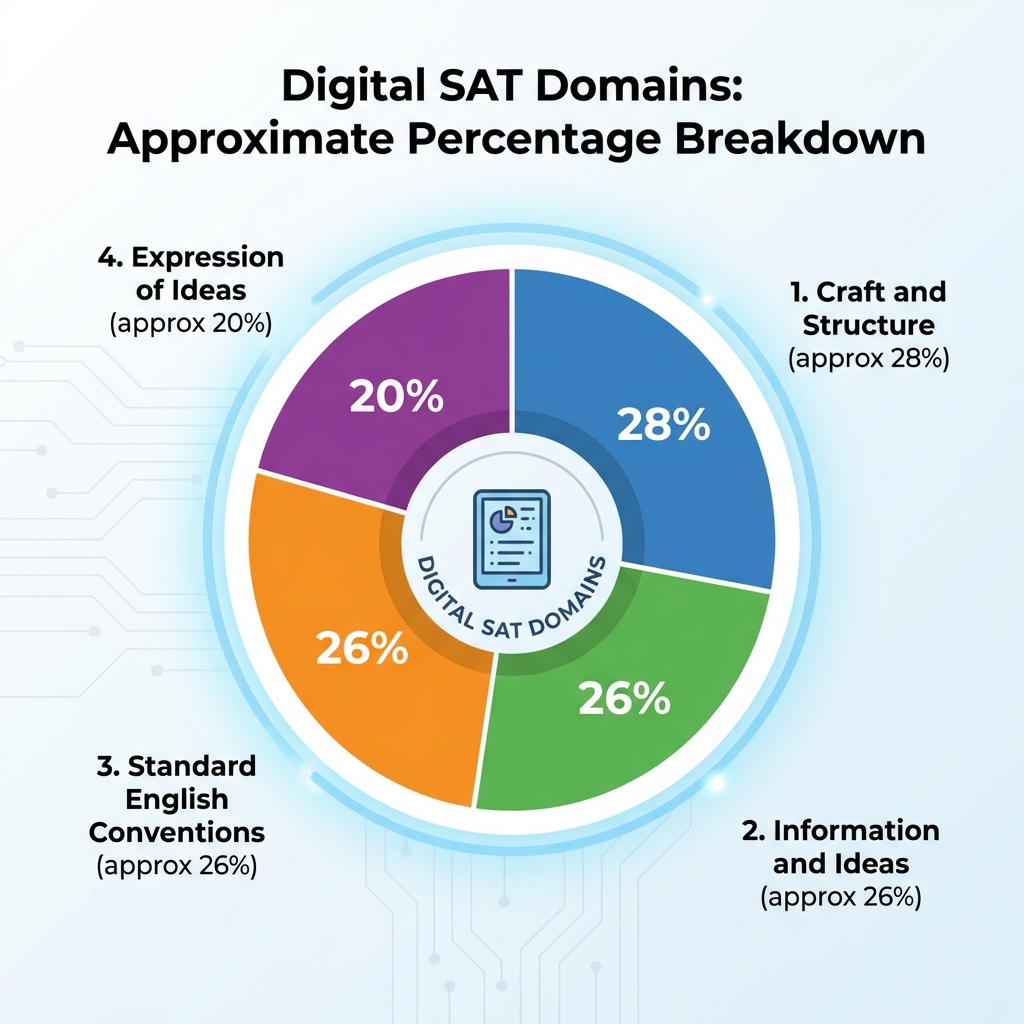
Domain 1: Craft and Structure
This domain tests your ability to understand high-utility words and phrases in context, evaluate text structure, and make connections between two related texts.
Words in Context
These questions ask you to select the most precise word or phrase to complete a blank in a passage. Unlike old vocabulary tests that required memorizing obscure words, the dSAT focuses on contextual nuance.
Strategy: The "Blank-Checking" Method
- Ignore the choices initially. Covering the answers prevents confirmation bias.
- Identify the "Pivot": Find the word or phrase in the text that dictates the meaning of the blank (e.g., words like but, however, consequently indicate contrast or cause).
- Generate a prediction: Fill in the blank with your own simple word.
- Match: Find the choice closest to your prediction.
Common Trap:
- Secondary Meanings: The SAT often uses common words in uncommon ways (e.g., "doctor" meaning to alter evidence, not treat a patient).
- Tone Mismatch: A choice might have the correct definition but the wrong connotation (e.g., using a slang term in a formal scientific text).
Text Structure and Purpose
These questions ask either what the purpose of the text is (why the author wrote it) or how the text is structured (how the argument flows).
- Purpose: Look for the main verb. Is the author trying to criticize, explain, compare, or advocate?
- Structure: Look for the shift. Does the text move from a specific example to a general generalization ($Specific \rightarrow General$) or from a hypothesis to a concession ($Hypothesis \rightarrow Counterpoint$)?
Cross-Text Connections
You will be presented with two short texts (Text 1 and Text 2) on the same topic. You will usually be asked how the author of Text 2 would respond to Text 1, or to identify a point of agreement/disagreement.
The Logic of Comparison:
Let $A$ be the argument of Text 1 and $B$ be the argument of Text 2.
- If the question asks for disagreement, look for $\neg A$ (NOT A) in the choices.
- Always adhere to Strict Scope: If Text 1 discusses "French painters in the 19th century," an answer choice discussing "European artists generally" is likely incorrect due to being too broad.
Domain 2: Information and Ideas
This domain focuses on your ability to locate, interpret, evaluate, and integrate information and ideas from texts and infographics.
Central Ideas and Details
- Central Idea: The "Big Picture." What is the main thesis? These answers are usually abstract and summarize the entire passage.
- Details: Specific facts. These questions are literal; the answer is explicitly stated in the text, often using synonyms.
Command of Evidence: Textual
These questions often present a hypothesis or a literary claim and ask which quotation or detail would best support or weaken it.
Execution Steps:
- Identify the Claim: Underline the specific argument needing support.
- Isolate the Variable: What specific element must be proven? (e.g., If the claim is "The poet uses nature imagery to depict sadness," you must find a quote containing both nature and sadness.)
- Eliminate Irrelevance: Most wrong answers support a different claim made in the passage, not the specific one asked about.
Command of Evidence: Quantitative
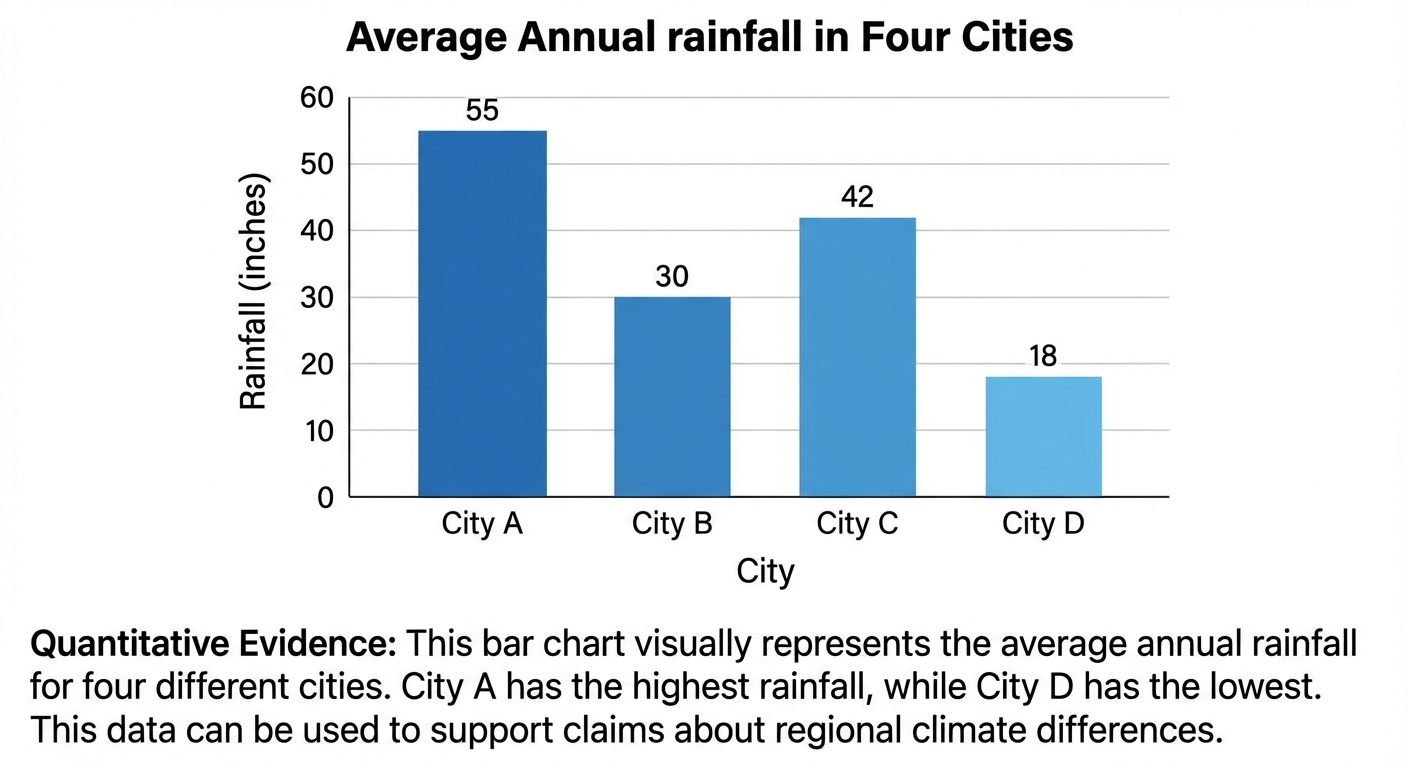
You will be analyzing a graph, table, or chart accompanied by a short text. You must interpret the data to complete a sentence.
Key Principles:
- Read the Axes and Legends: Never skip the label units (e.g., "in thousands," "percent change").
- Verify the Datum: The correct answer often simply translates a visual data point into text (e.g., "The bar for 2015 is higher than 2014").
- Connect to the Text: The data choice must support the argument in the paragraph. If the paragraph argues that "populations declined," select the data point showing a decrease.
Inferences
Inference questions on the SAT are not like literature class inferences. You are not "reading between the lines" to guess feelings. You are completing a logical syllogism.
The Formula:
Premise A + Premise B \rightarrow Conclusion
- Premise A: Species X typically lives in warm climates.
- Premise B: A fossil of Species X was found in Antarctica.
- Inference: Antarctica must have once had a warm climate.
Common Mistakes in Inference:
- Speculation: Going beyond the strict logical consequence.
- Extreme Language: Avoid words like always, never, or impossible unless the text supports them explicitly.
Domain 3: Standard English Conventions
This domain tests grammar, usage, and punctuation. These are rule-based questions. Relying on "what sounds right" is a trap; relies on the rules of Standard American English.
Sentence Boundaries and Punctuation
To master punctuation, you must distinguish between an Independent Clause (IC) (a complete sentence) and a Dependent Clause (DC) (an incomplete thought).
1. The Period and Semicolon
Grammatically, a period (.) and a semicolon (;) are identical on the SAT. They both separate two independent clauses.
- Rule: $IC + \textbf{;} + IC$
- Tip: If two answer choices are identical except one uses a period and the other a semicolon, both are wrong.
2. The Colon
A colon (:) introduces a list, an explanation, or an elaboration.
- Rule: $IC + \textbf{:} + \text{Anything (word, list, phrase, or clause)}$
- Condition: The part before the colon must be a complete sentence. The part after explains the part before.
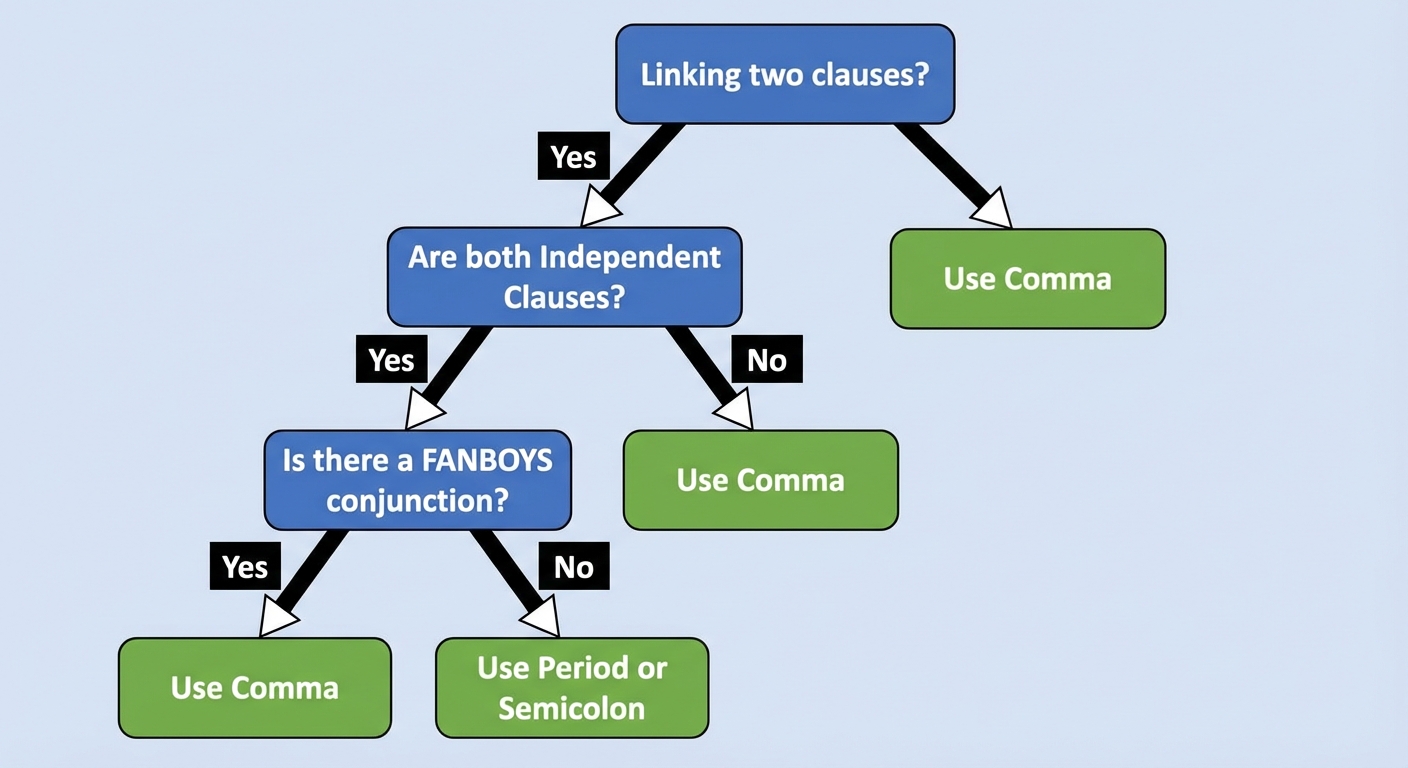
3. The Comma
Commas have specific use cases:
- Lister: $A, B, \text{ and } C$.
- Separator: $DC, IC$ (Introduction strategy).
- FANBOYS: $IC, + \text{ (for, and, nor, but, or, yet, so) } + IC$.
- Parenthetical: separating non-essential information defined by appositives.
Form, Structure, and Sense
Subject-Verb Agreement
Singular subjects take singular verbs; plural subjects take plural verbs.
- Trick: The SAT puts "junk" between the subject and verb to confuse you.
- Example: "The box [of old dusty photographs] sits on the floor." (Ignore the prepositional phrase).
Verb Tense
Keep tenses consistent within the time frame of the narrative.
- Historical Present: Discussions of literature or art usually take the present tense (e.g., "In the novel, the protagonist travels…").
Pronoun-Antecedent Agreement
Pronouns must match the noun they replace.
- Ambiguity: If a pronoun like "it" or "they" is unclear, the correct answer is often the specific noun itself.
- Entity Rule: Companies, teams, and groups are singular "it," not plural "they." (e.g., "Apple released its new phone," not "their new phone").
Domain 4: Expression of Ideas
These questions focus on the rhetorical impact of writing, specifically Transitions and Rhetorical Synthesis.
Transitions
Transition words act as bridges between ideas. To solve these, you must analyze the relationship between the sentence before the transition and the sentence after.
The Three Logical Categories:
- Continuation/Similarity ($A + A$): The second sentence agrees with or adds to the first.
- Keywords: Additionally, Furthermore, Moreover, Likewise, Indeed.
- Contrast/Reversal ($A \rightarrow \neg A$): The second sentence disagrees or presents an exception.
- Keywords: However, Nevertheless, Conversely, Despite this, On the other hand.
- Causation/Result ($A \rightarrow B$): The second sentence is a result of the first.
- Keywords: Therefore, Thus, Consequently, As a result, Accordingly.
Technique:
Read the two sentences without the transition word. Determine the relationship solely based on meaning. Then select the word that matches that relationship.
Rhetorical Synthesis (Note-Taking Questions)
You are provided with a list of bulleted notes and a specific goal (e.g., "The student wants to emphasize the difference between two painting styles").
Strategy:
- Read the Prompt Question First: Identify the specific goal. Do not read the bullet points first.
- Filter: Look for the answer choice that explicitly fulfills the goal.
- If the goal is to "introduce a specific work," the answer must name the work.
- If the goal is to "compare," the answer must mention both items and a distinction.
- Ignore Grammar: These choices are usually all grammatically correct. The test is strictly about relevance.
Common Mistakes & Pitfalls
1. The "Recall" Error
Students often rely on outside knowledge rather than the text.
- Rule: If it isn't in the passage, it doesn't exist. Even if a statement is historically true (e.g., "George Washington was the first US president"), if the passage focuses on his farming habits, the political statement is relevantly incorrect.
2. The "Half-Right" Trap
In Reading questions, the College Board loves answers where the first half is perfect, but the last word is wrong.
- Rule: If any part of an answer choice is false, the entire choice is false. Be skeptical of adjectives.
3. Misidentifying Clause Types
Confusing a generic noun phrase for a clause leads to punctuation errors.
- Incorrect: "The study was comprehensive; covering all aspects."
- Why: "Covering all aspects" is a phrase, not an independent clause. You cannot use a semicolon.
- Correction: "The study was comprehensive, covering all aspects."
4. Ignoring "Dangling Modifiers"
When a sentence starts with a descriptive phrase followed by a comma, the subject immediately after the comma must be the thing being described.
- Wrong: "Walking down the street, the trees looked beautiful."
- Why: The trees were not walking down the street.
- Right: "Walking down the street, I thought the trees looked beautiful."
Mnemonics for Review
| Acronym | Stands For | Usage |
|---|---|---|
| FANBOYS | For, And, Nor, But, Or, Yet, So | Coordinating conjunctions that connect two independent clauses when preceded by a comma. |
| THAMOS | Therefore, However, Also, Meanwhile, Otherwise, Subsequently | Conjunctive adverbs. These usually require a semicolon before them and a comma after if connecting clauses ($IC; \text{ however, } IC$). |
| POE | Process Of Elimination | It is easier to find 3 wrong answers than 1 right one. Always cross out known errors. |