The Water Cycle
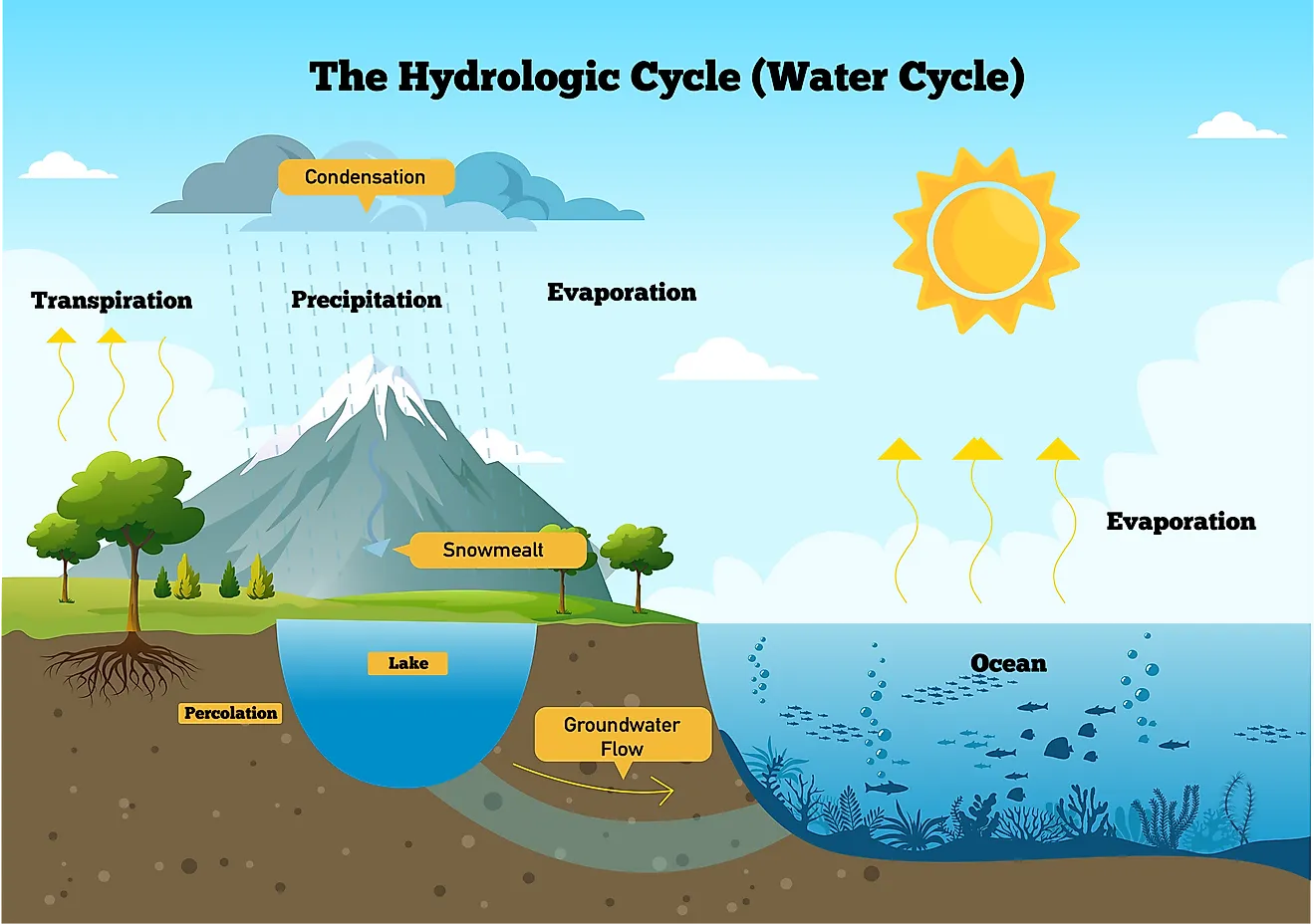
The water cycle, also known as the hydrological cycle, is the continuous movement of water on, above, and below the surface of the Earth. It involves various processes that ensure the constant recycling and redistribution of water across different reservoirs such as the atmosphere, oceans, rivers, lakes, and underground water stores. Here’s a detailed breakdown of the key processes:
1. Evaporation
Definition: The process where water changes from a liquid state to a gas (water vapor) due to heat.
How it works: Water from oceans, lakes, rivers, and other bodies of water is heated by the sun. As the temperature rises, water molecules gain energy and break free into the atmosphere as water vapor.
Types of Evaporation:
Evaporation from oceans and lakes: Major source of water vapor.
Transpiration: The release of water vapor from plants and trees. This is often combined with evaporation and referred to as evapotranspiration.
2. Condensation
Definition: The process where water vapor cools and changes back into liquid water or ice.
How it works: As water vapor rises into the atmosphere, it cools and condenses to form water droplets. This is the process that leads to the formation of clouds.
Cloud formation: Tiny water droplets or ice crystals come together around small particles (like dust) in the atmosphere to form clouds.
3. Precipitation
Definition: The process where condensed water in clouds falls back to Earth due to gravity.
Types of precipitation:
Rain: Liquid water droplets that fall when the air temperature is above freezing.
Snow: Frozen water crystals that fall when temperatures are below freezing.
Sleet: Small pellets of ice that form when rain freezes before hitting the ground.
Hail: Larger balls of ice that form in strong thunderstorms with updrafts.
Drizzle: Very fine, light rain.
4. Infiltration
Definition: The process by which water soaks into the ground.
How it works: When precipitation occurs, some of the water infiltrates into the soil, replenishing groundwater supplies. The rate of infiltration depends on the type of soil, vegetation, and whether the ground is already saturated.
Groundwater recharge: This water becomes part of the underground water supply, which can feed wells, springs, and other groundwater sources.
5. Runoff
Definition: The movement of water over the ground surface towards bodies of water like rivers, lakes, and oceans.
How it works: After precipitation, water that doesn’t infiltrate the soil flows over the land, carrying with it soil, nutrients, and pollutants. Runoff plays a major role in transporting water to larger bodies like rivers and oceans.
Factors influencing runoff:
Slope of the land: Steeper slopes increase runoff.
Vegetation cover: Dense vegetation reduces runoff by allowing water to be absorbed.
Soil type: Impermeable soils increase runoff as they prevent water infiltration.
Urbanization: Concrete and asphalt surfaces increase runoff by not allowing water to soak in.
6. Collection (Storage)
Definition: Water that collects in large bodies of water such as oceans, lakes, rivers, or underground reservoirs.
How it works: Water from precipitation, runoff, and groundwater flows into various storage areas.
Oceans: The largest reservoir of water on Earth, holding about 97% of Earth's water.
Lakes and Rivers: Temporary storage before water is either evaporated or flows back into the ocean.
Groundwater: Water stored in underground aquifers, replenished by infiltration.
7. Groundwater Flow
Definition: The movement of water through the soil and rock layers below the Earth's surface.
How it works: Water infiltrates into the ground and moves through the pores of soil or cracks in rock layers, eventually emerging at the surface in the form of springs or feeding into rivers.
8. Transpiration
Definition: The process by which plants release water vapor into the atmosphere from their leaves.
How it works: Plants absorb water through their roots and release it as vapor through tiny pores called stomata on the leaves. This is a vital part of the water cycle, as it accounts for a significant portion of the water vapor in the atmosphere.
Key Points about the Water Cycle:
Continuous Cycle: The water cycle is a never-ending process where water is constantly being recycled.
Energy Source: The sun is the primary energy source that drives the water cycle through evaporation and heating.
Climate Influence: Climate, temperature, and geographical location can significantly influence the rate of processes like evaporation, precipitation, and runoff.
Human Impact: Human activities such as deforestation, urbanization, and agriculture can impact the water cycle by altering runoff patterns, reducing transpiration, or affecting infiltration rates.
Summary:
The water cycle is essential for maintaining the balance of Earth's ecosystems. It involves the processes of evaporation, condensation, precipitation, infiltration, runoff, collection, and groundwater flow, with the sun providing the energy to drive these processes. Each stage of the cycle is interlinked, and together they ensure water is distributed across the planet.