5.6: Observational Learning; Imitating the Actions of Others
Observational learning: learning that occurs through observing the actions of others
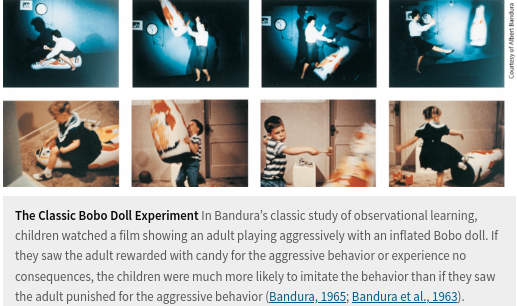
Psychologist Albert Bandura showed that obsverational learning involves active cognitive processes, not mere “mechanical copying”
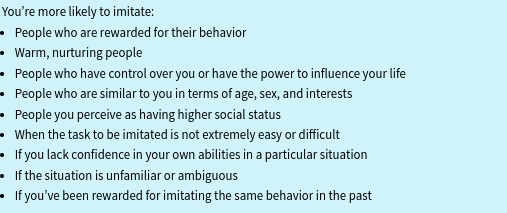
Bandura suggests that 4 cognitive processes interact to determine whether imitation will occur:
1.) You must pay attention to the other persons behavior
2.) You must remember the other persons behavior so that you can perform it at a later time
3.) You must transform this mental representation into actions that you are capable of reproducing
4.) There must be some motivation for you to imitate the behavior
Mirror Neurons and Observational Learning
Rizzolatti discovered mirror neurons
Mirror Neurons: brain cells that become activated both when individuals perform a motor act and when they observe the same motor act done by another individual
They suggest that our brains have a built-in capacity for imitation, a capacity that is the foundation for many critically importane social behaviors like empathy
Researchers believe that we acquired this ability for empathy through the mirror neuron system as a result of evolution
Applications of Observational Learning
An important implication of Bandura’s research is the relationship between media images of violence and behavior
Does Violent Media Cause Violent Behavior?
Some psychologists concluded that ‘exposure to violent media increases aggression and violence” but others are more cautious in their conclusions
Psychologists on both sides of the debate agree on one important point: violent behavior is a complex phenomenon that is unlikely to have a single cause