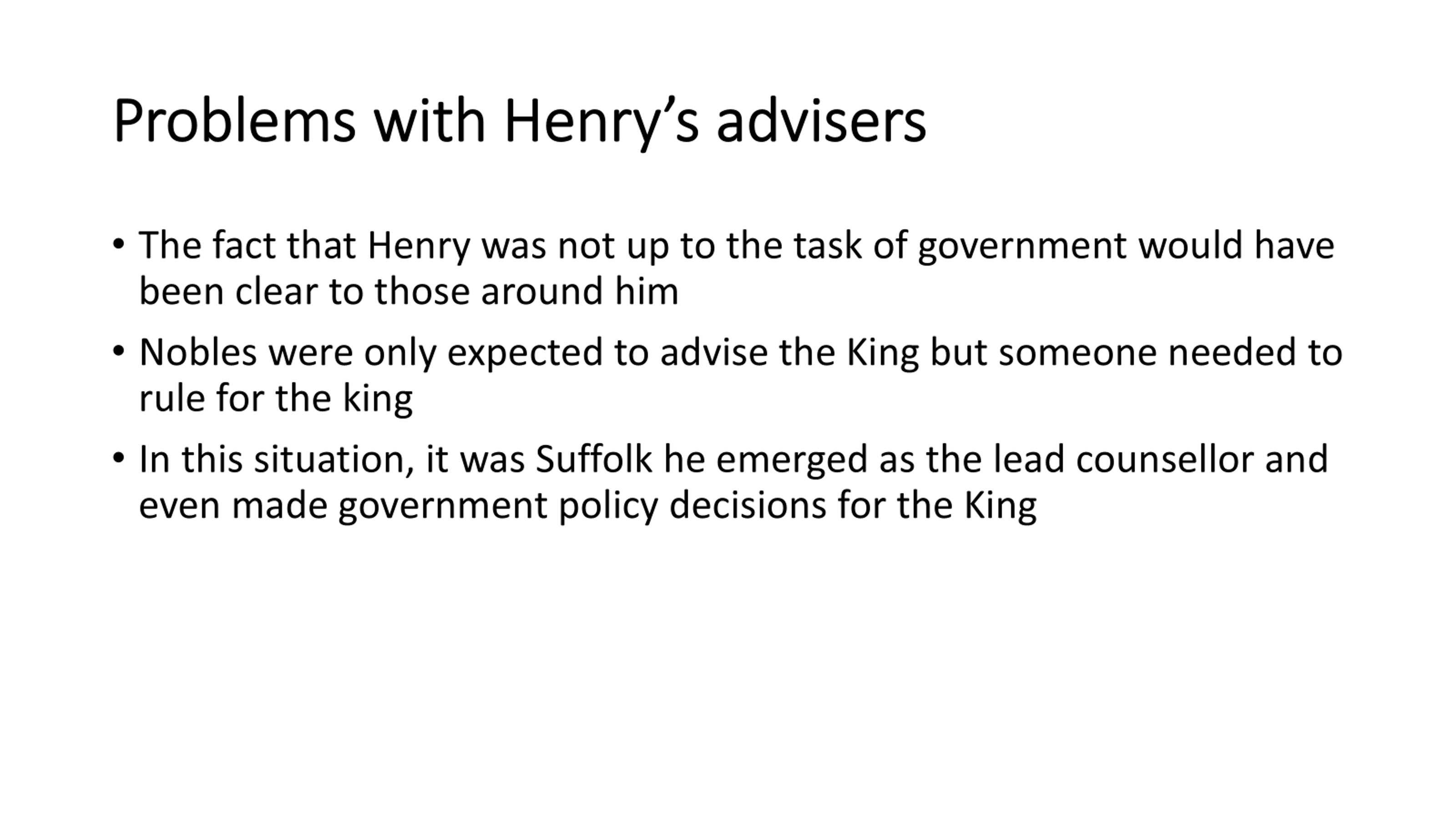
6 what problems did henrys advisors cause
Can you remember the key facts about the Duke of Suffolk?
What was the 1st Duke of Suffolk's name?
In what year was he born?
When was he executed?
Was he related to Henry VI?
Which famous rebellion did he fuel?
Whose marriage did he negotiate?
Why was he accused of treason?
TASK:
WORK IN PAIRS
One of you should find evidence that Suffolk 'personified the evil council'
The other should find evidence that he was 'doing his best to keep government together'
Gather evidence in the table below. Your job is to persuade your partner that your viewpoint of Suffolk is correct.
Suffolk 'personified the evil council' | Suffolk was 'doing his best to keep government together' |
|
|
Overall – What problems did Henry VI's advisers cause? (Around 200 words)
Henry VIs advisers took advantage of the fact that the king was very passive and influenceable, and used this to persuade him into spreading their own agenda and changing laws to benefit them and not the people or the country. Some attempted to manipulate the king to the extent that they were essentially in charge and running the country in his place, in everything but name. An example of this would be Suffolk, as he used this influence to help himself, leading to conflicts like Cade's rebellion and also caused major losses of land and men in France, as well as having major influence over the loss of Maine. This lead to the king getting a lot of blame for these things and getting a reputation as a poor king, until Suffolk was exiled for: Financial corruption, corrupting the legal system, misgovernment and encouraging the king of France to wage war on England. He was then killed on the way when his ship was intercepted, but Henry VI still got the blame as he was considered a poor king for choosing advisors with negative influence and for allowing them to have so much power over him and letting them manipulate him for their own corrupt purpose. This lead to Henry VI becoming less popular and his advisors becoming less trusted and losing power and popularity with the British people.