Economics
Microeconomics
General
Actions of buyers and sellers = prices of goods (markets)
Supply and Demand
Perfectly Competitive Market
Market: all the buyers and sellers of a particular product or service
often informal (ex. local gas stations)
Perfectly Competitive: when the good or service sold is highly standardized, has a large market, and participants are well informed of the price
buyers and sellers can buy and sell as they wish without influencing the market price
real world markets are characterized by degree of competition and in terms of the perfectly competitive model
Demand: from buyers
Law of Demand: inverse relationship between price and demand
Demand Schedule: table depicting price and demand relationship
Demand Curve: slope for quantity demanded and price
Quantity Demanded (point on curve)
Demand (entire curve)
Y-Axis: Price
X-Axis: Demand
Market Demand: add up quantity that every consumer may purchase at each possible price (ex. Market = sum of quantity of Nora and Steve)
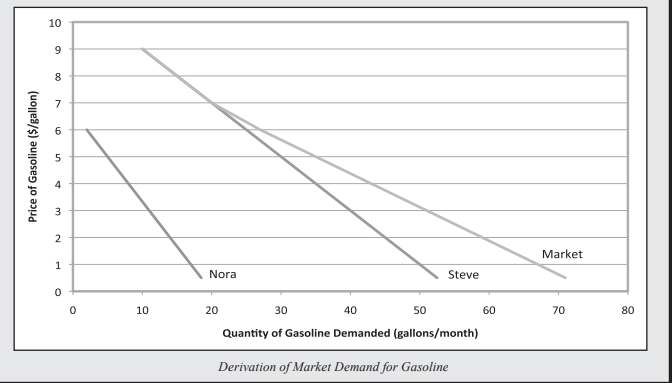
Shifts in Demand Curve
Normal Goods: demand is positively correlated with income
Irregular Goods: demand is negatively correlating with income (ex. bus tickets)
Substitutes: goods whose price decline caused lowered demand for other goods
Complements: goods whose price decline caused raised demand for other goods (ex. insurance and cars)
Tastes
Expectations: personal changes (ex. employment status)
Number of Buyers
Supply: from sellers
Law of Supply: direct relationship between price and quantity supplied
Shifts in Supply Curve
Input Prices: things supplies must purchase to supply a product (ex. labor costs)
Technology
Expectations
Number of Sellers: positive correlation between sellers and supplies
Profit-Maxxing: increase supply until marginal costs = marginal revenue
Equilibrium: when no participant in a market has reason to change their behavior
Where the market supply and demand curves intersect (1 point)
When market has natural tendency towards this combo of price and quantity
Competitive Markets gravitate towards equilibrium
Competitive Market Equilibrium Characteristics
Allocating Goods: deciding amount of supply
Consumer Surplus: the amount extra to what a consumer was planning to pay compared to the amount paid (ex. planning to pay $20 but only needed to pay $10. consumer surplus = $10
Total Area below Demand Curve
Producer Surplus
Total Surplus: all Consumer and Producer surpluses sum
Max Total surplus = satisfy Pareto efficiency (best for everyone)
Elasticity
Graph: flatter curve = higher elasticity
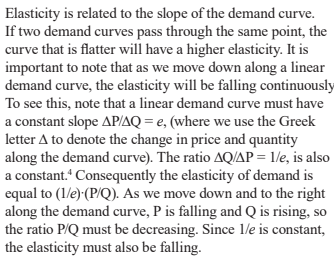
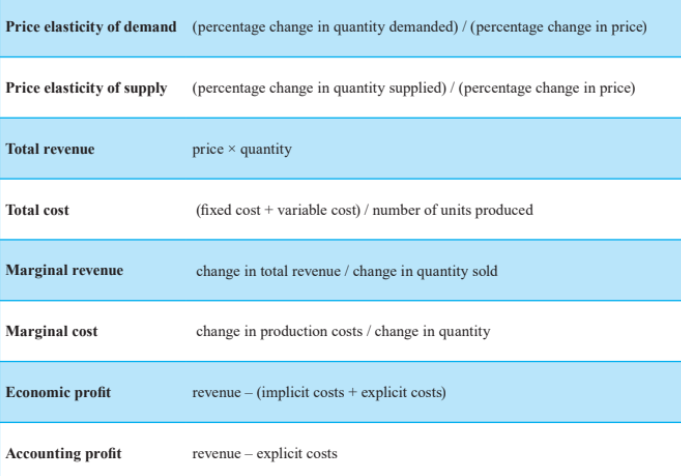
Price Elasticity of Demand = Percent change in quantity demanded / Percent change in price
How responsive consumers are to changes of price of a good
Elastic = positive change with increased price
Influences: Substitutes, Necessities, Market Definition, Time
Price Elasticity of Supply = Percent change in quantity supplied / Percent change in price
Influences: Ease, Resource Amount, Time
Using
Total Revenue = Price x Quantity
Government Policy
Price Controls: min wage, social changes (ex. setting all of __ to same price = competition + offset certain classes)
Taxes:
International Trade
Adding Opportunity to Trade
Absolute Advantage: when one is able to produce more amount of a good even compared to others with the same resources
Comparative Advantage
less lost/traded off = more comparative advantage
Isolated Economy
Production Possibility Frontier
trade-off relationship where x person’s work dictates/is proportional to x person’s rewards or is dependent on person x
Finding Firm’s Supply Curve
Fixed Cost: cannot be changed in short run
Variable Costs: can be
Marginal Cost: increases in cost due to producing additional output
Diminishing returns to scale: diminishing changeable factors due to limited, fixed factors (ex. number of workers vs number of machinery)
Marginal Revenue: increase in revenue due to producing additional output
Able to diminishing returns to scale, marginal costs will increase with output, and the supply curve will slope upwards
Entry, Exit, and Market Supply Curve
0 economic profits to business owners in a competitive market, but they earn opportunity wage ( they’re content, this is optimal)
prices help 1) ration scarce goods 2) allocate productive resources to difference activities (if price exceeds production cost- —> positive economic profit —> produce more with resources
graph: something pg 43
Imperfect Competition
markets with few suppliers
same objective as perfect: maximize profits
difference: amount supplied may affect price, demand curve is downward (supply up, price down)
market power: ability to control prices almost directly
Monopoly: single supplier
barriers of entry: prevents competitors
ownership of key resource
government-created: copyright or patent = exclusive rights
natural: a firm can sell at lower prices (large fixed prices, ex. railroads)
supply
profit-maxxing: same, increase supply as long as marginal revenue > marginal cost
inverse relationship between price and demand
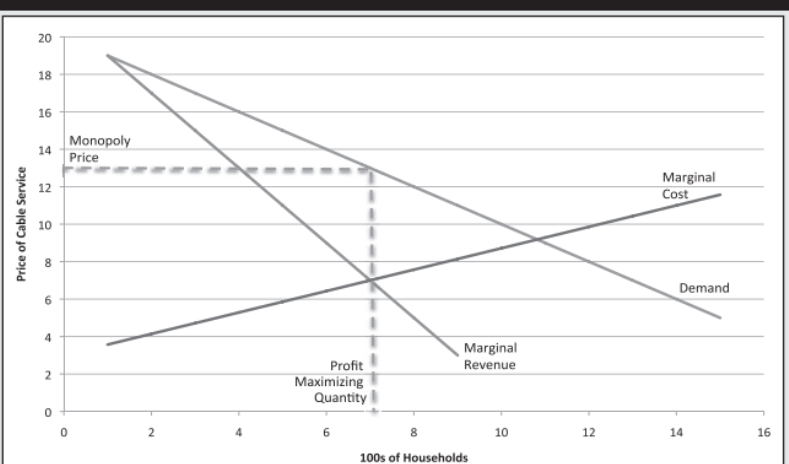
welfare consequences
consumer surplus
less social well-being
can sell at higher price w/o worry
dealing
Sherman Anti-Trust Act 1890: fed govt legislation increases market competition (reviews/removes competition-decreasers)
Regulation
Public ownership
perfect price discrimination
charging customers different prices = to the value they place on said service
offer price packages, price difference for age groups…
increase monopoly profits, social-welfare, fit perfect market demand curve
Oligopoly: few suppliers
challenge: must strongly consider other suppliers’ prices
cartel: suppliers agreement to cooperate (max profits, act like monopolist)
illegal in US
problem: marginal revenue up —> increase production —> value down
Monopolistic Competition
where firms produce similar but different products (ex. publishing books)
downard-demand curve
same-profit maxxing as monopoly
one firm profits well —> more competition comes —> firm profit decrease
no barriers of entry
may increase until profit = 0; lack of product identity
Profit Motive and Sources of Economic Change
Entrepreneurs: establish new products, services, or markets
Creative Destruction: by Joseph Schumpeter, opportunity to earn economic profits made by entrepreneurs as they invent unique innovations (ex. tech)
Market Failures
when markets fail to produce socially desirable outcomes
2 types:
Lack of Private Property rights: become public goods
Externiality:
when an unpaid action of one party affects another party in an unpaid way
Ex. concerts & hotels, beekeepers & apple farmers, neighbor house value
Effect on Resource Allocation: optimizing/considering external cost allows the market equilibrium between price and quantity be higher
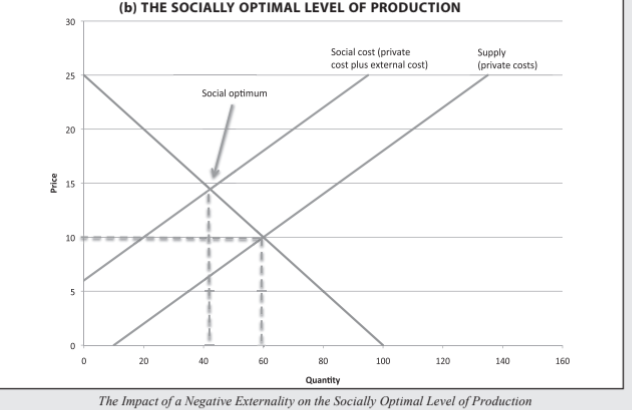
create incentives for industries to solve their problems
Agreement between industries that externally affect each other to share profits
Internalizing activities (ex. Netflix making its own shows)
Coase Theorem
Problems:
poorly defined property rights
Government Regulation
taxing to prevent negative externialities; best when externiality value can be estimated
quota: limit production
Coase Theorem
Ronald Coase: as long as involved parties can negotiate w/ each other, the private market should be able to resolve externiality problems
Property Rights
private property, etc.
externialities better managed when community decides on what to do collectively
Effects of Private Ownership
Tragedy of Commons: when nobody takes account for negative externialities (caused by overuse) of something owned by multiple people
Public and Private Goods
Rivalry in Consumption
Rival Good: a good that is to be competed for (ex. fixed # of pizza slices between your friends)
Degree of Excludability
ability to control who consumes this good
Non-excludable good (ex. national defense, firework display)
Private Goods: high degree of rivalry, consumption, and excludability (ex.haircuts, gasoline, food)
Common Resources: high rivalry and consumption, low excludability
no one really owns, source of externialities
public policy and taxes can help regulate
Collective Goods: low rivalry, high excludability
easy for monopoly to price too high and sell too little, government regulation may be needed
ex. pay-to-watch TV
Public Goods: low rivalry and excludability
Institutions, Organizations, and Govt
Institutions: formal and informal rules on human interaction
Cooperation of individuals is important
Government
Ability to tax citizens
Legal monopoly on use of force
Broader range support
Pork Barrel Politics
proclivity of elected officials to introduce projects that give money to communities
Logrolling: legislators trade voters so that their projects can be supported by other legislator (gets voted for)
Rent-seeking
socially unproductive activities that seek to direct economic benefits to one set of actors rather than another
bribing government official (over policy/regulation)
Proper Role of Government: not essential force that helps support broader range of transactions
Formulas
Macroeconomics
national economics
Macroeconomics Issues
Economic Growth and Living Standards
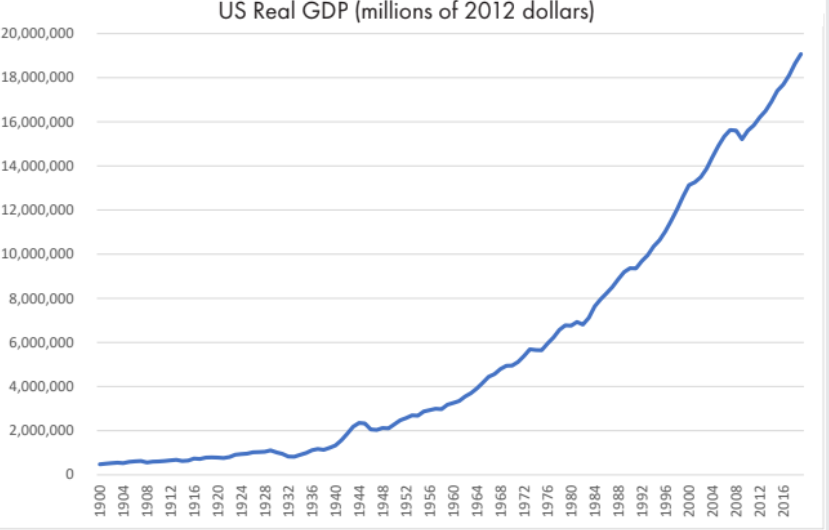
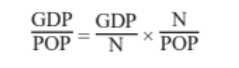
GDP: Output per capita
provides indication for what a typical person consume
Output/number of workers employed = average labor productivity
Recessions and Expansions
Expansion: a period from an economic trough to peak
Recession: a period from a economic peak to trough
Depression: severe recession
Business Cycle: alternating periods between expansion and recessions
Unemployment
Inflation
when all prices rise together
reduces purchasing power and makes people worse off
International Trade
Macroeconomic Measurement
Aggregation: combination of different things into a single economic variable (aggregates)
Gross Domestic Product (Output)
GDP: market value of all final goods and services produced in a country in a specific period of time
Market Value: use place’s dollar value
Final Goods and Services: end product of a chain of purchases
only final is considered in GDP
ex. Automobile (chain: parts, refiners…)
Intermediate Goods: goods used in production for final good
excluding intermediate goods ensures that other factors (vertical integration, double counting
ex. tomato sauce (tomato cost isn’t considered for GDP, but the value of the sauce is still valid)
Capital Goods: long-lived goods that are produced and also used to produce other goods and services
included in GDP in the year they are produced
if not included, then x country would have an inaccurately lower GDP than another country that did not invest in capital goods
ex. machinery
Within x Country: domestic, whatever created in x country
Specified Period: x thing is counted if x thing was produced entirely in x time period
ex. if house was produced last year but is being sold this year, it would not be counted in this year’s GDP
Limitations: difficult to categorize goods, excludes goods and services that aren’t sold (ex. housework, stuff not reported to govt so like cash-purchase only…), ignores non-beneficial factors (crime, natural disastors)
Other Way to Measure GDP
4 purchasing categories
GDP = C + I + G + NX
Household Purchases/Consumption Expenditures (C)
Consumer Durables
often require planning, are sensitive to interest rates; ex. cars
expenditures on new houses = investment ≠ consumer durables
Consumer Nondurables
Services
Investment (I)
Business fixed Investment/Capital Investment: business purchases
Residential Fixed Investment: for new houses/apartment
Inventories: unsold goods to company inventories
Government Purchases (G)
fed, state, and local payments of wages, govt purchases
transfer payments and debt interest ≠
Net Exports (NX)
Difference between value of exports and imports
Trade surplus: exports > imports
Trade deficit: imports greater than exports
Another way to measure GDP
GDP = Production = Expenditures = Income
basically, when good/service is sold, the revenue is distributed between workers and owners
Real GDP
adding up market value of all goods and services during a specified period; adjusted for inflation using base year
more accurate portrayal of economic growth and output
important to separate effects of price changes from changes in quantity of goods/services produced —> real GDP (isolates to single year)
Nominal GDP: using current market value/prices; current-dollar GDP
GDP Deflator: (GDP Deflator/100) x (Real GDP)
Measuring Inflation
Consumer Price Index (CPI)
CPI in a year t = 100 x (cost of bundle in year t) / (cost of bundle in base year)
used by US Bureau of Labor Statistics
reflects different consumption patterns and purchasing power; measures average changes in prices consumers pay for a “basket” of goods & services; how changes in price affect households’ abilities to maintain level of well-being/enjoyment; indicator of inflation/deflation
Rate of Change in CPI = inflation rate
Substitution Bias: a household may be able to still live comfortably by substituting with less expensive stuff; factor causing CPI to overstate effects of rising prices
Unmeasured Quality Change
New Goods and Services
GDP Deflator = 100 x (Nominal GDP) / (Real GDP)
only reflects prices of domestically produced goods
some stuff pg 75
Unemployment
indicator of how well the economy is performing
Unemployment Rate: percentage of labor force who’d like to work but can’t
never 0
Labor Force: all employed and unemployed individuals
Unemployed, Employed, Out of labor force ( hasn’t worked in past week and didn’t actively seek employment in the last 4 weeks)
Labor force participation rate: ratio of those in labor force to working-age population
Frictional Unemployment: when new workers enter the workforce, job market is harder for those looking for job
Structural Unemployment: available jobs require different skills/attributes
Cyclical Unemployment: due to rough cycles in economy
Economic Growth, Productivity, and Living Standards
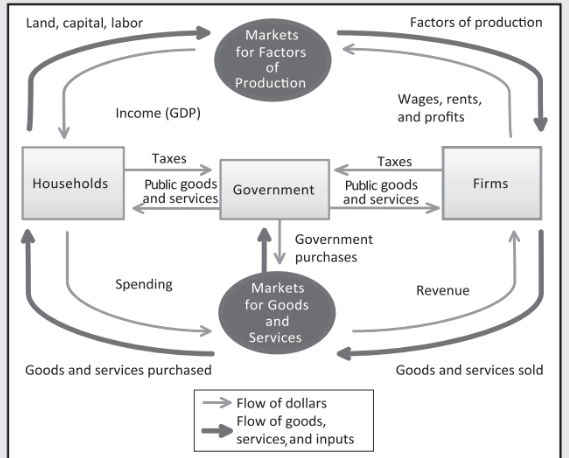
Circular Flow Model
Saving, Investment, and Financial System
Bond: certificate that specifies how much debt the borrower is to holder of the bond
includes:
date of maturity: when the loan will be repaid
rate of interest to pay periodically until fully repaid
principal: the promise to pay back original value
price of bond is inverse with interest rate (attractive to buyers)
risk is direct with interest rate
Intermediaries: 3rd party that acts as links
Banks:
can pay borrowers using the money of people that store money there, give interest rate to the store-ers + charge borrowers more
low-risk, insured, can withdraw whenever
provide checking account —> facilitate buying
Mutual Funds:
for savers with small funds to purchase bonds and stocks + gives knowledge
Saving
84-85
How Decisions are Coordinated
-87
crowding out: tendecy of government to reduce private investment
Money
Medium of Exchange
Unit of Account: yardstick to establish the value of different goods and service
Store of Value: item for transferring purchasing power over time (ex. paper currency)
Fiat Money: (ex. dollar bill)
Commodity Money: item with intrinsic value
Liquidity: measure of ease an asset can be converted into the economy’s medium of exchange
Measuring Money:
M1 and M2
M2 = M1 + array of other assets
Federal Reserve System (“the Fed”)
Created 1913;
12 regional banks with individual board of directors. Bosses appointed by President and approved by Senate. terms to remove political pressures
banks’ bank; oversees commercial banks and clears checks
lender of last resort: when a member bank cannot obtain funds
Money supply: task of controlling quantity of money
Federal Open Market Committee (FOMC)
determine changes to monetary policy
administered rate: discount and interest rate
lower administered rates to stimulate economy. banks will then be less towards holding money and lean more towards loaning money; currency and deposits from public increase
ample reverse policy: raised administered rates to reduce inflation
Central Banks:
limited reserve policy: open market operations to adjust money supply + buying govt bonds
Reserves: money that must be kept to pay back depositors
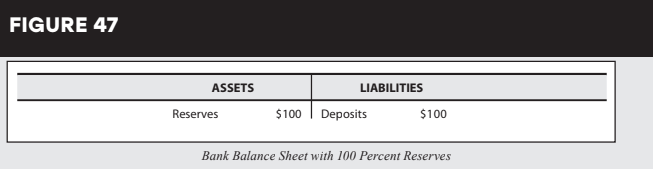
Money Multiplier: amount of money each sector creates from money in reserves
pg 91-93
Bank Run: rush of withdrawls
pg 94-111
US Economy in 1920s
Prosperity
Post-World War 1:
benefit from supplying goods and credit to Europe w/o as much warfare losses
post-economic constraint (for war) = consumers excited to spend = boom
supply scare = price up = collapse in prices = recovery = economy expand
Economy
structural change; urbanization; machinery = rural work ^^
innovation
wage-premium: white-collar jobs are increasingly more paird
Stock Market
mutual fund: intermediary holds diverse portfolio of securities
investment encouraged
Consumer Credit Expansion
Installment Financing: making payments towards buying an item
Consumption Smoothing: can buy more goods via borrowing
leveraged households: more debt
Urban Housing Boom
Building and Loan Associations
members joined to be eligible for mortgage
Asset Price Bubble: when a certain commodity’s price increases beyond intrinsic value (ex. houses, then cars…)
Global Context: US boom transferred around the world (due to fixed exchange rate gold standard). the Fed banks didn’t increase rates until later twenties, and were partially to blame for depression
Government
Laissez-faire
Local govt (pg 118-120)
Federal Govt
Prohibition
Immigration and Nationality Act of 1965 - restricting foreigners and other religions
Tariffs (tax on imported and exported goods); against globalization
Fordney-McCumber Tariff 1922
Smoot-Hawley Tariff 1930
New Deal: stimulate govt; Franklin D Roosevelt
Stock Market Crash
Causes:
Buying stocks on margins—> Fed Reserve increased interest rates —> reduced demand —> reduced buying —> stocks fall —> buyers cannot recover money
Food production up —> production up so farmers buy more stuff but then stocks/banks in trouble so prices fell —> farmers in debt
Banks: Fed Reserve officials lax with helping banks due to distrust due to the banks’ poor decisions + hard to know which banks are smar
dropping 50% in prices
McFadden Act 1927: prohibited banks from creating branches across state lines
Federal Deposit Insurance Corporation: improve bank stability
pg 128
1920s Effects:
“American Century” coined by Henry Luce
The Glass-Steagull Act of 1932: separated commercial and investment banks
regulations
Dodd-Frank Act in 2010: oversee financial stuff
1937 Recession
WW2, economic crisis ends (Work Progress Administration)