calvin cycle
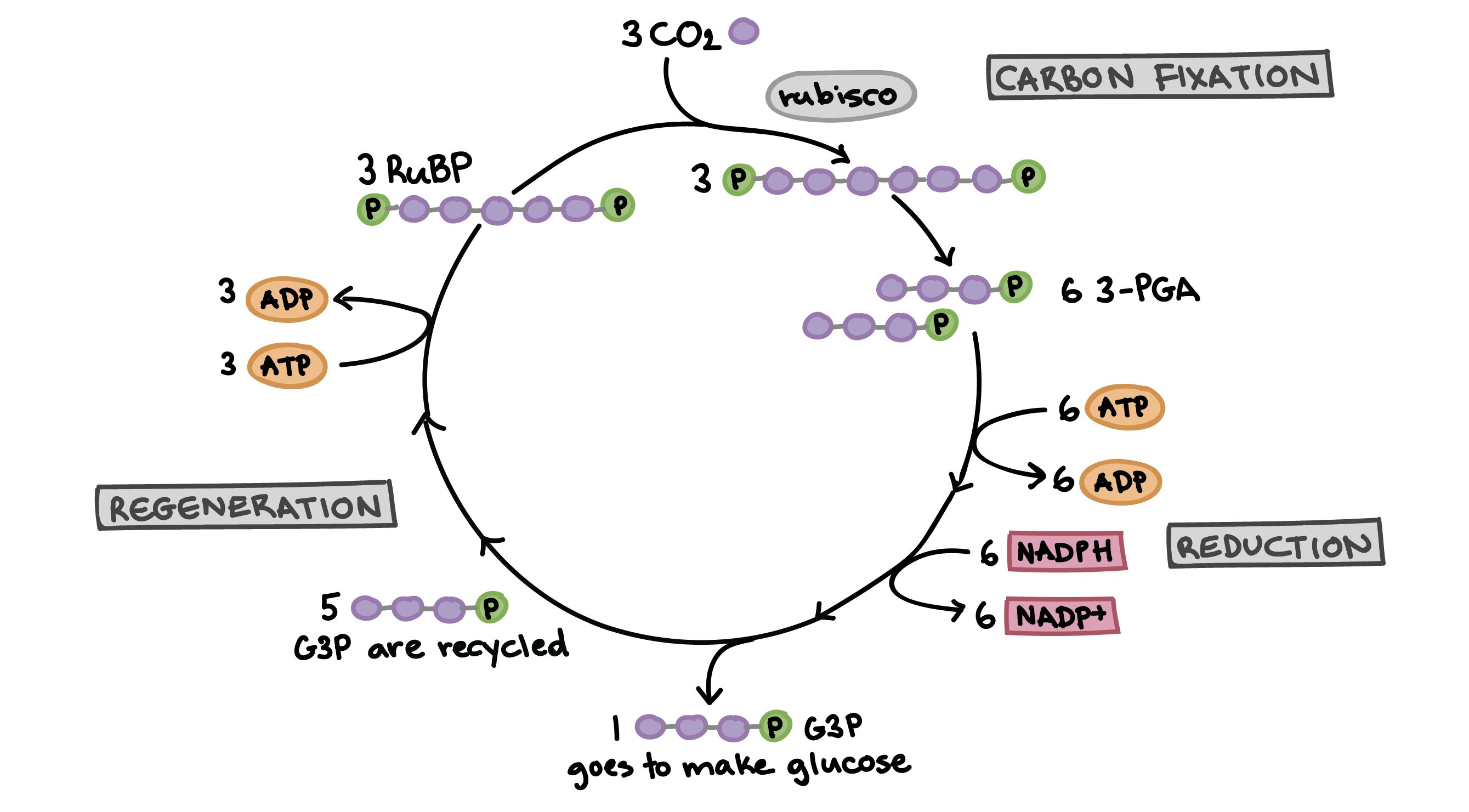
3 main phases of the Calvin cycle to remember: carbon fixation, reduction, regeneration
fixation - making an inorganic form of carbon organic
Carbon fixation catalyzed by rubisco
carbon dioxide added to RuBP (1,5-biphosphate) to form a 6-carbon intermediate which is highly unstable and splits immediately into 2 3C molecules (3-PGA)
Reaction: 3CO2 + 3RuBP → 6 3-PGA
photorespiration:
rubisco can take O2 as a substrate in place of CO2 - when O2 is added to RuBP, CO2 is released as in respiration - this results in ATP consumption and oxidation of carrier molecules that had already been reduced
Rubisco can be made more specific to reduce the risk of photorespiration, BUT this makes it slower - speed vs. selectivity is a constraint for photosynthetic organisms
Reduction:
energy from ATP and reduced electron carrier NADPH (products of light-dependent reactions) are used to convert PGA to 3-carbon carbohydrates (endergonic) → 6 triose phosphates/G3P
When this happens, NADPH is oxidized back to NADP+ - that returns to the site of light-dependent reactions
@ this point - 1 G3P exits the Calvin cycle and 5 proceed to step 3: regeneration
(2 turns of the Calvin cycle release 2 G3Ps which combine to form one glucose molecule)
Regeneration:
5 G3P (15 carbon in total) get transformed to RuBP using 3 ATP molecules (recall that RuBP contains 2 phosphate groups)
3 RuBP molecules are regenerated
Other notes:
Calvin cycle produces more carbohydrates than are needed to sustain the cell - excess is converted to starch
Starch acts as the cell’s energy source when light to perform photosynthesis is unavailable
Excess light energy:
often, photosynthetic organisms have more light available than is necessary
Recall that light-dependent reactions and Calvin Cycle produce products that are reactants for the other - they depend on each other and must occur at similar rates
If the light-dependent reactions proceed too quickly as a result of excess light, there is an increased risk of producing reactive oxygen species which are highly toxic
2 preventative measures:
antioxidants (vitamin C, for example) detoxify ROS and are highly concentrated within chlorophylls
Xanthophylls - a type of yellow/orange carotenoid (that cause autumn leaf color) that accept light energy from chlorophyll and transform it to heat, preventing ROS