Practical 4-Adversarial Search
▶ Minimax
▶ α-β pruning
Minimax
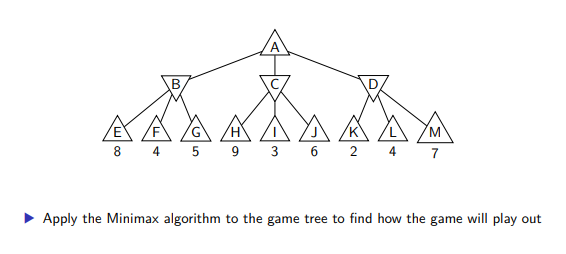
▶ At A, it is MAX’s turn. MAX will choose the maximum of B, C, D
▶ What are the values of B, C, D?
▶ At each of these states, it is MIN’s turn. MIN will choose the minimum of the states below it.
▶ At B, MIN would choose F, so the value of B is 4
▶ At C, MIN would choose I, so the value of C is 3
▶ at D, MIN would choose K, so the value of D is 2
▶ MAX chooses B!
α-β pruning
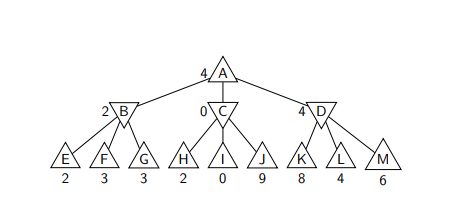
▶ E=2, F=3, and G=3, so B=2 and A is at least 2
▶ H=2, so C is at most 2
▶ A is at least 2 already
▶ We don’t need to look further below C; I and J are pruned ▶ K=8, so D is at most 8
▶ A is at least 2 and D is at least 8, so D might improve utility; keep searching
▶ L=2, so D is at most 2
▶ A is at least 2 already
▶ We don’t need to look further below D; M is pruned
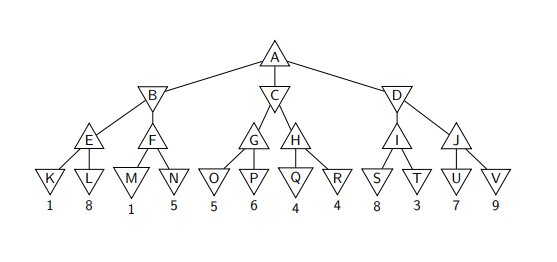
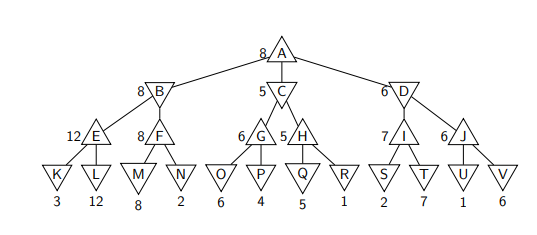
▶ K=1 and L=8, so E=8 and B is at most 8
▶ M=1 and N=5, so F=5, B=5, and A is at least 5
▶ O=5 and P=6, so G=6 and C is at most 6
▶ Q=4 and R=4, so C=4, A is still at least 5
▶ S=8 and T=3, so I=8 and D is at most 8
▶ U=7 and V=9, so J=9, D=8 and A=8
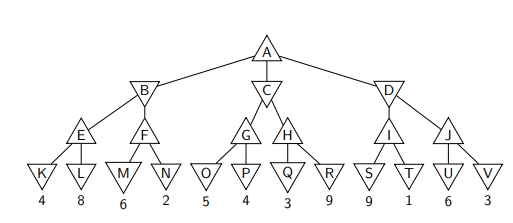
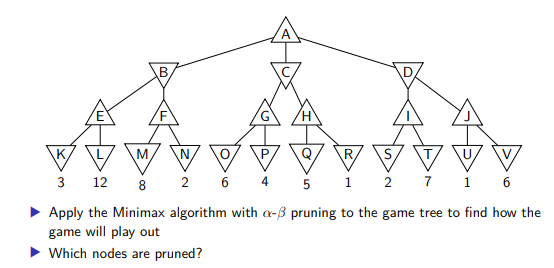
▶ K=4 and L=8, so E=8 and B is at most 8
▶ M=6 and N=2, so F=6, B=6, and A is at least 6
▶ O=5 and P=4, so G=5 and C is at most 5
▶ A is at least 6 already, as C is at most 5, it will never be chosen
▶ We don’t need to look further below C: H, Q, and R are pruned
▶ S=9 and T=1, so I=9 and D is at most 9
▶ U=6 and V=3, so J=6, D=6 and A=6