macromolecules
Organic Chemistry: The study of all compounds containing bonds between carbon atoms.
Carbon
4 valence electrons that form strong covalent bonds
allows for unlimited chain lengths with other carbon atoms
backbone of most organic molecules
frequently partnered with H, O, N, and C
MACROMOLECULES
most biological molecules are polymers made by covalent bonds of monomers
formed by dehydration synthesis: removing H_2O links monomers together
ex: protein synthesis
Hydrolysis: addition of H2O breaks polymers into monomers, releasing energy
ex: digestion
CARBOHYDRATES
Sugars and polymers of sugars
often end in "-ose”
monomers: monosaccharide
monosaccharides: single sugar molecules
glucose: breakdown allows for ATP production
polysaccharides: large macromolecules formed from monosaccharides
could be formed by 100s of 1000s of monosaccharides
extra sugar can be stored as a starch (complex carbohydrate in plants) and glycogen (for animals)
made up of C, H, and O atoms (usually in a 1:2:1 ratio)
Functions:
Main source of energy for living things
SHORT TERM energy storage
Structural purposes
Cellulose- plants
chitin- arthropods and fungal cell walls
recognition/signaling molecules can trigger biological responses
glycoproteins and glycolipids*
Monosaccharides: Simple Sugars
Pentoses: 5 carbon sugars
Ribose and deoxyribose are the backbones of RNA and DNA
Hexoses: include glucose, fructose, mannose, and galactose
Bonded covalently with condensation reactions that form glycosidic linkages
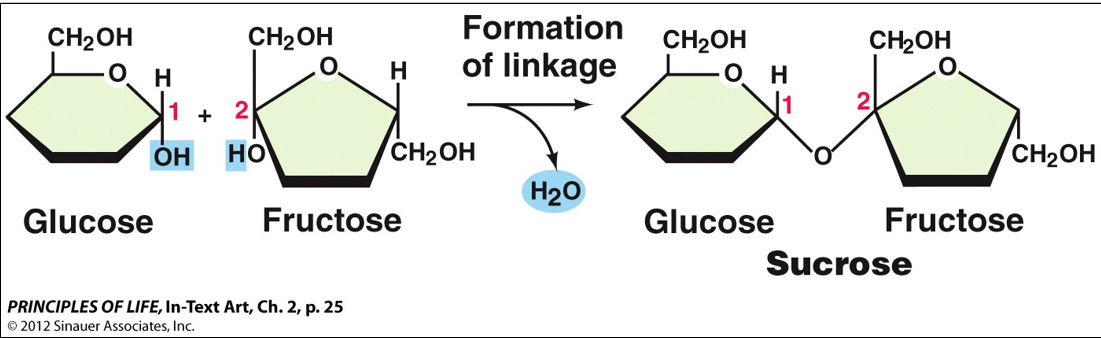
Sucrose is a disaccharide (Glucose + Fructose); oligosaccharide
Disaccharides
•Bonds formed by dehydration synthesis of monosaccharides » glycosidic linkages
*Oligosaccharides (2-9 monomers): many have additional functional groups.
often bound to proteins and lipids on cell surfaces, serving as recognition signals
Glycosylation: adding carbs to another molecule; adding glucose to a protein “Glycosylation is the reaction in which a carbohydrate, i.e. a glycosyl donor, is attached to a hydroxyl or other functional group of another molecule in order to form a glycoconjugate”
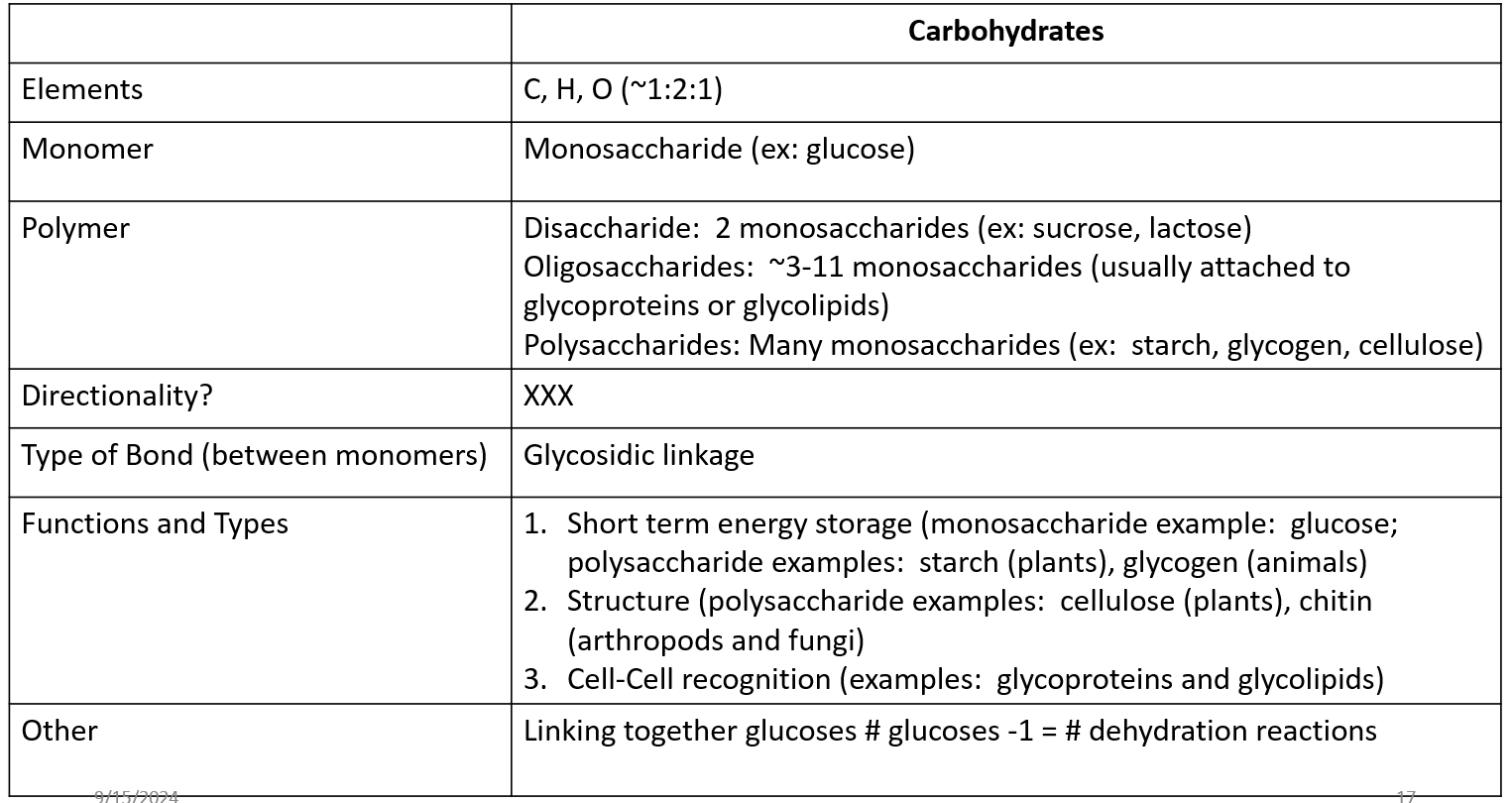
Polysaccharides: large polymers of monosaccharides
branching chains
starches: family of polysacchs of glucose
Glycogen: highly branched glucose
cellulose: H-bonds form fibers
LIPIDS
Hydrophobic. composed of C and H atoms
weak attraction when close together due to LDF forces
energy stored within C-C and C-H bonds
Structural role in cell membranes