Handling Emergencies
Emergencies can occur in any workplace. It is important to know how to recognize an emergency happening and what to do when there is an emergency. Some emergencies may be medical in nature. These emergencies may require first aid and even CPR. Having an up-to-date knowledge of CPR and first aid procedures makes a big difference in the outcome of the emergency. Ensuring complete and accurate incident documentation is crucial once the emergency has been resolved or taken care of.
Emergencies
Workplace emergencies include natural disasters, hazardous material exposure or spills, active shooters, workplace violence, medical, and more. It is vital to have education, training, and preparedness for any emergency to allow for the best outcome possible. Knowing the plans put in place by the facility in case of any emergency is essential to help keep patients, oneself, and other health care professionals safe. Identify an emergency as soon as it occurs and activate the appropriate emergency response.
Natural Disasters: Upon beginning work at a new facility, phlebotomists should confirm that they know all the identified safe places to gather in an emergency. Be sure to know where all the exits to the building are and the quickest way to evacuate. Knowing the facility’s guidelines for handling a natural disaster is also important. In the event of a natural disaster, such as a tornado or an earthquake, locate the designated area in the building or facility to shelter in place. Get there as quickly as possible, without running, and encourage others to get there quickly. Use the stairs, avoiding an elevator to help prevent being trapped in a power outage or if emergency personnel turn off the electricity. Follow the facility’s procedures for assisting patients and other health care professionals. To prepare for a fire, locate the fire extinguisher(s) in the facility so that they can respond as quickly as possible.
All staff should be aware of fire safety and the steps to follow if a fire should occur. Health care staff should be able to locate the fire extinguishers and know how to use them. Know where the nearest emergency exits are located and understand the evacuation plan if the fire is too large or begins spreading. To remember the order of action in case of a fire, remember the acronym RACE.
R: Rescue others who are in danger.
A: Alarm: Activate the fire alarm.
C: Confine the fire by closing doors and windows.
E: Extinguish the fire with the nearest fire extinguisher.

EXIT
Chemical Spills: Being aware of where to find the safety data sheet (SDS) for all chemicals helps determine the appropriate next steps. A safety data sheet is a document that provides information about a specific product and the safe use of it in the workplace. Check the SDS before working with a certain chemical or product. This will provide information on handling the chemical safely. It will also allow one to know the risk of handling the chemical or product, its flammability risk/level, and how to clean it up should there be a spill. If a hazardous material or chemical spills, do not attempt to clean up the spill unless appropriately trained and materials are available. If it is a high-level spill that cannot be controlled, evacuate, call 911, and assist in providing first aid to those in need. Do not reenter the building until it is cleared by the appropriate parties.
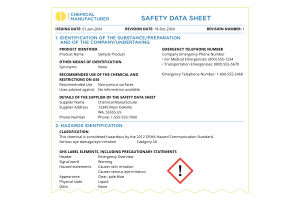
Section 1 provides identification of the substance/preparation and of the company/undertaking, which includes product identifier, product name, sample product. Other means of identifiation, synonyms or none. Recommended use of the chemical and restrictions on use, which includes recommended use, non-porous surfaces, uses advised against and no information available. Details of the supplier of the safety data sheet includes supplier name, address and phone number. Emergency telephone numbers are also provided. Section 2 lists the hazards identification, which includes classification and GHS label elements, including precautionary statements. Header: emergency overview; signal word: warning; hazard statements: causes skin irritation, causes serious eye irritation; appearance: clear, pale blue; physical state: liquid; odor: none.
SDS
Active Shooter: If an active shooter enters the facility, call 911 immediately and determine how to best protect oneself and patients. When possible, escape from the area and stay safe until the situation is controlled by law enforcement. When escape is impossible, attempt to hide. Turn off the volume on cell phones and stay as quiet as possible. If there is no other choice, fight, use improvised weapons, and scream and yell at the attacker. Only use this measure if no other options are available. Always comply with law enforcement instructions. They may not have time to explain why, but for everyone to be safe, follow their instructions. If workplace violence is occurring or has escalated, 911 can be called. If in imminent danger and one does not feel safe enough to do so, management or human resources (HR) can be contacted to attempt to deescalate the situation.
Medical Emergencies: Several medical emergencies can occur in the workplace, especially in a medical facility where patients are seen and treated. Medical emergencies may include seizures, hypo- or hyperglycemia (low or high blood sugar), syncope, broken bones, dislocations, choking, stroke, bleeding, and cardiac events. When it comes to phlebotomy, the primary emergency seen is syncope. However, other complications can occur, such as seizures. Some patients do not tolerate the process of blood collections well. Always ask the patient if they have ever fainted during a blood collection before. If they have fainted or been close to fainting, offer them a place to lie down during the blood draw. If performing a venipuncture on a patient who experiences syncope, immediately and carefully remove the tourniquet and needle from the patient and assist in getting them to a seated or lying position. Do not leave them alone until they have completely recovered. Always call for help when needed to keep health care workers and the patient safe. Another potential emergency that can occur during phlebotomy procedures is an accidental needle stick. Knowledge and understanding about each type of possible medical emergency and the support that can be provided increases the likelihood of positive outcomes for the patient. It is also essential to know the necessary supplies for each type of emergency to quickly assist, however needed.
First Aid and CPR
For phlebotomists, training in first aid and CPR is crucial. These skills can be critical in emergency situations that may arise during the blood collection process. Phlebotomists frequently work with patients who may experience nausea, dizziness, seizures, or syncope during blood collections and other procedures. They may also experience conditions caused by the procedure, such as hematoma or excessive bleeding.
When these events occur, knowing how to provide immediate first aid, including elevating the legs of the patient or applying cold compresses, can prevent further issues or complications. While less likely, phlebotomists may be near or with a patient when they experience one of many different types of emergencies. They must know the first aid measures required for each type of emergency. With all emergencies, stay with the patient or confirm that someone is with them until they have recovered or been transported for treatment.
Emergencies
Type of Emergency | Symptoms | First Aid |
|---|---|---|
External hemorrhage | Unexpected or profuse bleeding | Apply pressure using gauze or cloth. |
Shock | Pale, cold, clammy skin, rapid pulse, fast and shallow breathing | Elevate legs so head is lower than rest of the body, keep patient lying down. |
Stroke | Sudden numbness or weakness in face, arm, or leg on one side of the body, sudden confusion or trouble speaking, sudden trouble seeing or walking, sudden severe headache | Recognize signs and call 911 or alert provider immediately. |
Cardiac event | Patient is unresponsive, no pulse, not breathing | Begin CPR and use an AED when required. |
Nausea | Patients may state that they do not feel good or may vomit. Greenish hue to the skin, sweating, and deep gulping or excessive saliva | Stop procedure. Provide an emesis basin. Provide privacy and a wet cold compress. Do not provide food or drink until the patient recovers. |
Seizure | Suddenly becoming rigid and making jerking motions. Patients may appear conscious but unresponsive in the case of a petit mal. A grand mal can lead to full body convulsions. | Stop procedure. Call for help. Guide the patient to the floor and place on side when possible. Do not attempt to restrain or hold a person experiencing a seizure. |
Syncope | Sweating, pale or flush, shallow breathing | Stop procedure. Lean close to the patient to help reduce the risk of injury. Loosen tight clothing. Place a cold compress on their neck or head. Maintain patient in reclined position until recovered. |
Hematoma | A swelling that gathers quickly at the site of the needle insertion. May be discolored. | Stop the procedure and provide pressure on the site for at least 5 minutes to ensure the bleeding stops. |
Accidental artery puncture | Blood will be cherry red and filling with force into the ETS tube. | Withdraw needle immediately. Place pressure on the site for 5 to 15 min. |
Accidental needle stick | Feeling a sudden sharp pain near the needle and/or blood in the glove | Remove needle if stuck in skin. Rinse the area thoroughly. Document the incident. Seek medical care within 24 hr. May be necessary for testing for diseases such as HIV and hepatitis C and B. |
Petechiae | Small red spots appearing on the arm surrounding the tourniquet | Continue the collection, apply adequate pressure afterward to help stop bleeding promptly. |
Warning Signs of a Stroke
Memorize the acronym FAST to remember the warning signs of a stroke.
F = Face drooping
A = Arm weakness
S = Speech difficulty
T = Time to call 911
CPR training is vital for any health care team member in the unlikely event that a patient experiences cardiac arrest or stops breathing at any time during their time in the hospital or medical office. Knowing how to perform chest compressions, use an AED, or assist in maintaining an open airway, allows the phlebotomist to provide life-saving interventions until more advanced medical help arrives to take over. Certification in CPR and first aid ensures that the phlebotomist follows workplace safety regulations or standards and keeps them up to date on best practices for both.
It is important to know the proper CPR steps. For an adult needing CPR:
Check the scene for safety and use PPE.
Check for responsiveness, breathing, and life-threatening bleeding.
Call or direct an individual to call 911.
Gather or direct an individual to get an AED.
Ensure the person is on their back on a firm, flat surface and kneel beside them.
Provide 30 chest compressions.
Administer two rescue breaths.
Continue giving sets of 30 chest compressions and two breaths. Use the AED as soon as one is available. Follow the prompts on the AED. Continue until signs of life are seen or help arrives.
For a child or infant needing CPR:
Check the scene for safety and use PPE.
Check for responsiveness by shouting to get the baby or child’s attention. For a child, tap their shoulder and shout, and for a baby, tap their foot and shout, while checking for breathing and life-threatening bleeding.
Call or direct someone to call 911.
Gather or direct someone to get the AED.
Ensure the child or baby is on their back on a firm, flat surface. For a child, kneel beside them. For a baby, stand or kneel to the side of the baby with hips at a slight angle.
Give 30 compressions. For a small child, use one hand in the center of the child’s chest. For a baby, place both thumbs on the center of the chest.
Administer two rescue breaths.
Continue with sets of 30 compressions and two breaths until an AED is ready to use. Continue until signs of life are seen or another responder is available to take over.
Documentation and Reporting Requirements
Accurate documentation and reporting are important parts of a phlebotomist’s job, ensuring proper patient care, compliance, and integrity of laboratory results. Documentation is also important for patient safety and can be used for legal purposes in a court of law. Any documentation done in the patient’s medical record must be factual and objective. Proper documentation can help prevent errors, which can lead to potential harm to the patient. Reporting is another part of the phlebotomist’s job. This may involve reporting and documenting an adverse reaction during or after the blood collection process or reporting incidents internally.
Incidents that may need reporting include accidental needlesticks and exposure to bloodborne pathogens or other hazardous materials. When reporting must occur, an incident report must be filled out promptly. These forms are confidential and include what occurred, actions taken, and any corrective actions that may need to be taken. If a report involves a patient, the incident should be reported to the appropriate health care team members to ensure prompt and effective follow-up.
Phlebotomists must keep HIPAA regulations in mind as they fill out any incident reports involving a patient to ensure that sensitive health information is handled properly. OSHA requires that any needlestick injury or cut from a sharp object contaminated with another person’s blood or potentially infectious material be reported immediately after they occur. The incident must be documented in an incident report form, including all information about when it happened, how it occurred, and actions taken. Immediate reporting allows for timely evaluation, medical care, and even postexposure prophylaxis when indicated.