Wk 9.3 Enzyme Inhibition
Learning Goals
Understand allosteric regulation, allosteric sites, and allosteric regulators (activators/inhibitors).
Understand which domains in the enzyme can be the target of inhibitors, and the different modes of interaction of inhibitors with enzymes (reversible and irreversible inhibition).
Understand how competitive, uncompetitive, non-competitive, and mixed inhibition work and describe in detail how enzyme kinetics can be changed by these inhibitors (i.e. effects on Vmax KM).
Understand how irreversible inhibitors, including group-specific inhibitors, reactive substrate analogues, and mechanism-based inhibitors work.
Enzyme Activity Modulation
Enzyme activity can be altered by other molecules.
Two types:
Activators: increase activity (e.g., cofactors, fructose 2,6-bisphosphate activates phosphofructokinase 1 which increases glycolysis in response to insulin).
Inhibitors: decrease activity (e.g., feedback inhibition, herbicides, drugs).
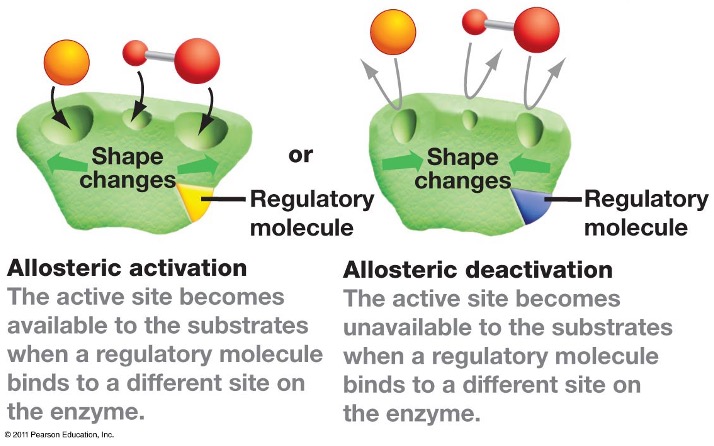
Inhibitors can either bind directly to the active site or cause a conformational change in the enzyme (allosteric regulator).
Allosteric Regulation of Enzymes
Typically involves a multimer (but not always).
Each subunit has:
A binding site for the substrate.
A separate binding site for the allosteric regulator (allosteric site).
Allosteric inhibitor blocks substrate binding.
Allosteric activator permits substrate binding.
Inhibitors are often used as drugs.
Types of Enzyme Inhibition
Reversible inhibitors (inhibitors bind to enzymes non-covalently):
Competitive inhibitors
Non-competitive inhibitors
Uncompetitive inhibitors
Mixed inhibitors
Irreversible inhibitors (inhibitors bind to enzymes covalently):
Group-specific inhibitors
Reactive substrate analogues
Mechanism-based inhibitors
Differentiation of inhibitor types is based on enzyme kinetics.
Competitive Inhibition
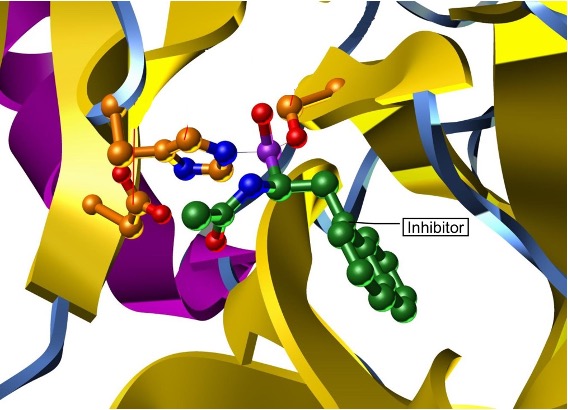
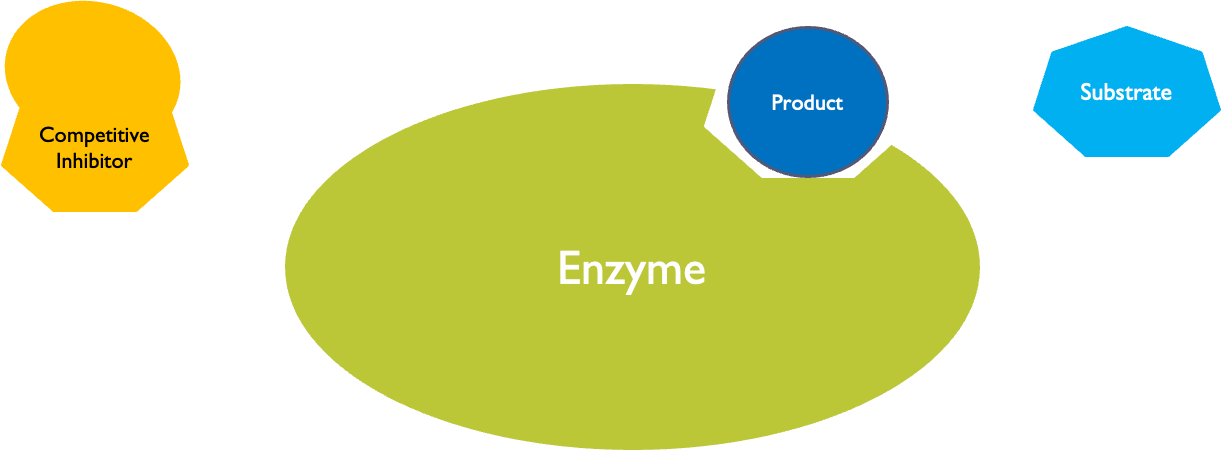
Inhibitor competes with the substrate for the binding site.
Cannot bind at the same time.
Binds to the free enzyme, not the enzyme-substrate complex.
The inhibitor can bind to the enzyme’s active site.
The design resembles a real substrate or co-factor.
Effect on kinetics
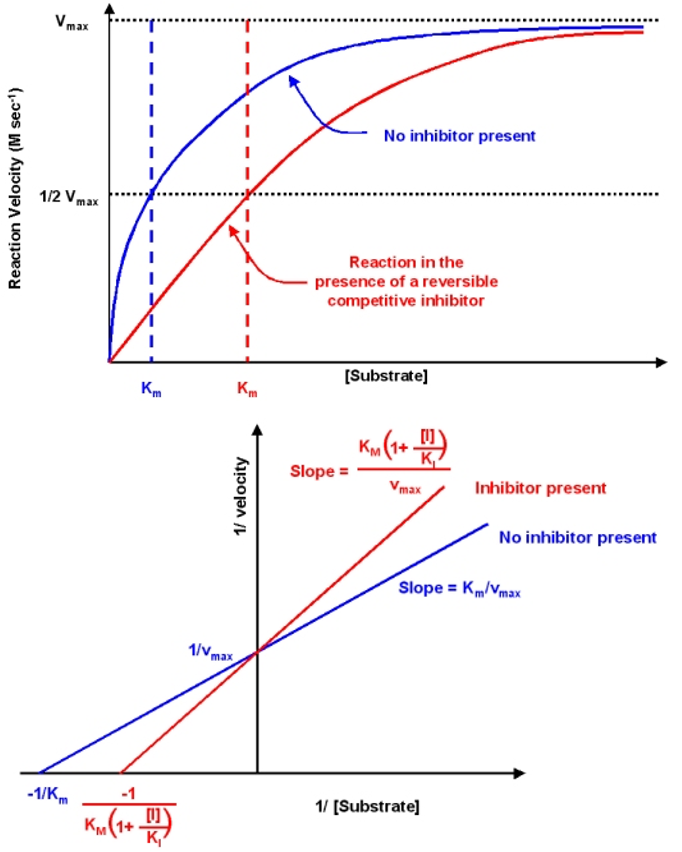
Less substrate can bind.
The reaction rate decreases at lower substrate concentrations.
More inhibitor = lower reaction rate.
Increasing substrate concentration decreases the effectiveness of the inhibitor.
= unchanged (can still reach the same maximum rate).
= increases because the inhibitor interferes with binding.
More substrate is needed to reach .
Examples: Methotrexate (cancer), Relenza (influenza).
Non-competitive Inhibition
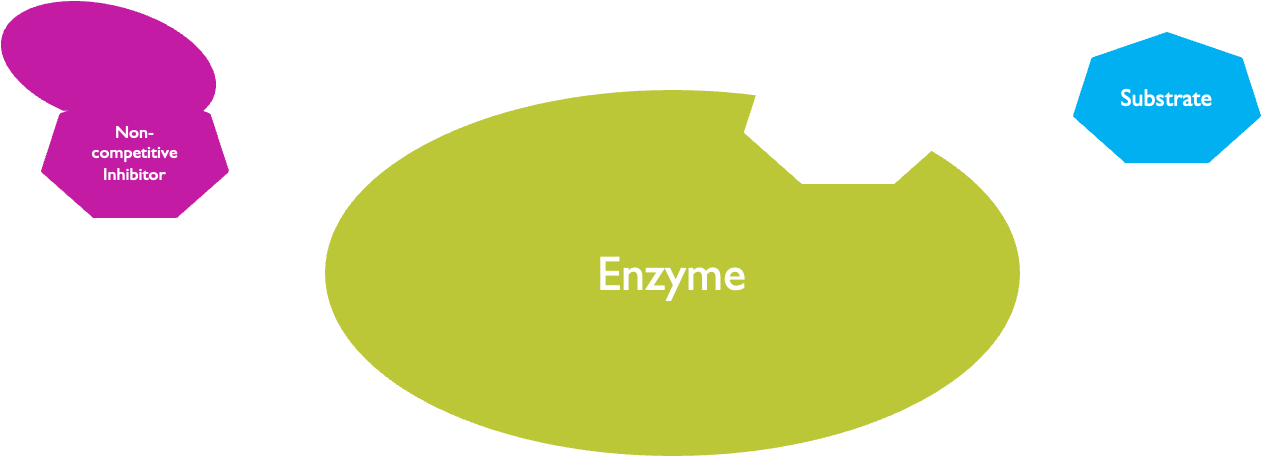
Binds whether the substrate is bound or not (allosteric site).
Equal affinity for the free enzyme or the enzyme-substrate complex.
Renders the enzyme catalytically inactive.
Prevents product formation (i.e., does not prevent binding » prevents catalysis).
Non-competitive Inhibition » Effect on kinetics
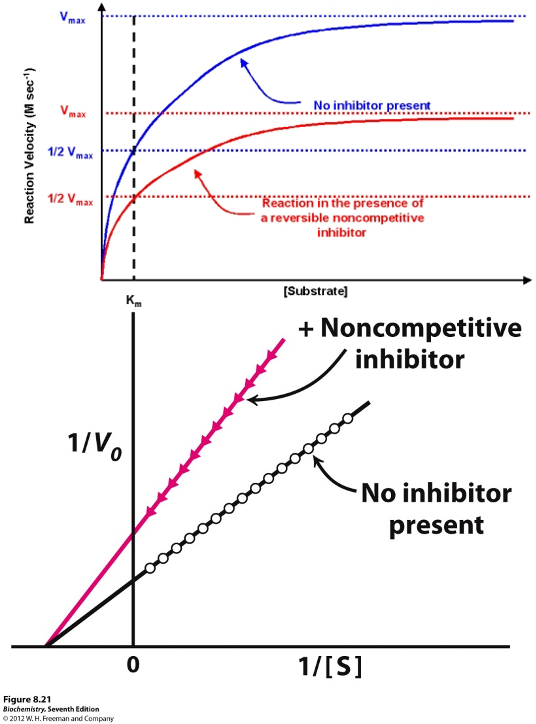
Reduces the effectiveness of both the free enzyme and the enzyme-substrate complex (i.e., the enzyme can’t function as well).
= decreases.
The enzyme is not working as efficiently.
A subset will always be bound to the inhibitor, so decreases.
The inhibitor cannot be removed by increased substrate concentration.
= unchanged.
Binds to both the free enzyme and the enzyme-substrate complex.
Does not change the apparent binding of the enzyme for the substrate.
Lowers the concentration of usable enzymes.
E.g., Nifedipine (anti-anginal/anti-hypertensive) affects CYP2C9 (cytochrome P450) enzyme.
Uncompetitive Inhibition
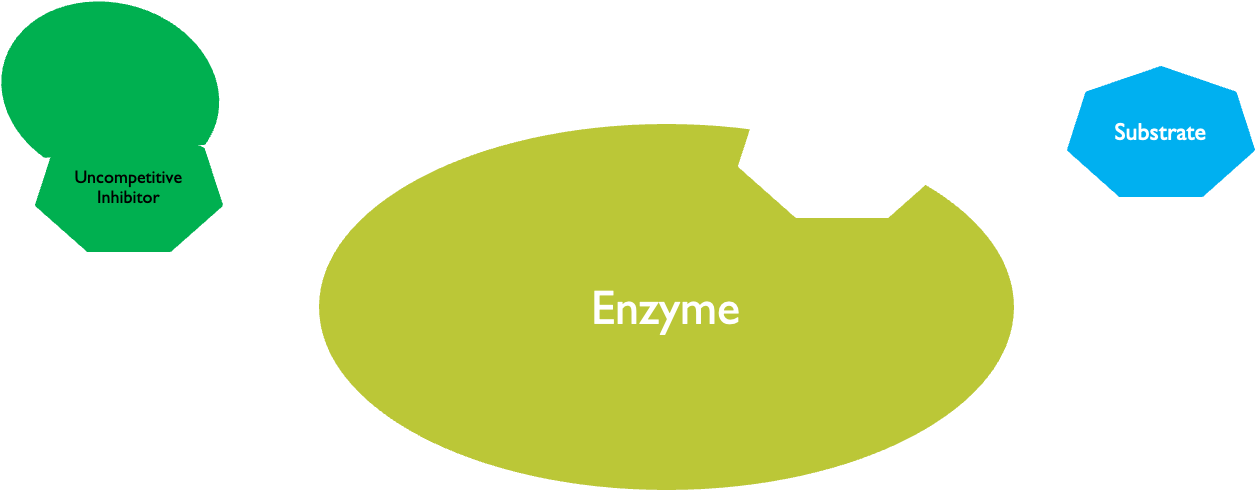
The inhibitor binds to the enzyme-substrate complex but not the free enzyme.
The inhibitor-enzyme-substrate complex is catalytically inactive.
Distorts the active site and prevents product formation.
NB: Does not bind to the active site; will only bind once the substrate has bound.
Uncompetitive Inhibition » Effect on kinetics
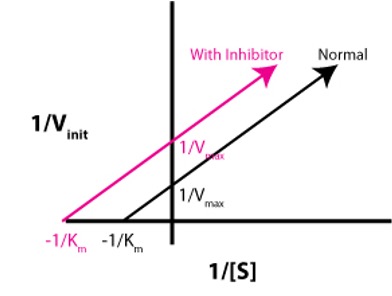
Reduces the effective concentration of the enzyme-substrate complex.
= decreases.
The enzyme-substrate complex does not dissociate.
The product is not formed, so the reaction rate is decreased.
= decreases.
Binding efficiency increases.
The enzyme-substrate complex does not dissociate.
Works best at high substrate concentrations.
E.g., Lithium (antidepressants/bi-polar) affects Inositol monophosphatase.
Mixed Inhibition
Resembles non-competitive inhibition (binds at the allosteric site) - binds both before and after substrate binding.
Unlike non-competitive inhibition (equal affinity for free enzyme or enzyme-substrate complex), mixed inhibition has a greater affinity for one or the other.
= decreases.
= can increase (if it favors binding to the free enzyme) or decrease (if it favors binding to the enzyme-substrate complex).
E.g., xanthine oxidase () » gout.
Irreversible Inhibition
Permanently inactivate the enzyme (decreases enzyme concentration).
Group-specific inhibitors:
react with a specific amino acid side chain (e.g., iodoacetamide modifies cysteine residues and inhibits cysteine peptidases).
Reactive substrate analogues (a.k.a. affinity label):
structurally similar to the substrate and react with the substrate (e.g., TPCK inhibits chymotrypsin).
Mechanism-based inhibitors:
the inhibitor binds to the active site of the enzyme, so during the normal enzymatic reaction, a covalent bond is formed, which results in permanent inactivation (e.g., Penicillin and Aspirin).
Allosteric Activators
Rare but can happen.
Bind to the enzyme and change its shape to increase affinity for the substrate.
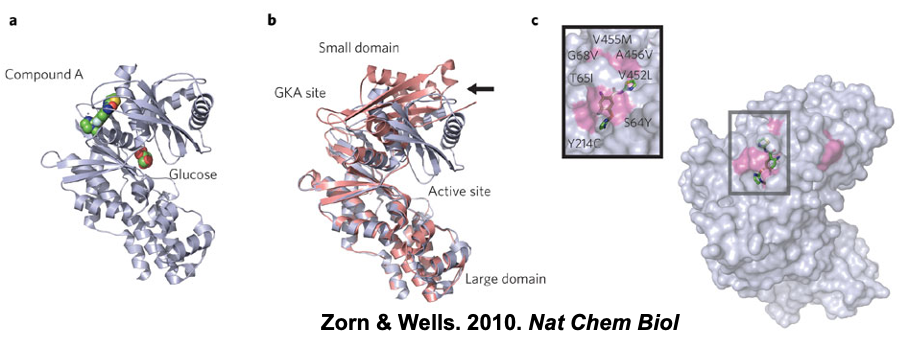
E.g., MK-0941 (Glucokinase activator).
Glucokinase is involved in glycolysis and is inactivated in maturity onset diabetes of the young (MODY).
MK-0941 allosterically alters the shape of glucokinase and increases affinity for glucose.
Reference: Zorn & Wells. 2010. Nat Chem Biol.
Discussion Question
Q: Which of the following statements about non-competitive inhibitors is CORRECT?
A. is unchanged
B. is unchanged
C. Binds to the enzyme-substrate complex only
D. Binds irreversibly
Practice Exam Question
Q: In enzyme kinetics, the is…
A. Half
B. Unchanged by a competitive inhibitor
C. Increased by an uncompetitive inhibitor
D. The negative reciprocal of the x-intercept on a Lineweaver-Burk plot.
Summary Table
Type of Inhibition | Binds to Free Enzyme? | Binds to Enzyme-Substrate Complex? | Effect on | Effect on |
|---|---|---|---|---|
Competitive inhibitor | Yes | No | Unchanged | Increase |
Non-competitive inhibitor | Yes | Yes | Decrease | Unchanged |
Uncompetitive inhibitor | No | Yes | Decrease | Decrease |
Mixed inhibitor | Yes | Yes | Decrease | Increase or Decrease |
General Summary
Enzymes can be allosterically regulated - activated or inhibited.
Two types of inhibitors: reversible (competitive, non-competitive, uncompetitive, mixed) and irreversible (reactive substrate analogues, group-specific inhibitors, mechanism-based inhibitors).