Learning & Behaviour
is a change in behaviour. is an observable action that can be repeated and measured. Some behaviours you are born knowing how to do, which makes them behaviours. are behaviours that happen automatically, they can be learned or innate.
Classical Conditioning
Classical conditioning is the association of a that have no relationship outside of the conditioning.
Ivan Pavlov (1849-1936)
Ivan Pavlov developed and used classical conditioning unintentionally by studying the salivation of dogs. He noticed that when he put on his lab coat, the dogs would salivate. Putting on the lab coat signaled to the dogs there would be food which produced an involuntary response, salivation.
Classical conditioning is learning that an unimportant event will signal an important event.
| Unconditional Stimulus (US) | Biologically important event that affects our behaviour |
|---|---|
| Unconditional Response (UR) | Biologically important response occurs due to a biologically important event |
| Conditional Stimulus (CS) | Event that is meaningful because it is linked to the biologically important event |
| Conditional Response (CR) | Learned response in preparation for the biologically important event |
Pavlov focused on the relationship between the conditional stimulus and the unconditional stimulus.
The aim of classical conditioning is to make a neutral stimulus by pairing it with an already-meaningful stimulus.
The conditional stimulus can be presented before or after the unconditional stimulus. places the CS before the US so that the CS signals the US will occur. This creates a positive correlation between the stimuli and increases the response. places the CS seconds before the US which is the most effective type of excitatory conditioning. places the CS a few seconds before the US. places the CS minutes or hours before the US.
places the CS at the same time or after the US. This creates a negative correlation between the two stimuli and will decrease the response. places the US a the start of the CS. places the US a few seconds before the CS.
is a type of trace conditioning where we learn not to eat foods that make us sick hours later (long-delayed conditioning). This behaviour tends to be long-lasting and hard to get rid of.
is the decrease of the conditional response to the conditional stimulus. This occurs when the US stops being presented. The CS only has value because it signals the US will occur and when the US is removed, the CS is no longer valuable. When the CS is presented alone after a rest period it will elicit the CR, this is called . CR stops when the CS doesn’t accurately predict that the US will occur, but the association between the two does not disappear after extinction.
The unconditional stimulus can be (pleasant) or (unpleasant). We learn to associate the US with CS which changes how we feel about the previously neutral CS.
occurs when we notice similarities between stimuli and respond the same to the stimuli. occurs when we notice the differences in stimuli and therefore respond differently. occurs when an already conditioned signal is paired with a neutral stimulus that elicits the conditioned response.
are arbitrary stimuli used in safety signal treatment programs to treat PTSD. These signals are excitatory or inhibitory and signal to the patient that the stimulus will or won’t occur. People with PTSD presented with both signals will produce the conditioned response when both signals are shown simultaneously while people without PTSD will react to the inhibitory signal, meaning they will react as if the stimulus will not occur.
John Watson (1878-1958)
John Watson is a behaviourism influenced by the work of Pavlov and utilized classical conditioning in his experiments. His was an unethical experiment where Watson conditioned a baby into being afraid of white rats. This was done by making a loud noise every time the baby was in the presence of a white rat. Stimulus generalization and discrimination can be seen as the baby was afraid of some other white-furred things, such as rabbits, dogs, and fur coats, but not others like Watson’s hair or his white Santa mask.
| Unconditional Stimulus (US) | White rats |
|---|---|
| Unconditional Response (UR) | Indifference towards white rats |
| Conditional Stimulus (CS) | Loud noise |
| Conditional Response (CR) | Fear of white rats |
Operant Conditioning
Operant conditioning . We chose to act a certain way based on past experiences.
E.L. Thorndike
Thorndike is credited for instrumental (operant) conditioning and is known for his . Cats placed in a box had to perform a specific sequence of behaviours to earn a reward. Operant conditioning is mainly concerned with the consequences of behaviour. The law of effect describes how we associate situations and behaviours. Behaviours can either lead to which makes them more likely to occur or can lead to which makes them less likely to occur. refers to the behaviours that lead to something pleasant that we will do more often; satisfaction. refers to behaviour that leads to something unpleasant that will do less often; discomfort.
describes how the observer must watch the model do the behaviour and get rewarded in order to exhibit the target behaviour.
B.F. Skinner
Skinner is a behaviorist that coined the term operant conditioning. are important environmental events that precede behaviour and consequences are stimuli that increase or decrease the probability of the behaviour in the future. are when different responses yield different consequences and the behaviour is learned faster. are when different behaviour yields the same consequence, and behaviour is learned slower. Skinner identified four (consequences that result in different behaviour), positive or negative reinforcement or punishment. associates behaviour with the consequence occurring while associates behaviour with the consequence not occurring. increase the probability of behaviour and decreases the probability of behaviour.
| Positive | Negative | |
|---|---|---|
| Reinforcement | Added consequence increases behaviour | Removed consequence increases behaviour |
| Punishment | Removed consequence decreases behaviour | Removed consequence decreases behaviour |
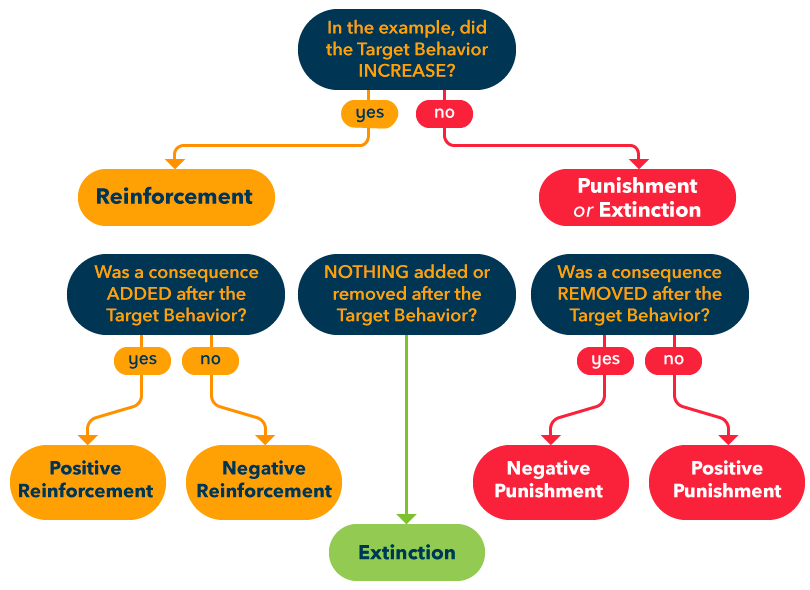
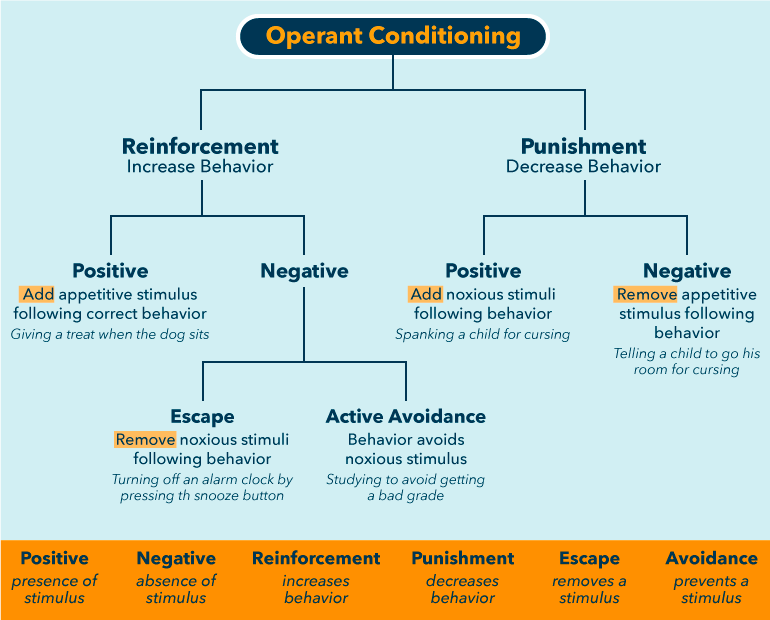
Negative reinforcement occurs as escape or avoidance. is when the adverse stimulus is removed and is when the adverse stimulus is not present but will be if you do not act.
The specific response we are looking for is called the .
occurs when a behaviour no longer yields the same consequence and that behaviour becomes less likely in the future.
At the beginning of operant extinction, there will be a high rate of behaviour without consequence where the subject is trying to obtain the consequence, which is referred to as an . Extinction bursts lead to an increased frequency, duration or intensity of the conditioned behaviour before decreasing. Behaviour that is continuously reinforced will become extinct faster than behaviour that was irregularly reinforced, this is known as the .
is the reinforcement of specific behaviours to obtain a target behaviour. This happens gradually by reinforcing simpler behaviours at the start and shaping them into the c__omplex target behaviour__.
A will determine if the consequence will reinforce and increase the frequency of behaviour.
have biologically important consequences that make behaviour more likely to occur. are paired with primary reinforcers to make behaviour more likely to occur.
Schedules of reinforcement describe when reinforcement will occur. They can be fixed or variable ratios or intervals.
| Fixed | Variable | |
|---|---|---|
| Interval | Reinforcement is given after a set amount of time | Reinforcement is given after an average amount of time |
| Ratio | Reinforcement is given after a set number of responses | Reinforcement is given after an average amount of responses |
Social Learning
Social learning is vicarious learning is done by watching others.
is a phase of social learning where the observer copies the models behaviour.
Albert Bandura (1925-2021)
Bandura studied observational learning and his famous his experiment. Children watched an adults play aggressively with toys, gently with toys, or observed no adult at all. Then the children were placed in the room with the toys. Those who saw the adults interact aggressively with the toys did the same while the other groups did not.
Bandura’s theory of observational learning
- Attention phase: observer notices model/s behaviour
- Retention phase: observer thinks about performing model’s behaviour
- Production phase: observer preformed model’s behaviour
- Motivation phase: observer imitates model’s behaviour which produces the same reward as the model and reinforces the behaviour
Latent Learning
Latent learning is learning that has been done but has not been demonstrated yet.
Edward Tolman (1886-1959)
Tolman is credited for the establishment of and approached his behavioural studied using meditational neobehaviourism or operational behaviourism. His famous experiment involved putting rats in a maze, the rats that recieved food at the end of the maze made fewer errors than the rats that did not recieve food. Tolman theorized that the group of rats not given food were constructing a cognitive map of the maze. A is the mental image of our physical surroundings.
Biological Constraints
describes how some stimuli are better conditional stimuli than others because they are more evolutionarily important.
can be used to treat phobias, which are irrational and extreme fears.
occurs when we experience an adverse stimulus prevents us from being able to control other aversive stimuli in the future. This can be because the avoidance or escape behaviour does not work and we do not know how to proceed.
Martin Seligman (1942-present)
Seligman’s learned helplessness experiment involved shocking dogs where there was no way the dogs could avoid the aversive stimulus. The dogs where then placed in a box with a short barrier where they would be able to escape the stimulus. Instead of escaping when shocked, the dogs would stay put which demonstrates learned helplessness.