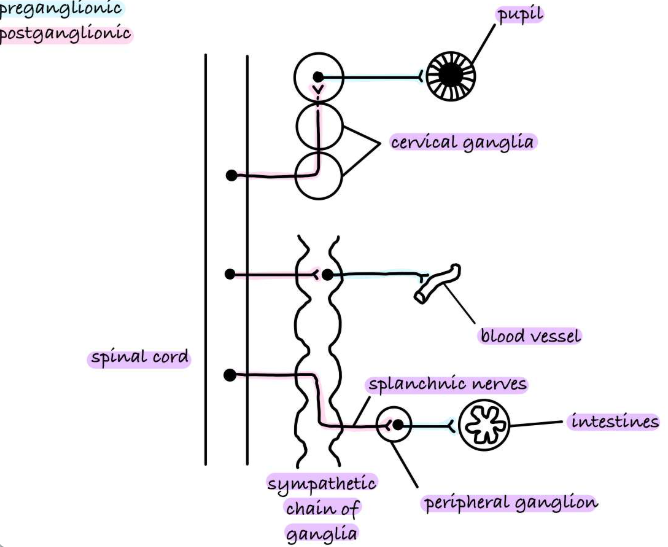
Autonomic Nervous System
Somatic vs Autonomic Nervous System:
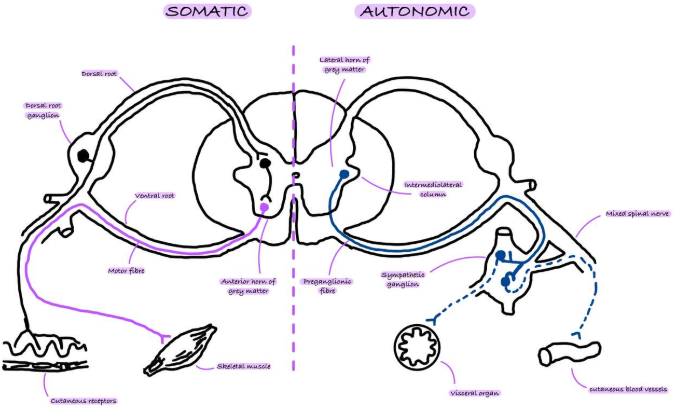
Axons of the somatic nervous system have a single myelinated axon extending from the CNS to the effector.
Axons of the autonomic nervous system have a two neurone chain (the preganglionic neurone extends to the ganglion, and the postganglionic neurone extends to an effector).
Motor Pathways:
Axons that form synapses with ganglion cells are known as preganglionic autonomic fibres.
Axons that innervate effector cells are known as postganglionic autonomic fibres.
The postganglionic neurone has many varicosities (terminal-like structures found along the axon) from which neurotransmitters are released.
Autonomic Nervous System:
Conveys all outputs from the CNS to the rest of the body (except motor innervation of skeletal muscle).
Regulates mostly involuntary processes in homeostasis, such as:
Heartbeat
Contraction of smooth muscle
Exocrine and some endocrine secretions
Energy metabolism
Sympathetic and parasympathetic systems function separately. They have opposite effects in some states, such as heart rate, but not in others, e.g. salivary gland secretion.
Both systems exert continuous physiological control under normal conditions, meaning that when neither are extreme, they both cooperate.
Sympathetic activity increases during stress (e.g. in an aroused state, the fight-or-flight response occurs, leading to increased heart rate, blood glucose etc., and causes pupillary dilation and hair erection.
Parasympathetic activity dominates during satiation and repose.
Influenced by sensory information via control centres in the brain.
Parasympathetic Nervous System:
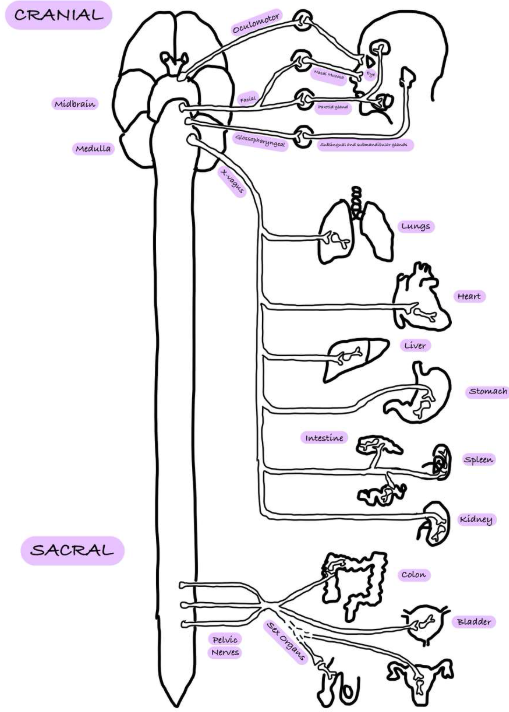
Preganglionic axons emerge from cranial and sacral regions of the CNS.
They form synapses in ganglia near to, or adjacent to effector tissue.
Sacral nerves form pelvic plexuses containing scattered ganglia.
There are also some ganglia within tissues, such as abdominal viscera (e.g. bladder).
In general, preganglionic fibres are long, and postganglionic fibres are short.
Sympathetic Nervous System:
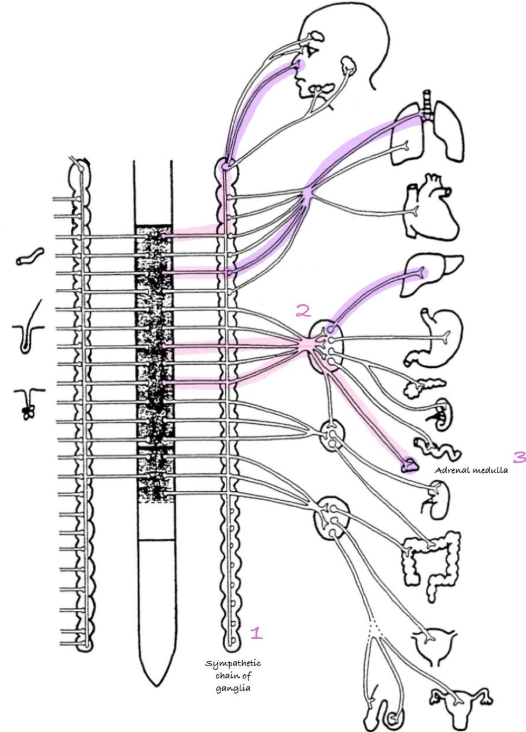
Preganglionic sympathetic axons entering chains terminate in:
Paravertebral Sympathetic Chains - both pre- and post-ganglionic axons may run for some distance up/down the sympathetic chain before forming synapses.
Prevertebral Ganglia/Plexuses - there are 3 in the abdominal cavity; coeliac ganglion, superior mesenteric ganglion, and the inferior mesenteric (hypogastric) ganglion.
Adrenal Medulla - some preganglionic fibres emerging from the 10th and 11th thoracic segments run in the greater splanchnic nerve and terminate on chromaffin cells in the medullae of the adrenal glands.
Forming Synapses: