Chapter 3A
Exchange Rates
Exchange rates are quoted as foreign currency per unit of domestic currency or vice versa.
e.g. how much can be exchanged for one yen or for one dollar?
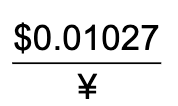
e.g. 1.10 USD/EUR or 0.91 EUR/USD
e.g. 3.65 QAR/USD or 0.27 USD/QAR
The numbers above are called quotes.
To get the indirect exchange rate, divide 1 by the direct quote. How much can be exchanged for one dollar?
Exchange rates allow us to denominate the cost or price of a good or service in a common currency.
e.g. if a Nissan costs ¥2,500,000 then;

Depreciation and Appreciation
Depreciation is a decrease in the value of a currency relative to another currency. A depreciated currency is less valuable (less expensive):
It can be exchanged for (can buy) a smaller amount of foreign currency.
$1/€ ——> $1.20 € means the dollar has depreciated relative to the euro.
It now takes $1.20 to buy one euro, so the dollar is less valuable.
The euro has appreciated relative to the dollar: it is now more valuable.
It can buy fewer foreign-produced goods denominated in foreign currency.
e.g. a Nissan costs

it is less expensive than
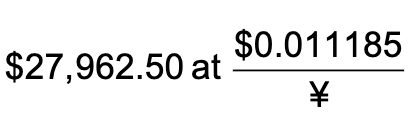
A depreciated currency means that imports are more expensive and domestically produced goods and exports are less expensive.
it lowers the price of exports relative to the price of imports.
Appreciation is an increase in the value of a currency relative to another currency. An appreciated currency is more valuable (more expensive).
It can be exchanged for (can buy) a larger amount of foreign currency.
$1/€ ——> $0.90/€ means the dollar has appreciated relative to the euro.
It now takes only $0.90 to buy one euro, so the dollar is more valuable.
The euro has depreciated relative to the dollar: it is now less valuable.
It can buy more foreign-produced goods denominated in foreign currency.
e.g. a Nissan costs

becomes less expensive
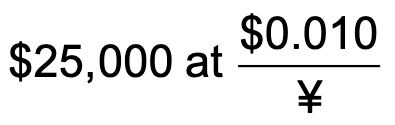
An appreciated currency means that imports are less expensive and domestically produced goods and exports are more expensive.
it raises the price of exports relative to the price of imports.
Foreign Exchange Markets
Foreign exchange markets are where foreign currencies and other assets are exchanged for domestic ones.
Institutions buy and sell deposits of currencies + other assets for investment purposes.
most transactions exchange foreign currencies for U.S. dollars.
The participants:
Commercial banks and other depository institutions: transactions involve buying/selling deposits in different currencies for investment purposes.
Corporations (non-financial businesses) conduct foreign currency transactions to buy/sell goods, services and assets.
Non-bank financial institutions(mutual funds, hedge funds, securities firms, insurance companies, pension funds) may buy/sell foreign assets for investment.
Central banks: conduct official international reserves transactions.
Buying + selling in the forex market are dominated by commercial and
investment banks.
Interbank transactions of deposits in foreign currencies occur in amounts of $1 million or more.
Central banks sometimes intervene, but the direct effects of their transactions are small and transitory (brief) in many countries.
Computer and telecommunications technology transmit information rapidly and have integrated markets.
The integration of financial markets implies there can be no significant differences in exchange rates across locations.
Arbitrage means: buying at low prices and selling at higher price for profit.
e.g. if the euro is selling for $1.1 in New York and $1.2 in London, ppl could buy euros in New York (cheaper) and sell them in London at a profit.
Spot Rates and Forward Rates
Spot rates are ex rates for currency exchanges “on the spot” or when trading occurs in the present.
Forward rates are ex rates for currency exchanges that will occur at a future (“forward”) date.
these are typically 30, 90, 180, or 360 days in the future.
rates are negotiated between two parties in the present, but the exchange occurs in the future.
spot and forward ex rates tend to move in a highly correlated fashion.
Triangular arbitrage
Cross rates
Investing in different currencies