Biology
Topic 2- Organisation
Tissues, Organs and Organ Systems
Cell Organisations
How cells are organised
-Cells are basic building blocks making up all living organisms
-Specialised cells organised to form tissues, forming organs, forming organ systems
-Large multicellular organisms have different systems inside them for exchanging and transporting minerals
Tissue
-Group of similar cells that work together to carry out a particular function
-Can include more than one type of cell e.g:
-Muscular tissue which contracts to bring about movement
-Glandular tissue which secretes substances like enzymes
-Epithelial tissue which covers some body parts, e.g. the inside of the gut
Organs
-A group of different tissues that work together to perform a certain function
-E.g. stomach made up of muscular tissue, glandular tissue and epithelial tissue
Organ Systems
-Group of organs working together to perform a particular function
-e.g. digestive system made of glands, stomach, liver, small intestine, large intestine
Lungs
Purpose
-To get oxygen from the air into the bloodstream to get to cells for respiration and removing carbon dioxide in the blood
-Exchange of gases all happens within the lunges
-Air is forced in and out of the lungs by breathing
Thorax
-Top part of the body, separated from the lower part of the body (abdomen) by the muscle diaphragm
-Lungs in the thorax
-Lungs are like big pink sponges protected by a ribcage
-Lungs surrounded by pleural membranes

-Air breath in goes through the trachea
-Trachea splits into two tubes called ‘bronchi’ (one to each lung)
-Bronchi splits into bronchioles
-Bronchioles end in small bags called alveoli, where gas exchange takes place by diffusion
Alveoli
-Lungs contain millions of alveoli (air sacs) surrounded by a network of blood capillaries
-Where gas exchange happens
-Blood passing alveoli has just returned to lungs from rest of the body so contains lots of carbon dioxide and very little oxygen
-Oxygen diffuses out of alveolus into the blood
-Carbon dioxide diffuses out of the body to alveolus to be breathed out

-When blood reaches body cells, oxygen is released from red blood cells and diffuses into body cells
-Carbon dioxide diffuses out of body cells into blood and carried back to lungs

Calculating breathing rate
-Often asked question
-Number of breaths/ number of minutes = breaths per minute
Circulatory System→ The Heart
Function of the circulatory system
-To get food and oxygen to every cell in the body
-Also a waste collection with carbon dioxide and urea collected to be removed from the body
-Includes the heart, blood vessels and the blood
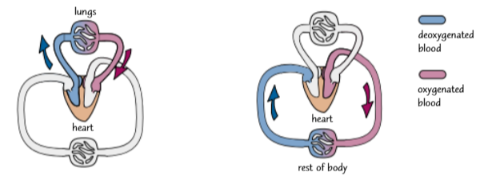
Double Circulatory System
-Two circuits joined and work together
-First circuit→ right ventricle pumps deoxygenated blood to the lungs to take in oxygen. Blood then returns to the heart
-Second circuit→ left ventricles pumps oxygenated blood around all other organs of the body. Blood gives up oxygen at the body cells and deoxygenated blood returns to the heart to head to the lungs
Structure of the Heart
-Pumping organ that keeps blood flowing around the body
-Walls made of mostly muscle tissue which contracts to pump blood
-4 chambers: right atrium, right ventricle, left atrium, left ventricle
-Main blood vessels leading in and out of the chambers are the vena cava, pulmonary artery, aorta and pulmonary vein

-Vena cava → right atrium → right ventricle → pulmonary artery → pulmonary vein → left atrium → left ventricle → aorta → on a loop!
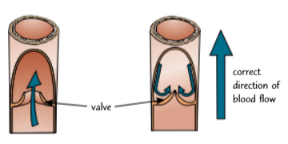
-Heart has valves to ensure the blood goes in the right direction
-Coronary arteries branch off aorta and surround the heart to ensure it gets all oxygenated blood it needs
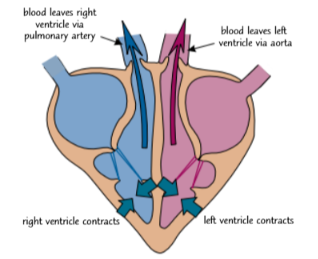
Blood flow through the heart
Blood flows into the two atria from the vena cava and pulmonary vein
Atria contracts which pushes blood into the ventricles
Ventricles contract, forcing blood into pulmonary artery and aorta and out the heart
Atria fill again and the whole cycle starts again


Hearts Pacemaker
-Resting heart rate is controlled by a group of cells in the right atrium wall that act as a pacemaker
-These cells produce a small electric impulse which spreads to surrounding muscle cells, causing contractions
-Artificial pacemakers can be used for those with an irregular heart beat due to the cells not working properly
-A little device implanted under the skin with a wire going to the heart→ produces an electric current to keep the heart beating regularly
The Circulatory System→ The Blood Vessels
Arteries
-Blood vessels which carry blood away from the heart, towards the organs
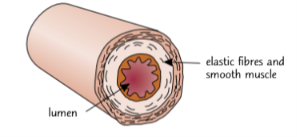
-Heart pumps blood out at high pressure to artery walls are strong and elastic
-Contains thick layers of muscle to make them strong
-Elastic fibres allow them to stretch and spring back
-Thick walls compared to the size of the hole down the middle (lumen)
Capillaries
-Arteries branch into capillaries
-Involved in the exchange of materials at the tissues
-Carry blood really close to every cell in the body to exchange substances with them
-Supply food and oxygen to the cells and take away waste products like carbon dioxide
-Really tiny→ too small to see
-Permeable walls so the substances being exchanged with the cells can diffuse in and out
-Walls usually only one cell thick which increases rate of diffusion by decreasing the distance over which diffusion occurs
-Capillaries are very narrow giving them a large surface area to volume ratio, increasing diffusion rate

Veins
-Capillaries eventually join up to form veins
-Carry blood to the heart
-Blood at its lowest pressure so walls do not need to be as thick as artery walls
-Have a bigger lumen than arteries to help the blood flow despite lower pressure

-Have valves to keep blood flowing in right direction
Calculating rate of blood flow
-Rate of blood flow = volume of blood/ number of minutes
The Circulatory System→ The Blood
What?
-A tissue
-Function is to transport substances around the body
-Made up of red blood cells, white blood cells and platelets which are all suspended the liquid plasma
Red blood cells
-Job is to transport oxygen around the body
-Have a biconcave shape to give them a large surface area for absorbing oxygen and they contain a red pigment called haemoglobin which carries the oxygen
-Do not have a nucleus which allows more room for haemoglobin meaning they can carry more oxygen
Transporting oxygen
-All body cells need oxygen for respiration
-Oxygen enters the lungs when you breathe in, then red blood cells transport the oxygen from the lungs to all the cells in the body
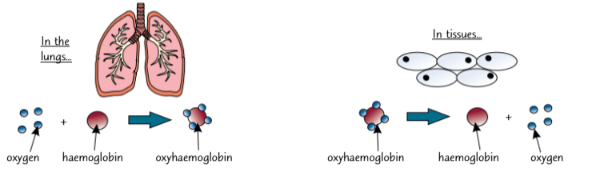
-In lungs, oxygen diffuses into blood. Oxygen combines with haemoglobin in the blood cells to become oxyhaemoglobin
-In body tissues, oxyhaemoglobin splits up into haemoglobin and oxygen to release oxygen to the cells
White Blood Cells
-Different types of white blood cells but they all have the same function→ to defend against microorganisms that cause disease. Can do this in different ways:
-Engulf unwelcome microorganisms (process called phagocytosis) and digest them
-Produce antibodies to fight microorganisms
-Can produce antitoxins to neutralise any toxins produced by the micro-oganisms
-Do have a nucleus
Platelets
-Small fragments of cells
-No nucleus
-Help blood to clot at a wound→ seals the wound and stop you loosing too much blood
-Stops micro-organisms from getting in at the wound
-Lack of platelets can cause excessive bleeding and bruising
Plasma
-Pale straw-coloured liquid which carries just about everything in the blood. It carries:
-Red and white blood cells and platelets
-Nutrients like glucose and amino acids→ soluble products of digestion which are absorbed from the small intestine and taken to cells of the body
-Carbon dioxide from the organs to the lungs
-Urea from the liver to the kidneys
-Hormones
-Proteins
-Antibodies and antitoxins produced by the white blood cells
Plant Cell Organisation
How are plant cells organised?
-Plants made of organs such as stems, roots and leaves
-Plant organs work together to make organ systems which can perform the various tasks that a plant needs to carry out to survive and grow→ e.g. transporting substances around the plant
-Plant organs are made of tissues, e.g:
-Epidermal tissue→ covers whole plant
-Palisade mesophyll tissue→ part of leaf where most photosynthesis happens
Leaf Structure
-Leaf is an organ made up of several types of tissue
-Contain epidermal, mesophyll, xylem and phloem tissue
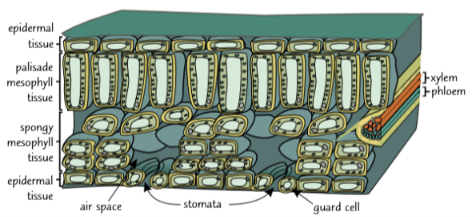
-Epidermal tissues are covered with a waxy cuticle, which helps to reduce water loss by evaporation
-Upper epidermis is transparent so light can pass through to palisade layer
-Palisade layer has lots of chloroplasts near the top of the leaf where they can get the most light
-Xylem and phloem form a network of vascular bundles which deliver water and other nutrients to the entire leaf and take away the glucose produced by photosynthesis as well as supporting the structure
-Tissue of leaves are also adapted for efficient gas exchange
-Plant leaf:
-Epidermal tissue
-Palisade mesophyll tissue
-Spongy mesophyll tissue
-Epidermal tissue
-Underside: air space, stomata and guard cells
-Includes xylem and phloem
Transpiration and Translocation
Transport tissues in plants
-Flowering plants have two separate types of tissue- phloem and xylem- for transporting substances around
-Both types of tissue form ‘tubes’ which go to every part of the plant but are totally separate
Phloem
-Made of columns of elongated living cells with small pores in the end walls to allow cell sap to flow through
-Cell sap is a liquid made up of the substances being transported and water
-Phloem tubes transport food substances made in the leaves to the rest of the plant for immediate use or storage
-Transport goes in both directions→ from roots to leaves and leaves to roots
-Process called translocation

Xylem
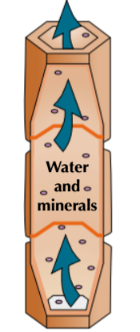
-Made of dead cells joined end to end with no end walls between them an a hole down the middle
-Strengthened with lignin
-Carry water and mineral ions up the plant→ from roots to stem and leaves
-Movement of water from roots through the xylem and out the leaves is the transpiration stream
The Transpiration Steam
-Transpiration is the loss of water from a plant
-Movement of water through a plant from roots to the leaves
Water from inside a leaf evaporates and diffuses out the leaf, mainly through stomata
Creates a slight shortage of water in the leaf so more water is drawn up from the rest of the plant through the xylem vessels to replace it
More water is drawn up from the roots so there is a constant transpiration stream of water through the plant

-Transpiration is a side-effect of the way leaves are adapted for photosynthesis
-Must have stomata in them so gases can be exchanged easily
-As there is more water inside the plant than in the air outside, water escapes the leaves through the stomata by diffusion
Transpiration and Stomata
Factors affecting transpiration rate
Light Intensity
-Brighter the light, greater the transpiration rate
-Stomata begin to close as it gets darker→ photosynthesis cannot happen in the dark so do not need to be open to let CO2 in
-When stomata are closed, very little water can escapeAir flow
-Better the airflow around the leaf (i.e. strong winds), the greater the transpiration rate
-If air flow around the leaf is poor, water vapour surrounds the leaf and doesn’t move away, causing a concentration of water particles outside the leaf as well as inside so diffusion doesn’t happen as quickly as if there is good airflow
-Diffusion happens quickly from area of higher concentration to area of lower concentrationHumidity
-Drier the air around the leaf, the faster the transpiration happens
-Humid air means there is a lot of water in it so not a large concentration gradient from the leaf
Investigating Transpiration rate
-Can estimate rate of transpiration by measuring uptake of water by a plant
-Can assume water uptake by plant is directly related to water loss by leaves (transpiration)
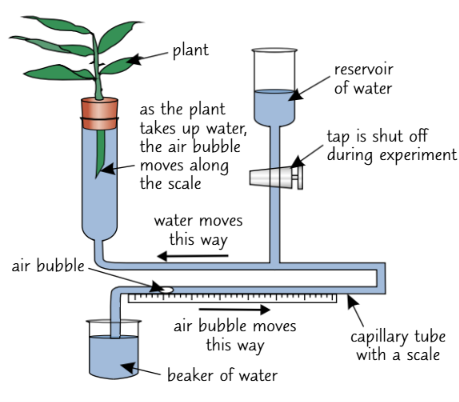
-Apparatus set up as shown in diagram
-Record the starting position of the air bubble
-Start a stopwatch and record distance moved by the bubble per unit of time
-Keep conditions constant throughout the experiment
Guard Cells
-Two guard cells surround each stoma
-Have a kidney shape which opens and closes the stomata in the leaf
-When plant has lots of water, guard cells fill with it and go turgid making the stomata open to gases can be exchanged for photosynthesis→ also helps stop too much water vapour escaping
-When plant is short for water, guard cells lose water and become flaccid, making stomata close→ helps stop too much water vapour escaping

-Thin outer walls and thickened inner walls to make opening and closing work
-Also sensitive to light and close at night to save water without losing out on photosynthesis
-Usually on the underside of the leaves as the lower surface is shaded and cooler so less water is lost through the stomata than if they were of the upper surface
-Adapted for gas exchange and controlling water loss within a leaf
Investigating stomata and guard cells
For some plants, you can peel the epidermal tissue off the leaf and mount a piece on a microscope slide. Using a pipette, put a large drop of water onto the slide then place the tissue into the water using tweezers, put a cover slip on
For a leaf not possible to peel the top layer off, you make an ‘imprint’ of its surface using clear nail varnish→ apply a thin layer of varnish to underside of leaf, allow to dry then use a piece of sticky tape to remove varnish from leaf, gently peeling then stick tape to a microscope slide
Put on microscope’s stage and focus microscope. Start with least powerful objective lens and work way up until you can see the stomata and guard cells clearly
Now estimate total number of stomata on surface. Make sense to only count a ‘sample’
Count stomata in field of vision and when finished move slid so you look at a new field and count again. Do at least three times then determine average number per field of vision
Estimate total number of stomata on the entire surface
-Can compare distribution of stomata in different areas of a leaf or between leaves
Health and Disease
Introduction to Health and Disease
Diseases
-Often responsible for causing ill health
-Health is the state of physical and mental well-being
-Can be communicable or non-communicable
Communicable Diseases
-Those that can spread between people or between animals and people
-Can be caused by e.g. bacteria, viruses, parasites and fungi
-Measles and malaria are common examples
Non-Communicable Disease
-Those that cannot spread between people or people and animals
-Generally last for a long time and get worse slowly
-Asthma, cancer and coronary heart disease are common examples
Interaction of diseases
-Diseases can interact and cause other physical and mental health issue that do not seem related
Examples
-Those with immune system issues mean increased chance of suffering from communicable diseases
-Some types of cancer can be triggered by certain viruses
-Immune system reactions caused by pathogen infection may trigger allergic reactions
-Mental health issues such as depression can be triggered
Other factors effecting health
-Diet
-Stress
-Life situation (e.g. can you access medicine easily?)
Cardiovascular Disease
What?
-Term used to describe disease of heart or blood vessels
-Common example is coronary heart disease
-When coronary arteries get blocked by layers of fatty material building up
-Arteries narrow, restricting blood flow so lack of oxygen to heart muscle→ could result in heart attack
Stents
-Wire mesh tubes
-Inserted inside arteries to widen them and keep them open
-Ensures blood can pass through to the heart muscles, keeping the heart beating

Stents Advantages | Stents Disadvantages |
-Effective for a long time | -Risk of complications during operation |
-Relatively quick recovery time from surgery | -Risk of infection from surgery |
-Risk of developing blood clots near the sent→ thrombosis |
Statins
-Drugs that can remove the amount of ‘bad’ cholesterol present in the blood stream
-Cholesterol is an essential lipid the body produces and needs to function properly
-Too much of cholesterol can cause health problems
-Fatty deposits form in the arteries
-Taking statins slows down the rate of fatty deposits forming in the arteries
Statins Advantages | Statins Disadvantages |
-Reduces risk of strokes, coronary heart disease and heart attacks | -A long term drug that must be taken regularly so risk of being forgotten |
-Increases amount of a beneficial type of cholesterol→ this type can also remove ‘bad’ cholesterol from the blood | -Sometimes has negative side effects with some very serious |
-Some studies suggest statins may prevent other diseases | -Not an instant effect as it takes time to kick in |
Artificial Hearts
-Mechanical devices that pump blood for a person whose heart has failed
-Usually temporary fix until a donor heart is found
-Some cases are permanent so reduces need for a donor heart
Artificial Heart Advantages | Artificial Heart Disadvantages |
-Less likely to be rejected by immune system than a donor heart | -Surgery can lead to bleeding and infection |
-Made of metals or plastics so are not recognised as ‘foreign’ by the bodies immune system | -Don’t always work as well as a natural heart→ parts could wear out or the electric motor could fail |
-Blood flows less smoothly which can cause blood clots→ blood thinners taken but this means wounds may not be able to heal as well | |
-May be uncomfortable for the patient |
Replacement Heart Valves
-Valves in the heart can be damaged or weakened by heart attacks, infection or old age
-Damage may cause valve tissues to stiffen so it won’t open properly or a vale may become leaky, allowing blood to flow in both directions, rather than just forward
-Blood wont circulate as effectively as normal
-Severe valve damage can be treated by replacing the valve
-Replacement valves can be ones taken from humans or other mammals→ biological valves
-May be man-made→ mechanical valves
-Replacing a valve is a less drastic procedure than a whole heart transplant
-Fitting artificial valves is still major surgery and there can still be problems with blood clots
Artificial Blood
-When someone loses a lot of blood, e.g. car accident, their heart can still pump the remaining red blood cells around as long as the volume of their blood can be topped up
-Artificial blood is a blood substitute which is sued to replace the lost volume of blood
-Safe (if no air bubbles can get into blood)
-Can keep people alive if they lose up to 2/3 of their red blood cells
-Gives the patient enough time to produce new blood cells, if not, patient will need a blood transfusion
-Ideally, an artificial blood product would replace the function of the lost red blood cells, so there is no need for a blood transfusion→ scientists currently working on this
Risk Factors for Non-Communicable Diseases
What?
-Things linked to an increase in the likelihood that a person will develop a certain disease during their lifetime→ don’t guarantee that someone will get the disease
-Risk factors are often aspects of a person’s lifestyle
-Can be the presence of certain substances in the environment
-Many non-communicable diseases are caused by several different risk factors interacting with each other rather than one factor alone
-Lifestyle factors can have different impacts locally, nationally and globally
-Nationally, people from deprived areas are more likely to smoke, have a poor diet and not exercise→ cardiovascular disease, obesity and Type 2 diabetes is higher
Risk Factors that cause disease
Examples
-Smoking has been proven to directly cause cardiovascular disease, lung disease and lung cancer
-Obesity can directly cause Type 2 diabetes by making the body less sensitive or resistant to insulin
-Drinking too much alcohol can cause liver disease
-Exposer to radiation can cause cancer
Correlation and cause
-Risk factors are identified by scientists looking for correlations in data, and correlation doesn’t always equal cause
-Some risk factors are not capable of directly causing a disease but are related to another risk factor that is
The cost of non-communicable diseases
Human Cost
-Tens of millions of people around the world die from non-communicable diseases per year
-People with the diseases may have a lower quality of life or a shorter lifespan
-Effects not only the person with the diseases themselves, but their loved ones to
Financial Cost
-Cost for the NHS (an other health organisations around the world) of researching and treating these diseases is huge
-Families may need to move or adapt their home to help a family member with a disease, can be costly
-If resulting in death, family’s income will be reduced
Cancer
Tumours
-Cancer caused by uncontrolled cell growth and division
-Not all tumours are cancerous→ can be benign or malignant
Benign Tumours
-Where tumours grow until there is no more room
-Tumour stays in one place, rather than invading other tissues in the body
-Not normally dangerous and the tumour is not cancerous
Malignant Tumours
-Where tumour grows and spreads to neighbouring healthy tissues
-Cells can break off and spread to other parts of the body by travelling in the bloodstream
-Malignant cells then invade healthy tissues elsewhere in the body and form secondary tumours
-Dangerous and can be fatal→ are cancerous
Risk Factors for Cancer
-Cancer survival rates have increased due to medical advances such as improved treatment, being able to diagnose cancer earlier and increased screening for the disease
-Risk factors can increase the change of developing some cancers
-Having risk factors does not mean that you will definitely get cancer→ an increased risk in comparison
-Some risk factors associated with aspects of a person’s lifestyle, some with genetics
Lifestyle risk factors examples:
-Smoking→ linked to lung, mouth, bowel, stomach and cervical cancer
-Obesity→ linked to bowel, liver and kidney cancer
-UV exposure→ Increased chance of developing skin cancer
-Viral infection→ some viruses linked to certain types of cancer
Genetic Risk Factors
-Genes control activities of your cells and you characteristics
-Can inherit faulty genes that make you more susceptible to cancer
Enzymes and Digestion
Enzymes
-Reactions inside living things must be carefully controlled to get the right amounts of substances
-Living thins produce enzymes that act as biological catalysts which reduce the need for high temperatures and we only have enzymes to speed up useful chemical reactions in the body
-A catalyst is a substance which increases the speed of a reaction, without being changed or used up in the reaction
-All large proteins and all proteins are made up of chains of amino acids
-These chains folded into unique shapes which enzymes need to do their job
Active Sites
-Every enzymes has an active site with a unique shape that fits onto the substance involved in a reaction
-Substance the enzyme acts on is called the substrate
-Enzymes usually only catalyse one specific reaction
-Substrate must fit into its active site, if substrate doesn’t match the enzyme’s active sit, reaction won’t be catalysed

-Above image shows ‘lock and key’ model of enzyme action
-In reality, active site changes shape a little as the substrate binds to it to get a tighter fit→ called ‘induced fit’ model of enzyme action
Optimum conditions for enzymes
-Enzymes need right conditions, temperature and pH, for them to work best→ optimum conditions
Temperature
-Changing temperature changes the rate on an enzyme-catalysed reaction
-Higher temperature increases the rate at first, but if gets too hot, some bonds holding the enzyme together break, changing the shape of the enzymes active site→ denatured
-Optimum temperature is around 37*C for enzymes in a human body

pH
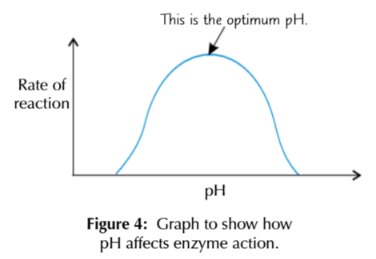
-If too high or too low, pH interferes with the bonds holding the enzymes together, chancing the shape of the active site and denatures the enzyme
-All enzymes have an optimum pH they work best at
-Optimum pH is different for different enzymes depending on where they work, for many it is pH 7
-E.g. Pepsin, an enzyme used to break down proteins in the stomach, works best as pH 2, acidic
Calculating the rate of a reaction
-Often useful to calculate rate of an enzyme-controlled reaction
-Rate is a measure of how much something changes over time
-Rate= 1000/time
-Units are s-1 since rate is given per unit of time
-Rate = change/time
Required Practical 5: Investigating Enzymatic Reactions
Investigating the effect of pH on amylase
-Enzyme amylase catalyses the breakdown of starch to maltose
-If starch is present, iodine solution will change from orange to blue-black
Put a drop of iodine solution into every well of a spotting tile
Set up equipment as shown, heat the water until it is 35*C (use a thermometer to measure the temperature). Try to keep water temperature constant throughout the experiment
Use a syringe to add 1cm3 of amylase solution and 1cm3 of a bugger solution with a pH of 5 to a boiling tube. Using a test tube holders, put the boiling tube into the beaker of water and wait five minutes
Use a different syringe to add 5cm3 of a starch solution to the boiling tube
Immediately mix contents of boiling tube and start a stop clock
Use continuous sampling to record how long it takes for the amylase to break down all of the starch. Use a dropping pipette to take a fresh sample from the boiling tube every thirty seconds and put a drop into a well. When the iodine solution remains orange, starch is no longer present
Repeat whole experiment with buffer solutions of different pH values to see how pH affects the time taken for the starch to be broken down
Remember to control any variables each time to make it a fair test

Enzymes and Digestion
The Digestive System
-An organ system that breaks down food so that nutrients can be absorbed into the body from the gut
-Food broken down in two ways
-By mechanical digestion→ includes teeth grinding food and stomach churning food
-By chemical digestion→ enzymes help to break down food

Digestive Enzymes
-Enzymes involved in digestion work outside body cells
-Produced by specialised cells in glands and in the gut lining and then released into the gut to mix with food molecules such as carbohydrates, proteins and lipids
-Starch, proteins and lipids are large, insoluble molecules, too big to pass through walls of digestive system, so digestive enzymes break them into smaller ones; sugars, amino acids, glycerol, fatty acids
-Smaller, soluble molecules can pas easily through walls of digestive system, allowing them to be absorbed into the bloodstream
-Body makes good use of products in digestion: can make new carbohydrates, proteins and lipids and some glucose made is used in respiration
-Different digestive enzymes help to break down different types of foods
Carbohydrases
-Convert carbohydrates into simple sugars
-Amylase is an example of a carbohydrase
-Breaks down starch into sugars
-Amylase made in the salivary glands, pancreas and small intestine
-Works in mouth and small intestine
Proteases
-Digestive enzymes that catalyse the conversion of proteins into amino acids
-Made in stomach, pancreas and small intestine
-Works in stomach and small intestine
Lipases
-Digestive enzymes that catalyse the conversion of lipids into glycerol and fatty acids
-Made in the pancreas and small intestine
-Works in the small intestine
Enzyme→ | Amylase | Proteases | Lipases |
Helps break down… | Starch | Proteins | Lipids |
…into… | Sugars | Amino acids | Glycerol and fatty acids |
Made in the… | Salivary glands, pancreas and small intestine | Stomach, pancreas and small intestine | Pancreas and small intestine |
Work(s) in the… | Mouth and small intestine | Stomach and small intestine | Small intestine |
Bile
-Produced in the liver
-Stored in the gall bladder before released into small intestine
-Hydrochloric acid in stomach makes pH too acidic for enzymes in small intestine to work properly
-Bile is alkaline- neutralises the acid and makes conditions alkaline
-Enzymes in small intestine work best in alkaline conditions
-Bile also emulsifies fat→ breaks fat into tiny droplets, giving them a bigger surface area for lipase to work on, making digestion faster
Require Practical 4: Food Tests
Preparing food sample
Get a piece of food and break it up use a pestle and mortar
Transfer the ground up food to a beaker and add some distilled water
Give mixture a stir with a glass rod to dissolve some of the food
Filter the solution using a funnel lined with filter paper. Will get rid of all solid bits of food
Testing for Sugars
-Found in all sorts of foods such as biscuits, cereal and bread
-Two types of sugar: no-reducing and reducing
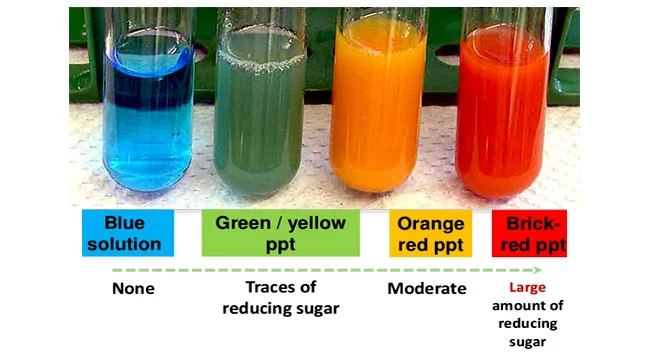
-Can test for reducing sugars in food using Benedict’s test
Prepare a food sample using method described above
Prepare water bath set to 75*C
Add Benedict’s solution to test tube (about 10 drops) using a pipette
Place test tube in water bath using a test tube holder and leave for 5 minutes. Ensure tube is pointing away from you
During this time, if the food sample contains reducing sugar, solution in test tube will change from blue to green, yellow or brick-red (dependent on amount of sugar in food)
-Positive result is one where test has identified presence of what is being tested (sugar in this case)
-Negative result is one where test has not identified presence of what’s being tested for
Testing for Starch
-Can check food samples for presence of starch using iodine test
-Foods such as pasta, rice and potatoes contain a lot of starch
Make a food sample using the method above and transfer 5cm3 of sample to a test tube
Add a few drops of iodine solution and gently shake the tube to mix the contents. If sample contains starch, colour of solution will change from orange to blue-black

Testing for Proteins
-Can use biuret test to see if a type of food contains protein
-Meat and cheese are protein-rich and good foods to use in test
Use method above to prepare food sample. Transfer 2cm3 sample to a test tube
Add 2cm3 of biuret solution to sample and mix contents of tube by gently shaking it
If food sample contains protein, solution will change from blue to purple

Testing for Lipids
-Lipids found in foods such as olive oil, margarine and milk
-Can test for lipid presence using Sudan III stain solution
Prepare a sample of the food testing using above method (not filtering it). Transfer about 5cm3 into a test tube
Use a pipette to add 3 drops of Sudan III stain solution to test tube and gently shake tube
Sudan III stain solution stains lipids. If food sample contains lipids, mixture will separate out into two layers. Top layer will be bright red

Topic 4- Bioenergetics
The Basics of Photosynthesis
What?
-The process that produces glucose in plants
-Uses energy to change carbon dioxide and water into glucose and oxygen
-Plants use the glucose for many things such as making cell walls and proteins
Where?
-Takes place in the chloroplasts in green plant cells which contain pigments such as chlorophyll that absorb light
-Energy is transferred to the chloroplast from the environment by light
-Photosynthesis is endothermic- i.e. energy is transferred from the environment in the process
-Happens in the leaves of all green plants- largely what leaves are for

Word Equation
-Carbon Dioxide + Water (presence of light) → glucose + oxygen
Symbol Equation
6CO2 + 6H2O (light) → C6H12O6 + 6O2
How Plants Use Glucose
What?
Respiration
-A process which occurs in all living organisms- where energy is released from the breakdown of glucose
-Plants use this energy to convert the rest of the glucose into various other useful substances, which they can use to build up new cells to grow
-To produce some of these substances plants also need to gather a few minerals from the soil
Making cellulose
-Glucose is converted into cellulose for making strong cell walls, especially in a rapidly growing plant
-Cell walls support and strengthen the cells
Making amino acids
-In plant cells, glucose combined with nitrate ions (absorbed from the soil) to make amino acids
-Building blocks for proteins and when joined in a particular sequence, form a particular protein
Storage of glucose
Lipids
-Plants store lipids in seeds
-E.g. sunflower seeds contain a lot of oil so we get cooking oil and margarine from them
Starch
-Stored as starch so it is ready for use when photosynthesis rates drop off, e.g. winter time
-Stored in roots, stems, seeds and leaves
-E.g. Potato and parsnips plants store a lot of starch underground over the winter so a new plant can grow from it the following spring, we eat the swollen storage organs
-Insoluble which makes it better for storing that glucose and a cell with lots of glucose in would draw in lots of water and swell up
The Rate of Photosynthesis
Limiting factors in photosynthesis
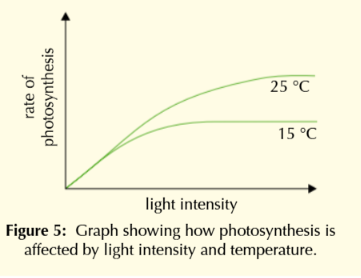
-Affected by the intensity of light, concentration of carbon dioxide (C02) and the temperature
-All three factors must be at the right level to allow a plant to photosynthesise as quickly as possible
-If one factor is too high/low, it becomes the limiting factor
-E.g. at night, less light so light intensity is limiting factor
-E.g. winter is usually cold so temperature is limiting factor
-E.g. if warm and bright enough, amount of CO2 is limiting usually
-Amount of chlorophyll can also be a limiting factor for photosynthesis
Interpreting data on the rate of photosynthesis
Effect of light intensity
-Provides the energy needed for photosynthesis
-As light intensity is raised, rate of photosynthesis increases steadily- only to a certain point

-Can change light intensity in a lab by moving a lamp closer/ further away from the plant
Effect of carbon dioxide level
-CO2 increases the light intensity to a certain point

Effect of temperature
-Enzymes are proteins which increase rate of photosynthesis in plant cells
-The speed at which enzymes work is affected by temperature
-Enzymes work slower in lower temperatures, but if the plant is too hot, the enzymes will denature (45*C)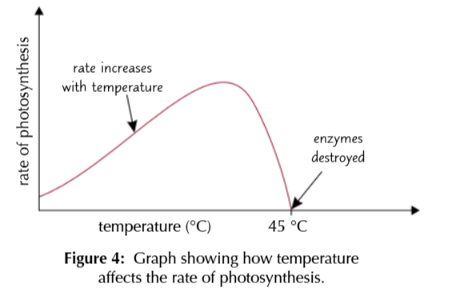
Graphs with more than one limiting factor

Required Practical 6: Investigating the Rate of Photosynthesis
Investigating photosynthesis rate
To investigate the effect of different light intensities on the rate of photosynthesis, you must be able to measure the rate. One way involves an aquatic plant, such as Canadian pondweed. Rate at which the pondweed produces oxygen corresponds to the rate at which it is photosynthesis
How the experiment works:
-A source of white light is placed at a specific distance from the pondweed
-Leave the pondweed for a couple of minutes to adjust to the new light intensity before starting the experiment
-Pondweed is left to photosynthesis for a set amount of time and as it photosynthesises, oxygen released will collect in the capillary tube
-Syringe is used to draw the gas bubble in the tube alongside a ruler and the length of a the gas bubble is measured- proportional to the volume of 02 produced
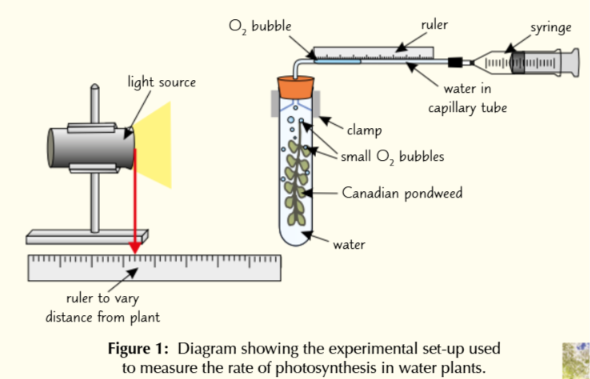
-Experiment repeated twice with the light source at the same distance and mean volume of O2 produced is calculated
-Whole experiment is repeated with light source at different distances from the pondweed
Controlling Variables
-Independent variable: light intensity
-Dependent variable: amount of oxygen produced, represented by the length of the bubble
-All other variables must remain constant to ensure a fair test
Calculating rate of photosynthesis
-Can compare results at different light intensities by giving the rate of photosynthesis as the length of the bubble per unit time. e.g. cm/min
-To calculate rate, divide total length of bubble by the time taken to produce it
Inverse Square Law
What?
-When the lamp is moved away from the pondweed, the amount of light that reaches the pondweed decreases
-Distance and light intensity are inversely proportional (but the the square)
-Light intensity ∝ 1/distance (d) 2
Artificially Controlling Plant Growth
Greenhouse
-If you know ideal conditions for photosynthesis, you can create an environment which maximises the rate of photosynthesis, which in turn maximises the rate of plant growth
-Most common way to artificially create a better environment for plants is to frow them in a greenhouse
-Commercial growers often grow large quantities of plants in commercial greenhouses
-Condition which can be managed in a greenhouse:
Temperature
-Help traps the Sun’s heat and ensure temperature does not become limiting
-Can also be controlled with a heater and shades in the summerLight
-Always needed for photosynthesis so farmers often supply artificial light during darkCarbon dioxide concentration
-Can increase the level of carbon dioxide in the greenhouse
-Fairly common way is to use a paraffin heater to heat the greenhouse- as paraffin burns, it makes carbon dioxide as a by-productGeneral health of plants
-Keeping plants enclosed in a greenhouse also makes it easier to keep them free from pests and diseases
-Farmers can add fertilisers to the soil to provide all minerals the plants need
Greenhouse costs
-Controlling the conditions costs money but the better conditions will bring more profit from the crops
-Important not to supply more of something that the plant needs so money is not wasted
Interpreting data on artificial environments
-If given data about controlling photosynthesis, questions can be asked about it

Aerobic Respiration
Respiration and enzymes
-Chemical reactions that occur inside cells are controlled by enzymes
-All reaction involved in respiration are catalysed by enzymes
-Respiration is the process of transferring energy from the breakdown of glucose
-All living things respire (so in plants too and how they release energy from their food)
-Respiration is the process of transferring energy from glucose, which goes on in every cell
-Respiration is exothermic- i.e. transfers energy to the environment
What?
-Respiration using oxygen
-Most efficient way to transfer energy from glucose
-Happens all the time in plants and animals
-Most reactions in aerobic respiration happen inside the mitochondria
Word Equation
-glucose + oxygen → carbon dioxide + water
Symbol Equation
C6H12O6 +6O2 → 6CO2 +6H2O
Energy from respiration
-Organisms use the energy transferred by respiration to fuel many process- need to know:
Organisms use energy to build up larger molecules from smaller ones (e.g. proteins and amino acids)
Animals use energy to allow their muscles to contract (which in turn allows them to move)
Mammals and birds use energy to keep their body temperature steady (unlike other animals, mammals and birds keep their bodies constantly warm)
Anaerobic Respiration
What?
-When your body cannot supply enough oxygen to your muscles so do anaerobic respiration as well as aerobic respiration
‘Anaerobic’ means ‘without oxygen’
-Incomplete breakdown of glucose, making lactic acid
-Word equation for anaerobic respiration in muscle cells:
-glucose → lactic acid
-Do not transfer nearly as much energy as aerobic respiration
-Glucose is not fully oxidised (as it does not combine with oxygen)
-Only useful in emergencies; e.g. during exercise when it allows you to keep on using your muscles for a while longer
Oxygen Debt
-After resorting to anaerobic respiration, when exercise stopped, you have ‘oxygen debt’
-Amount of extra oxygen your body needs after exercise
-Must ‘repay’ oxygen you didn’t get to your muscles in time as lungs and heart could not keep up
Removing Lactic Acid
-The extra oxygen that ‘repays’ the oxygen debt is needed to react with the lactic acid in the muscles to form harmless carbon dioxide and water
-Oxygen debt is the amount of extra oxygen the body needs after exercise to react with the build-up of lactic acid and remove it from the cells
-Pulse and breathing rate stay high whilst there are high levels of lactic acid and carbon dioxide to deliver more oxygen to the cells and take away the carbon dioxide
-Blood entering muscles transports the lactic acid to the liver where it is converted back to glucose
Anaerobic respiration in plants and yeast
-Can respire without oxygen, but produce ethanol (alcohol) and carbon dioxide, not lactic acid
-Glucose → ethanol + carbon dioxide
Fermentation
-Anaerobic respiration in yeast cells is called fermentation
-Great economic value because it is used to make bread and alcoholic drinks
-Carbon dioxide from fermentation that makes bread rise
Exercise
Energy for exercise
-Muscle cells use oxygen to transfer energy from glucose which is used to contract the muscles
-When exercising, more muscles contract more frequently than normal so more energy required which comes from increased respiration
-Physical activity:
-Increases your breathing rate and breath volume to meet the demand for extra oxygen
-Increases your heart rate to make your blood flow quicker, delivering more oxygen and glucose to cells for respiration, and taking more carbon dioxide away
-When doing vigorous exercise (like sprinting), your body cannot supply oxygen to your muscle quickly enough, so start respiring anaerobically
-Long periods of exercise cause muscle fatigue- muscles get tired and then stop contracting quickly
Recovery Period
Investigating the effect of exercise
-Can measure breathing rate by counting breaths , and heart rate by taking the pulse
Metabolism
What?
-Lots of chemical reactions happening all the time, controlled by enzymes
-Many of these reactions are linked together to form bigger reactions
-Overall these reactions are endothermic (take in energy form the environment) as in most reactions, larger molecules are made from smaller ones
-In other reactions, larger molecules are broken down into smaller ones and overall exothermic
-Sum of all reactions that happen in a cell or body is called metabolism
Topic 5- Homeostasis and Response
The Nervous System
Homeostasis
What?
-Conditions inside your body must be kept steady, even when external environments change
-Important as your cells need the correct conditions to function properly, including right conditions for enzymes action
-Homeostasis is the regulation of the conditions inside your body (and cells) to maintain a stable internal environment in response to changes in both internal and external conditions
-Have lots of automatic control systems in your body, regulating your internal environment→ includes both nervous and hormonal (chemical) communication systems
-All automatic control systems made up of three main components:
-Receptors
-Coordination centres
-Effectors
Stimuli and Negative Feedback
-A stimulus is a change in your environment you may need to respond to
-Stimulus can be light, sound, touch, pressure, pain, chemical or change in position or temperature
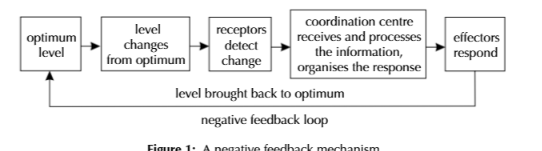
-Receptors detect a stimulus when the level of something is too high or low
-Receptors send this information to coordination centre which processes the information and organises a response from effectors
-Effectors respond to counteract the change→ brings levels back to optimum
-Mechanisms restoring optimum level is called negative feedback mechanism
Nervous System
What?
-Organisms must respond to stimuli in order to survive
-Cells of multicellular organisms must communicate first
-Nervous system allows you to respond to surrounds and coordinate your behavior
-Made up of neurons (nerve cells)
Receptors
-Cells that detect stimuli
-Many different types:
-Taste receptors on the tongue
-Sound receptors in the ears
-Smell receptors in the nose
-Light receptors in the eyes
-Can form part of larger, complex organisms, e.g the retina in the eye is covered in light receptor cells
Central Nervous System (CNS)
-Where all information from receptors is sent
-Where reflexes and actions are coordinated
-In vertebrates (animals with a spine), it consists of the brain and spinal cord only
-In mammals, the CNS is connected to the body by sensory neurons and motor neurons
Effectors
-’Instructions’ from CNS sent along neurons to effectors
-Muscles or glands which respond to nervous impulses and bring about a response to a stimulus
-Muscles contract
-Glands secrete chemical substances, hormones
-Different types of neurones
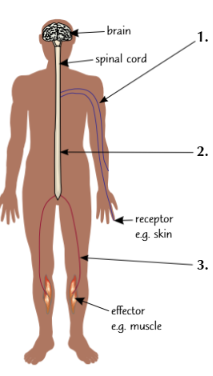
Sensory neurones carry information as electrical impulses from receptors in snse organs to the CNS
Relay neurones carry electrical impulses from sensory neurones to motor neurones, found in the CNS
Motor neurons carry electrical impulses from the CNS to the effectors

Synapses and Reflexes
-Connection between 2 neurones
-Nerve signal is transferred by chemicals which diffuse across the gap
-The chemicals set off a new electrical signal in the next neurone
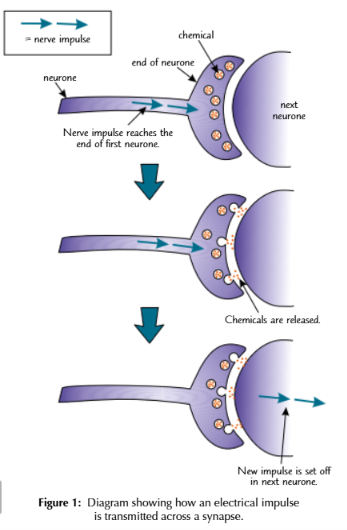
-Neurones deliver information very quickly because signal is transmitted by electrical impulses
-Synapses slow down transmission of a nervous impulse as diffusion of chemicals across the gap takes time (still fast though)
Reflexes
-Fast, automatic responses to certain stimuli
-Bypass conscious brain completely
-Can reduce chance of injury among other things, e.g. pupils dialating
Reflex Arcs
-Passage of information in a reflex
-Neurones in reflex arc go through spinal cord on an unconscious part of the brain
-Main stages:
When receptors detect stimuluses, impulses sent along a sensory neurone to a relay neurone in the CNS
When impulses reach a synapse between sensory neurone and relay neurone, they trigger chemicals to be release. These chemicals cause impulses to be sent along relay neurones
When impulses reach a synapse between a relay neurone and a motor neurone see point 2
Impulses travel along motor neuron to effector (usually muscle)
If effector is muscle, will respond to impulse by contracting, if gland, will secrete hormones
-As you do not think about it, this is quicker than a normal response

Required Practical 7: Investigating Reaction Time
What?
-The time it takes to respond to a stimulus→ often less than a second
-Can be affected by factors such as age, gender or drugs, as well as the type of stimulus (e.g. hear it)
Measuring reaction time- Example
Caffeine is a drug that can speed up a person’s reaction time. The effect of caffeine on reaction time can be measured. You will need another person for this experiment- this is the person whose reaction time will be tested. You will provide the stimulus. Here is what to do:
The person being tested should sit with their arm resting on the edge of table (should stop them moving their arm up or down during the test)
Hold a ruler vertically between their thumb and forefinger. Ensure the zero end of the ruler is level with their thumb and finger. Let go without giving any warning
The person being tested should try to catch the ruler as quickly as they can- as soon as they see it galls
Reaction time is measured by the number of the ruler where it is caught, at the top of the thumb- the further down it is caught, the slower their reaction time
Repeat the test several times then calculate the man distance the ruler fell
The person being tested should then have a caffeinated drink and after 10 minutes, repeat
Controlling Variable
-Use same person to catch the ruler each time
-Person should use the same hand
-Ruler dropped from same height
-Ensure person tested has not had any caffeine before start of experiment
Safety Issues
-Any drink need to be consumed outside the lab→ away form chemicals or other hazards
-Too much caffeine ca cause unpleasant side effects so person tested should avoid drinking too much caffeine after experiment is completed
Measuring reaction time using a computer
-Can give more precise reaction time as they can remove the possibility of human error from the measurement
-Computers can record the reaction time in milliseconds and give a more accurate measurement
-Can remove possibility the person can predict when to respond
The Brain
Brain function
-Part of the central nervous system along with spinal cord
-Made of billions of interconnected neurones
-In charge of all complex behaviours
-Controls and coordinates everything you do
Regions of the brain
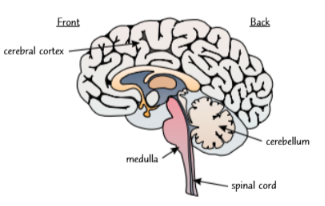
Cerebral Cortex
-Outer wrinkly layer of the brain
-Responsible for things like consciousness, intelligence, memory and language
Medulla
-At the base of the brain, top of the spinal cord
-Controls unconscious activities like breathing and heartbeat
Cerebellum
-Found at back of brain
-Responsible for muscle coordination
Studying the brian
Studying patients with brain damage
-If a small part of the brain has been damaged, the effect this has on the patient can tell you about what the damaged part of the brain does
Electrically stimulating the brain
-Brain can get stimulated by pushing a tiny electrode into the tissue and giving it a small zap of electricity
-Observing what stimulating different parts of the brain does to get an idea of what each part does
MRI scans
-A magnetic resonance imaging (MRI) scanner is a big tube-like machine that can produce a very detailed picture of the brain’s structure
-Used to find out what areas are active when people do things such as listening to music or recalled a memory
Benefits and risks
-Can lead to development of treatment for disorders of the nervous system if you know more about the brain
-Brain is complex and delicate with investigations or treatments are very difficult
-Could cause physical damage or increased problems with brain function (e.g. difficulties with speech)
They Eye
Structure of the eye
-Sclera→ tough, supporting wall of the eye
-Cornea→ transparent outer layer found at the front of the eye. Refracts light into the eye
-Pupil→ hole in the centre of the eye, through which light enters
-Iris→ contains muscles allowing it to control the diameter of the pupil and therefore how much light enters the eye
-Retina→ layer at the back of the eye that contains two types of light receptor cells. One type sensitive to light intensity and other sensitive to colour
-Lens→ focuses the light onto the retina
-Ciliary muscle and suspensory ligaments→ control shape of lense
-Optic nerve→ carries impulses from receptors on retina to the brain

Iris Reflex
-Very bright light can damage the retina so a reflex is needed to protect it
-When light receptors in the eye detect very bright light, a reflex is triggered that makes the pupil smaller
-Circular muscles in the iris contract and the radial muscles relax
-Reduces amount of light that can enter the eye
-Opposite happens in dim light
-Radial muscles contract and circular muscles relax
-Pupils made wider

Accommodation
-Ability to look at near and distant objects is an examples of a reflex- an automatic reaction
-Eye focuses light on the retina by changing the shape of the lens- known as accommodation
Looking at near objects
Ciliary muscle contracts, which slacken the suspensory ligaments
Les becomes fat (more curved)
Increases amount by which it refracts light
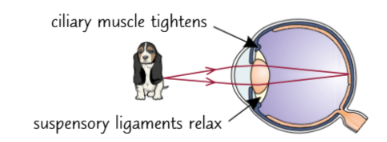
Looking at distance objects
Ciliary muscle relaxes, allowing suspensory ligaments to pull tight
This makes the lens go thin (less curved)
Refracts light by a smaller amount

-If the lens cannot refract light by right amount, person will be sort or long sighted
Correcting Vision Defects
Long and short sightedness
-Light entering eye must be focused on the retina to form a clear image and they eye does this by changing shape of the retina
Long-sightedness (hyperopia)
-Unable to focus on near objects
-Occurs when lens is the wrong shape and doesn’t refract the light enough or the eyeball is too short
-Images of near objects brought into focus behind the retian
-Can use glasses with a convex lens to correct long-sightedness
-Len refracts light ray so they focus on the retina

Short-sightedness (Myopia_
-Unable to focus on distant object
-Occurs when lens is wrong shape and refracts light too much or eyeball is too long
-Image of distant objects are brought into focus in front of the retina
-Use glasses with concave lens so light rays focus on retina

Alternative treatments for myopia and hyperopia
Contact lenses
-Thin lenses that sit on the surface of the eye
-Shaped to compensate for the fault in focusing
Popular as they are lightweight and almost invisible and more convenient than glasses for sport activities
-Two main types→ hard lenses and soft lenses
-Soft lenses generally more comfortable but carry a higher risk of eye infections than hard lenses
Laser eye surgery
-Laser used to vaporise tissue, changing the shape of the cornea (so how strongly it refracts light)
-Slimming it down makes it less powerful and can improve short sight
-Changing the shape so it is more powerful will improve long sight
-Surgeon can precisely control how much tissue the laser takes off, completely correcting the vision
-Risk of complications such as infection or eye reacting poorly, making vision worse
Replacement lens surgery
-Long-sightedness may be more effectively treated by replacing lens of eye over laser surgery
-Natural lens of eye is removed and an artificial lens made of clear plastic inserted in its place
-Involves work inside the eye, replacing a lens carries higher risks than laser eye surgery including possible damage to the retina which could lead to loss of sight
Controlling Body Temperature
Monitoring body temperature
-Needs to be kept around 37 degrees Celsius as this is when enzymes work the best
-Body temperature must be carefully monitored and controlled- body must constantly balance amount of energy gained and lost to keep core body temperature constant
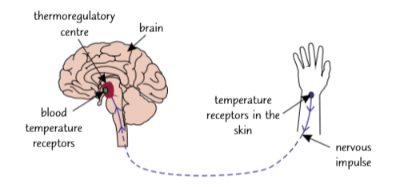
-Part of the brain called the thermoregulatory centre acts as your own personal thermostat
-The thermoregulatory centre receives information about body temperature from receptors
Receptors in the thermoregulatory centre that are sensitive to the temperature of the blood flowing through the brain
Receptors in the skin that send information about skin temperature via nervous impulses
How is body temperature controlled
-Kept around a constant level due to a negative feedback system
Responding to a rise in body temperature
-Effectors produce a response that increases the amount of heat lost from the body and the body cools down

Hairs on the skin lie flat meaning less air is trapped near the surface of the skin so isn’t a layer of insulating air surrounding the skin. Allows heat to be transferred to the environment more easily
Sweat produced by sweat glands. When sweat evaporates from the skin, it transfers energy to the environment, helping to reduce body temperature
Blood vessels supplying the skin capillaries dilate so more blood flows close to the surface of the skin. Called vasodilation which helps transfer energy form the skin to the environment
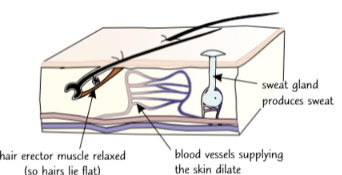
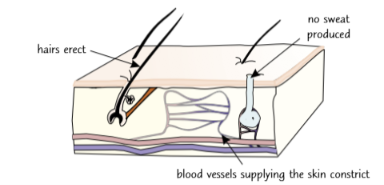
Responding to fall in body temperature
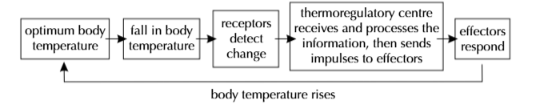
-Some effectors work antagonistically (e.g one effector heat and another cools and they will work at the same time to achieve a very precise temperature) which allows more sensitive response
Hairs on the skin stand up trapping an insulating layer of air next to the skin, reducing the amount of energy transferred to the environment
No sweat produced
Blood vessels supplying skin capillaries constrict to reduce the skin’s blood supply. This is called vasoconstriction and reduces the amount of blood that flows close to the surface of the skin and so less energy is transferred from the skin to the environment
You shiver (muscles contract automatically). This needs respiration, which transfers some energy to warm the body
The Endocrine System
Hormones
What?
-Chemical molecules released directly into the blood to regulate bodily processes
-Carried in the blood plasma (liquid part of blood) to other parts of the body
-Only affect particular cells in particular organs (target organs)
-Hormones control things in organs and cells than need constant adjustment
-'Hormones are chemical messengers which travel in the blood to activate targe cells'
The endocrine system
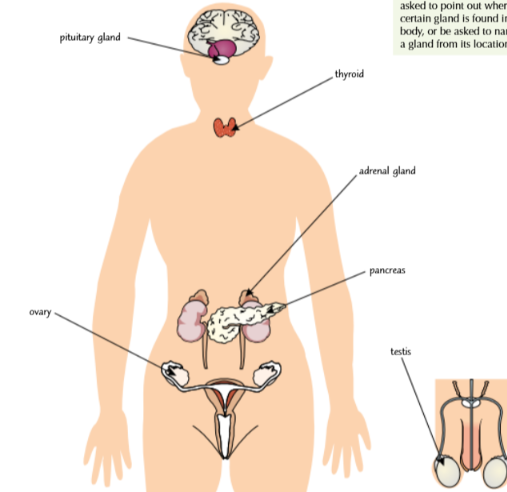
-Hormones produced in (an secreted by) various glands, called endocrine glands
-Glands make up the endocrine system
-Uses hormones to react to changes in the environment or changes inside the body
Endocrine Glands
-Pituitary glad:
-Produces many hormones that regulate body conditions
-Sometimes called the ‘master glad’ as these hormones act on other glands, directing them to release hormones that bring about change
-Pancreas:
-Produces insulin used to regulate the blood glucose level
-Thyroid:
-Produces thyroxine which is involved in regulating things such as the rate of metabolism, heart rate and temperature
-Adrenal glands:
-Produce adrenaline used to prepare the body for a ‘fight or flight’ response
-Ovaries (female only):
-Produce oestrogen involved in the menstrual cycle
-Testes (male only):
-Produce testosterone controlling puberty and sperm production in males
Nerves | Hormones |
Fast action | Slower action |
Act for a short time | Act for a long time |
Acts on very precise area | Acts in a more general way |
Controlling Blood Glucose
Glucose concentration of the blood
-Glucose is a type of sugar
-Throughout the day, the blood glucose level varies:
-Eating food containing carbohydrate puts glucose into the blood from digestive system
-Normal metabolism of cells removes glucose from the blood
-Vigorous exercise removes much more glucose from the blood
Hormonal control of blood glucose
-Changes in blood glucose level are monitored by the pancreas
-Pancreas produces hormones which help to control the blood glucose level
Insulin
-A hormone produced by the pancreas
-Decreases blood glucose level when it gets too high:
After a meal containing carbohydrate, a person’s blood glucose level rises. The rise is detected by the pancreas
Pancreas responds by producing insulin, which is secreted into the blood
Insulin causes body cells to take up more glucose from the blood. Cells in the liver and muscles can take up glucose and convert it into a storage molecules called glycogen
This causes the blood glucose level to fall
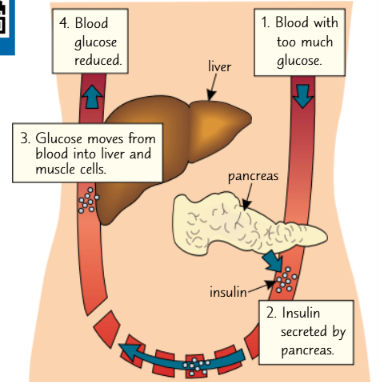
Glucagon
-Hormone produced by the pancreas
-Increases the blood glucose level when it gets too low
-Works with insulin to control blood glucose level in a negative feedback together- keep glucose levels around optimum
If a person’s blood glucose levels fall too far, the fall is detected by the pacreas
Pancreas responds by producing glucagon which is secreted into the blood
Glucose can be stored in the muscle and liver as glycogen. Glucagon causes glycogen to be converted back into glucose, which enters the blood
Causes the blood glucose level to rise

Type 1 Diabetes
Controlling Type 1 diabetes
Insulin therapy
-Usually involves injecting insulin into the blood
-Usually have several injections of insulin throughout the day, likely at mealtimes
-Injections ensure glucose is removed from the blood quickly once the food has been digested
-Stops level of glucose in the blood getting too high and is a very effective treatment
-Amount of insulin that needs to be injected depends on persons diet and how active they areLimit the intake of food rich in simple carbohydrates, i.e. sugars (cause blood glucose level to spike rapidly)
-Advised to spread their intake of starchy carbohydrates throughout the day
-Pick varieties of these foods that are absorbed more slowly (gradual rise)Regular exercise
-Helps lower the blood glucose level as the increased metabolism of cells during exercise removes more glucose from the blood
-Insulin used to be extracted from the pancreas of pigs or cows, but now human insulin is made by genetic engineering
-Human insulin doesn’t cause adverse reactions in patients, like animal insulin did
Type 2 diabetes
-Condition where a person becomes resistant to their own insulin
-Still produce insulin, but body’s cell don’t respond properly to the hormone
-Cause a person’s blood glucose level to rise to a dangerous level
-Being overweight can increase your change of developing Type 2 diabetes, as obesity is a major risk factor in the development of the disease
Controlling Type 2 Diabetes
Eating a carbohydrate controlled diet
-Includes controlling a person’s intake of simple carbohydrates to avoid sudden rises in glucoseRegular exercise
-Helps to lower the blood glucose level
Modern treatment options
Diabetics can have a pancreas transplant
-Successful operation means they won’t have to inject themselves with insulin again
-Body may reject the tissue thought. This could be prevented by taking costly immunosuppressive drugs which often have serious side effectsModern research into artificial pancreases and stem cell research may mean the elimination of organ rejections, but there is a way to go yet
Testing for diabetes
-At high blood glucose level, glucose begins to move into the urine
-Diabetes can be tested for by looking for glucose in a urine sample
-Blood test for glucose can then confirm the diagnosis
-Blood test is more reliable as it gives the current level of glucose in the blood and can detect a high level of glucose when the level is not yet high enough for glucose in the urine
Interpreting blood glucose level graph
-Changes in a person’s blood glucose level over time can be shown by a graph
-Shape of graph can vary depending on whether the person has diabetes

Controlling Water Content
Role of the kidneys
-Make urine by taking waste products out of your blood
-Substances filtered out of the blood as it passes through the kidneys
-Process is called filtration
-Useful substances, including glucose, some ions and the right amount of water, are then absorbed back into the blood- selective reabsorption
-Substances removed from the body in urine include urea (waste product from breakdown of proteins) and excess ions and water
Adjustment of water content
-Body must constantly balance the water coming in against the water going out
-We lose water from the skin in sweat and from the lugs when we exhale
-Cannot control how much we lose in the above ways so the water is balanced by the amount we consume and removed by the kidneys in urine
Adjustment of ion content
-Ions such as sodium are taken into the body in food and then absorbed into the blood
-If the ion (or water) content of the body is wrong, this could upset the balance between ions and water, meaning too much or too little water is drawn into cells by osmosis
-Having the wrong amount of water can damage cells or mean they don not work as well as normal
-Some ions are lost is sweat (why its salty tasting) but this amount is not regulated so the right balance of ions in the body must be maintained by the kidneys
-Right amount of ions is reabsorbed into the blood after filtration and the rest is removed from the body in urine
Removal of urea
-Proteins cannot be stored by the body so any excess amnio acids are converted into fats and carbohydrates which can be stored
-Occurs in the liver and involves a process called deamination
-Ammonia produced as a waste product from this process
-Ammonia is toxic so converted to urea in teh liver
-Urea transported to the kidneys, where it is filtered out of the blood and excreted from the boy in urine
Anti-diuretic hormone (ADH)
-Structures in the kidney where filtration and selective reabsorption take place are called the kidney tubules
-Kidney can let more or less water move out of the tubules to change the water content of the blood- more water leaving and is reabsorbed into the blood, more concentrated the urine
-Process controlled by a Hormone called anti-diuretic hormone (ADH)
-Acts on the cells in the kidney tubules, causing them to be more or less permeable to water and so changing the volume of water that can be reabsorbed
-ADH released into the bloodstream by the pituitary gland
-Brain monitors the water content of the blood and instructs the pituitary gland to release ADH into the blood according to how much is needed
-Whole process of water content regulation is controlled by negative feedback

Kidney Failure
Effects of kidney failure
-If kidneys do not work properly, waste substances build up in the blood and you lose your ability to control the levels of ions and water in your body
-Can cause problems in the heart, bones, nervous system, stomach, mouth, etc…
-If lead untreated, kidney failure will eventually result in death
-Some treatment options:
Dialysis treatment→ where machines do the job of the kidneys
Kidney transplant→ where the diseased kidney is replace by a healthy one
Kidney Dialysis
-Dialysis machine takes over the role of a failing kidney and filter the blood
-Must be done regularly to keep the concentrations of dissolved substances in the blood at normal levels and to remove waste substances
-The person’s blood flows alongside a partially permeable membrane, surrounded by dialysis fluid

-Partially permeable membrane allows things like ions and waste substances through, but not big molecules like proteins (just like the membranes in they kidney)
-Dialysis fluid has the same concentration of dissolved ions and glucose as healthy blood meaning useful dissolved ions and glucose won’t be lost from the blood during dialysis
-Only waste substances and excess ions and water diffuse across the membrane
Problems with dialysis
-Not a pleasant experience and many patients need a dialysis session three times a week with each session taking 3-4 hours
-Can lead to infections and can cause blood clots
-Must be careful about what they each to avoid too much of a particular ion building up between dialysis sessions
-Patients must limit the amount of fluid they take in as the kidneys play and important role in maintaining the water content of the body. When kidneys are not functioning properly, fluid can build up in the body
-Machines are expensive for the NHS to run
Kidney transplants
-Only cure currently
-Healthy ones usually transplanted from people who have died suddenly, e.g. car accident, and who are on the organ donor register or carry a donor card (and relatives agree)
-Can also be transplanted from people who are still alive as we have two and only need one but still a small risk to the person donating the kidney
Rejection
-Problem of kidney transplants
-Happens when antigens on the donor kidney are not recognised as being part of the body by the recipient’s white blood cells
-White blood cells produce antibodies to attack the donor

Preventing rejection
-Donor with a tissue-type that closely matches the patient’s is chosen
-Tissue type is based on a cell’s antigens
-More similar the tissue types, the more similar the antigens which reduces the chance of the patient’s white blood cells identifying the donor antigens as ;foreign’ and producing antibodies to attack the donor
-Recipient is treated with drugs that suppress the immune system
-Drugs reduce the production and release of antibodies by the white blood cells so the immune system won’t attack the transplanted kidney
Other problems with kidney transplants
-Long waiting lists of kidneys
-Even if a kidney with a matching tissue-type is found, there is still the possibility that it will be rejected
-Taking drugs that suppress the immune system means the person is vulnerable to other illnesses
-Kidney transplant is a major operation so it can be risky
-Despite the issues, kidney transplants can put an end to the hours spent on dialysis, allowing recipients to lead a relatively normal life
-Transplants are also cheaper than long-term dialysis treatment
Animal and Plant Hormones
Puberty and the Menstrual Cycle
Puberty
-Body starts releasing sex hormones that trigger secondary sexual characteristics and cause eggs to mature in females
-In Males, the main reproductive hormone is testosterone, produced by the testes and stimulates sperm production
-In females, the main reproductive hormone is oestrogen, produced by the ovaries as well as bringing about physical changes, oestrogen is involved in the menstrual cycle
The Menstrual Cycle
-Monthly sequence of events in which the female body releases an egg and prepares the uterus in case it recieves a fertilised egg
-Has four stages:
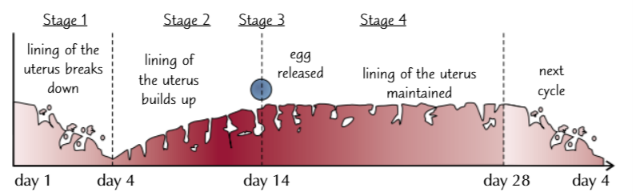
When menstruation (bleeding) starts. Uterus lining breaks down for about four days
Lining of the uterus builds up again, from day 4 to 14, into a thick spongy layer full of blood vessels ready to receive a fertilised egg
An egg is released from the ovary at day 14, called ovulatoin
Wall is then maintained for about 14 days, until day 28. If no fertilised egg has landed on the uterus wall by day 28, the spongy lining starts to break down again and the cycle starts again
Hormonal control of the menstrual cycle
-Follicle stimulating hormone (FSH)
-Causes an egg to mature in one of the ovaries, in a structure called a follicle
-Luteinising hormone (LH)
-Stimulates the release of an egg at day 14 (ovulation)
-Oestrogen and progesterone
-Involved in the growth and maintenance of the uterus lining
Hormone interaction in the menstrual cycle
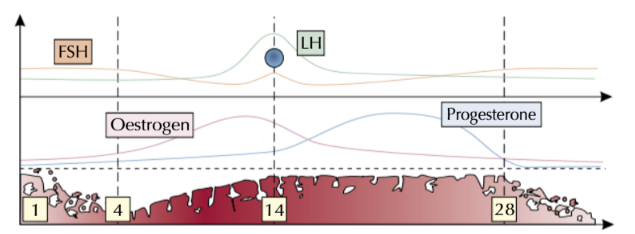
-Levels of the four hormones above fluctuate throughout the cycle
-Hormones interact with each other to promote or inhibit the release of other hormones
FOLP
FSH is produced in the pituitary gland and causes an egg to mature in an ovary. Also stimulate the ovaries to produce oestrogen
Oestrogen is produced in the ovaries and causes the lining of the uterus to grow. Also stimulates the release of LH and inhibits the release of FSH
LH is produced by the pituitary gland and stimulates the release of an egg at day 14 (ovulation)
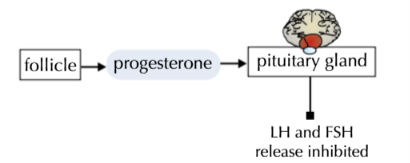
Progesterone is produced in the ovaries by the remains of the follicle after ovulation. Maintains the lining of the uterus during the second half of the cycle. When the level of progesterone falls, the lining breaks down. Progesterone also inhibits the release of LH and FSH
-Levels of FSH, LH, oestrogen and progesterone change throughout the menstrual cycle
-The change in one hormone can be used to predict the change in the another


Contraceptives
Reducing fertility
-Contraceptives used to prevent pregnancy
-Hormones oestrogen and progesterone can be taken by women to reduce their fertility and so are often used as contraceptives
Oestrogen
-Prevent egg release
-If oestrogen taken every day to keep level permanently high, it inhibits FSH productions meaning, after a while, egg maturation and therefore egg release stop and stay stopped
Progesterone
-Reduce fertility e.g. by stimulating the production of tick cervical mucus which prevents any sperm getting through and reaching an egg
-Inhibits egg maturation and therefore the release of an eff too
Oral Cotraceptives
-Pill is an oral contraceptive
-First version (combined oral contraceptive pill) was made in the 19950s ad contained high levels of oestrogen and progesterone
-Many concerns about link between oestrogen in the pill and side effects like blood clots
-Pill now contains lower doses of oestrogen so has fewer side effects
-Also a progesterone-only pill and has fewer side effects than the combined pill and is just as effective
Benefits of the combined oral contraceptive pill
-Pill is over 99% effective at preventing pregnancy
-Shown to reduce the risk of getting some types of cancer
Problems with the combined oral contraceptive pill
-Isn’t 100% effective→ still a very slight chance of getting pregnant
-Can cause side effects like headaches, nausea, irregular menstrual bleeding and fluid retention
-Doesn’t protect against STDs (sexually transmitted disease)
Skin patches, implants and injections
-Contraceptive patch contains oestrogen and progesterone (same as the combined pill). Small parch stuck onto the skin. Each patch lasts one week
-Contraceptive implant inserted under the skin of the arm. Releases a continuous amount of progesterone sopping the ovaries releasing eggs, making it hard for sperm to a swim to the egg and stops any fertilised egg implanting in the uterus. Can last for three years
-Contraceptive injection also contains progesterone. Each dose lasts 2 to 3 months
Barrier methods
-Non hormonal barrier forms of contraception are designed to stop the sperm from getting to the egg
-Condoms:
-Worn over the penis during intercourse to prevent the sperm entering the vagina.
-Also female condoms worn inside the vagina.
-Only form of contraception that will protect against sexually transmitted diseases
-Diaphragm:
-Shallow plastic cup that fits over the cervix to form a barrier
-Must be used with spermicide (substance which disables or kills sperm)
-Spermicide can be used alone as a contraceptive, but not as effective as used with a diaphragm
Intrauterine devices
-(IUD) is a T-shaped device that is inserted into the uterus to kill sperm and prevent implantation of a fertilised egg
-Two main types→ plastic IUDs that release progesterone and copper IUDs that prevent sperm surviving in the uterus
Surgical methods
-Sterilisation involves cutting or tying the fallopian tubes (connects ovaries to uterus) in a female or the sperm duct (tube between testes and penis) in a male.
-Permanent procedure, however very small chance the tubes can rejoining
Natural Methods
-Finding out when in the menstrual cycle the woman is most fertile and avoiding sexual intercourse on those days
-Popular with those who think the hormonal and barrier methods are unnatural, but is not very effective
-Only way to be completely suer that sperm and egg don’t meet is to not have intercourse- abstinence
Increasing Fertility
-Hormones can be taken by women to increase their fertility
-E.g. some women have an FSH level that is too low to cause their eggs to mature meaning no eggs are released and the women cannot get pregnant
-Hormones FSH and LH can be injected by these women to stimulate egg maturation and release in their ovaries
-‘Fertility drugs’ can help a lot of women to get pregnant when previously they couldn’t.
-Often used during IVF to
Problems with fertility drugs
-Don’t always work→ some women may have to use the treatment many times = expensive
-Too many eggs could be stimulated, resulting in unexpected multiple pregnancies (e.g. twins)
In vitro fertilisation (IVF)
-A process that can be used to help couple who are having difficulty having children
-IVF involves the following steps:
FSH and LH given to the woman to stimulate the maturation of multiple eggs
Eggs are then collected from the woman’s ovaries
Eggs are fertilised in a lab using the man’s sperm
Fertilised eggs grow into embryos (small ball of cells) in a laboratory incubator
Once the embryos have formed, one or two of them are transferred to the woman’s uterus. Transferring more than one improves the chance of pregnancy

Pros and Cons of IVF
-Gives an infertile couple a child
-Multiple births can happen if more than one embryo grows into a baby→ risky for the mother and babies
-Success rate is low→ average success rate in UK about 26% making the process incredibly stressful and often upsetting, especially if it ends in multiple failures
-Both emotionally and physically stressful for the women with some having strong reaction to the hormones, e.g. abdominal pain, vomiting and dehydration
-Considerations must be taken by both the patient and doctor
Development in microscopy
-Advancements in microscope techniques have helped to improve the techniques of IVF
-Specialised micro-tools have been developed to use on the eggs and sperm under the microscope
-Development of time-lapse imaging (microscope and camera built into incubator) meaning the growth of embryos can be continuously monitored to help identify those that are more likely to be a success
Social and ethical issues
-IVF often results in unused embryos that are eventually destroyed which raises ethical concerns of potential human lives being destroyed
-Genetic testing of embryos before implantation also raises ethical issues as some people think it could lead to the selection of preferred characteristics, such as gender or eye colour
Thyroxine and Adrenaline
Thyroxine
-Hormone released by the thyroid glad, found in the neck
-Large role in regulating the basal metabolic rate→ speed at which chemical reactions in the body occur while the body is at rest
-Also responsible for many body processes such as stimulating protein synthesis for growth and development
-Released in response to thyroid stimulating hormone (TSH), released from the pituitary gland
Negative Feedback
-System keeps the amount of thyroxine in the blood at the right level
-When level of thyroxine in the blood is higher than normal, secretion of TSH from teh pituitary gland is inhibited. Reduces the amount of thyroxine released from the thyroid gland, so level in blood falls to normal
-When level of thyroxine in the blood is lower than normal, secretion of TSH from pitutary gland is stimulated which increases the amount of thyroxine released from the thyroid galnd, level rises to normal

Adrenaline
-Hormone released by the adrenal gland
-Rekeased in response to stressful or scary situation
-Brain detects fear or stess and sends nervous impulses to th adrenal glands and responds by secreting adrenaline
-Gets the body ready for ‘fight or flight’ by triggering mechanisms that increase the supply of oxygen and glucose to cells in the brain and muscles
-e.g. increases heart rate
Plant Hormones
A plant’s needs
-Able to detect and respond to stimuli in order to survive
-e.g. need light to make own food and so can maximse amount of light they recieve
-e.g. can sense and respond to gravity to ensure roots and shoots grow in right direction
Auxin
-Plant hormone that conrols growth near tips of shoots and roots
-Controls growth of a plant in response to different stimuli
-Controls:
-Phototropism→ plant growth in response to light
-Gravitropism→ plant growth in response to gravity
-Produced in the tips of roots and shoots and moves backwards to stimulate cell elongation process which occurs in the cells just behind the tips
-If tip of shoot is removed, no auxin is available and shoot may stop growing

Shoot and root growth
Shoots grow towards light
-When shoot tips exposed to light, more auxin accumulates on the side in the shade
-Makes cells grow faster on shaded side
-Shoots bend towards light

Shoots grow away from gravity
-When shoots grow sideways, gravity produces unequal distribution of auxin in the tip
-More auxin on the lower side
-Causes lower side to grow faster, bending shoot upwards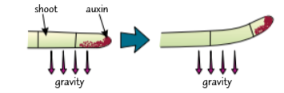
Roots grow towards gravity
-When shoots grow sideways, gravity produces unequal distribution of auxin
-Auxin accumulates on lower side
-In roots, extra auxin inhibits growth
-Cells on top elongate faster and root bends downwards

Required Practical 8: Investigating Plant Growth Responses
Investigating the effect of light
Put 10 cress seeds into three different Petri dishes, each lined with moist filter paper
Shine a light onto one of the dishes from above and two of the dishes from different directions
Leave cress seeds alone for one week until you can observe their response
You know the growth response of the cress seedlings is due to light only, if you control all other variable:
-Number of seeds→ use same number of seeds in each dish
-Type of seed→ use seeds that all come from the same packet
-Temperature→ keep Petri dishes in a place where temperature is stable
-Water→ use measuring cylinder to add the same amount of water to each dish
-Light intensity→ keep distance between bulb and dish the same for each dish
Investigating the effect of gravity
Put four cress seedlings into a Petri dish lined with damp cotton wool (root of each seedling should be pointing in a different direction)
Store Petri dish vertically for a few days in the dark, so you know your results won’t have been affected by light
Should find the roots of each seedling grow downwards and shoots grow upwards
Uses of Plant Hormones
Auxins
Killing weeds
-Weeds are mostly broad leaved plants
-Selective weedkillers developed using auxins which only affect broad-leaved plants-Disrupts normal growth patterns, soon killing them
Growing from cuttings with rooting powder
-Usually just putting a cutting in soil means it won’t grow-Adding rooting powder, containing auxins, allows cuttings to grow and produce roots rapidly
-Enables growers to produce many clones very quicklyGrowing cells in tissue
-Tissue culture can be used to grow clones of a plant from a few of its cells
-Hormones (such as auxins) need to be added to the growth medium (along with nutrients) to stimulate the cells to divide to form both roots and shoots
Gibberellins
Controlling dormancy
-Many seeds won’t germinate until going through certain conditions→ called dormancy
-Seeds treated with gibberellins to alter dormancy and at different times of the yearInducing fertility
-Some plants require certain conditions to grow
-If plants are treated with gibberellins, they flower without any change in their environment
-Also used to grow bigger flowersGrowing larger fruits
-Seedless varieties of fruit often do not grow as large
-If gibberellins are added, these plants grow larger to match the size of the normal fruit
Ethene
-Gas produced by aging parts of a plant
-Influences growth of the plant by controlling cell division
-Can be used to speed up ripening of fruits→ either in shop or before picking
-Fruit can be picked unripe then ripened on the way to the shops so they are perfect to sell
-Ripening delayed by adding chemicals to block ethenes effect on fruit/ reduce amount produced
-Some chemicals can be used to react with ethene to remove it from the air
Topic 6- Inheritance, Variation and Evolution
DNA and Reproduction
DNA
Chromosomes and DNA:
-DNA is the chemical which all of the genetic material in a cell is made up from
-DNA is coded information- basically all the instructions to put an organism together and make it work
-What is in you DNA determines what inherited characteristics you have
-DNA is found in the nucleus of animal and plant cells in really long structures called chromosomes
-The DNA is coiled up to form the ‘arms’ of the chromosome. Chromosomes usually come in pairs
-DNA is a polymer- a large molecule built from a chain of smaller molecules
-DNA is made up of two strands coiled together in the shape of a double helix

Genes and Proteins:
-A gene is a small section of DNA found on a chromosome
-Each gene codes for a particular sequence of amino acids which are put together to make a specific protein
-Amino acids are the building blocks that make up protiens
-Only 20 amino acids are used, but they make up thousands of different proteins
-Genes tell us what order to put the amino acids together
-DNA also determines what proteins the cell produces that in turn determines what tupe of cell it is

Genomes:
-A gnome is the entire set of genetic material in an organism
-A huge research project called the Human Genome Project mapped out the genes that make up human chromosomes
-Understanding the genome is a really important tool for science and medicine for many reasons. e.g. it allows scientists to identify genes in the genome that are linked to different types of diseases
The Structure of DNA
Nucleotides:
-DNA stands are polymers made up of lots or repeating units called nucleotides
-There are 4 different nucleotides- each nucleotide consists of a sugar, a phosphate group and one of four different ‘bases’
-The sugars and phosphate groups in the nucleotide form a ‘backbone’ to the DNA stands
-The sugars and phosphate groups alternate
-The four different bases are A,T,C,G

Bases:
-It is the order of bases in a gene that decides the order of amino acids in a protein
-Each amino acid is coded for by a sequence of three bases in the gene
-The amino acids are joined together to make various proteins, depending on the order of the gene’s bases
Complementary base pairing:
-Each base in a DNA stand links to a base of the opposite stand in the helix
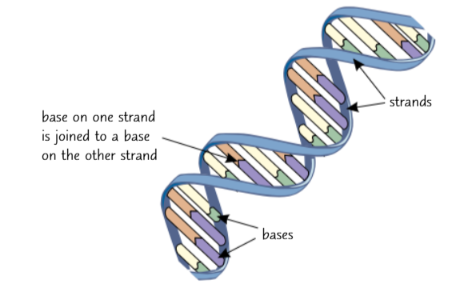
-A always pairs up with T
-C always pairs up with G
-This is called complementary base pairing
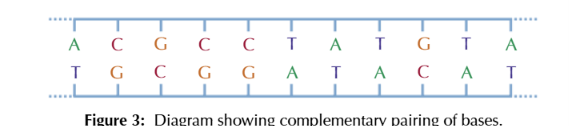
Non-coding parts of DNA:
-There are some parts of DNA that do not code for proteins
-Some of these non-coding parts switch genes on and off, so they control whether or not a gene is expressed (used to make a protein)
Protein Synthesis
-Proteins are made in the cell cytoplasm on tiny structures called ribosomes
-To make proteins, ribosomes use the code in the DNA
-DNA is found in the cell nucleus and cannot move out of it because it is very large so the cell get the DNA to the ribosomes using a molecule called mRNA (which is made by copying the code from DNA)
-mRNA acts as a messenger between DNA and the ribosome- it carries the code between the two and acts as a template
-The correct amino acids are brought to the ribosome in the correct order by carrier molecules

Protein functions:
-When a chain of amino acids has been assembled, it folds into a unique shape which allows the protein to perform the task it is meant to do
-Proteins have many different functions:
-Enzymes
-Hormones
-Structural Proteins
Mutations
What?:
-Occasionally a gene may mutate
-A mutation is a random change in an organism’s DNA, they can sometimes be inherited
-Mutations occur continuously. They can occur spontaneously (e.g. when a chromosome isn’t quite fully replicated properly) however, the chance of mutation is increased by exposure to certain substances or some types of radiation
-Mutations change the sequence of DNA bases in a gene, which produces a genetic variant
-As the sequence of DNA bases codes for the sequence of amino acids that make up a protein, mutation to a gene sometimes lead to a change in the protein that i codes for
-Most mutations have very little of no effect on the protein, some will change it to such a small extent that its function or appearance is unaffected, however some mutations can seriously effect a protein
-Sometimes the mutation will code for an altered protein with a change in its shape, this could affect its ability to perform its function
-If there is a mutation in the non-coding DNA, it can later how genes are expressed
Types:
Insertions:
-Where a new base is inserted into the DNA base sequence where it shouldn’t be
-An insertion changes the way the groups of three bases are ‘read’, which can change the amino acids that they code for
-Insertion can change more than one amino acid as they have a knock-on effect on the bases further on in the sequence
Deletions:
-When a random base is deleted from the DNA base sequence
-They change the way that the base sequence is ‘read’ and have a knock on effects further down the sequence
Substitutions:
-When a random base in the DNA base sequence is changed to a different base
-Only effects one amino acid coding
Reproduction
Sexual Reproduction:
-Where genetic information from two organisms (a father and a mother) is combined to produce offspring which are genetically different to either parent
-The mother and father produce gametes by meiosis
-In humans, each gamete contains 23 chromosomes- half the number of chromosomes in a normal cell
-The egg from the mother and the sperm cell from the father fuse together to from a cell with the full number of chromosomes (half from mother, half from father)
-The fusion of gametes is known as fertilisation
-The offspring inherits features from both parents, this mixture of genetic information produces variations in the offspring
Sexual reproduction involves the fusion of male and female gametes. Because there are two parents, the offspring contain a mixture of their parents’ genes and are genetically different to their parents
-Flowering plants can reproduce in this way to- they also have egg cells, but their version of sperm is known as pollen
Asexual Reproduction:
-Only one parent so the offspring are genetically identical to that parent
-Happens by mitosis- an ordinary cell makes a new cell by dividing in two
-The new cell has exactly the same genetic information as the parent cell- a clone
-In asexual reproduction there is only one parent. There is no fusion of gametes, no mixing of chromosomes and no genetic variation between parent and offspring. The offspring are genetically identical to the parent- they are clones
-Bacteria, some plants and some animals reproduce asexually
Meiosis
-To make gametes which only have half the original number of chromosomes, cells divide by meiosis
-This process involves two cell divisions
-In humans, it only happens in the reproductive organs (ovaries and testes)
-Meiosis produces cells which have half the normal number of chromosomes:
The cell duplicates its genetic information, forming two armed chromosomes- one arm of each chromosome is an exact copy of the other arm. After replication, the chromosomes arrange themselves into pairs
In the first division in meiosis, the chromosome pairs line up in the centre of the cell
The pairs are then pulled apart so each new cell only has one copy of each chromosome
In the second division, the chromosomes line up in the centre of the cell. The arms or the chromosome are pulled apart
You get 4 gametes, each with only a single set of chromosomes in it. Each of the gametes is genetically different from the others because the chromosomes all get shuffled up during meiosis and each gamete only gets half of them, at random

Embryo Development:
-After two gametes have fused during fertilisation, the resulting new cell divides by mitosis to make a copy of itself
-Mitosis repeats many times to produce lots of new cell in an embryo
-As the embryo develops, these cells then start to differentiate into different types of specialised cells that make up whole organism
More of Reproduction
Advantages of sexual reproduction
-There is variation in the offspring which increases the chance of a species surviving a change in the environment, a survival advantage
-Variations which survive then reproduce with the desired characteristics (Natural Selection)
-We can use selective breeding to speed up natural selection, allowing us to produce animals with desirable characteristics (selective breeding is where individuals with desirable characteristics are bred to produce offspring that have the desirable characteristics too). This means we can increase food production
Advantages of asexual reproduction
-There only needs to be one parent so requires less energy as organisms don’t have to find a mate so is also faster
-Many identical offspring can be produced in favourable conditions
Both methods examples:
-Malaria is caused by a parasite. The parasite reproduces sexually when in the mosquito and asexually when it is in the human host
-Many species of fungus can reproduce both sexually and asexually. They release spores which can become new fungi when they land in a suitable place
-Loads of plant species produce seeds sexually but can also reproduce asexually
Genetics
X and Y Chromosomes
-23 pairs of Chromosomes in every human body cell
-22 are matched pairs of chromosomes (control characteristics) and the 23rd pair are labelled XY or XX and decide your sex
-Males have an X and a Y chromosome: XY (The Y chromosome causes male characteristics)
-Females have two X chromosomes: XX (The XX combination allows female characteristics to develop)
-When making sperm, the X and Y chromosomes from the original male cell are drawn apart in the first division of meiosis
-There is a 50% chance each sperm cell gets an X chromosome and a 50% it gets a Y chromosome

-When making eggs, the original cell has two X chromosomes, so all eggs end up with one X chromosome
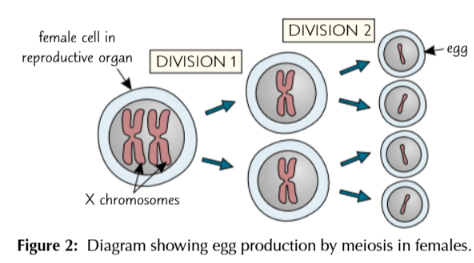
-At fertilisation, the sperm fertilises the egg and the chromosomes from the gametes combine, forming a new individual with the correct number of chromosomes
-Whether the individual is male or female depends on the combination of sex chromosomes it receives
-Genetic diagrams can be used to show sex inheritance and finding the probability of any offspring inheriting either combination of sex chromosomes
-Probability is a measure of how likely something is to happen, can be written as a fraction/ percentage
Alleles and Genetic Diagrams
-What genes you inherit control what characteristics you develop
-Different genes control different characteristics
Alleles:
-All genes exist in different version of alleles
-Gametes only have one allele of each gene, but all the other cells in an organism have two
-We inherit half of our alleles from our mother and half from our father
-Letters usually represent alleles in genetic diagrams
-If an organism has two alleles for that particular gene that are the same, it is homozygous
-If an organism has two alleles for that particular gene that are different, it is heterozygous
-The allele for the characteristic that is shown in a heterozygous is the dominant, and the other is recessive
-Your genotype is the combination of alleles you have
-Your alleles work at a molecular level to determine what characteristics you have- your phenotype
-Characteristics that are determined by a single gene can be studied using monohybrid crosses (where you cross two parents to look at just one characteristic)
-Results given in ratios
Inherited Disorders
-Disorders that are caused by a faulty allele which can be passed onto an individual’s offspring
-You must know about cystic fibrosis and polydactyly
Cystic Fibrosis:
-An inherited disorder of the cell membranes
-Results in the body producing a lot of thick sticky mucus in the air passages and in the pancreas
-The allele that causes cystic fibrosis is a recessive allele
-Because it is recessive, people with only one copy of the allele won’t have the disorder (carriers)
-For a child to have the disorder, both parents must be either carriers or have the disorder themselves
Polydactyly:
-Causes a baby to be born with extra fingers or toes
-It usually does not cause cany other problems so is not life-threatening
-Caused by a dominant allele and so can be inherited if just one parent carries the defective allele
Embryonic Screening:
Pre-implantation genetic diagnosis (PGD)
-During IVF, embryos are fertilised in a laboratory and then implanted into the mother’s womb
-Before being implanted, it is possible to remove a cell from each embryo and analyse its genes
-Embryos with desired alleles would be implanted and the rest destroyedChorionic villus sampling (CVS)
-Usually carried out between 10 and 13 weeks of pregnancy
-Involves taking a sample of cells from part of the placenta and analysing their genes
-The part of the placenta that is taken and the embryo develop from the same original cell so they have the same genes
-If the embryo is found to have an inherited disorder, the parents can decide whether or not to terminate the pregnancy
Issues surrounding embryonic screening:
For:
-Helps to stop people having certain inherited disorders that could negatively affect their health
-Treating disorders cost the Government (and taxpayers) a lot of money, so screening embryos could reduce healthcare costs
-During IVF, most of the embryos are destroyed anyway (PGD ensures that the selected one is healthy)
-If an inherited disorder is diagnoses through CVS, parents do not have to terminate but have the option
Against:
-May come a point where everyone wants to screen their embryos so they can pick the most ‘desirable’ one (e.g. hair or eye colour, etc..)
-Implies people with genetic problems are ‘undesired’- increase prejudice
-After PGD, the rejected embryos are destroyed- unethical and they are a potential humans
-Risk that CVS could cause a miscarriage and also if inherited disorder seen, abortion is potential
-Screening embryos is expensive
The Work of Mendel
-Gregor Mendel was an Austrian monk who trained in mathematics and natural history at the University of Vienna
-Mendel noted how characteristics in plants were passed on from one generation to the next
-The results of his research were published in 1866 and eventually became the foundation of modern genetics
-Mendel did a lot of experiments with pea plants
-In one experiment he crossed two pea plants of different heights and the offspring were all tall

-He then bred two of these all pea plants together. The offspring consisted of 3 tall and 1 dwarf

-Mendel has shown that the height characteristics in pea plants were determined by separately inherited ‘hereditary units’ passed on from each parent
Evolution and Classification
Variation
-Differences in species are called variation within a species
-Two types of variation: Genetic variation and environmental variation
Genetic Varation:
-Organism’s characteristics determined by the genes inherited from their parents
-Genes are the codes inside your cells which control how you are made, they are passed on in sex cells (gametes), which offspring develop from
-Most animals get some genes from mother and some from father
-Combining of genes from two parents causes genetic variation
Environmental Variation
-Environment that organisms live and grow in also cause variation
-Covers a wide range of differences- from a tattoo to a sub tan and yellow leaves, etc…
-Any difference that has been caused by the conditions something lives in an environmental variation
Genetic and Environmental Variation
-Most characteristics are determined by a mixture of genetic and environmental factors
Mutations
-A random change in an organism’s DNA and occur continuously
-Means the gene is altered, which produces a genetic variation as the gene codes for the sequence of amino acids that make up a protein
-Gene mutations sometimes lead to changes in the protein it codes for
-Most genetic variants have little or no effect on the protein the gene codes for
-Some may change to a small extent so the function is unaffected and so most mutations have no effect on an organism’s phenotype
-Very rarely cause dramatic effect that they determine phenotype
-In the environment changes, the phenotype makes an individual more suited to the new environment, can become common throughout the species relatively quickly by natural selection
Evolution and Extinction
Theory of Evolution
-All of today’s species have evolved from simple life forms that first started to develop over 3 billion years ago
Charles Darwin
-Used observations he made on a huge round-the-world trip, along with experiments, discussions and new knowledge of fossils and geology to suggest theory of evolution by natural selection
Process:
All individuals within a species show a wide range of variation for a particular characteristic (e.g. have a wide range of fur lengths)
Due to range of variation, some individuals will be more suited to environment than others (e.g. short fur is better in a hot climate)
Individuals most suited to the environment will be more likely to survive and breed successfully
Useful characteristics will be passed on to offspring
New Discoveries
-As relevant scientific knowledge wasn’t available at the time, could not give a good explanation for why new characteristics appeared or how individual organisms passed on beneficial adaptations to offspring
-Beneficial genetic variants are passed on to future generations in the DNA that parents contribute to their offspring (genetic variants, phenotypes, etc…)
-New discoveries meant scientists have developed Darwin’s original ideas into the theory of evolution by natural selection that is accepted today
Today’s Theory of Evolution by Natural Selection
Individuals within a species who wide variation in characteristics (phenotypic variation) due to the mix of genetic variants in the population (e.g. some rabbits have big ears, some have small)
Some genetic variants give rise to characteristics better suited to the environment. Organisms with these characteristics have better chance of survival and successful breeding. (e.g. big-ears mean they can hear a fox coming better and not get eaten)
Genetic variants responsible for useful characteristics are more likely to be passed on to the next generation (e.g. all bay rabbits are born with long ears)
-Over time, genetic variant for a useful characteristic will become more common in a population
An Accepted Hypothesis
-As more evidence is gathered, the theory becomes more widely accepted
Speciation
-Over a long period of time, the phenotype of organisms can change so much due to natural selection that a completely new species is formed- speciation
-Speciation happens when populations of the same species change enough to become reproductively isolated so the cannot interbreed to produce fertile offspring
Extinction
-When no living individuals of a species remain
-Fossil record contains many species that do not exist anymore- said to be extinct
-Species become extinct for these reasons:
-Environment changes too quickly (e.g. destruction of habitat)
-New predator kills them all (e.g. humans hunting them)
-New disease kills them all
-Cannot compete with another (new) species for food
-Catastrophic event happens that kills them all (e.g. volcanic eruption or collision with an asteroid)
Ideas About Evolution
Controversy
-When he proposed his theory in his book “On the Origin of Species”, in 1859 it was controversial for many reasons:
-Went against common religious beliefs about how life on Earth developed and was the first plausible idea without God influence
-Darwin could not explain why these new, useful characteristics appeared or how they were passed on from individual organisms to their offspring as he did not know about genes or mutations
-Not enough evidence to convince many scientists as not many other studies had been done into how organisms change over time
Lamarck
-Jean-Baptiste Lamarck (1744-1829) argued that changes that an organism acquires during its lifetime will be passed on to its offspring
Accepting or Rejecting Hypotheses
-The only way to find out whose hypothesis is right is to find evidence to support or disprove each one
Selective Breeding
-When humans artificially select plants or animals that will breed so the genes for particular characteristics remain in the population
-Organisms are selectively bred to develop features that are useful or attractive. E.g.:
-Animals that produce more meat or milk
-Crops with disease resistance
-Dogs with a good, gentle temperament
-Decorative plants with big or unusual flowers
Process of Selective Breeding
-Basic process involved is:
From your existing stock, select the ones which have the characteristics you are after
Breed them with each other
Select the best of the offspring and breed them together
Continue this process over several generations and the desirable trait gets strong and eventually all offspring have the characteristic
-In agriculture, selective breeding can be used to improve yields
-People have done it for thousands of years and is how we have edible crops from wild plants have have domesticated animals like cows and dogs
Reducing the Gene Pool
-Main issue is it reduces the gene pool- number of different alleles in a population- in breeding
-Inbreeding can cause health problems as there is more chance of the organisms inheriting harmful genetic defects when the gene pool is limited
-Some dogs are particularly susceptible to certain defects due to inbreeding (e.g. heart disease in boxer dogs)
-Can be a serious problem if new disease appears as if one is susceptible to the disease, all are

Genetic Engineering
-To transfer a gene responsible for a desirable characteristic from one organism’s genome into another organism, so that is also ahs the desired characteristic
-Done by ‘cutting out’ the desired gene and transferring it into the cells of another organism
How Genetic Engineering Works
Useful gene is isolated (cut) from one organism’s genome using enzymes and is inserted into a vector
Vector is usually a virus or a bacterial plasmid depending on the type of organism that the gene is being transferred
When the vector is introduced to the target organism, the useful gene is inserted into its cell(s)
-In some cases, the transfer of the gene is carried out when the organism receiving the gene is at an early stage of development (e.g. egg or embryo) so the organism develops with the characteristics coded for by the gene
Uses
-E.g.
-Genetically modified crops have had their genes modified
-Bacteria have been genetically modified to produce human insulin that can treat diabetes
-Sheep have been genetically engineered to produce substances, like drugs, in their milk that can be used to treat human diseases
-Scientists are researching genetic modification treatments for inherited disorders caused by faulty genes- gene therapy
Issues Surrounding Genetic Engineering
-Potential for solving many problems but not everyone thinks it is a good idea
-Worries about long-term effects of genetic engineering, that changing a person’s gene s may accidentally create unplanned problems, which could then get passed on to future generations
Issues surrounding GM crops
-Benefits
-Characteristics chosen for GM crops can increase yield, making more food
-People living in developing nations often lack nutrients in their diets. GM crops could be engineered to contain the nutrient that is missing. E.g. ‘Golden Rice’ is a GM rice crop containing beta-carotene and lack of this substance causes blinded
-Concerns
-Will affect the number of wild flowers that live in and around the crops- reducing farmland biodiversity
-Not everyone is convinced GM crops are safe and some concerns that we may not fully understand the effects of eating them on human health
Cloning
-Making an exact (genetically identical) copy of an organism
-Asexual production produces clones naturally
-Cloning can be done artificially (by humans)
Cloning Plants
-Two ways of doing this
Tissue cultures
A few plant cells are put in a growth medium with hormones and they grow into new plants- clones of the parent tissue
Can be made very quickly, in very little space, and be frown all year.
Tissue culture is used by scientists to preserve rare plants that are hard to reproduce naturally and by plant nurseries to produce lost of stock quickly

Cuttings
Gardeners can take cuttings from good parent plants and plant them to produce genetically identical copies (clones) of the parent plant
These plants can be produced quickly and cheaply
An older, simpler method than tissue culture
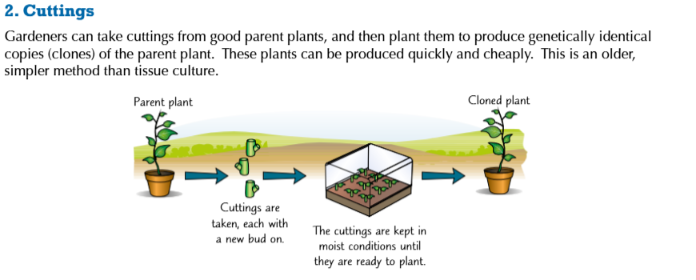
Embryo Transplants
-Can produce animal clones using embryo transplants
-An embryo is created, then split many times in the early stages to form clones
-The cloned embryos are implanted into host mothers to continue developing

Adult Cell Cloning
-Can also be used to make animal clone
-Involves taking an unfertilised egg cell and removing its nucleus
-Nucleus is removed from an adult body cell and is inserted into the ‘empty’ egg cell
-Egg cell is stimulated by an electric shock, making it divide like a normal embryo
-When embryo is a ball of cells, it is implanted into uterus of an adult female (surrogate mother)
-Embryo grows into a clone of the original adult body cell as it has the same genetic information
-Technique used to create Dolly- famous cloned sheep
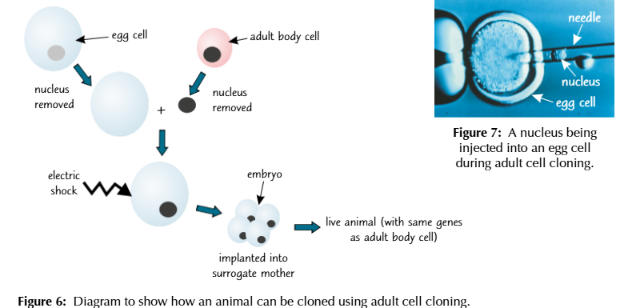
Issues Surrounding Cloning
-Benefits
-Cloning quickly gets you lots of ‘ideal’ offspring with known characteristics which can benefit farmers
-Study of animal clones could lead to greater understanding of the development of the embryo, and of ageing and age-related disorders
-Can be used to preserve endangered species
-Concerns
-Gives a ‘reduced gene pool’ meaning there are fewer different alleles in a population and if one is susceptible to disease, the whole population can be wiped out
-Possible that cloned animals may not be healthy as normal ones. e.g. Dolly had arthritis
-Worry that humans may be cloned in the future, and if allowed, any success may follow many unsuccessful attempts with children for example being born severely disabled
Fossils
-Remains of organisms from many years ago, found in rocks
-Provide evidence that organisms lived a long time ago
-Fossils can tell us how organisms have evolved over time, comparing fossils with species that are alive today
How?
Gradual replacement by minerals
Teeth, shells, bones, etc.. which do not decay easily, can last a long time when buried and are eventually replaced by minerals as they decay, forming rock-like substance shaped like the original hard part
Surrounding sediment also turns to rock, but fossil stays distinct inside the rock and eventually someone digs it up
Most fossils are made this way
From casts and impressions
Fossils formed when an organism is buried in a soft material like clay
Clay later hardens around it and organism decays, leaving a cast of itself
Animal’s burrow or a plant’s rootlet traces can be preserved as casts
Things such as footprints can also be pressed into soft materials, leaving an impression when the material hardens
From preservation in places where no decay happens
Microbes involved in decay need the right conditions in order to break down material- meaning plenty of oxygen, moisture, right temperature and pH for enzymes to work properly
If conditions are not right, decay won’t take place and dead organism’s remains won’t be preserved
Origins of Life on Earth
-Various hypotheses suggesting how life first came into being
-Primordial swamp?, simple organic molecules were bought to Earth on comets?
-Cannot be supported or disproved due to a lack of valid evidence because:
-Scientists believe many early organisms were soft-bodied, and soft tissue tends to decay away completely, without forming fossils
-Fossils that did form millions of years ago have been destroyed by geological activity (e.g. tectonic)
-Fossil record is incomplete
Speciation
-A species is a group of similar organisms that can reproduce to give fertile offspring
-Specification is the development of a new species
-Occurs when populations of the same species become so differently that they can no longer successfully interbreed to produce fertile offspring
Isolation
-Where populations of a species are separated
-Can happen due to a physical barrier
-Can eventually lead to speciation
Natural Selection
-When two populations are isolated due to a physical barrier, conditions on either side of the barrier will be slightly different
-As the environment is different on each side, different characteristics will become more common in each population due to natural selection:
Each population shows genetic variation because they have a wide range of alleles
In each population, individuals with characteristics that make them better adapted to their environment have a better chance of survival and so are more likely to breed successfully
So the alleles that control the beneficial characteristics are more likely to be passed on to the next generation
-Eventually, individuals from the different populations will have changed so much that they won’t be able to breed with one another to produce fertile offspring
-The two group have become a separate species- i.e. speciation has occurred
Alfred Russel Wallace
-A scientist working at the same time as Charles Darwin
-One of the early scientists working on the idea of speciation
-His observations greatly contributed to how we understand speciation today
-Wallace independently came up with the idea of natural selection and published work on the subject together with Darwin in 1858 which prompted Darwin to publish his book in 1859
-Observations he made while travelling the world provided lots of evidence to support the theory of evolution by natural selection
Antibiotic-Resistant Bacteria
Antibiotic resistance
-Can develop random mutations in their DNA, like all organisms, which can lead to changes in the bacteria’s characteristics, e.g. being less affected by a particular antibiotic
-As bacteria are so rapid at reproducing, they can evolve quite quickly
-Ability to resist antibiotics is a big advantage and non-resistant bacteria will be killed by antibiotics, but a resistant bacterium is better able to survive, even in a host who is being treated to get ride of the infection
-A resistant strand lives for longer and reproduces many more times which can increase the population size of the antibiotic-resistant strain
-No effective treatment against resistant strands so the infection easily spreads between people
Spread of antibiotic resistance
-Problem is getting worse- partly due to the overuse and inappropriate use of antibiotics
-Antibiotics do not cause resistance- they create a situation where naturally resistant bacteria have an advantage and so increase in numbers
-Important to only take antibiotics that are prescribed
-Some countries restrict the use of antibiotics in animals as they an lead to development of antibiotic-resistant bacteria which can then spread to humans
-Rate of development of antibiotics is slow in comparison and is also very costly
Classification
The Linnaean System
-Traditionally, organisms have been classified according to a system first proposed in the 1700s by Carl Linnaeus, which groups living things according to their characteristics and structures that make them up
-Living things are first divided into kingdoms (e.g. plant kingdom),
-Kingdoms are then subdivided into smaller and smaller groups- phylum, class, order, family, genus, species
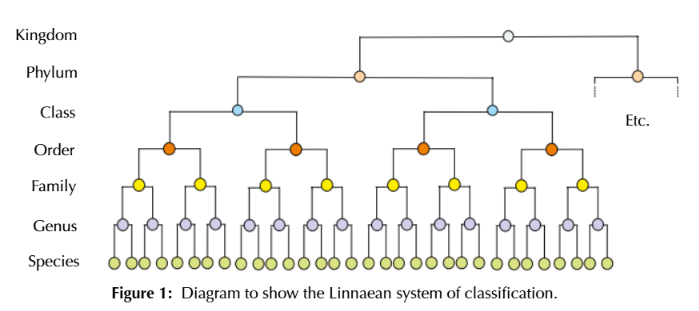
The Three-Domain System
-Knowledge of biochemical processes taking place inside organisms developed and microscopes improved (allowed us to find more about internal structures of organisms), scientists put forward new models of classification
-1990, Carl Woese proposed the three-domain system using evidence gathered from new chemical analysis techniques such as RNA sequence analysis
-Woese found that in some cases, species thought to be closely related in traditional classification systems are in fact not as closely related to each other
-Organisms are first split into three large groups called domains:
Archaea
Once thought to primitive bacteria, but they are actually a different type of prokaryotic cell
Can be found in extreme places such as hot springs and salt lakes
Bacteria
Domain contains true bacteria like E.coli and Staphylococcus
Often look similar to Archaea, lots of biochemical differences between them
Eukaryota
Domain includes a broad range of organisms including fungi, plants, animals and protists
-These are then subdivided into smaller groups- kingdom, phylum, class, order, family, genus, species
The Binomial System
-Every organism is given its own two-part Latin name
-First part refers to the genus that the organism belongs to which give you information on the organism’s ancestry
-Second part refers to the species
-e.g. Humans are known as Homo sapiens. ‘Homo’ is the genus and ‘sapiens’ is the species
-Binomial system is used worldwide and means scientists in different countries or who speak different languages all refer to a particular species by the same name- avoiding potential confusion
Evolutionary Trees
-Show how scientists think different species are related to each other
-Show common ancestors and relationships between species
-More recent the common ancestor, the more closely related the two species- the more characteristics they are likely to share
-Scientists analyse lots of different types of data to work out evolutionary relationships
-For living organisms, they use the current classification data
-For extinct species, they use information from the fossil record