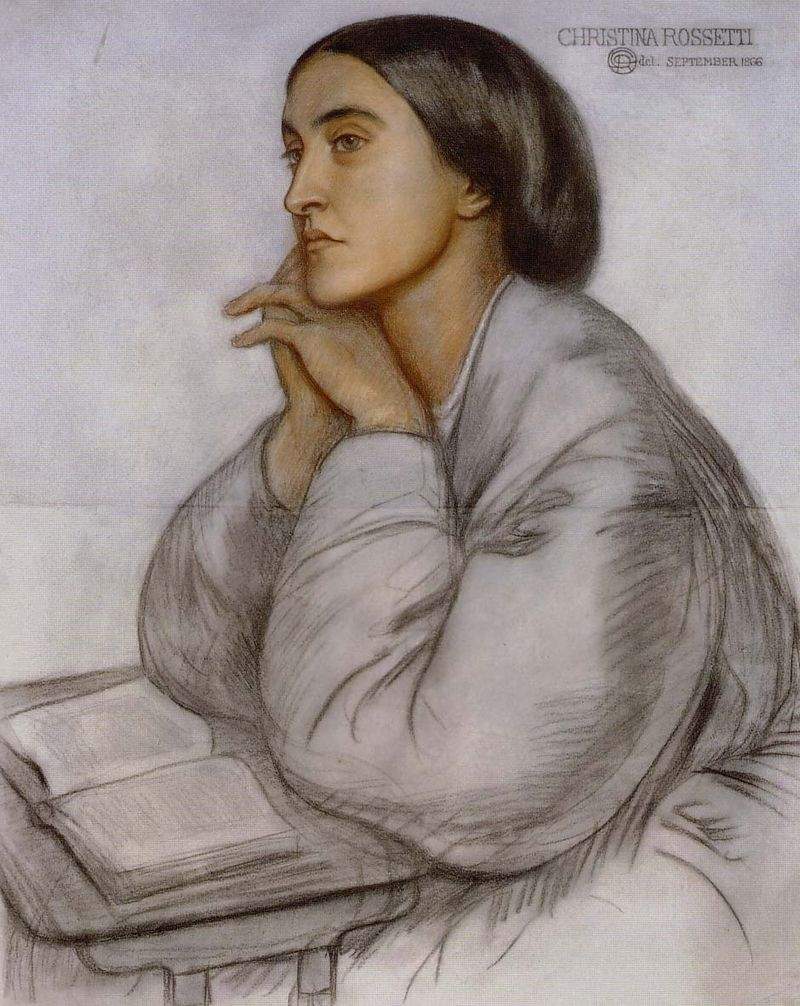
Christina Rossetti
Authorial Context: Christina Rossetti (1830–1894)
English poet Christina Rossetti was born in London to an exiled Italian father and an Anglo-Italian mother. Her father, Gabriele, was a poet and encouraged Christina and her siblings to pursue the arts. Their house was full of philosophers, writers, and fellow Italian exiles, so Rossetti had a varied education. Unfortunately, the family faced health and financial troubles when Rossetti was a young teenager.
As these events unfolded, Rossetti devoted herself more and more to the Anglo-Catholic faith, which would go on to dictate many of her life choices. Rossetti broke off three romantic relationships in her young adulthood for religious reasons.
Rossetti had written steadily throughout her youth, but in 1848 she published her first two poems in a literary magazine. Goblin Market and Other Poems was released in 1862 to widespread acclaim from fellow poets, including Tennyson. "Goblin Market," a moral fairy tale about resisting temptation, embodies Rossetti's spiritual fervor. Although Rossetti had always dwelt on spiritual issues in her poetry, devotional writing characterizes her later career. She also published successful children's poetry. In 1894, Rossetti died of breast cancer and was buried in north London.
Rossetti's Legacy
In the Victorian period, Christina Rossetti was quickly recognized as one of the greatest female poets of her age, and so she remains today. Her poems "In the Bleak Midwinter" and "Love Came Down at Christmas" became popular Christmas carols! At the end of the twentieth century, her poems began to be analyzed from a feminist angle; her words speak to the repression and inner conflict many women suffered 150 years ago.
Rossetti is also remembered for her lyrical gift: her poems, unencumbered by academic allusions, speak directly and effortlessly to the heart. She found strength in the limitations put on her as a woman.
"I loved you first"
00:54
Embedded here is an audio performance of the poem. To help with comprehension, listen along as you read or before/after you read.
I loved you first: but afterwards your love
Outsoaring mine, sang such a loftier song
As drowned the friendly cooings of my dove.
Which owes the other most? my love was long,
And yours one moment seemed to wax more strong; [5]
I loved and guessed at you, you construed me
And loved me for what might or might not be –
Nay, weights and measures do us both a wrong.
For verily love knows not 'mine' or 'thine;'
With separate 'I' and 'thou' free love has done, [10]
For one is both and both are one in love:
Rich love knows nought of 'thine that is not mine;'
Both have the strength and both the length thereof,
Both of us, of the love which makes us one.
"I loved you first"

Poem Analysis
Who does the speaker address in this poem?
Her lover
Her readership
Her parents
SUBMIT
TAKE AGAIN
Like most sonnets, this poem has a "turn": a shift in tone or idea. Where does this shift occur?
Between lines 9 and 10
Between lines 5 and 6
Between lines 7 and 8
SUBMIT
TAKE AGAIN
What is the purposeful difference between the first and last line?
First line displays real love; last line displays shallow love
First line focuses on the present; last line focuses on the future
First line begins with "I"; last last begins with "both"
SUBMIT
TAKE AGAIN
According to the speaker in this poem, what is true love?
"Dead before Death" (1862)
00:57
Embedded here is an audio performance of the poem. To help with comprehension, listen along as you read or before/after you read.
Ah! changed and cold, how changed and very cold!
With stiffened smiling lips and cold calm eyes:
Changed, yet the same; much knowing, little wise;
This was the promise of the days of old!
Grown hard and stubborn in the ancient mould, [5]
Grown rigid in the sham of lifelong lies:
We hoped for better things as years would rise,
But it is over as a tale once told.
All fallen the blossom that no fruitage bore,
All lost the present and the future time, [10]
All lost, all lost, the lapse that went before:
So lost till death shut-to the opened door,
So lost from chime to everlasting chime,
So cold and lost forever evermore.
"Dead before Death"
Poem Analysis
What word best summarizes the tone of this poem?
Hopeful
Defeated
Defiant
SUBMIT
TAKE AGAIN
Which of the following lines contains a simile?
Line 8
Line 14
Line 2
SUBMIT
TAKE AGAIN
Which of the following words are repeated in the poem?
Changed
Cold
Blossom
Lies
All
Lost
Ever-
Sham
SUBMIT
TAKE AGAIN
Who do you think the "we" is in this poem? What group in Rossetti's time was like a "blossom that no fruitage bore"? What group was given "the sham of lifelong lies"?
"Remember" (1862)
In the later Victorian years, mourning was almost fashionable: Queen Victoria mourned for 40 years after the death of Prince Albert in 1861. In the first eight lines of this poem, Rossetti seems to mirror this glorification of mourning; ultimately, she comes to a very un-Victorian conclusion.
Remember me when I am gone away,
Gone far away into the silent land;
When you can no more hold me by the hand,
Nor I half turn to go yet turning stay.
Remember me when no more day by day [5]
You tell me of our future that you plann'd:
Only remember me; you understand
It will be late to counsel then or pray.
Yet if you should forget me for a while
And afterwards remember, do not grieve: [10]
For if the darkness and corruption leave
A vestige of the thoughts that once I had,
Better by far you should forget and smile
Than that you should remember and be sad.
"Remember"

Poem Analysis
"Remember" is a Petrarchan sonnet, which means that a "turn" (shift in tone or message) occurs at the beginning of line 9. What new message does the speaker shift to after line 9?
It's alright if you don't remember me: I would rather you be happy!
If you don't remember me, you will not find me in heaven.
By remembering me, you keep me alive.
SUBMIT
TAKE AGAIN
What is the rhyme scheme of this poem?
AAAA BBBB CCC DDD
ABBA ABBA CDD ECE
ABBA BBAA CED ECE
SUBMIT
TAKE AGAIN
The poem's first eight lines (the octave) have a typical rhyme scheme for a Petrarchan sonnet. The last six (the sestet) are a little different, which makes sense for this poem! Rossetti is breaking from the cultural norm in the message of the last six lines.
Do you agree with the speaker that it is better to forget and be happy than to remember and be sad? Is it possible to remember and be happy at the same time?
"Up-Hill" (1862)
00:59
Does the road wind up-hill all the way?
Yes, to the very end.
Will the day's journey take the whole long day?
From morn to night, my friend.
But is there for the night a resting-place?
A roof for when the slow dark hours begin.
May not the darkness hide it from my face?
You cannot miss that inn.
Shall I meet other wayfarers at night?
Those who have gone before.
Then must I knock, or call when just in sight?
They will not keep you standing at that door.
Shall I find comfort, travel-sore and weak?
Of labour you shall find the sum.
Will there be beds for me and all who seek?
Yea, beds for all who come.
"Up-Hill"
Poem Analysis
This poem is unique: did you notice how Rossetti put it together? The structure of "Up-Hill" is a conversation. The non-indented lines are one speaker, and the indented lines are another. We don't know who these speakers are, but Speaker 1 seems to have all the questions, while Speaker 2 has all the answers!
Because there are two speakers, there are two different tones at play. Speaker 1's attitude is fearful and unsure. He/she basically asks, in different ways, "Is everything going to be okay?" By contrast, Speaker 2 responds with gentle confidence; he/she speaks with a seemingly complete understanding of the situation. Speaker 2 says, in different ways, "It will be okay."
Identify the rhyme scheme. How does the rhyme scheme help establish that this poem has two distinct voices?