Midterm Studying
Sexual Selection
- Intersexual Selection
- the selection of an individual of one gender for mating by an individual of the other gender
- Intrasexual Selection
- This form of selection within a gender fighting for a potential mate
- The members within one sex competing with each other to mate with females
Lateral gene transfer
Horizontal gene transfer or lateral gene transfer is the movement of genetic material between unicellular and/or multicellular organisms (two different species)
Natural Selection
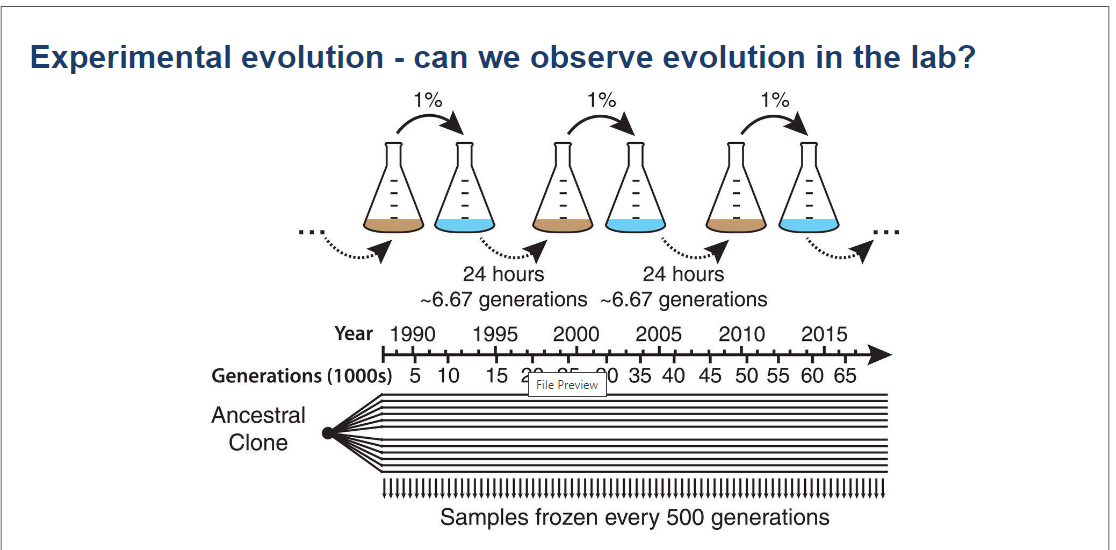
- If certain alleles are associated with the favored phenotypes, they increase in frequency while other alleles decrease in frequency. The result is evolution—a violation of the assumptions of the Hardy–Weinberg model.
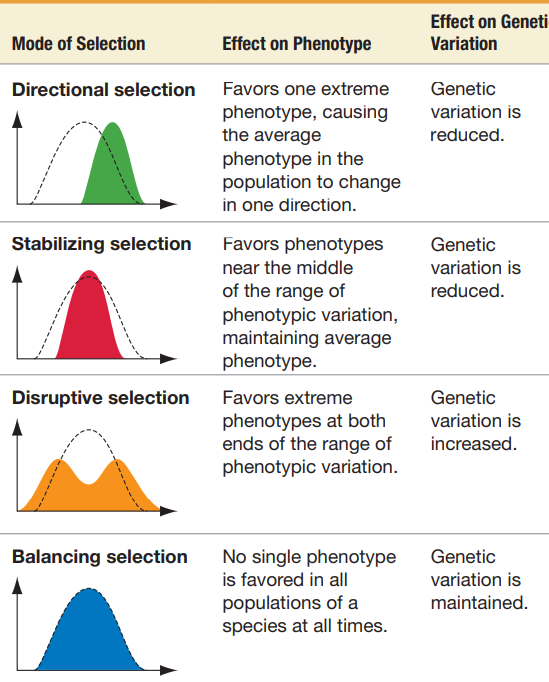
Modes of Selection
Disruptive selection is important because it sometimes plays
a part in speciation, or the formation of new species
Genetic Variation
- They often focus on genetic variation—the number and relative frequency of alleles that are present in a particular population.
- The reason is simple: Lack of genetic variation in a population is usually bad.
Genetic Drift
- causes allele frequencies to change randomly. In some cases, drift may cause alleles
that decrease fitness to increase in frequency
Mutation
- modifies allele frequencies by continually introducing new alleles. The alleles created by mutation may be beneficial or deleterious (detrimental) or have no effect on fitness.
Gene Pool
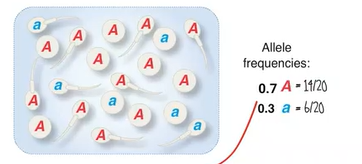
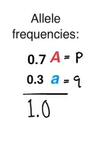
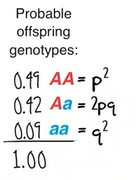
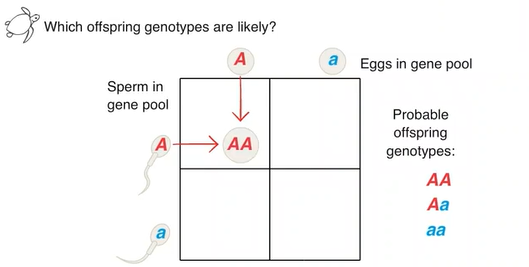
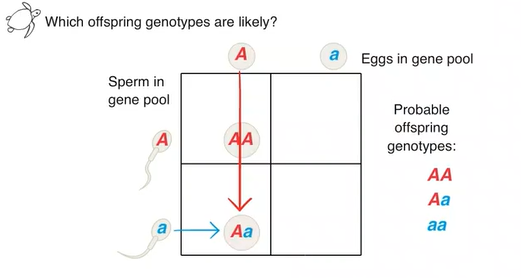
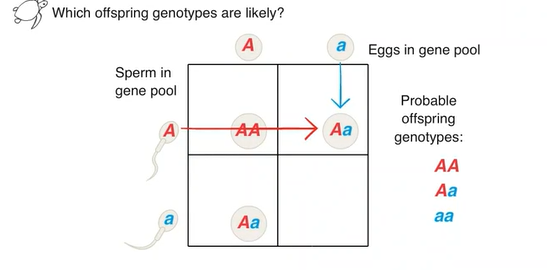
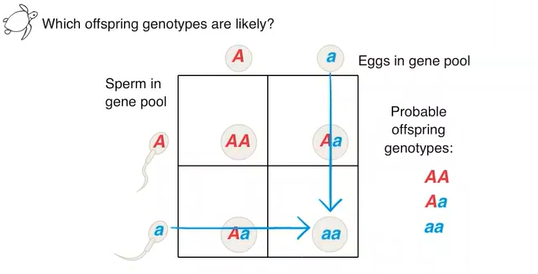
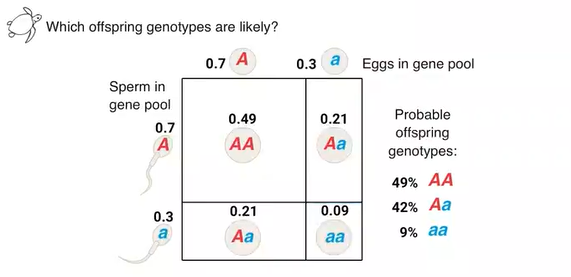
- all of the alleles from all the gametes produced in each generation go into a single group called the gene pool and then combine at random to form offspring.
Questions from Quiz
Which evolutionary mechanism results in adaptation?
- Natural Selection
Predict whether evolution due to genetic drift is likely to occur in the Brazilian Atlantic rain forest, where jucara palms are becoming isolated in smaller "islands" of forest because of human activities. Explain your reasoning.
- Genetic drift is likely to occur in palms in forest fragments due to the bottleneck effect. The allele frequencies within each of the surviving forest fragments are likely to differ from the allele frequencies in the original, intact population by chance.
Why is genetic drift aptly named?
- It causes allele frequencies to drift up or down randomly.
Which statement about genetic drift is correct?
- Genetic drift becomes increasingly important with increasing population size
Gene flow can either increase or decrease the average fitness of a population.
- True
Select the correct statement about gene flow.
- Gene flow makes allele frequencies more similar between populations.
Mutations do not occur because an organism wants or needs them. They just happen randomly and can be beneficial, neutral, or deleterious.
Quiz #5
[https://mediaplayer.pearsoncmg.com/assets/secs-bio-origin-of-new-species-3]()
[https://mediaplayer.pearsoncmg.com/assets/secs-bio-origin-of-new-species-2]()
[https://mediaplayer.pearsoncmg.com/assets/secs-bio-origin-of-new-species-1]()
Which mechanism of reproductive isolation causes postzygotic isolation?
- Hybrid sterility; Zygotes can be formed, but hybrid offspring are sterile as adults, resulting in reproductive isolation of the two populations.
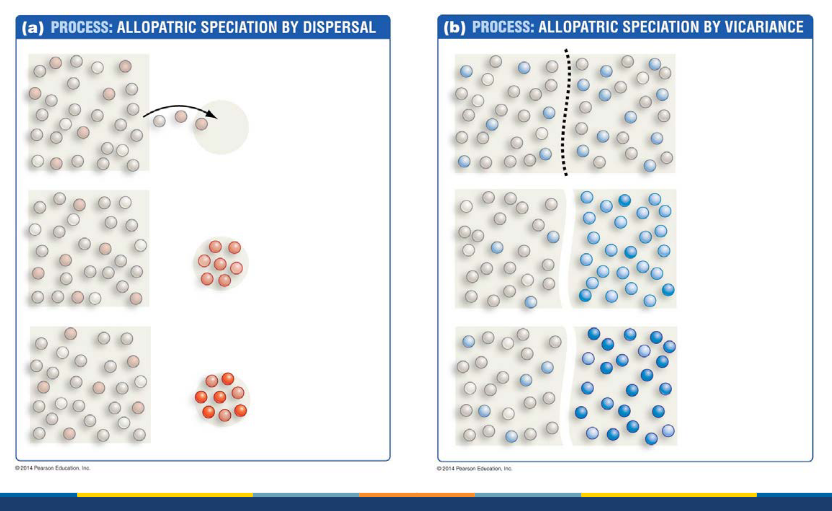
Which of the following describes vicariance?
- A population is fragmented into isolated subpopulations.
Which of the situations below describes vicariance?
- The Grand Canyon forms, separating two populations of squirrels on the North Rim and the South Rim.
Which is the first step in allopatric speciation?
- Geographic isolation of two populations is the first step in allopatric speciation.
Founder Effects
Speciation:
\
- Genetic Isolation:
- A barrier to gene flow isolates populations
- Mutation, selection, and genetic drift in isolated populations cause divergence.
Biological Species Concept
- Temporal
- Populations are isolated bnecause they breed at adifferent times
- Habitat
- Populations are isolated because theyu breedi n different habitats.
- Behavioral
- Populations do not interbreed because they have different courtship displays.
- Mechanical
- Mating fails because male and female reproductive sturctures are incompatible.
- Gametic Barrier
- Mating faikls because eggs and sperm are incompatible.
- Hybrid inviability
- Hybrid offspring do not develop normally and die at some point during early development.
- Hybrid Sterility
- Hybrid offspring mature but are sterile as adults
- Downsides
- no fossils
- no asexual reproduction
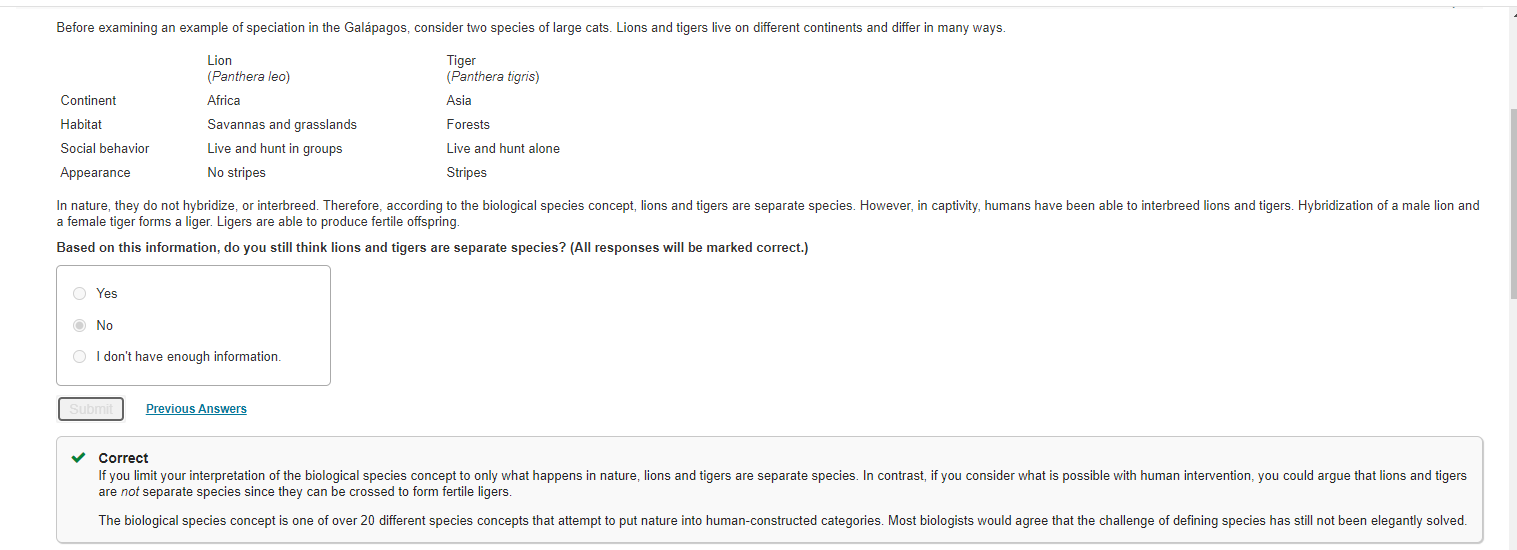
- viable offspring (hybrids) do not equal a new species
Reproductive Isolation
- Habitat Isolation:?
- Temporal: live together but do not mate
- Behavioral Isolation: Impede mating or prevent fertilization i.e bowerbird
- Mechanical Isolation: two animals can’t physically mate
- Gametic Isolation: a whole bunch of species will throw gametes for mating with each other (Mass Spawning)
Reproduction Isolation: Postzygotic barriers
- Prevent a hybrid from developing into a viable, fertile adult
Morphospecies concept
- The neotropical strawberry frog is polymorphic.
- Different phenotypes may be incorrectly called different species
- Cryptic species: incorrectly identified as the same (NOT THE SAME)
What is the underlying source of random variation for reproductive isolation?
- mutation
Phylogenetic Species Concept
- Backtracking
- Tables
Allopatric speciation
Geographic Isolation
Genetic Isolation
Genetic Divergence
How do autopolyploidy and allopolyploidy differ?
The chromosomes of an autopolyploid individual come from the same species, while an allopolyploid individual has sets of chromosomes from different species.
Why are Northeast Pacific populations of transient and resident killer whales thought to represent different ecotypes rather than different species?
Transient and resident killer whales differ in feeding culture but can mate and produce viable offspring in captivity.
PRACTICE
Modern humans (Homo sapiens) and archaic humans called Neanderthals (H. neanderthalensis) shared a common ancestor in Africa but diverged in different geographic areas. When modern humans migrated out of Africa and dispersed around the world starting about 100,000 years ago, they overlapped with Neanderthals in Europe. This scenario is best described as
species living in sympatry following allopatric speciation
Humans are diploid and have 46 chromosomes (or two sets). How many sets of chromosomes are found in each human gamete?
Answer: 1
Humans are diploid and have 46 chromosomes. How many chromosomes are found in each human gamete?
Answer: 23
_____ is the process by which haploid gametes form a diploid zygote.
Answer: Fertilization
A particular diploid plant species has 48 chromosomes, or two sets. A mutation occurs and gametes with 48 chromosomes are produced. If self-fertilization occurs, the zygote will have _____ set(s) of chromosomes.
Answer: 4
Which of these terms applies to an organism with extra sets of chromosomes?
Answer: Polypoids
Mutant tetraploid plants _____.
Answer: Hybridization
Which description of reinforcement is correct?
Answer: Reinforcement is the genetic divergence of populations in different environments.