Lecture 22: One Health & Zoonotic Diseases
Learning outcomes
Define and describe the meaning of the term of “one health”
Discuss the relationship between human, animal and environmental factors and the impact this has on the emergence and spread of infectious diseases.
Define and be able to discuss three examples of zoonotic disease.
One Health Concept
Definition: One Health is an integrated, unifying approach that aims to sustainably balance and optimize the health of people, animals and ecosystems .
The idea is to recognize that the health on one aspect influences the others.
They are interconnected.
Objective: Mitigate the emergence and spread of infectious diseases by addressing human, animal, and environmental factors.
One Health; Is a Global Health Framework:
An approach to designing and implementing programs, policies, legislation and research in which multiple sectors communicate and work together to achieve better public health outcomes.
Building capability to detect and respond to emerging epidemic and pandemic disease threats
One Health primarily aims to tackle infectious diseases.
Multiple factors influence the emergence of these infectious diseases.
Emergence and spread of infectious diseases.
Factors Influencing Infectious Disease Emergence:
Changes in land use practices.
Deforestation ect.
Demographic changes in human and animal populations.
I.e. The concentration of humans in cities.
Also things like the way humans and animals can interact (through travel).
Contamination of food and waterways.
Pathogen evolution
Viruses and Bacteria mutate often
New Strains Arise.
Antibiotic resistance.
Environmental changes.
Medical practices
Including antibiotics usage.
People living longer = Larger population of elderly.
Overall population health.
Functioning of immune system.
These diseases are often capable of infecting multiple host species and circulating between multiple populations:
Humans, domestic animals and wildlife (zoonoses)
This leads to the need for complex disease management strategies
The way these different groups might exhibit sickness.
Different way we can control the movement wild versus domestic animals.
These types of diseases have large Economical and social impacts.
Thus they have stimulated a change in our approach to public health issues.
Have to take into account animal and ecosystem health, not just humans.
Thus countries and sectors working together.
Requires Global Framework.
That’s where ‘One Health’ comes into play.
Collaboration Across Sectors:
Integration of expertise from multiple fields such as epidemiology, veterinary science, and public health.
International organizations involved:
WHO, OIE/WOAH, FAO, CDC, GHSA…
National agencies:
One Health Aotearoa, NZFSA/MPI, Ministry of Health, IDReC, mEpiLab, Animal Industry bodies (BLNZ, DNZ, PIANZ…), ESR, Biosecurity NZ, …..
Massey is part of a Global One Health Research Partnership (GOHRP) and other such programs.
Aim is to Prevent, Detect (early), Respond (quickly).
Zoonotic Diseases
Definition: Diseases that can be transmitted between animals and humans.
Origin can be Viral, Bacterial, Fungal or Parasitical
Not minor problems
Global and Deadly.
Major burden to health services and economies
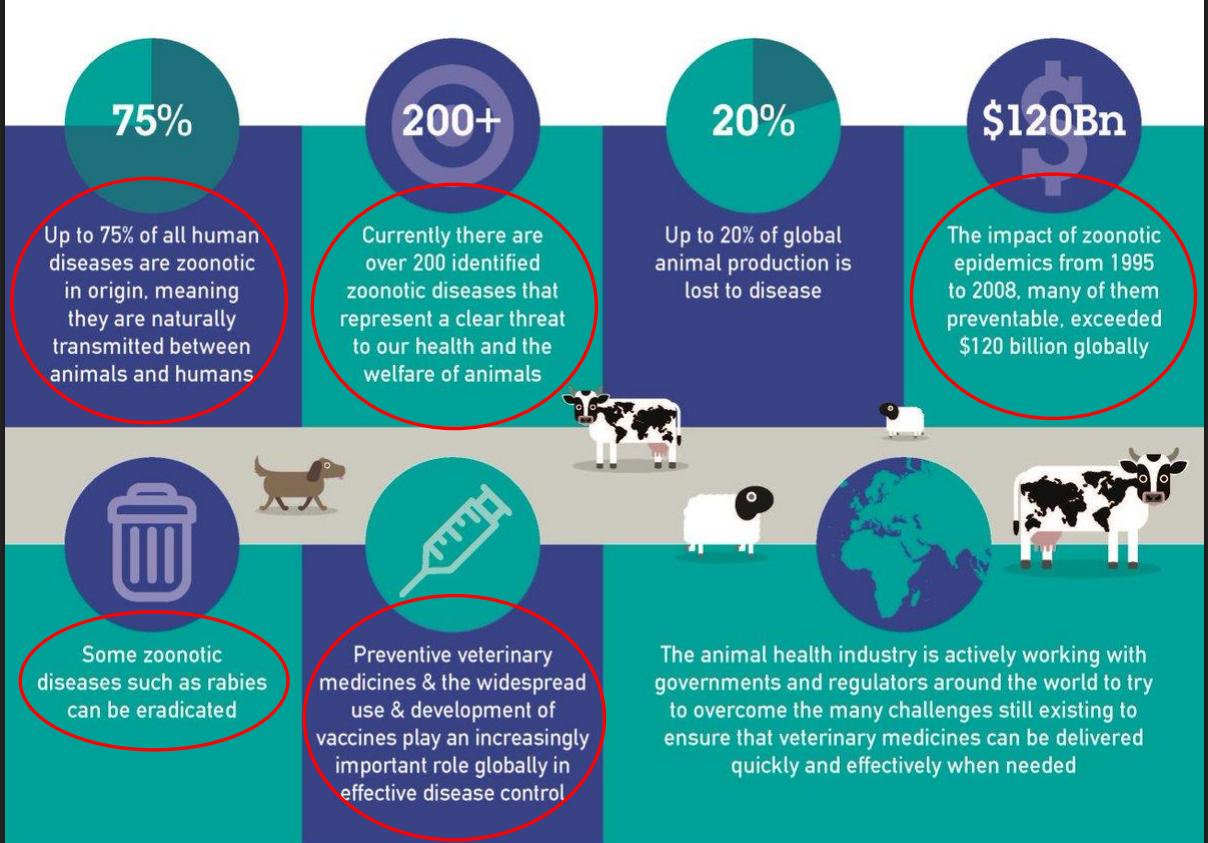
Economic Burden:
Up to 75% of all human diseases are of zoonotic origin.
Significant losses in animal production due to disease ect., estimated up to $120 billion globally from 1995-2008.
Examples:
Rabies:
Eradication possible.
Plague (Yersinia pestis):
Historical impact: "Black Death" in the 14th century.
More than 50 million deaths.
Enormous economic and social impact.
Long history as a biological weapon.
Use of it to deliberately cause outbreaks.
Currently around 600 global infections reported per year.
Resembly easy to treat
Treatable with antibiotics.
21 cases of plague were recorded in New Zealand between 1900 and 1911.
While New Zealand dosen’t have the bacteria Yersinia pestis currently, it has both species of rodent flea necessary for the transmission of the plague bacteria.
Reason Biosecurity is so important.
Campylobacteriosis:
Most frequently notified disease in New Zealand.
Marked seasonality in notifications, with the peaks in spring and summer.
Symptoms: Abdominal pain, fever and watery diarrhea, sometimes bloody.
Illness of variable severity.
Caused by Campylobacter spp.
Zoonotic infection
Often the animals have asymptomatic carriage (don’t show symptoms)
Strains:
C. jejuni associated primarily with poultry; also cattle, sheep and domestic pets
C. coli associated with pigs and poultry
C. fetus (animals are symptomatic with carriage- causing abortions in cattle and sheep)
Most commonly acquired from eating contaminated meat (especially undercooked chicken) or unpasteurized milk.
New Zealand had a high rate of incidences:
Intervention required:
Government Public health response included regulation of chicken contamination.
Here in New Zealand, drinking water contaminated with fecal matter or direct contact with domestic or farm animals are also common modes of transmission.
E.g. August 2016: Campylobacter contamination of the water
supply caused more than 5000 Havelock North residents to
fall ill and was linked to the deaths of three elderly people.
Sheep faeces were likely source;
Heavy rain across sheep paddocks causing contaminated water to enter a pond close to the town water supply
Salmonella (non-typhoidal):
Second most common bacterial cause of foodborne illness in New Zealand.
The bacteria lives in the gut of animals.
Domestic and wild animals including birds especially poultry, fish, reptiles, amphibians, insects, pigs, cattle, rodent and pets; also humans.
Many animals and birds are asymptomatic carriers of Salmonella spp.
Common routes of infection are via food, water, animal contact and exposure to the farm environment.
Risk factors: close association with poultry and could lead to severe illness, especially in young children.
The highest rate of disease is reported in young children.
They are more susceptible and don’t have good hygiene practices.
Strains that effect farm animals (symptomatic)
S. Hindmarsh
Causes Ewe deaths.
S. Brandenburg
In the South Island
Causes late pregnancy abortions in sheep
How Salmonella spreads on farms:
Aborting ewes.
Environmental contamination, black-backed gulls spread disease to other farms
Carrier sheep (stress may trigger shedding), contaminated water sources and contaminated sheep yard dust.
Human cases usually due to work related exposure to the organism.
Eg. farmers and abattoir staff.
Spread of disease by birds:
S. Typhimurium DT160:
Caused extensive mortality in wild birds, and enteric disease In humans in New Zealand during winter/spring 2000.
Spread from South to North Island
Because birds can fly.
Toxoplasmosis:
Caused by Toxoplasma gondii.
One of the world's most common parasites.
Common infection that occurs by eating infected meat or by exposure to the faeces of infected cats.
(Cysts found in infected meat and oocysts in faeces of infected cats.)
Usually harmless
However can cause serious problems if pregnant or have a weak immune system.
Second most common cause of abortion in sheep.
Leptospirosis:
Common occupationally acquired infection in New Zealand.
Animals get it from the environment and pass it onto humans.
Transferred by urine or water.
Big issue particularly in the dairy industry.
Controlled primarily through animal vaccines.
Bovine tuberculosis.
More of an issues in late 1950s’ to late 1990’s
Discovered in 1960’s that possums where one cause of transfer.
Influenza
Constantly mutating creating new strains.
Avian/Bird Flu (H5N1), Swine Flu (H1N1).
Spanish Flu 1918 Pandemic
Driver for scientific collaboration
1947: WHO Interim Committee of the UN established a Global Influenza Programme to track virus changes.
1952: Global Influenza Surveillance Network was officially launched - 26 collaborating laboratories around the world
Renamed the Global Influenza Surveillance and Response System (GISRS) - now comprises 153 institutions in 114 countries.
Sharing of viral material and data among different nations is a critical tool in global efforts against both seasonal flu and pandemic influenza.
Coronavirus (CoV)
SARS 2003 - Severe Acute Respiratory Syndrome
MERS 2012 - Middle East Respiratory Syndrome
Likely source is the bat • Intermediate hosts, masked palm civets and camels
COVID 2019 – nCoV
bats – snakes? – humans?
Disease Management Strategies
Collaborative Efforts: Importance of interdisciplinary approaches for effective disease management and prevention.
Isn’t just about zoonotic diseases: Also Pasture and Plant Health:
Animal health is intertwined with pasture management; quality impacts disease prevention.
Monitoring plant diseases and managing invasive pathogens is imperative for ecosystem health.
Research and Preparedness:
Continuous research into emerging infectious diseases and their ecological impacts.
Focus on pre-emptive strategies versus reactive responses to outbreaks
Consequences of increasing human and animal movements, habitat degradation...
Research and policy.
Global Initiatives: WHO’s emphasis on global health security and influenza preparedness is crucial in managing and predicting outbreaks.
Importance;
New Zealand has a reputation as a producer of safe food.
Maintain NZ disease free status – biosecurity
Food safety - traceability
Market assess, food supply, sustainability, economy
Protecting animal welfare and human health are priorities
Environment and ecosystem health/balance – waterways
Health and labour costs
Improved health = reduced reliance on antibiotic/anthelmintic drugs
MOH and MPI – control and monitor antibiotic use and antimicrobial resistance