Power and Strategy
Game theory
A branch of Mathematics that studies strategic interactions, meaning situations in which each actor knows the benefits they receive depend on the actions taken by all
When people are engaged in a social interaction and are
aware of the ways that their actions affect others, and vice
versa, we call this a strategic interaction.A strategy is defined as an action (or a course of action)
that a person may take:When that person is aware of the mutual dependence of
the results for herself and for others.The outcomes depend not only on that person’s actions,
but also on the actions of others.Models of strategic interactions are described as games.
Games
A game describes a social interaction:
1. Players – who is involved in the
interaction
2. Feasible strategies – actions each
player can take
3. Information – what each player
knows when choosing their action
4. Payoffs – outcomes for every
possible combination of actions
To provide predictions , we use the concept of best response: the strategy that will give a player the highest payoff, given the strategies the other players select.
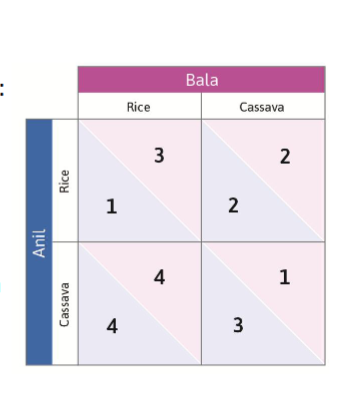
Dominant Strategy Equilibrium:
An outcome of a game in which every player plays
his or her dominant strategy (an action which
gives the highest payoff for a player no matter
what the others do. (decisions do not depend on what others do)Nash Equilibrium:
A strategy profile such that each player’s strategy
is a best response to the strategies played by
everyone else.The prisoner’s dilemma: is a game in which the payoffs in the dominant strategy equilibrium are lower for each player, and also lower in total, than if neither player played the dominant strategy. both players have a dominant strategy which, when played by both, results in an outcome that is worse for both than if they had both adopted a different strategy
Zero sum game: A game in which the payoff gains and losses of the individuals sum to zero, for all combinations of strategies they might pursue. the choice among points on the feasible frontier
In a social dilemma individuals pursue their individual objectives (payoffs from playing their dominant strategies) and it leads to an outcome which is Pareto dominated by some other outcome
Modelling Trade wars
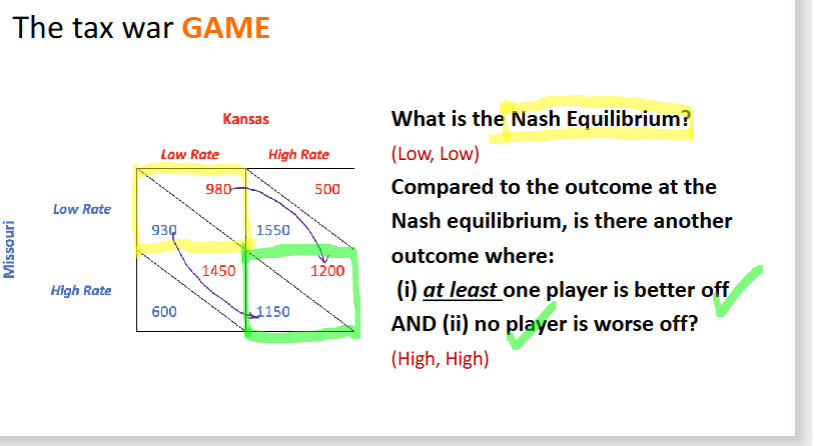
• Players: Missouri and Kansas
• Strategies: Each state chooses to tax firms
at either a ‘Low Rate’ or a ‘High rate’
• Payoffs: Government revenue ($ hundreds
of millions, shown in the table)
• Information: Simultaneous decision
(Low, Low) is Nash equilibrium- best response given other player
(High, High) is Pareto dominant over (low,low). At least one player if better off and no player is worse off
the Nash equilibrium is pareto inefficient - All outcomes except NE Pareto efficient
Bargaining
The ultimatum game: A sequential game where players
choose how to divide up
economic rents e.g. cash prize
The proposer’s offer may be
motivated by altruism,
fairness (50-50 split),
inequality aversion,
social norms, or reciprocity.
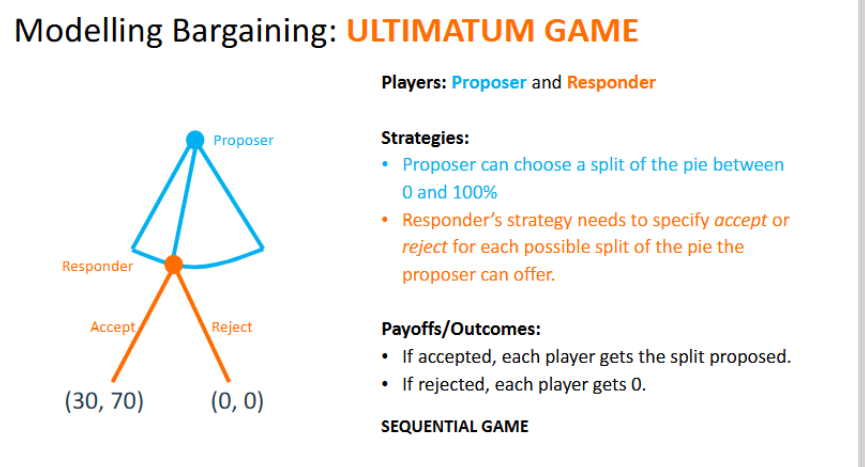
The Nash equilibrium here would be for player 1 to offer 50%, and player 2 to accept anything over 50%. If proposer offers less than 50% to other player, it will be rejected and proposer will get nothing (which is worse than 50%). • If proposer offers more than 50% to the other player, then the proposer will only get less than 50% of the pie and will be worse off than if they had offered 50%. • This means the proposer is playing a best response to the responder’s strategy.
if the proponent offered 30% and the respondent accepted anything, the proponent could be better off by offering less, since it would get accepted anyways.
Any strategy would be pareto efficient, as long as the whole pie (100%) is shared, since is not possible to make one player better off, without taking away/reducing the share of the other player.
Fairness
Nash equilibria are not necessarily efficient outcomes.
The tax war between Kansas and Missouri harmed government finance and its ability to provide public services.Pareto efficient outcomes are not necessarily fair.
Pareto efficiency applies when resources do not go unused (no ‘money left on the table’), but this can be a feature
of both even and uneven ‘splits of the pie’.Fairness is more subjective and is not typically incorporated into the utility functions (in most introductory texts).
But this doesn’t mean it can’t affect outcomes. If fairness is important to individuals or societies then it can lead to
the rejection of particularly low ‘splits of the pie’.
Summary
Institutions
Economics does not provide judgements about fairness, but it can clarify:
How institutions (rules of the game) affect inequality
Tradeoffs in the fairness of outcomes e.g. giving up equality
of income for equality of opportunityWhich public policies can address unfairness, and how
Institutions = the laws and social norms governing the way people interact in society.
• Institutions can be formal (written and enforced) or informal.they provide both the constraints and the incentives
in the terminology of game theory, we could say that
institutions are the ‘rules of the game’ Specifying, as in the ultimatum game, who can do what, when they can do it, and how the players’ actions determine their payoffs. Institutions in models
Power
Power: The ability to do and get the things we want in opposition
to the intentions of others.Since institutions determine who can do what, and how payoffs are
distributed, they determine the power individuals have to get what
they want in interactions with others.
Power in economics takes two main forms:It may set the terms of an exchange: By making a take-it-or-leave-it
offer (as in the ultimatum game).It may impose or threaten to impose heavy costs: Unless the other
party acts in a way that benefits the person with power.
Bargaining power
Bargaining power = extent of a person’s advantage in securing a larger share of the economic rents made possible by an
interaction.
Example: Ultimatum game
• Proposer’s right to make a take-it-or-leave-it offer
gives her more bargaining power, albeit constrained.
• Unlike in experiments, the assignment of power in
real economies is not random; it is itself determined by
institutions.
Feasible allocations
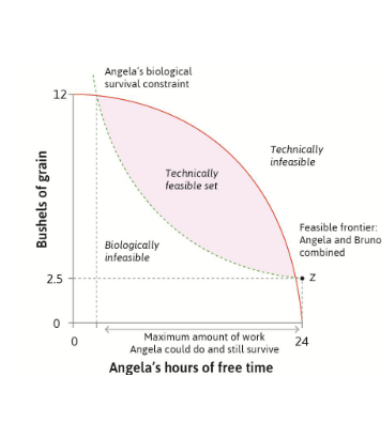
Angela faces a tradeoff between farming grain and her free time
The feasible frontier shows all the
technically feasible outcomes
(limited by technology).The biological survival constraint
shows all the biologically feasible
outcomes (limited by survival).Feasible allocations are given by the
intersection of these constraints.
Coercion
Now, the landowner Bruno can enforce any allocation he
wants – in effect, Angela is his slave.The allocation that maximizes his
economic rent: Where the slope of the biological
constraint (MRS) equals the slope of the
feasible frontier (MRT).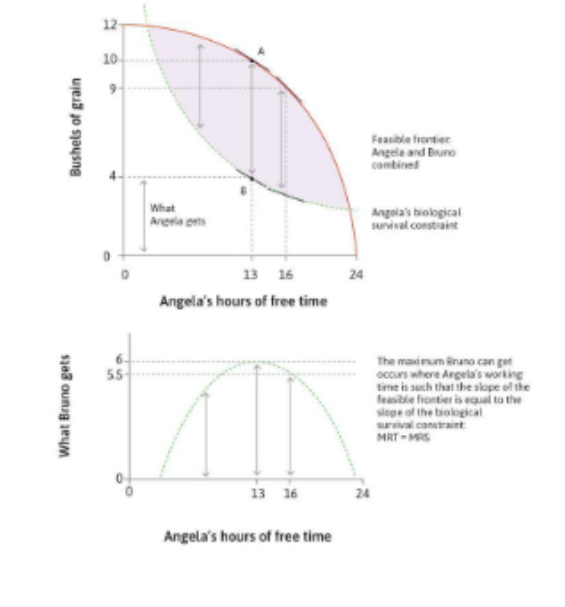
Introducing outside options
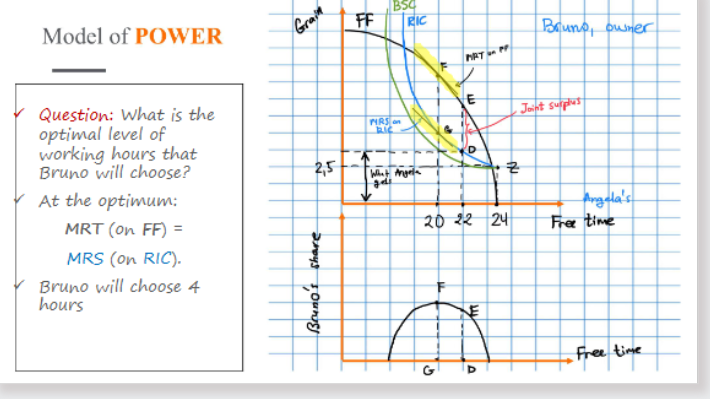
If Angela has an outside option like unemployment benefits, she now has a reservation indifference curve(RIC). this shows Combinations of grain & free time such that Angela just gets the outside option.
Angela needs 2.5 Bushels of grain to survive. Suppose the outside option provides 2.5 bushels.
Joint Surplus: Total amount of grain produced minus what Angela should get to work certain t hours.
The optimal level of working hours Bruno will choose is 4: MRT (on FF) = MRS (on RIC)
Angela is on her reservation indifference curve, so she earns no economic rent.
Under coercion, the allocation chosen is where the slope of the
biological constraint equals the slope of the feasible frontier.Without coercion, joint surplus is maximized where the slope of the reservation indifference curve equals that of the feasible frontier.
Total surplus is lower when both parties have to agree to the proposal.
Bruno takes the whole surplus as he has more bargaining power.
All the points along the line FG are pareto efficient - MRS=MRT at all these points
Angela’s MRS doesn’t change as she consumes more grain, as we assume quasi-linear preferences
Quasi-Linear preferences
We use this assumption to make the model simpler
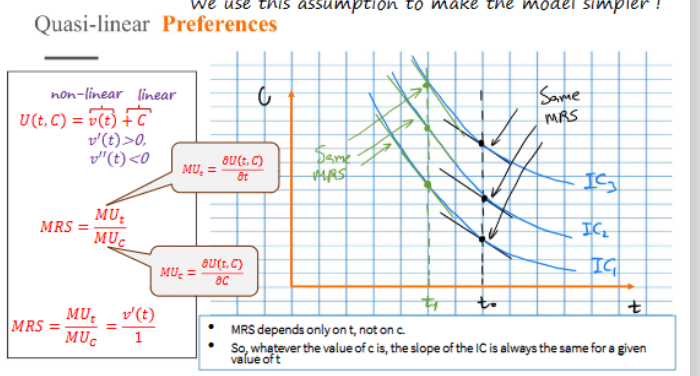
Hence in our example, the
Pareto efficiency curve is a
straight line
Changes in Labour laws
There are all sorts
of laws that limit
the amount of
working hoursInstitutions give workers power
Suppose the max
working hours is 4Angela can move to a
higher indifference
curve (IC2 to IC3)Bruno is also
better off,
because CJ > CH)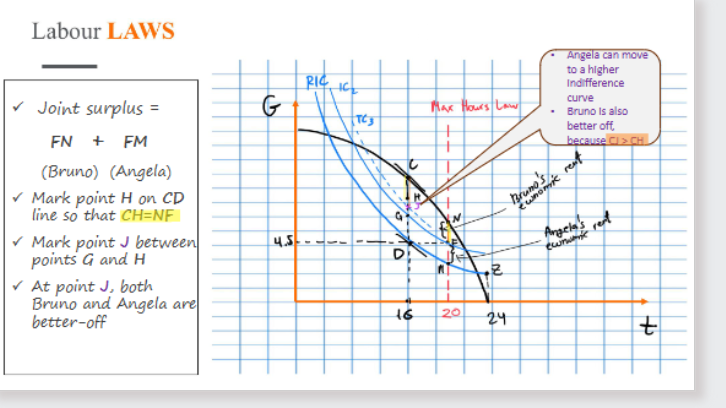
Determinants of Economic outcomes
Technology and biology determine which allocations are technically feasible.
Economically feasible allocations must be Pareto improvements of their
reservation options: Those reservation options may depend on institutions (such
as legislation on working hours).The outcome of an interaction depends both on what people want and their
ability to get it: Their preferences, and the institutions that provide their
bargaining power, decide how the surplus is distributed
Modelling Changes
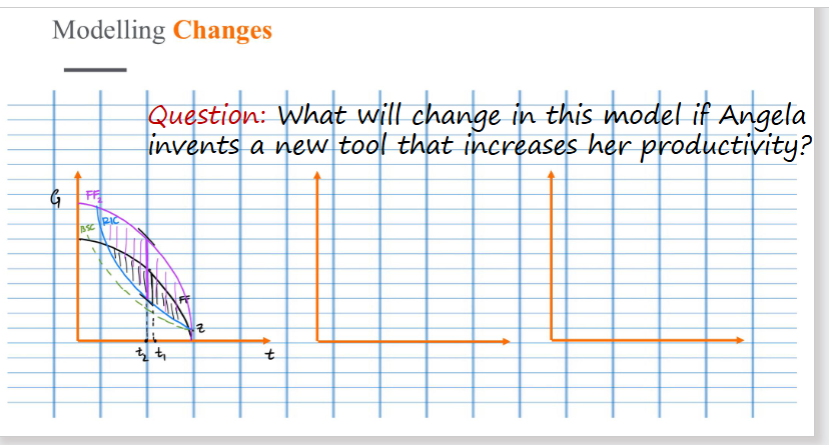
if Angela’s productivity increases, then her Feasible set expands, as she can produce more grain in a given time (FF1 to FF2)
She can gave more free time whilst producing the grain she needs to survive
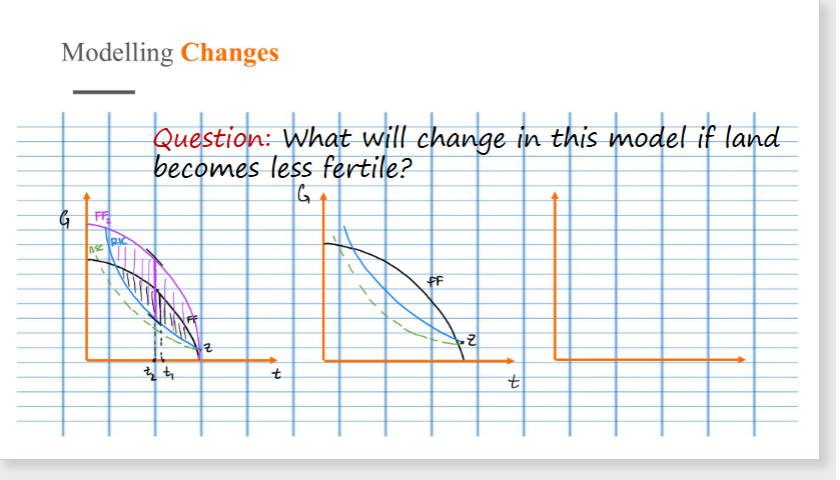
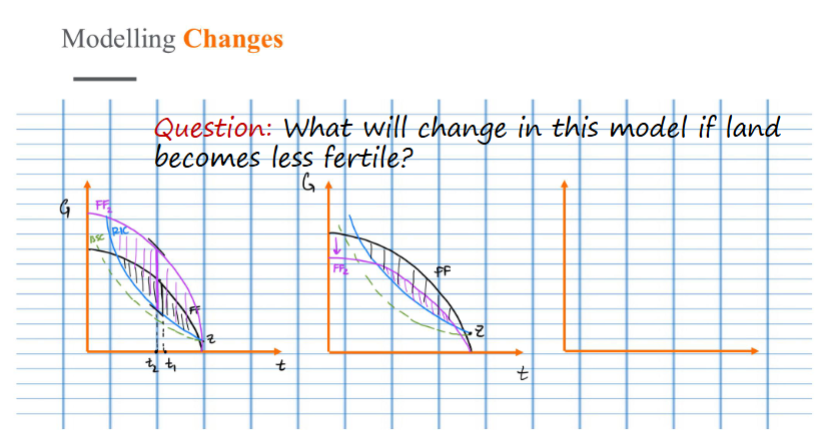
If land becomes less fertile, her feasible set shrinks (FF1 to FF2). this is a biological constraint
therefore it takes more time for her to produce the grain she needs, and the optimal point changes
Key terms and questions
How does a factor such as altruism change the outcome of a game such as the prisoner's dilemma?: In a Prisoner’s Dilemma, people usually defect because it gives them the best personal result. But if they are altruistic, they value the other person’s outcome too, so cooperating becomes more attractive. As a result, cooperation is more likely, and the game can move from the usual “both defect” outcome to a better outcome for both players.
Nash equilibrium: A situation where no one can improve their outcome by changing their choice, if others keep their choices the same. In this balance, each person's decision is the best response to what others are doing. For example, in a market where two competing stores have set prices, if neither store can attract more customers by changing its price while the other store’s price stays the same, they are in a Nash equilibrium.
Pareto efficiency:
situation where resources are allocated in a way that no one can be made better off without making someone else worse off. It represents an outcome where all possible gains from an interaction have been realized.Pareto efficiency curve: lies where all mutually beneficial trades have been exhausted, meaning people’s preferences are perfectly balanced (their willingness to trade is equal). At any point off the curve, there are still gains from trade, so you can move closer to the curve and make at least one person better off without hurting anyone. At all points, MRS=MRT
Institution: it is a set of rules or practices that shape how people interact in society, such as laws, customs, or organizations. These rules help coordinate behaviour and guide economic decisions.
Joint Surplus: the total benefit that all parties get from a trade or agreement, beyond what
they would have gained separately. It also shows how much better off everyone is from cooperationGains from exchange: The benefits that each party gains from a transaction compared to how they would have fared without the exchange
How does the bargaining (think of something like trade union negotiations) yield a Pareto improvement?: in trade union negotiations, workers may accept slightly lower wage demands in exchange for better job security or conditions, while firms agree because it improves productivity or avoids costly strikes. This agreement makes both sides better off compared to the disagreement outcome, so it is a Pareto improvement.