Topic 2: Salivary glands
Saliva has multiple functions:
Lubrication - cleans and moistens mouth. Dissolves food chemicals for tasting.
Digestive enzymes - contains salivary amylase that starts digestion of carbohydrates by breaking down starchy food.
Buffering - contains buffers that keeps the it at about pH 7 to control growth of microbes.
Immune defence - contains antibodies and lysosomes.
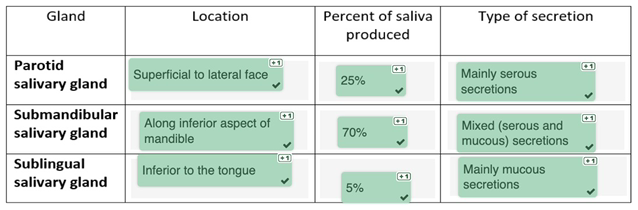
Saliva can be categorized into different types based on its composition and function. The two main types of saliva secretions are:
Serous (watery) secretions
Rich in water, electrolytes, and enzymes, particularly salivary amylase
Thin and clear in consistency.
Helps in lubrication and digestion of carbohydrates.
Mucous (thick/viscous) secretions
Rich in mucin proteins, which give it a thicker, more viscous consistency.
Acts as a protective barrier, coating the oral mucosa, teeth, and throat, thereby lubricating and protecting these surfaces from mechanical abrasion, chemical irritation, and microbial invasion.
Contributes to the formation of the bolus (chewed mass of food) during swallowing, aiding in its smooth passage through the esophagus.