The Market System (ch. 9-12)
Price Elasticity of supply is the responsiveness of supply to a change in price. Inelastic supply is where the change in price results in a proportionately smaller change in quantity supplied, and elastic supply is where the change in price results in a proportionately greater change to the quantity supplied. The formula for PES is PES = (% change in quantity supplied) / (% change in price).
PES < 1 = inelastic supply
PES > 1 = elastic supply
PES = 0 = perfectly inelastic
perfectly inelastic is where the quantity supplied is fixed and cannot be adjusted depending on the price
PES = ∞ = perfectly elastic
perfectly elastic is where producers will supply an infinite amount at a given price
PES = 1 = unitary elastic
a change in price will be matched by an identical change in quantity supplied
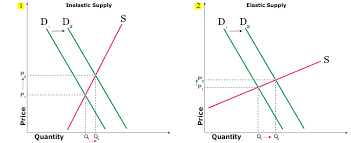
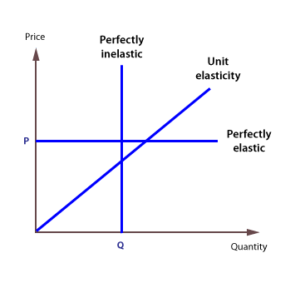
Factors affecting PES:
Factors of Production - if a producer has easier access to FoP, then there will be a production boost, thus making supply elastic
Mobility - if factors of production are easily mobile, as in they can easily be switched between uses, then supply will be elastic
Specialization - if products require specialized FoP then the supply will be inelastic
Stocks - if producers can hold stocks of goods for a long time, supply becomes elastic
Spare Capacity - supply becomes elastic if producers have spare capacity because firms can produce more with their resources
Time - the speed with which producers can react to a price change in the market affects PES, so when there is more time for producers to react, then there will be a more elastic supply
Income Elasticity of Demand (YED) is the responsiveness of demand to a change in income. The formula for it is YED = (% change in quantity demanded) / (% change in income). Necessities (basic goods which consumers need to buy) will generally be income inelastic. Luxury goods, which are bought with discretionary expenditure (non-essential spending or spending that is not automatic, usually have demand that is income elastic. Normal goods have an increase in income, which results in an increase in quantity demanded, and thus there is positive income elasticity. Inferior goods have an increase in income resulting in a decrease in quantity demanded, meaning that the value of income elasticity is negative.
If firms know the value of price elasticity, they can predict any effects on total revenue, helping them change prices to suit their needs much better. If firms know the value of income elasticity then they can predict any future changes in demand for their products, helping them choose prices depending on season etc.
Governments can raise revenue by introducing indirect taxes (ie VAT and excise duty (government taxes on certain products sold in a country)), so governments can target goods which are non-essential and products that are inelastic. Governments also consider PED when granting subsidies to producers, so if the subsidy is designed to help the poor, then PED must be price inelastic.
An economy is a system that attempts to solve the basic economic problem. Goods and services are provided by both the public sector and the private sector. The public sector is the provision of goods and services by businesses that are owned by individuals or groups of individuals, whereas the private sector is government organizations that provide goods and services in the economy.
The private sector:
sole traders - private sector, business owned and controlled by one person
partnerships - private sector, business owned and controlled by two plus people together, found in professions
companies - private sector, shareholders (people or organizations that own shares in a company) own the business, electing a board of directors to run the firms on their behalf
Goals of the private sector:
Survival - in the private sector, firms want to simply survive and keep running
Profit maximization - in the private sector, owners of firms want to make a profit. Companies provide shareholders through dividends (part of a company’s profits divided among shareholders)
Growth - a firm wants to exploit economies of scale so that profits are higher in the future
Social Responsibility - more firms want to please stakeholders
The public sector:
Central government departments - controlled by the central government, by teams or boards led by a government minister
Public corporations or state-owned enterprises - owned by the government, assets (resources belonging to a business that has value or power to earn) and liabilities (debt owed) belong to the state
Local authorities - delivered by local councils such as swimming pools etc
Other public sector organizations - such as the BBC, run by an export selected by a high-ranking official
Goals of the public sector:
Improve the quality of services - improve the standard of living for citizens
Minimize costs - government resources are scarce, you do not want to waste any of it
Allow for social costs and benefits - taking into account the wants and needs of stakeholders (individuals or groups who are an important part of an organization/of society because they have a responsibility within it and receive advantages from it)
Profit - the government still wants profit, even if it is generally helpful to society
There are multiple types of economy:
A market or free enterprise economy - relies the least on the public sector, which gets most things from the private sector
A command or planned economy - relies on the public sector to choose, produce and distribute goods
A mixed economy - relies on both the public and private sectors
In a mixed economy, the public sector provides goods which the private sector struggles to do, such as in a situation of market failure (where markets lead to inefficiency)
Market failure is where the market leads to inefficiency. This can happen in a range of situations:
Externalities - some firms don’t take into account all of the costs of production, such as creating a negative externality
Lack of competition - dominant firms may exploit consumers
Missing markets - public goods aren’t provided by the private sector, and merit goods are underprovided by the private sector
Lack of information - markets are only efficient with a free flow of information
Factor immobility - FoP must be able to move freely between uses. If this does not happen, then the government may impose the following interventions:
Regulation of businesses
Legalization to prevent domination
State money provides public goods and merit goods
Legislation to force firms to give all of the information
Retraining workers to stop factor immobility
Public goods have these two characteristics:
non-excludability - nobody can be prevented from consuming the good or service (such as the police force)
non-rivalry - consumption of a public good nu one individual cannot restrict the amount available to others
If the private sector provided public goods, there would be a free rider (individual who enjoys the benefit of a good but allows others to pay for it) issue.
Privatization is the transfer of public sector resources to the private sector. There are many forms of it:
Sale of nationalized industries (public corporations previously part of the private sector which was taken into state ownership) - natural monopolies were sold to become private
Contracting - contractors can now bid for services such as school meal provision
Sale of land and property
Privatization happens for the following reasons:
generate income - gets money for the government
public sector organizations are inefficient - lacked incentives, and selling them gave incentive
reduce political interference - the government cannot use these organizations for political gains
Effects of privatization:
On consumers - firms now had the pressure to meet customer needs whilst returning profit, meaning that they became efficient, sold better quality products, grew, and charged reasonable prices
On workers - many workers become unemployed and had to increase productivity by working harder and for longer hours
On businesses - their objectives change, they increase investment, have mergers or takeovers (the act of gaining control over a company by buying over 50% of shares), diversification (increase the range of goods or services it provides)
On the government - revenue generation, expensive (due to advertising), hostile takeovers (takeover which the firm does not want or agree to) after privatisation common