AP Psychology: Module 29
Learning and conditioning can be limited by biological constraints — especially in animals — which means that not all associations can be learned and conditioned equally well.
For example, each species’ predispositions prepare it to learn the associations that enhance its survival — this is known as preparedness.
Environments are not the whole story; biology matters, too
Preparedness: a biological predisposition to learn associations, such as between taste and nausea, that have survival value.
Humans, like animals, seem biologically prepared to learn some associations rather than others.
If you become violently ill four hours after eating contaminated oysters, you will probably develop an aversion to the taste of oysters more readily than to the sight of the associated restaurant, its pates, the people there, or the music that was played.
This is because our body biologically prepares us to learn taste aversion to bad foods.
Research has come to support Darwin’s principle of natural selection, as our ancestors learned taste aversion to certain foods, which helped them not eat anything toxic so that they could survive and have more descendants.
This is a biological influence on our learning and conditioning
Our preparedness to associate a CS with a US that follows predictably and immediately is adaptive.
Biological constraints predispose organisms to learn associations that are naturally adaptive.
For example, by using food as a reinforcer, you can condition a hamster to dig or to rear up because these are among the animal’s natural food-searching behaviors.
Instinctive drift: the tendency of learned behavior to gradually revert to biologically predisposed patterns.
Pavlov and Watson, in their dismissal of “mentalistic” concepts such as consciousness, underestimated the importance of not only biological constraints — such as preparedness and instinctive drift — and the effects of cognitive processes.
Cognitive processes such as thoughts, perceptions, and expectations.
Early behavioralists believed that rats’ and dogs’ learned behaviors could just be reduced to mindless mechanisms, so there was no need to consider cognition.
In 1972, researchers Rescorla and Wagner showed that animals can learn the predictability of an event.
If a shock is always preceded by a tone, and then may be preceded by a light that accompanies the tone, a rat will react with fear to the tone but not the light.
This is because although the light is followed by the shock, it adds no information to that of the already-sounded tone; the tone is a better predictor.
The more predictable the association, the stronger the conditioned response.
It is as if the animal learns expectancy, an awareness of how likely the unconditioned stimulus will occur.
Research has proven that associations can influence attitudes.
When British children viewed novel cartoon characters alongside either ice cream (Yum!) or Brussels Sprouts (Yuck!), the children preferred the ice cream.
Conditioned likes and dislikes are even stronger when people notice and are aware of associations they have learned.
COGNITION MATTERS!!!!!
As a result, classical conditioning treatments that ignore cognition often have limited success.
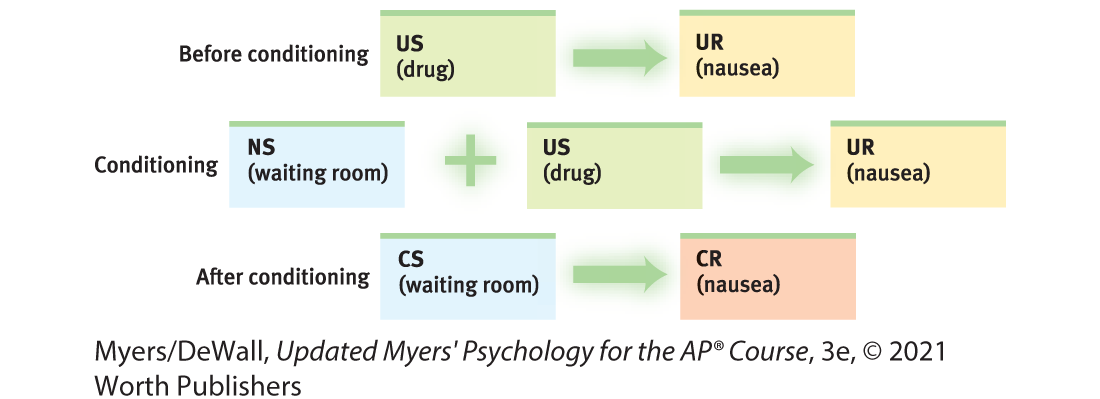
For example, people receiving therapy for alcohol use disorder may be given alcohol spiked with a nauseating drug. Will they then associate alcohol with sickness? Although it would seem so in a cut-and-dry situation, this is not the case because one’s awareness that the nausea is induced by the drug, not the alcohol, often weakens the association between drinking alcohol and feeling sick.
So, in classical conditioning, it is not only the CS/US association but also the thought that matters.
Cognitive map: a mental representation of the layout of one’s environment.
For example, after exploring a maze, rats act as if they have learned a cognitive map of it.
Latent learning: learning that occurs but is not apparent until there is an incentive to demonstrate it.
There is more to learning than associating a response with a consequence; there is also cognition
Insight: a sudden realization of a problem’s solution, which contrasts with strategy-based solutions.
For example, we may puzzle over a problem and, suddenly, the pieces fall together as we perceive the solution in a sudden flash of insight
Intrinsic motivation: a desire to perform a behavior effectively for its own sake.
Excessive rewards can destroy intrinsic motivation
In experiments, children who had been promised a payoff for playing with a puzzle or toy ended up playing with it less than the unpaid children did.
Extrinsic motivation: a desire to perform a behavior to receive promised rewards or avoid threatened punishment.
For example, if you are trying to get an assignment or reading done before a deadline rather than doing it because you are truly interested in it, you are extrinsically motivated.
Good extrinsic rewards signal a job well done (or something like that), rather than bribe or control someone.
People who focus on their work’s meaning (intrinsic motivation) not only do better but ultimately earn more extrinsic rewards.
Classical Conditioning | Operant Conditioning | |
|---|---|---|
Biological influences: | Natural predispositions constrain what stimuli and responses can easily be associated | Organisms most easily learn behaviors similar to their natural behaviors; unnatural behaviors instinctively drift back toward natural ones. |
Cognitive influences | Organisms develop an expectation that a CS signals the arrival of a US | Organisms develop an expectation that a response will be reinforced or punished; they will also exhibit latent learning, without reinforcement |
Problem-focused coping: attempting to alleviate stress directly by changing the stressor or the way we interact with that stressor.
For example, if your impatience leads to a family fight, we may go directly to that family member to work things out
We tend to use this form of coping when we feel we have control over a situation and can “fix” it.
Emotion-focused coping: attempting to alleviate stress by avoiding or ignoring a stressor and attending to emotional needs related to our stress reaction.
When we feel that we cannot change a situation, we tend to rely on this form of coping.
We may seek to relieve stress by reaching out to friends and things such as that, rather than going to the actual issue.
Personal control: our sense of controlling our environment rather than feeling helpless.
This, alongside our explanatory style and supportive connections, all help to influence our ability to cope successfully.
Learned helplessness: the hopelessness and passive resignation an animal or person learns when unable to avoid repeated aversive events.
In an experiment, dogs were strapped in a harness and given repeated shocks with no opportunity to avoid them. Later, when they were given the option to escape the punishment, the dogs displayed learned helplessness, staying and waiting for the worst.
When we start to perceive a loss of control, we become more susceptible to stress and ill health.
In several cases, workers with the most control live longer.
Control also helps us to explain the link between economic status and longevity.
High economic status predicts a lower risk of heart and respiratory diseases, along with longer lifespans, healthier offspring, reduced risks of birth weight, infant mortality, smoking, and even violence.
Losing control predicts health problems because losing control provokes an outpouring of stress hormones — this is the biological factor that comes into play.
When people (or animals) feel that they cannot control their environment, their hormone levels rise, blood pressure increases and immune responses drop.
Stress increases when we have a lack of control
People tend to feel like they lose control in many situations, but primarily the conditions they live in in their environment.
People in high-density neighborhoods, prisons, and dorms diminish feelings of control.
Increasing control — allowing prisoners to move chairs and control room lights and the TV; having workers participate in decision-making; and allowing people to personalize their workplace — has noticeably improved health and morale.
In a study on this topic in a nursing home, 93% of those who were encouraged to exert more control became more alert, active, and happy.
Perceived control is basic to human functioning.
People thrive when they live in conditions of personal freedom and empowerment — freedom and personal control foster human flourishing.
However, in Western cultures, researchers have found that the excess of freedom has led to way too many choices, which can result in increased depression, lower life satisfaction, or even behavior paralysis.
This tyranny of choices brings information overload and a greater likelihood that we will feel regret over what we left behind or didn’t choose.
External locus of control: the perception that chance or outside forces beyond our control determine our fate.
PTSD can stem from those who possess an external locus of control
Today’s generation of Americans express an external locus of control, which contrasts the internal belief in generations before — this shift may help to explain the worsening depression rates in teens
Internal locus of control: the perception that we control our own fate.
In different studies, it has been revealed that “internals” have achieved more success in school or work, acted more independently, enjoyed better health, and felt less depressed than the “externals.”
They have a greater sense of control, which correlates to their overall well-being
Another way to say that we are in control of our own fate is to believe that we have free will.
Studies have shown that those who believe they have free will learn better, perform better, and behave more happily. They also enjoy making decisions, favor punishing rule breakers, and oppose government control of personal lives.
These types of people also exhibit another type of control known as willpower or self-control
Self-control: the ability to control impulses and delay short-term gratification for greater
long-term rewards
When we have a sense of personal control over our lives, we are more likely to develop self-control
Self-control predicts good health, higher income, and better school performance.
Strengthening self-control requires attention and energy, just like building muscle.
Improved self-control helps you to control anger, dishonesty, smoking, and excessive spending.
Self-control varies over time, as it tends to weaken after use, recover after rest, and grow stronger.
Develop your self-discipline, and self-control can help you have a happier, healthier, and more successful life