B2
CELLS
B2.1
Cells - The basic unit structure in all organisms.
‘Building blocks of life’ (smallest unit)
Capable of surviving on their own.
Can replicate independantly.
Multicellular organism - Composed of many cells.
Unicellular organism - Composed of only one cell (Bacteria)
How are new cells made?
In multicellular organisms, new cells are made by splitting into 2. The 2 new cells can then split into 4 cells and so on. When they do this, they are either growing or replacing dead cells.
In unicellular organisms, each individual cell is an organism. When a cell divides into 2, it is reproducing. This is called assexual reproduction.
Eukaryotic and Prokaryotic Cells
Plant and Animal Cells → Eukaryotes
Have a nucleus
Bacteria Cells → Prokaryotes
Do not have a nucleus
Hierarchy
Cell → Tissue → Organ → Organ System → Organism
Tissue
Group of cells working together for a specific function
Organ
Group of tissues working together for a particular function
Organ system
Group of organs working together for a major function
Organism
An individual living being that can carry out all life processes, made up of one or more cells.
Cell structure
Three types of cells
Plant
Animal
Bacterial
Plant Cell
Plant cell → Eukaryotic → Multicellular organisms
(They have all components of an animal cell and a few others)
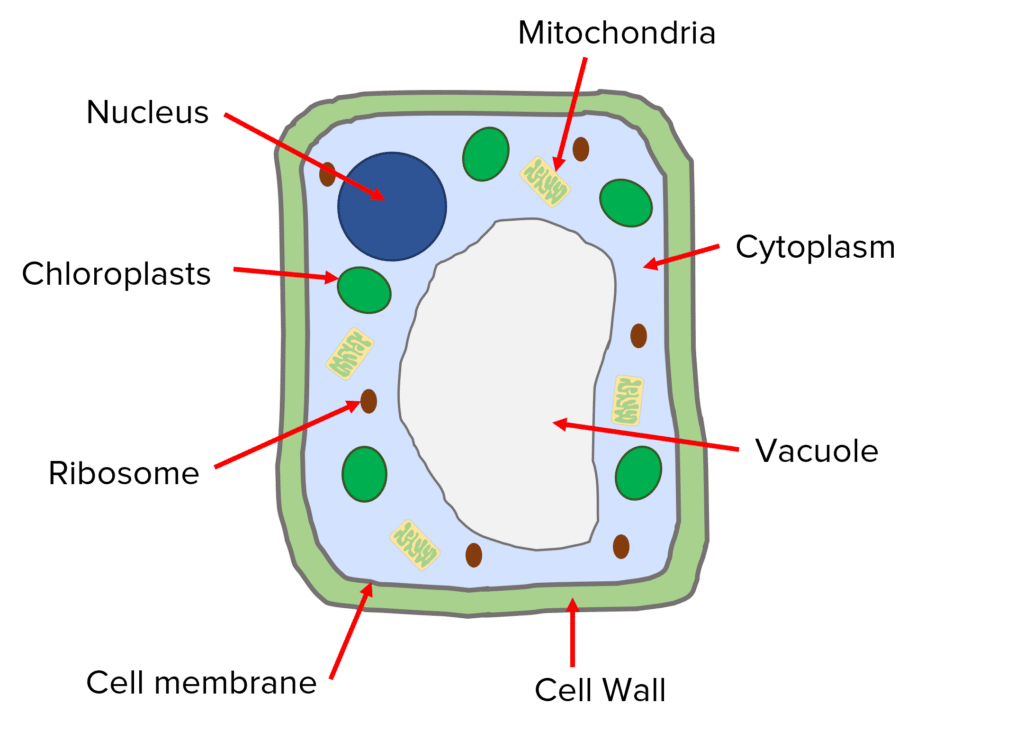
Parts and Functions-
Cell wall
Strengthens the cell and gives it support.
Made of cellulose
Cell membrane
Controls the movement of substances in and out of the cell.
Nucleus
Contains the plant’s genetic material
(DNA = instructions for making new cells)
Permanent Vacuole
Stores nutrients in the form of sap, and water and waste products.
Keeps cell structure rigid to support the plant.
Cytoplasm
Liquid - gel structure where chemical reactions take place.
It is where all the organelles are suspended.
Mitochondria
Provide cells with energy during respiration.
Chloroplast
Contains chlorophyll → green pigment which absorb sunlight for photosynthesis.
It is where photosynthesis happens.
Ribosomes
Synthesise proteins from amino acids.
Animal Cell
Animal Cell → Eukaryotic → Multicellular organisms
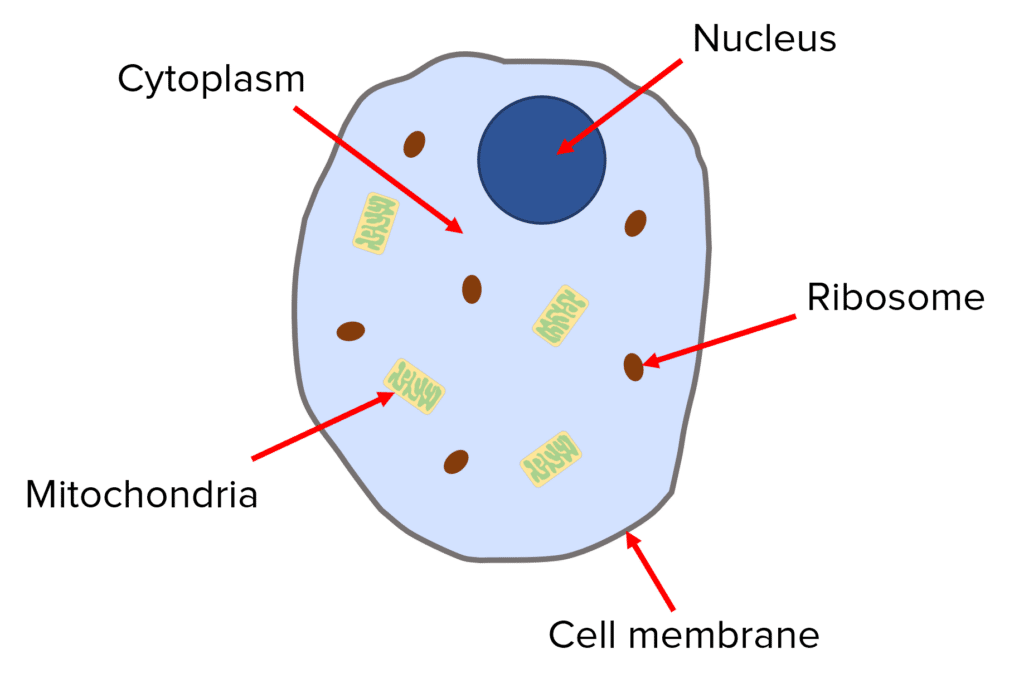
Parts and Functions-
Nucleus
Contains the animal’s genetic material
(DNA = instructions for making new cells)
Cytoplasm
Liquid - gel structure where chemical reactions take place.
It is where all the organelles are suspended.
Cell membrane
Controls the movement of substances in and out of the cell.
Mitochondria
Provide cells with energy during respiration.
Ribosomes
Synthesise proteins from amino acids.
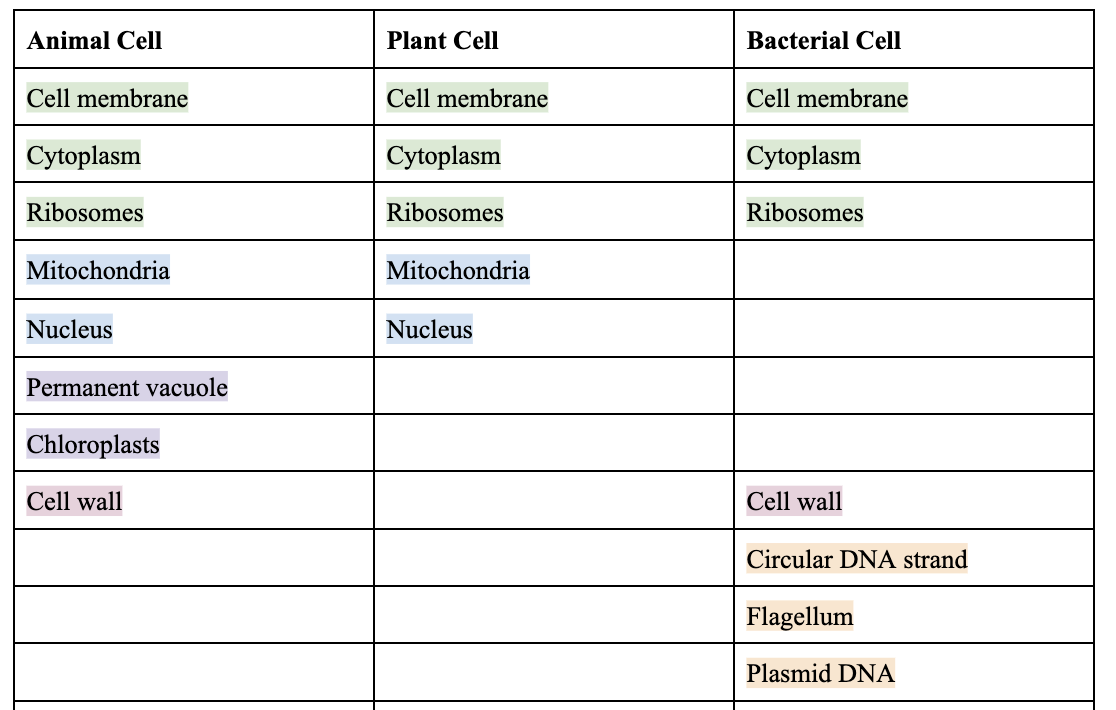
Plant cell vs Animal cell
Animal cells have all of the same structures as plant cells, except the following:
Cell membrane, permanent vacuole, chloroplasts. (because they do not need them)
Bacterial Cell
Bacteria cell → Prokaryotic cell → Unicellular organisms
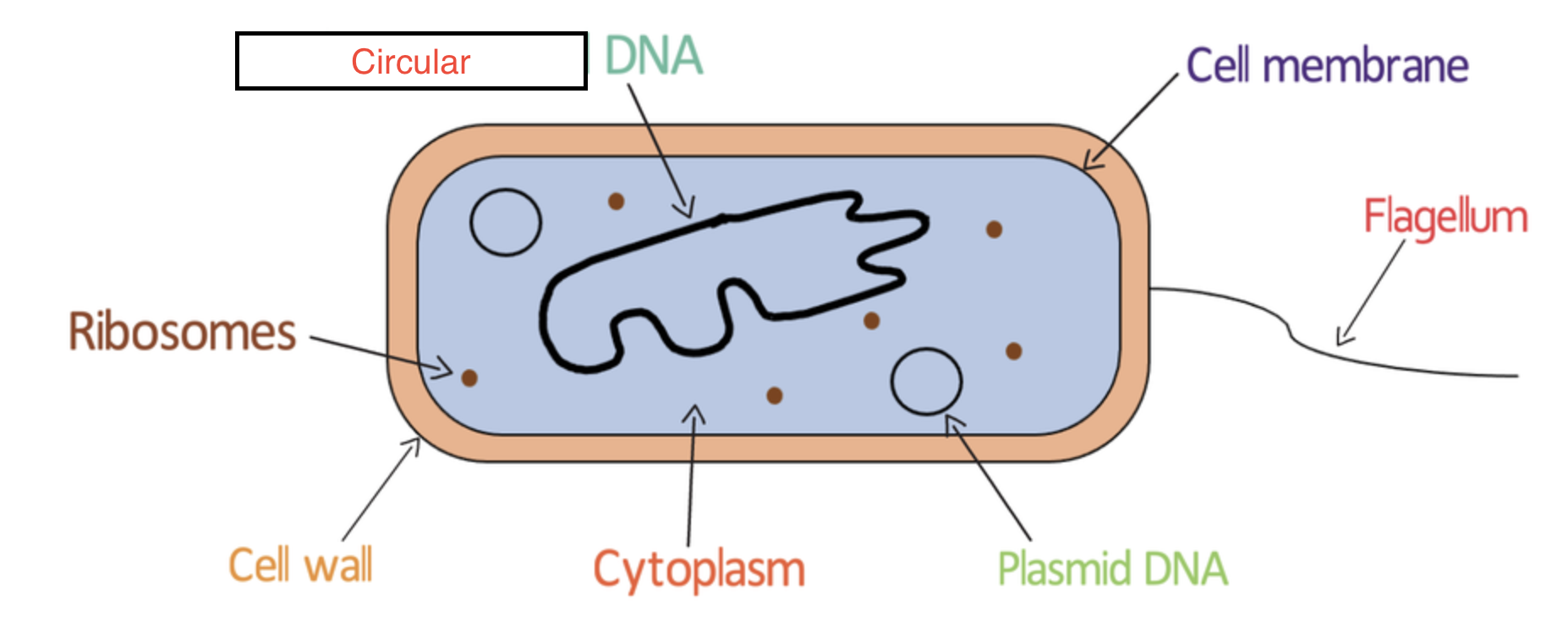
Parts and Functions:
Circular DNA (strands)
Genes they need to survive and reproduce (instead of a nucleus)
One circular, strand
Free to float around the cytoplasm
Plasmid
Carry ‘extra’ genes such as antibiotic resistance
Only some bacterial cells have them
Flagellum
Thread like structures that portrude from the back of the cell.
Allow the bacteria to move around freely.
The bacteria will move towards beneficial substances (nutrients/oxygen) and away from harmful substances (toxins).
Cell wall
Strengthens the cell and gives it support.
Made of cellulose
Cell membrane
Controls the movement of substances in and out of the cell.
Cytoplasm
Liquid - gel structure where chemical reactions take place.
It is where all the organelles are suspended.
Ribosomes
Synthesise proteins from amino acids.
Specialised cells
In addition to the basic cell, organisms have many specialised cells that perform specific functions.
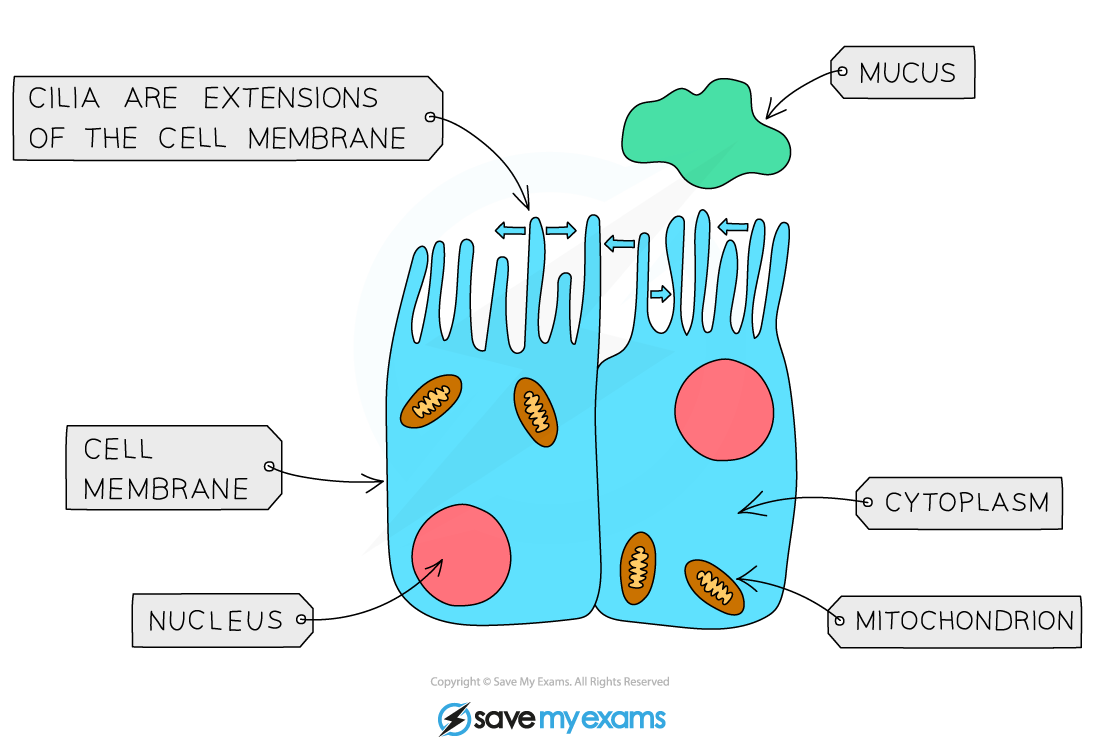
Cilliated Cell
Controls the movement of mucus in the trachea and bronchi.
They line the surfaces of respitory passages.
They have hair like portrusions that move rythmically to push mucus towards the nose and mouth where it can be removed.
The mucus is created by goblet cells, which are dotted in between ciliated cells.
The mucus captures particles such as pathogens, bacteria and viruses so they cannot enter the lungs.
Root hair Cell
Aids the absorption of water and mineral ions from the soil.
Located at the edge of the roots close to the soil.
Have long potrutions to increase the surface area and increase the absorption rate.
Thin, permeable cell wall.
Water enters by osmosis and minerals through active transport.
Have lots of mitochondria to provide energy during active transport.
B2.2
Size of Specimens
Images we use to observe cells have all been magnified. Real life cells can only be seen under a microscope.
The following formula indicates by how much an image has been magnified:
Magnification = Image size/Actual size
Units: Both Image size and Actual size must be in mm
Remeber to check the units and then convert them before calculating!
Example:
An image of a leaf is 30mm in size and it’s actual thickness is 2mm. What is the maginification?
30mm ÷ 2mm = 15mm
Answer = 15 (no units)
How to convert micrometers into milimeters
Micrometers = µm
From µm → mm = divide by 1000
From mm → µm = multiply by 1000