G&D M6 Notes
M6: Plagiocephaly, Craniosynostosis, and Torticollis
6.3 Plagiocephaly & Craniosynostosis
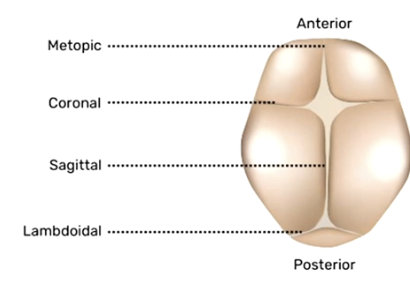
What cranial suture(s) run anterior to posterior?
Sagittal & Metaopic
What cranial suture(s) run right to left?
Coronal & Lambdoidal
What is Plagiocephaly?
Asymmetrical shaping of the head
What are the two types of Plagiocephaly?
Craniosynostosis & Deformational Plagiocephaly (DP)
What causes Craniosynostosis?
Premature closure of cranial sutures
What causes Deformational Plagiocephaly (DP)?
External pre or post-natal forces to the head
What is the most common form of Deformational Plagiocephaly (DP)?
Plagiocephaly
Types of Deformational Plagiocephaly (DP) | Head Shape | Picture |
Plagiocephaly | Parallelogram shape | 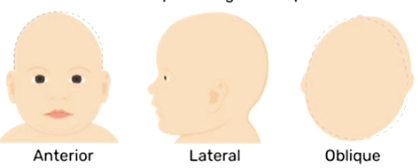 |
Brachycephaly | Wide side-side, Short front-back | 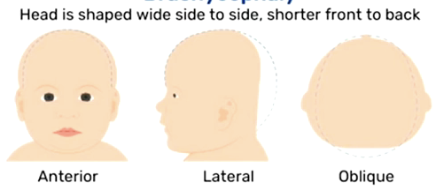 |
Scaphocephaly | Wide front-back, Short side-side | 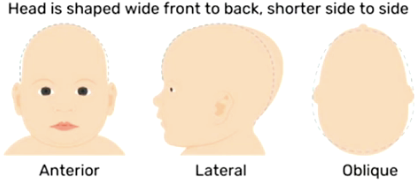 |
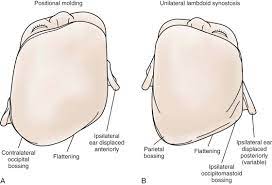
Identify this type of cranial deformation
Ipsilateral occipitoparietal flattening causes:
🡪 Ipsilateral ear displaced anteriorly
🡪 Ipsilateral frontal bossing
🡪 Contralateral occipital bossing
Plagiocephaly
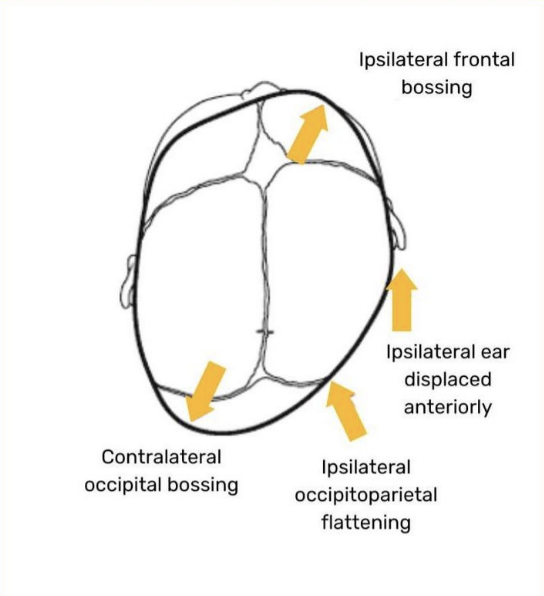
Identify this type of cranial deformation
Ipsilateral occipitoparietal flattening causes:
🡪 Ipsilateral ear displaced posteriorly
🡪 Contralateral frontal bossing
🡪 Contralateral parietal bossing
Lambdoidal Craniosynostosis
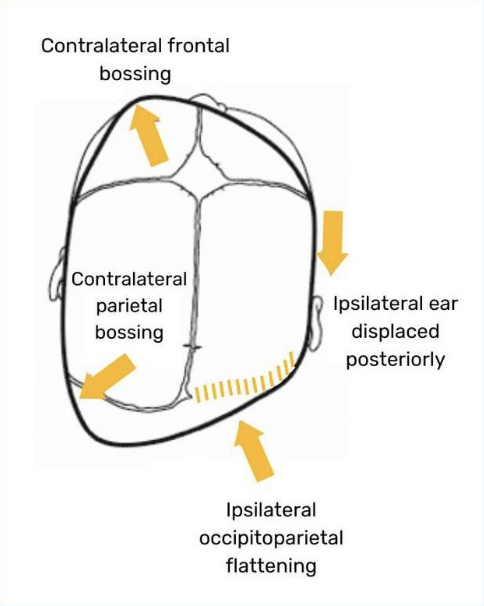
Identify this type of cranial deformation
Ipsilateral coronal flattening causes:
🡪 Ipsilateral ear displaced anterior & superior
🡪 Ipsilateral eyebrow raised
🡪 Contralateral frontal bossing
🡪 Retruded forehead & supraorbit
Unicoronal Synostosis
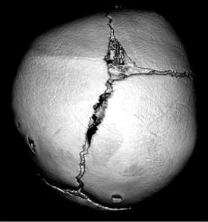
How does treatment for craniosynostosis and plagiocephaly differ?
Craniosynostosis requires surgery
Plagiocephaly can be treated with external forces
What is the Cranial Vault Asymmetry Index (CVAI) equation?
Used for Plagiocephaly Assessment
Plagiocephaly Severity Scale | CVAI | Treatment | Clinical Findings |
Grade 1 (Normal) | < 3.5 | Not required | Symmetrical WNL |
Grade 2 (Mild) | 3.5 – 6.25 | Reposition to counteract asymmetrical causing forces | Minimal asymmetry in one posterior quadrant |
Grade 3 (Moderate) | 6.25 – 8.75 | Repositioning & recranial molding | - Two quadrants involved - Mod.-sev. Posterior quadrant flattening - Minimal or anterior ear shift |
Grade 4 (Severe) | 8.75 – 11.0 | Cranial remolding orthosis | - 2-3 quadrants involved - Severe posterior quad. flattening - Mod. ear shift - orbit asymmetry |
Grade 5 (Very Severe) | > 11.0 | Cranial remolding orthosis | - 3-4 quadrants involved - Severe posterior quad. flattening - Severe ear shift - orbit & cheek asymmetry |
What age range is cranial remolding orthosis most effective?
4 to 12 months
Prevention | Environment | Attention | |
When awake | - supine - firm surface - loose fitting clothes | - regularly attracted - bilateral - with voice & gestures | - limit car seat usage |
When asleep | - supine - firm surface - no pillows - light blanket |
6.4 Congenital Torticollis
What muscle is important in diagnosing Congenital Torticollis?
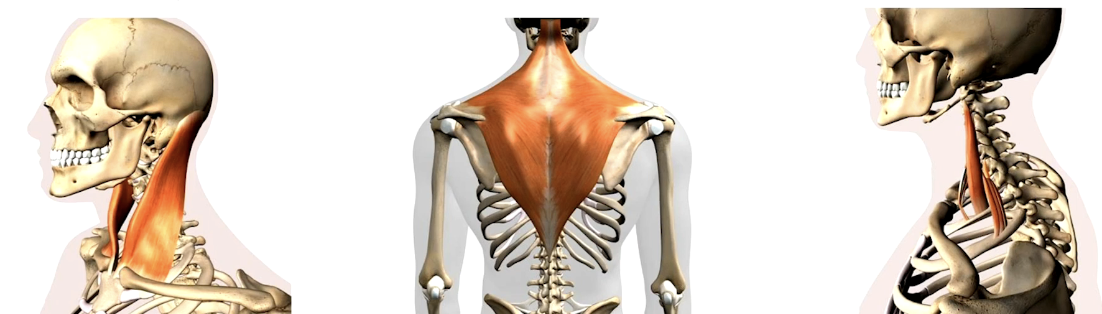
Sternocleidomastoid
Sternocleidomastoid
Origin: Cranial part of the manubrium of the sternum and medial 1/3 of clavicle
Insertion: Lateral surface of mastoid process, lateral ½ of superior nuchal line of occipital bone
Action:
- Acting unilaterally - ipsilateral lateral flexion and contralateral rotation
- Acting bilaterally - flexion and extension
- With head in fixed position – elevates sternum to act as an accessory breathing muscle
What is true Congenital Torticollis?
Impaired SCM at birth causing asymmetrical neck positioning
What neck position is caused by Congenital Torticollis?
Ipsilateral side bend & Contralateral rotation of the impaired SCM
Besides SCM what other muscles are affected by Congenital Torticollis?
Ipsilateral Upper trapezius
Ipsilateral scalenes
What can excessive fibrosis from a healing SCM cause?
Palpable nodule
What are causes of Torticollis?
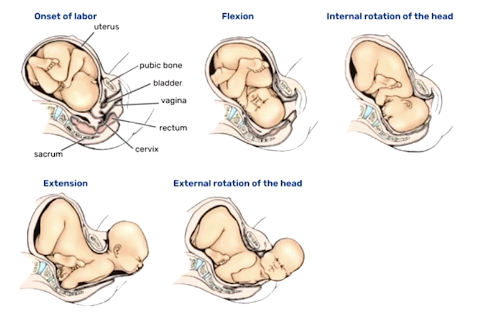
Trauma at birth
Pre, peri, and post-natal positioning
Right rotation of the neck 🡪 left SCM tightness, vice versa
Left sided torticollis = Left SB, Right rotation = limited Right SB, Left rotation
Don’t need to memorize Clinical practice guidelines