Lasers and Fibre Optics
Objectives
Explain basic interactions of radiation with matter (absorption, spontaneous emission, stimulated emission)
Understand basic principle, construction and applications of laser systems
Comprehend working principle of optical fibres and their applications
Classify types of optical fibres with merits & demerits
Characteristics of Laser Light
Highly monochromatic (single wavelength ➔ high spectral purity)
Highly coherent (fixed phase relationship across space/time ➔ interference & holography)
Highly directional (very small divergence ➔ long-distance propagation, drilling, targetting)
Sharply focusable to extremely high power densities (micromachining, surgery)
Interaction of Radiation with Matter
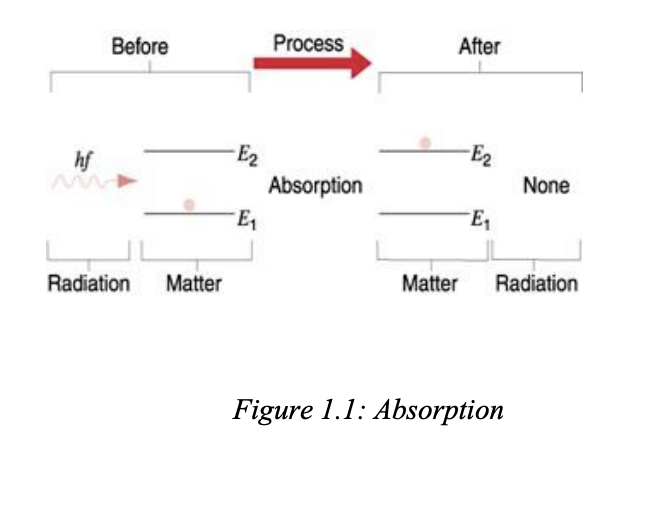
Absorption
Photon of frequency is absorbed when E2-E1 = hf
Atom promoted from ground level E1 to excited level E2; photon disappears
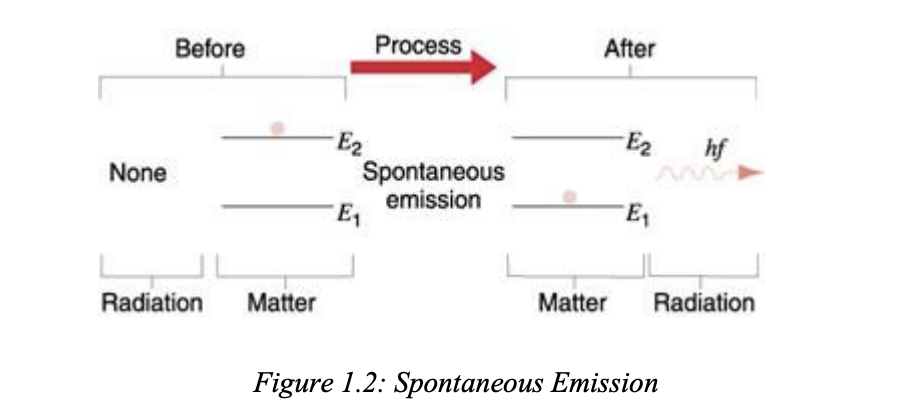
Spontaneous Emission
Excited atom (average lifetime ) returns to lower level without external trigger
Emits photon of energy
Photons random in phase, direction ➔ ordinary light = incoherent
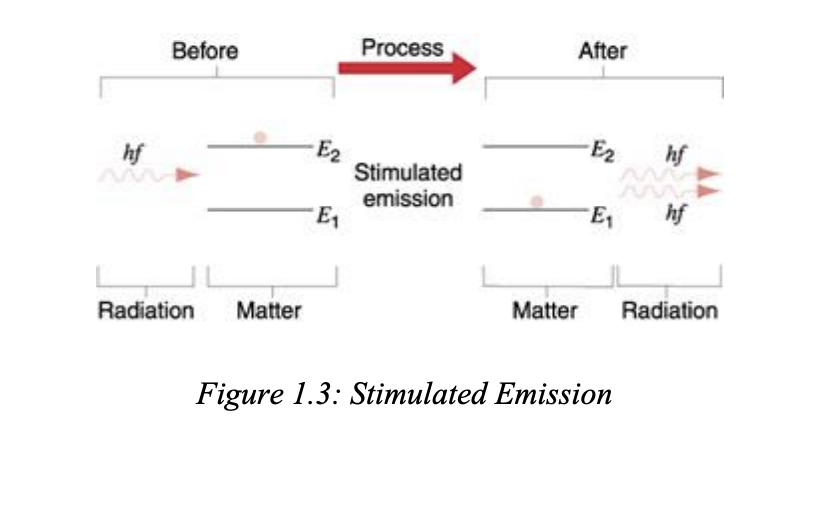
Stimulated Emission
Incident “stimulating” photon of proper forces excited atom to de-excite prematurely
Two output photons:
Same frequency, phase, polarization, direction (perfectly coherent)
Basis for laser amplification
Population Inversion
At thermal equilibrium (Boltzmann):
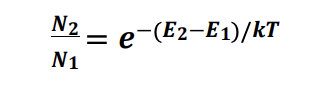
k is Boltzmann constant,
N1 is density of atoms with energy
E1 & N2 is density of atoms with energy E2
Population inversion: N2>N1 (non-equilibrium); achieved via pumping mechanisms
Requires metastable state (lifetime ) to “store” atoms in upper level
Einstein Coefficients (A & B)
: probability/coeff. of induced absorption
: probability/coeff. of spontaneous emission
: probability/coeff. of stimulated emission
Rate Equations
Absorption:
Spontaneous emission:
Stimulated emission:
Thermal Equilibrium Condition
Derivation using Planck’s law yields:
(absorption probability equals stimulated-emission probability)
Dependence on Frequency & Temperature
For : ➔ spontaneous dominates (visible/UV)
For : comparable ➔ stimulated significant (IR)
For : ➔ stimulated dominates (microwave; MASER)
Amplification Under Non-Equilibrium
With population inversion, \dfrac{R{emission}}{R{abs}}=\dfrac{N2}{N1}>1 (Eq. )
Optical cavity feeds back photons, exponentially growing coherent wave ➔ laser output
Essential Laser Components
Pumping system: energy source (flash-lamp, electrical discharge, current injection)
Active (lasing) medium: atoms/ions/molecules/semiconductor junction where population inversion occurs
Resonant (optical) cavity: pair of mirrors (one fully, one partially reflecting) providing feedback & mode selection
Specific Laser Systems
He–Ne Laser (Gas, Four-level)
Mixture: He 80 %, Ne 20 % at low pressure in glass discharge tube
Pumping: electric discharge excites to metastable ; resonant energy transfer pumps to
Population inversion between (Ne) and
Output: red light through partially reflecting mirror
Brewster windows ensure linear polarization & minimize losses
Ruby Laser (Solid-state, Three-level)
Medium: doped with (ruby rod)
Pumping: intense flash-lamp excites ions to ; fast non-radiative decay to metastable
Population inversion between and ground
Optical cavity: silvered end faces of rod (or external mirrors)
Output: deep red pulses (Q-switching common)
Semiconductor (Injection) Laser
p–n junction in GaAs or GaAlAs; dimensions (1\,\text{mm}\times1\,\text{mm}\times1\,\text{mm})
Heavy doping + forward bias ((V\approx E_g/e)) ➔ carrier overflow, population inversion in depletion region
Mirrors: cleaved, polished crystal ends (one partial)
High current density ((\sim20\,\text{kA/cm}^2)) for continuous wave (CW) emission
Advantages: compact, efficient, directly modulatable; basis of CDs, telecom transmitters
Applications of Lasers (Selected)
Scientific research: spectroscopy, nonlinear optics, plasma diagnostics
Engineering: optical fibre communication, micro-welding, precision cutting, alignment
Medicine: bloodless surgery (ophthalmic retina repair, dermatology, dentistry)
Bar-Code Scanner
Laser beam scans UPC stripes; black absorbs, white reflects ➔ photodiode converts intensity variations to digital code
Narrow, directional beam ensures readability at various angles/distances
Laser Printer
Charging: drum positively charged
Writing: modulated laser discharges pattern corresponding to image
Developing: toner adheres to discharged areas
Transfer: negatively charged paper attracts toner
Fusing: heat + pressure melt toner into paper
Laser Cooling
Utilizes photon momentum () to slow atoms
Two main schemes:
Doppler cooling
Sisyphus cooling
Achievable temperatures: mK → µK → nK; enables Bose-Einstein condensation, precision clocks
Optical Fibres
Construction
Core: glass/plastic, refractive index
Cladding: lower index (<); maintains TIR
Protective jacket: polyurethane; multiple fibres form cable
Typical diameters:
Principle – Total Internal Reflection (TIR)
For \thetai>\thetac at core–clad interface, light is totally reflected, propagating through curved paths without appreciable loss
Critical angle: \thetac = \sin^{-1}\big(\tfrac{n2}{n_1}\big)
Acceptance Angle, Cone & Numerical Aperture (NA)
For external medium index ; incident angle must satisfy:
Numerical aperture: (for )
Fractional index difference: ; relation
Skip Distance (inter-reflection spacing)
with
Modes & Normalized Frequency
Normalized frequency
Number of guided modes (multimode):
Fibre Types
Single-mode Step-Index: narrow core (5–10 µm); V<2.405 ➔ only fundamental mode; minimal dispersion, highest bandwidth
Multimode Step-Index: large core (50–200 µm); many modes; easy coupling but suffers intermodal dispersion
Multimode Graded-Index (GRIN): core index decreases parabolically from center; equalizes path lengths ➔ lower dispersion than step-index multimode
Attenuation Mechanisms
Absorption
Impurities (transition metals, OH⁻) absorb photons ➔ heat or re-emit incoherently
Intrinsic absorption in pure silica (IR vibrational bands, UV electronic bands)
Scattering (Rayleigh )
Micro-density fluctuations, compositional variations, bubbles
Other losses
Micro-bending: random tiny bends along fibre
Macro-bending: tight curves (<10 cm radius) during installation; power radiates out of core
Connectors/splices: Fresnel reflections, misalignment
Dispersion (Pulse Broadening)
Material dispersion ()
Wavelength dependence of refractive index
Waveguide dispersion
Different propagation angles for different (\lambda) within same mode
Intermodal (modal) dispersion
Multiple modes travel different path lengths ➔ only in multimode fibres
Applications of Optical Fibres
Fibre-Optic Networking
Nodes interconnected by fibre links; dedicated wavelength “lightpaths”
Advantages: huge bandwidth, low loss, immunity to EMI, small size/weight
Fibre-Optic Communication System
Transmitter (laser/LED) ➔ fibre channel ➔ receiver (photodiode)
Digital data encoded via intensity, phase or wavelength division multiplexing (WDM)
Other Uses
Sensors (temperature, strain, chemical), gyroscopes
Flexible fibrescope/endoscope for medical diagnostics
Industrial inspection in hazardous environments
Ethical and Practical Implications
Eye safety: high-power lasers demand stringent standards (ANSI Z136)
Data privacy: enormous capacity raises security concerns; encryption essential in fibre networks
Environmental impact: fibre cables less resource-intensive than copper; but rare-earth elements in lasers require responsible sourcing
Numerical & Statistical References (from transcript’s problem set)
Example: three-level laser at , Boltzmann ratio at
Ruby laser: rod × , pulse energy computed when all ions de-excite
He–Ne laser 2.3 mW emits photons/min
Step-index fibre (core 63.5 µm, ): , etc.
Connections to Foundational Principles
Stimulated emission predicted by Einstein ➔ unifies quantum transitions with Planck radiation law
TIR and Snell’s law foundational for waveguides; analogous to microwave waveguide reflections
Laser cooling exploits conservation of momentum & Doppler effect, bridging quantum optics and thermodynamics
Real-World Relevance
Internet back-bone capacity depends on DWDM (Dense WDM) using single-mode fibres and diode lasers
Supermarkets, logistics rely on laser scanners for inventory management
Semiconductor lasers enable optical storage (CD/DVD/Blu-ray) and LiDAR in autonomous vehicles
Summary of Merits & Demerits
Single-mode fibre: +highest bandwidth, −difficult coupling
Multimode step: +easy alignment, −high dispersion
GRIN fibre: compromise, −fabrication complexity
Ruby laser: +robust, −high threshold, pulsed only
He–Ne: +stable CW, −bulky/low power
Semiconductor laser: +compact, efficient, −temperature sensitive, beam divergence