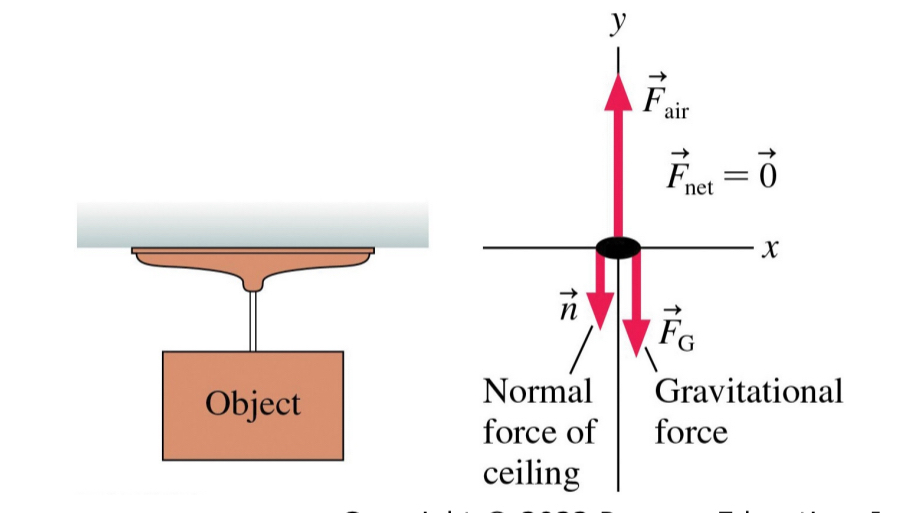
The suction cup is in equilibrium: F<em>air=mg+n</em></p></li><li><p>Upwardforceexertedbytheair:F_{air}=pA=p\pi r^2=\pi(0.050m)^2(101,300Pa)=796N</p></li><li><p>Maximumweightwhenthenormalforcenisreducedtozero:FG = mg = F{air}</p></li><li><p>m = \frac{F_{air}}{g} = \frac{796 N}{9.8 m/s^2} = 81 kg</p></li></ul></li><li><p><strong>Review:</strong>Asuctioncupcansupportamassofupto81kgwithaperfectvacuuminside.</p></li><li><p>P0+A=F</p></li><li><p>Fair+fm=pAatthebottom</p></li><li><p>PA=P0A+mg+P0A+pAdg</p><imgsrc="https://knowt−user−attachments.s3.amazonaws.com/f6f41022−a7f4−48a9−b706−c1bd5436bd5f.jpg"></li></ul><h5collapsed="false"seolevelmigrated="true">PressureinLiquids</h5><ul><li><p>Foraliquidinstaticequilibrium,balancingforcesinafree−bodydiagram:</p><ul><li><p>pA = p_0 A + mg</p></li><li><p>Volumeofthecylinder:V = Ad</p></li><li><p>Massofthecylinder:m = \rho Ad</p></li><li><p>Hydrostaticpressureatdepthd:</p><p>p = p_0 + \rho g d</p></li></ul></li></ul><h5collapsed="false"seolevelmigrated="true">Example:PressureonaSubmarine</h5><ul><li><p>Asubmarinecruisesatadepthof300m.Calculatethepressureatthisdepthinpascalsandatmospheres.</p></li><li><p><strong>Solution:</strong></p><ul><li><p>Densityofseawater:\rho = 1030 kg/m^3</p></li><li><p>Pressureatdepthd=300m:</p><p>p = p_0 + \rho g d = 101,300 Pa + (1030 kg/m^3)(9.80 m/s^2)(300 m) = 3.13 \times 10^6 Pa</p></li><li><p>Convertingtoatmospheres:</p><p>p = \frac{3.13 \times 10^6 Pa}{1.013 \times 10^5 Pa/atm} = 30.9 atm</p></li></ul></li></ul><h5collapsed="false"seolevelmigrated="true">LiquidsinHydrostaticEquilibrium</h5><ul><li><p>Aconnectedliquidinhydrostaticequilibriumrisestothesameheightinallopenregionsofthecontainer.</p></li><li><p>Thepressureisthesameatallpointsonahorizontallinethroughaconnectedliquidinhydrostaticequilibrium.P1=P2</p></li></ul><h5collapsed="false"seolevelmigrated="true">Example:PressureinaClosedTube</h5><ul><li><p>Waterfillsatube.Determinethepressureatthetopoftheclosedtube,assumingp_0=1.00atm.</p></li><li><p><strong>Model:</strong>Thepressureisthesameatallpointsonahorizontalline.</p></li><li><p><strong>Solution:</strong></p><ul><li><p>Atapoint40cmabovethebottomoftheopentube(depthof60cm):</p><p>p = p_0 + \rho g d = 1.013 \times 10^5 Pa + (1000 kg/m^3)(9.80 m/s^2)(0.60 m) = 1.072 \times 10^5 Pa = 1.06 atm</p></li></ul></li><li><p>Thepressureatthetopoftheclosedtubeis1.06atm.</p></li></ul><h4collapsed="false"seolevelmigrated="true">GaugePressure</h4><ul><li><p>Manypressuregaugesmeasuregaugepressure(p_g),whichisthedifferencebetweentheabsolutepressure(p)andatmosphericpressure(1atm).</p></li><li><p>Thepressuretakeninthetire(example)ismeasuredingagepressurep−1atm=PgPg+1atm=P</p><ul><li><p>p_g = p - 1 atm</p></li></ul></li></ul><h5collapsed="false"seolevelmigrated="true">Example:UnderwaterPressureGauge</h5><ul><li><p>Anunderwaterpressuregaugereads60kPa.Whatisitsdepth?</p></li><li><p><strong>Model:</strong>Thegaugereadsgaugepressure.</p></li><li><p><strong>Solution:</strong></p><ul><li><p>p = 1 atm + \rho g d</p></li><li><p>p_g = p - 1 atm = \rho g d</p></li><li><p>d = \frac{p_g}{\rho g} = \frac{60,000 Pa}{(1000 kg/m^3)(9.80 m/s^2)} = 6.1 m</p></li></ul></li></ul><h4collapsed="false"seolevelmigrated="true">Barometers</h4><ul><li><p>Abarometermeasuresatmosphericpressurebymeasuringtheheight(h)ofaliquidcolumninatube.</p></li><li><p>p_{atmos} = \rho g h</p></li><li><p>P=p0+pgh</p></li><li><p>P1+p0+O</p></li><li><p>P2=O+pgh</p></li><li><p>Pgh=p0</p></li></ul><h5collapsed="false"seolevelmigrated="true">PressureUnits</h5><tablestyle="min−width:125px"><colgroup><colstyle="min−width:25px"><colstyle="min−width:25px"><colstyle="min−width:25px"><colstyle="min−width:25px"><colstyle="min−width:25px"></colgroup><tbody><tr><thcolspan="1"rowspan="1"><p>Unit</p></th><thcolspan="1"rowspan="1"><p>Abbreviation</p></th><thcolspan="1"rowspan="1"><p>Conversionto1atm</p></th><thcolspan="1"rowspan="1"><p>Uses</p></th><thcolspan="1"rowspan="1"><p></p></th></tr><tr><tdcolspan="1"rowspan="1"><p>pascal</p></td><tdcolspan="1"rowspan="1"><p>Pa</p></td><tdcolspan="1"rowspan="1"><p>101.3kPa</p></td><tdcolspan="1"rowspan="1"><p>SIunit:1Pa=1N/m^2</p></td><tdcolspan="1"rowspan="1"><p></p></td></tr><tr><tdcolspan="1"rowspan="1"><p>atmosphere</p></td><tdcolspan="1"rowspan="1"><p>atm</p></td><tdcolspan="1"rowspan="1"><p>1atm</p></td><tdcolspan="1"rowspan="1"><p>general</p></td><tdcolspan="1"rowspan="1"><p></p></td></tr><tr><tdcolspan="1"rowspan="1"><p>millimetersofmercury</p></td><tdcolspan="1"rowspan="1"><p>mmofHg</p></td><tdcolspan="1"rowspan="1"><p>760mmofHg</p></td><tdcolspan="1"rowspan="1"><p>gasesandbarometricpressure</p></td><tdcolspan="1"rowspan="1"><p></p></td></tr><tr><tdcolspan="1"rowspan="1"><p>inchesofmercury</p></td><tdcolspan="1"rowspan="1"><p>in</p></td><tdcolspan="1"rowspan="1"><p>29.92in</p></td><tdcolspan="1"rowspan="1"><p>barometricpressureinU.S.weather</p></td><tdcolspan="1"rowspan="1"><p></p></td></tr><tr><tdcolspan="1"rowspan="1"><p>poundspersquareinch</p></td><tdcolspan="1"rowspan="1"><p>psi</p></td><tdcolspan="1"rowspan="1"><p>14.7psi</p></td><tdcolspan="1"rowspan="1"><p>engineeringandindustry</p></td><tdcolspan="1"rowspan="1"><p></p></td></tr></tbody></table><h4collapsed="false"seolevelmigrated="true">HydraulicLift</h4><ul><li><p>Ahydraulicliftusesfluidpressuretoliftheavyobjects,suchascars.</p></li><li><p>AreaxdistanceV1=V2+A1d1=A2d2</p></li><li><p>Instaticequilibrium:</p><ul><li><p>\frac{F1}{A1} = \frac{F2}{A2} - \rho g h</p></li></ul></li><li><p>Ifpiston1ispusheddownadistanced1,thecarisliftedbydistanced2:</p><ul><li><p>\frac{d1}{d2} = \frac{A2}{A1}(nottestedon)</p></li></ul></li></ul><h5collapsed="false"seolevelmigrated="true">Example:LiftingaCar</h5><ul><li><p>Ahydraulicliftfilledwithoilhasa25−cm−diameterpistonsupportingacar.Compressedairpushesona6.0−cm−diameterpiston.Whatpressuredoesthegaugeread,soa1300kgcaris2.0mabovethecompressed−airpiston?</p></li><li><p><strong>Model:</strong>Incompressibleoilwithdensity900kg/m^3.</p></li><li><p><strong>Solution:</strong></p><ul><li><p>Weightofthecar:F_2 = mg = (1300 kg)(9.8 m/s^2) = 12,700 N</p></li><li><p>Pistonareas:A1 = \pi (0.030 m)^2 = 0.00283m^2andA2 = \pi (0.125 m)^2 = 0.0491 m^2</p></li><li><p>Forcerequiredtoholdthecaratheighth=2.0m:</p><p>\frac{F1}{A1} = \frac{F2}{A2} + \rho g h</p><p>F1 = \frac{A1}{A2} \left( F2 + \rho g h A_2 \right) = \frac{0.00283 m^2}{0.0491 m^2} \left( 12,700 N + (900 kg/m^3)(9.8 m/s^2)(2.0 m)(0.0491 m^2) \right) = 782 N</p></li><li><p>Pressureappliedbythecompressed−airpiston:</p><p>p = \frac{F1}{A1} = \frac{782 N}{0.00283 m^2} = 276 \times 10^3 Pa = 276 kPa = 2.7 atm</p></li></ul></li></ul><h4collapsed="false"seolevelmigrated="true">Buoyancy</h4><ul><li><p>Buoyancyistheupwardforceexertedbyafluidonanobject.</p></li><li><p>Fup>Fdown</p></li><li><p>Fb=Fwater+Fg</p></li><li><p>Thepressureintheliquidexertsanetupwardforceonthecylinder:<em>net=F</em>up−Fdown</p></li><li><p>Thebuoyantforceonanobjectisthesameasthebuoyantforceonthefluiditdisplaces.</p></li><li><p><strong>Archimedes’Principle:</strong>Afluidexertsanupwardbuoyantforceonanobjectimmersedinorfloatingonthefluid.Themagnitudeofthebuoyantforceequalstheweightofthefluiddisplacedbytheobject.</p></li><li><p>Fb=Wd(FB=AVfg)</p><ul><li><p>FB = \rhof V_f g</p><ul><li><p>\rho_fisthedensityofthefluid.</p></li><li><p>V_fisthevolumeofthedisplacedfluid.equivalenttothevolumeoftheportionoftheobjectthatisimmersedinthefluid.</p></li></ul></li></ul></li></ul><h5collapsed="false"seolevelmigrated="true">Example:HoldingaBlockofWoodUnderwater</h5><ul><li><p>A10cm×10cm×10cmblockofwoodwithdensity700kg/m^3isheldunderwaterbyastring.Whatisthetensioninthestring?<br>∗Free−bodydiagramoftheforcesactingonthewood.</p><imgsrc="https://knowt−user−attachments.s3.amazonaws.com/09d6f8af−fc99−48bd−bb4c−f213755444f3.jpg"></li><li><p><strong>Solution:</strong></p><ul><li><p>Theblockisinequilibrium:\sum Fy = FB - T - m_o g = 0</p></li><li><p>T = FB - mo g</p><p>mo = \rhoo V_o</p><p>FB = \rhof V_f g</p><p>T = (\rhof - \rhoo) V_o g</p><p>V_o = (0.1 m)^3 = 1.0 \times 10^{-3} m^3</p><p>T = ((1000 kg/m^3) - (700 kg/m^3)) (1.0 \times 10^{-3} m^3) (9.8 m/s^2) = 2.9 N</p></li></ul></li></ul><h4collapsed="false"seolevelmigrated="true">FloatingObject</h4><ul><li><p>Thevolumeoffluiddisplacedbyafloatingobjectofuniformdensityis:</p><ul><li><p>Vf = \frac{mo}{\rhof} = \frac{\rhoo}{\rhof} Vo</p></li></ul></li><li><p>Thevolumeofthedisplacedfluidislessthanthevolumeoftheuniform−densityobject:</p><ul><li><p>\frac{Vf}{Vo} = \frac{\rhoo}{\rhof} < 1</p></li></ul></li><li><p>Foricebergs:</p><ul><li><p>\rho_{ice} = 917 kg/m^3</p></li><li><p>\rho_{seawater} = 1030 kg/m^3</p></li><li><p>\frac{Vf}{Vo} = \frac{917 kg/m^3}{1030 kg/m^3} \approx 0.89</p></li><li><p>About90h = \frac{mo}{\rhof A}</p></li></ul></li></ul><h4collapsed="false"seolevelmigrated="true">FluidDynamics</h4><ul><li><p><strong>Ideal−FluidModelAssumptions:</strong></p><ol><li><p>Incompressible:Morelikealiquidthanagas.</p></li><li><p>Nonviscous:Morelikewaterthansyrup.</p></li><li><p>Steadyflow:Laminarflowratherthanturbulentflow.</p></li></ol></li><li><p>Laminarflow:Smooth,streamlineflow.</p></li><li><p>Turbulentflow:Irregular,chaoticflow.</p></li><li><p>EquationofContinuityfortwopointsinaflowtube:</p><ul><li><p>A1 v1 = A2 v2</p></li></ul></li><li><p>VolumeflowrateQisconstant:</p><ul><li><p>Q = vA</p></li></ul></li></ul><p>Dx1/dtA1=dx2/dtA2</p><h4collapsed="false"seolevelmigrated="true">Bernoulli’sEquation</h4><ul><li><p>Theenergyequationforfluidinaflowtube:</p><ul><li><p>p1 + \frac{1}{2} \rho v1^2 + \rho g y1 = p2 + \frac{1}{2} \rho v2^2 + \rho g y2</p></li></ul></li><li><p>AlternativeformofBernoulli’sequation:</p><ul><li><p>p + \frac{1}{2} \rho v^2 + \rho g y = constant</p></li><li><p>Restatementofconservationofenergy</p></li><li><p>Workdonebypressurehastogodownifpotentialandkineticenergygoupforeverythingtoremainconstant</p></li></ul></li></ul><h5collapsed="false"seolevelmigrated="true">Example:AnIrrigationSystem</h5><ul><li><p>Waterflowsthroughpipes.Thewater’sspeedthroughthelowerpipeis5.0m/sandapressuregaugereads75kPa.Whatisthegaugereadingofthepressuregaugeontheupperpipe?<br>∗TreatthewaterasanidealfluidobeyingBernoulli’sequation.</p></li><li><p><strong>Solution:</strong></p><ul><li><p>Bernoulli’sequationbetweenpoints1and2:</p><p>p2 = p1 + \frac{1}{2} \rho (v1^2 - v2^2) + \rho g (y1 - y2)</p></li><li><p>Thecross−sectionareasandwaterspeedsatpoints1and2arerelatedby</p><p>v2 = \frac{A1}{A2} v1 = \frac{r1^2}{r2^2} v_1 = \frac{(0.030 m)^2}{(0.020 m)^2} (5.0 m/s) = 11.25 m/s</p></li><li><p>Thepressureatpoint1isp_1 = 75 kPa + 1 atm = 176,300 Pa.</p><p>p_2 = 176,300 Pa + \frac{1}{2} (1000 kg/m^3) ((5.0 m/s)^2 - (11.25 m/s)^2) + (1000 kg/m^3) (9.8 m/s^2) (-3.0 m) = 105,900 Pa</p></li><li><p>Thisistheabsolutepressure;thepressuregaugeontheupperpipewillread</p><p>p = 105,990Pa - 1atm = 4.6kPa</p></li></ul></li></ul><h4collapsed="false"seolevelmigrated="true">Lift</h4><ul><li><p>Airflowoverawinggeneratesliftbycreatingunequalpressuresaboveandbelow.</p></li><li><p>Ifkineticenergygoesuppresuregoesdown</p></li><li><p>Pressuregoesuppotentialenergygoesdown</p><imgsrc="https://knowt−user−attachments.s3.amazonaws.com/d37bccd3−a43d−432e−9c0b−16297bf15526.jpg"></li></ul><h4collapsed="false"seolevelmigrated="true">AverageFlowSpeed</h4><ul><li><p>AverageflowspeedwhereQisthevolumeflowrateandAisthecross−sectionareaofthetube.<br>v_{avg} = \frac{Q}{A}</p></li></ul><h4collapsed="false"seolevelmigrated="true">Elasticity</h4><ul><li><p>Elasticitydescribeshowobjectsdeformunderstress.</p></li><li><p>Intheelasticregion,theforceneededtostretchasolidrodisproportionaltothechangeinlength:</p><ul><li><p>F = k \Delta L</p></li></ul></li><li><p>\frac{F}{A}isproportionalto\frac{\Delta L}{L}.</p></li><li><p>Young’sModulus(Y):</p><ul><li><p>\frac{F}{A} = Y \frac{\Delta L}{L}</p></li><li><p>\frac{F}{A}=tensilestress</p></li><li><p>\frac{\Delta L}{L}=strain</p></li></ul></li></ul><h5collapsed="false"seolevelmigrated="true">ElasticPropertiesofVariousMaterials</h5><tablestyle="min−width:100px"><colgroup><colstyle="min−width:25px"><colstyle="min−width:25px"><colstyle="min−width:25px"><colstyle="min−width:25px"></colgroup><tbody><tr><thcolspan="1"rowspan="1"><p>Substance</p></th><thcolspan="1"rowspan="1"><p>Young’sModulus(N/m^2)</p></th><thcolspan="1"rowspan="1"><p>BulkModulus(Pa)</p></th><thcolspan="1"rowspan="1"><p></p></th></tr><tr><tdcolspan="1"rowspan="1"><p>Steel</p></td><tdcolspan="1"rowspan="1"><p>2.0×10^{11}</p></td><tdcolspan="1"rowspan="1"><p>1.6×10^{11}</p></td><tdcolspan="1"rowspan="1"><p></p></td></tr><tr><tdcolspan="1"rowspan="1"><p>Copper</p></td><tdcolspan="1"rowspan="1"><p>1.1×10^{11}</p></td><tdcolspan="1"rowspan="1"><p>1.4×10^{11}</p></td><tdcolspan="1"rowspan="1"><p></p></td></tr><tr><tdcolspan="1"rowspan="1"><p>Aluminum</p></td><tdcolspan="1"rowspan="1"><p>7.0×10^{10}</p></td><tdcolspan="1"rowspan="1"><p>7.6×10^{10}</p></td><tdcolspan="1"rowspan="1"><p></p></td></tr><tr><tdcolspan="1"rowspan="1"><p>Concrete(typical)</p></td><tdcolspan="1"rowspan="1"><p>3.0×10^{10}</p></td><tdcolspan="1"rowspan="1"><p>−</p></td><tdcolspan="1"rowspan="1"><p></p></td></tr><tr><tdcolspan="1"rowspan="1"><p>Wood(Douglasfir)</p></td><tdcolspan="1"rowspan="1"><p>1.0×10^{10}</p></td><tdcolspan="1"rowspan="1"><p>−</p></td><tdcolspan="1"rowspan="1"><p></p></td></tr><tr><tdcolspan="1"rowspan="1"><p>Plastic</p></td><tdcolspan="1"rowspan="1"><p>3.5×10^{9}</p></td><tdcolspan="1"rowspan="1"><p>−</p></td><tdcolspan="1"rowspan="1"><p></p></td></tr><tr><tdcolspan="1"rowspan="1"><p>Mercury</p></td><tdcolspan="1"rowspan="1"><p>−</p></td><tdcolspan="1"rowspan="1"><p>2.2×10^{10}</p></td><tdcolspan="1"rowspan="1"><p></p></td></tr><tr><tdcolspan="1"rowspan="1"><p>Water</p></td><tdcolspan="1"rowspan="1"><p>−</p></td><tdcolspan="1"rowspan="1"><p>2.9×10^{9}</p></td><tdcolspan="1"rowspan="1"><p></p></td></tr></tbody></table><h5collapsed="false"seolevelmigrated="true">Example:StretchingaWire</h5><ul><li><p>A2.0−m−long,1.0−mm−diameterwireissuspendedfromtheceiling.Hanginga4.5kgmassfromthewirestretchesthewire’slengthby1.0mm.WhatisYoung’smodulusforthiswire?Canyouidentifythematerial?</p></li><li><p><strong>Solution:</strong></p><ul><li><p>F = mg = (4.5 kg)(9.80 m/s^2)</p><p>A = \pi r^2 = \pi (0.5 \times 10^{-3} m)^2 = 7.85 \times 10^{-7} m^2</p><p>\Delta L = 1.0 \times 10^{-3} m</p><p>Y = \frac{F/A}{\Delta L / L} = \frac{5.6 \times 10^7 N/m^2}{5.0 \times 10^{-4}} = 1.1 \times 10^{11} N/m^2</p></li></ul></li></ul><h4collapsed="false"seolevelmigrated="true">VolumeStressandtheBulkModulus</h4><ul><li><p>Avolumestressappliedtoanobjectcompressesitsvolumeslightly.</p></li><li><p>Thevolumestrainisdefinedas\frac{\Delta V}{V},andisnegativewhenthevolumedecreases.</p></li><li><p>Volumestressisthesameasthepressure.</p></li><li><p>\frac{\Delta V}{V} = - \frac{p}{B},whereBisthebulkmodulus.</p></li></ul><p></p><h6collapsed="false"seolevelmigrated="true">Bernoulli’sEquation</h6><ul><li><p>Theenergyequationforfluidinaflowtube:</p></li><li><p>p1+1/Pv12+Pgy1=p2+1/2Pv22+Pgy2</p></li><li><p>AlternativeformofBernoulli’sequation:</p></li><li><p>p + \frac{1}{2} \rho v^2 + \rho g y = constant</p></li><li><p>Keyconcepts:</p><ul><li><p><strong>Pressure(p):</strong>Representstheforceperunitareaexertedbythefluid.InBernoulli′sequation,pressureaccountsforthepotentialenergyduetothecompressionofthefluid.</p></li><li><p><strong>KineticEnergyDensity(\frac{1}{2} \rho v^2):</strong>Representsthekineticenergyperunitvolumeofthefluid,where\rhoisthedensityandvisthevelocityofthefluid.Thistermaccountsfortheenergyassociatedwiththemotionofthefluid.</p></li><li><p><strong>GravitationalPotentialEnergyDensity(\rho g y):</strong>Representsthegravitationalpotentialenergyperunitvolumeofthefluid,wheregistheaccelerationduetogravityandyistheheightaboveareferencepoint.Thistermaccountsfortheenergyassociatedwiththefluid′sverticalposition.</p></li></ul></li><li><p>Implicationsandapplications:</p><ul><li><p><strong>HorizontalPipe:</strong>Ifapipeishorizontal(yisconstant),thenregionswithhighervelocitywillhavelowerpressure,andviceversa.</p></li><li><p><strong>StaticFluid:</strong>Ifthefluidisstatic(v=0),Bernoulli′sequationsimplifiestothehydrostaticpressureequation,p + \rho g y = constant.</p></li><li><p><strong>FlowthroughConstrictions:</strong>Whenafluidflowsthroughaconstriction,itsvelocityincreases,leadingtoadecreaseinpressure.Thisprincipleisutilizedinventurimetersandcarburetors.</p></li></ul></li><li><p>Derivationsandspecialcases:</p><ul><li><p><strong>Torricelli′sTheorem:</strong></p></li><li><p>Describesthespeedoffluidflowingoutofanopeningatthebottomofatank.</p></li><li><p>DerivedfromBernoulli′sequationbycomparingapointatthesurfaceofthefluid(1)andapointattheopening(2).</p></li><li><p>p1 + \frac{1}{2} \rho v1^2 + \rho g y1 = p2 + \frac{1}{2} \rho v2^2 + \rho g y2</p></li><li><p>Assumingp1 = p2(bothatatmosphericpressure),andv1 \approx 0(largetank),theequationsimplifiesto:\rho g y1 = \frac{1}{2} \rho v2^2 + \rho g y2</p></li><li><p>Solvingforv2gives:v2 = \sqrt{2g(y1 - y2)} = \sqrt{2gh},wherehistheheightofthefluidabovetheopening.</p></li><li><p><strong>VenturiEffect:</strong></p></li><li><p>Describesthereductioninfluidpressurethatresultswhenafluidflowsthroughaconstrictedsectionofapipe.</p></li><li><p>Fromthecontinuityequation,A1 v1 = A2 v2,whereAisthecross−sectionalareaandvisthevelocity.</p></li><li><p>FromBernoulli′sequation,p1 + \frac{1}{2} \rho v1^2 = p2 + \frac{1}{2} \rho v2^2$$