Chapter 5:Managerial Planning and Goal Setting (copy)
The What and Why of planning
What is planning?
definition: planning is the process of preparing for change and coping with uncertainty by formulating future courses and actions.
Why planning?
Planning provides direction to managers, Forces analytical thinking and evaluation of alternatives, Planning reduces uncertainty, Planning minimizes waste and redundancy, Planning establishes the goals or standards used in controlling.
Levels of goals and plans
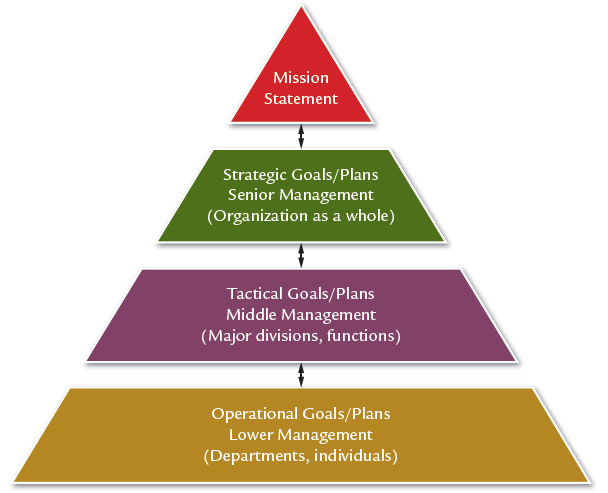
A goal: (farsighted and general) Is a general statement of intention, Typically with a time horizon of a long term.
An objective: (nearsighted and specific) Is a specific commitment to achieve a measurable result that supports the completion of a goal. Within a specified period of time of medium to short term.
SMART objectives respect the following criteria: Specific, Measurable, Attainable, Relevant and Time-based
Organizational mission and vision
The organizational vision is a road map of a company’s future and provides a rationale for going there.
The organizational mission is the organization’s reason for existence and serves to communicate purpose and direction to employees, customers, vendors… •Who are we? Who do we serve? What do we do? Why do we exist?
integrated planning
Strategic Planning →Tactical Planning →Operational planning
types of planning
- Strategic planning Includes a high-level overview of the entire business, looks at the long-term issues of the organization, and helps develop a plan for growth or change of a business function., Goals developed at the strategic planning level are often increased by dividing them into tactical and operational levels.
- Tactical planning, Supports strategic planning. It includes tactics that the organization plans to use to achieve what’s outlined in the strategic plan.
- Determine the contribution that subunits can make with allocated resources.
- Carried out by middle-level managers
- Operational planning:
- Identifies the specific procedures and actions required at lower levels in the organization. •It is more detailed because
- it is involved with the day-to-day operations of the organization.
- The setting of work schedules.