Optogenetics and Chemogenetics
Optogenetics Overview
Optogenetics combines genetic and optical methods to control neuronal activity. It involves:
Opsins: Light-sensitive proteins crucial for optogenetics, present in the retina and involved in phototransduction (transforming light into electrical signals).
Microbial Opsins: Primarily used in optogenetics.
Optogenetics allows to turn on or off specific neurons in the brain to investigate their function in circuits, behaviors, and diseases, targeting specific neuronal populations, using light-sensitive proteins (Opsins).
Tools
Electrical
Physical
Pharmacological
Genetic
Optogenetic
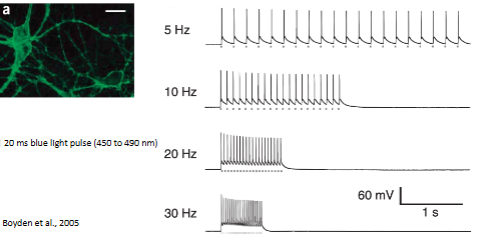
Channelrhodopsin-2 (ChR2)
Light-gated cation channel (non-specific).
Sensitive to blue light (~470nm).
Light induces conformational change (all trans to 13-cis).
Pore opens, allowing cation flow into the cell, inducing depolarization and action potential firing.
Returns to original state within milliseconds.
Point mutations (H134R, E123T) affect efficacy and kinetics.
Halorhodopsin
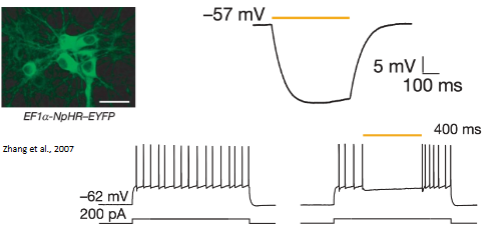
7 transmembrane protein (halobacteria).
Light-activated chloride pump.
Sensitive to yellow/orange light (~570-590nm).
Uses light energy to move chloride into the cell, hyperpolarizing neurons (silencing cells).
Multiple variants to increase efficiency and cellular localization.
Microbial Opsins Variations
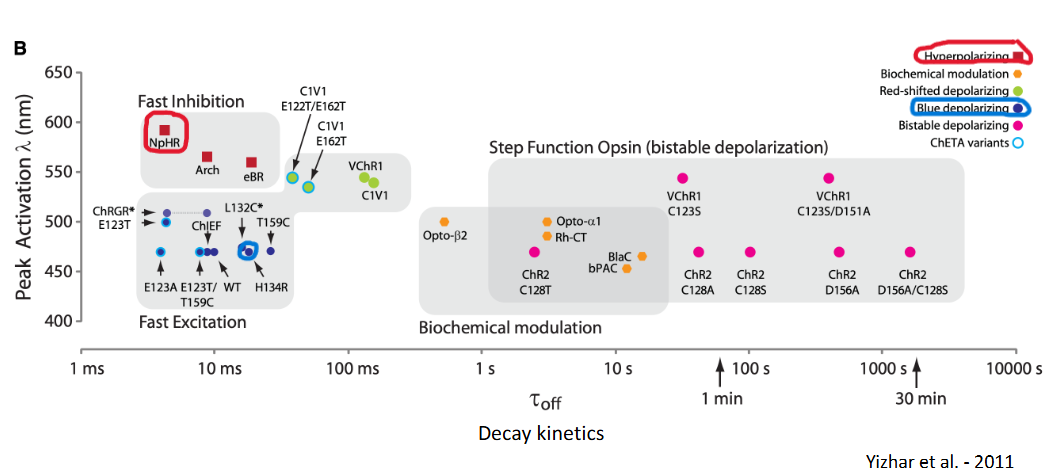
Several microbial opsins exist, each with different:
Peak Activation Wavelengths
Kinetics (Fast Excitation / Fast Inhibition)
Functions (Hyperpolarizing, Red-shifted depolarizing, Blue depolarizing, Bistable depolarizing, Biochemical modulation)
Cre-LoxP System
Cre-LoxP system allows control over the location and timing of gene expression and involves:
LoxP sites: Specific 34-base pair sequences with an 8-base pair core and two 13-base pair inverted repeats where recombination occurs.
Cre recombinase: Catalyzes recombination between LoxP sites.
When LoxP sites are in the same direction, Cre excises the DNA between them.
When LoxP sites are in opposite directions, Cre flips the DNA.
Floxing: Deletion, translocation, or inversion of a gene via Cre-Lox recombination.
Discovered in bacteriophages (P1 bacteriophage); not native to the mouse genome.
Cre and loxP strains
Cre expressing strains: Cre transgene under a tissue-specific promoter.
Inducible cre strains: Modified Cre that is non-functional until an inducing agent is administered (e.g., doxycycline, tetracycline, tamoxifen).
LoxP-flanked (floxed) strains: LoxP sites flanking a target gene.
Cre reporter strains: LoxP sites with visible marker proteins to trace Cre recombination.
Specific Promoter examples
VGAT-Cre
VGluT2-Cre
PV-Cre
ChAT-Cre
Adeno Associated Viruses (AAVs)
AAVs are non-enveloped viruses with single-stranded DNA, used to transduce cell lines/tissues with a gene of interest. Genome is ~ 4.8 kilobases (kb).
DIO: Double-floxed Inverted Orientation
FLEX: Flip-excision switch - involves stable Cre-dependent transgene inversion - very efficient and very compact (only 5\% of AAV packaging size)
WPRE (WHP Posttranscriptional Response Element) - is a DNA sequence that when transcribed it creates a tertiary structure enhancing expression; it is commonly used to increase the expression of genes delivered by viral vectors. [WHP: woodchuck hepatitis virus]
Promoters: examples: EF1a, Syn, Thy1, CMV, CAG
Experimental Approaches
Different approaches to express opsins:
Virus delivery system (floxed): Spatial selectivity, larger number of copies, combination of strategies, such as VGAT-Cre.
Tg opsin-YFP: Whole brain expression, ubiquitous expression, consistent across subjects, non-invasive, immediate use, such as VGAT-ChR2-eYFP
Virus delivery system (non-floxed): Naive animals, easier colony management, such as CAMKII-ChR2-eYFP.
Optogenetics and Chemogenetics (Part 2)
Chemogenetics Overview
Chemogenetics is similar to optogenetics in that they are both used to powerful modulate neuronal activity. Many steps and tools are similar to optogenetics (use of transgenic mice –Cre, AAV delivery of chemogenetic constructs, modulation of neuronal activity in circuits or in vivo). However, the mechanism of action is very different than optogenetics.
Cre transgenic mouse (specific neuronal populations) + Viral Delivery (AAVs) of specific Opsins (Optogenetics) or Receptors (Chemogenetics) will lead to neuronal manipulation will be done with light (Optogenetics) or by specific receptor Ligands (chemogenetics)
Chemogenetics engineer receptors that respond to ligands, targeting specific cells (Cre-LoxP system). Is a technique that allows to control neuronal activity, the effect is reversible.
DREADDs
DREADDs (Designer Receptors Exclusively Activated by Designer Drugs) is the most widely used chemogenetic approach. They are engineered proteins (receptors) that interact with previously unrecognized small molecules (ligands).
DREADDs Types
hM3Dq: Based on the human muscarinic receptor (M3). Couples with Galphaq protein, induces intracellular calcium release, and increases neuronal activity. Activated by CNO (Clozapine-N-Oxide).
hM4Di: Modified form of the human M4 muscarinic receptor. Couples with G\alphaq protein, reduces neuronal activity, and inhibits neurotransmitter release. Activated by CNO or Compound 21.
Other designer receptors are:
GsD
KORD
CNO
CNO (Clozapine-N-Oxide) used to activate DREADDs:
Synthetic ligand (Designer Drug)
Pharmacologically inert
High affinity for hM3Dq and hM4Di
Injected intraperitoneally (can also be injected locally in the brain)
Effects observed in 10-15 minutes, peaking at 45-50 minutes, and returning to baseline in ~9h
Dose is 1-3mg/kg.
Problem: CNO can metabolize into Clozapine (antipsychotic drug), leading to undesirable side effects at higher doses, therefore other ligands are being developed (Compound 21, Perlapine,…).
Chemogenetics and DREADDs in Research
Drd2-Cre mice: Selectively target and manipulate Mossy Cells activity in vivo using excitatory and inhibitory DREADDs.
Chemogenetics: Context Fear experiment
It involves associative learning with emotional arousal from painful stimuli in a spatial context.
The data suggest that eDREADD-treated mice had worse performance during the learning and memory phase of the task on the context fear experiment
CNO affected training only or both training and testing. Assesses recognition of a novel object in a familiar environment.
iDREADD mice spent significantly more time exploring objects than control mice and eDREADD mice. Conversely, eDREADD mice spent significantly less time exploring objects compared with control mice, consistent with worse performance described in other tasks above. This was particularly true for females
iDREADDs significantly improved performance in the HCNOE task eDREADDs worsened performance. Effects were evident in both sexes, the effects in males were less robust.
Chemogenetics: Example experiment
Experiments use Slc6a4-Cre mice injected with Floxed hM3Dq in the dorsal raphe nucleus.
Question/Hypothesis: Serotininergic neurons in the dorsal raphe play a role in anxiety behaviours.
Methods: Electrophysiological recordings and behavioural tests (open field) to measure anxiety.
Results/Conclusions: CNO leads to depolarization of hM3Dq-expressing serotonine dorsal raphe neurons. Activation of these neurons increases anxiety, as demonstrated by decreased time in the center of the arena.
Chemogenetics Summary
Uses Designer Receptors Exclusively Activated by Designer Drugs (DREADDs).
GCPR (modulation of intracellular signaling pathways).
Genetically modified – no longer responsive to endogenous ligand.
Delivered generally via AAVs (Cre-LoxP system).
Activated by designer drugs such as CNO.
Manipulate neuronal activity (activation / inhibition).
Long term (minutes to hours - not ON/OFF!!).
Chemogenetics vs Optogenetics
Both chemogenetics and optogenetics have led to important neuroscience discoveries and they allow to manipulate neuronal activity. They are cell type selective (Cre-LoxP system) and can test hypotheses related to the role of a particular neuronal population in a circuit or in behaviours.
Main Differences
Timing:
Optogenetics: High temporal resolution (opsins can be turned on and off rapidly with specific light wavelengths). Precisely link neuronal activity with behavior.
Chemogenetics: Lower temporal precision. Relies on chemical activation, drug diffusion, and receptor activation. Effects last for minutes to hours, which may be beneficial for studying some behaviors.
Control of stimulation:
Optogenetics: Better control through light intensity and fiber optic size.
Chemogenetics: Less precise, controlled by drug concentration.
Invasiveness:
Optogenetics: Requires AAV injections and fiber optic implantation.
Chemogenetics: Less invasive; designer ligands can be injected intraperitoneally. (microinjection in the brain can be done to be more precise).