Project Management
Project Management
Project
Project
A project is a specific and temporary activity with a start and end date, with clear goals set, defined objectives needed to be completed in a given budget.
Elements of a project –
Resources (FOP)
Money
Scope
Time
A project must be planned, managed, cost efficient to be successful
Key elements of project management
Defining the project, setting goals
Dividing it into smaller activities
Controlling and managing it at every stage
Assigning clear roles
Quality standards issue
Impact of project failure
Bad publicity
Loss of future contracts
Penalty payments
Reasons for failure
Not enough information
Lack of finance, legal issues
Lack of coordination
Community against the product
Errors, wastage
Bad management, customers could not buy the product
Workers aren't motivated, not skilled enough, incompetent
Economic situations (neg)
Outdated project, quickly changing market
Bad planning- resources aren't sufficient
Critical path analysis
CPA is a planning technique that identifies all tasks in a project, puts them in the correct sequence and allows for the identification of the critical path.
Activities that must be completed to achieve this shortest time make the critical path
Process of identifying critical path –
Identify the objective
Put the tasks in a sequence and draw a network diagram
Add durations
Identify the critical path
Network diagrams
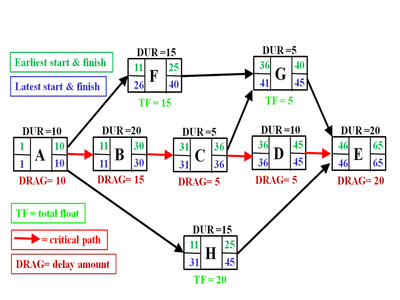
It is a diagram used in critical path analysis that shows the logical sequence of activities and the logical dependence between them – so the critical path can be identified
EST (Earliest Start Time) = EST of previous activity + duration of current activity
LFT (Latest Finish Time) = LFT in the previous node- duration of current activity
Free float shows the length of time an activity can be delayed without delaying the start of next activity
Free float = EST (next activity)-duration- EST (Current activity)
Total float = LFT- Duration- EST
Total float is the amount of time an activity can be delayed by without delaying the whole project
Total float = 0 the activity is on the critical path and cannot be delayed
Dummy activities
Indicated by a dotted line
Does not consume time or resources
Used when –
A & B start a project, C follows only A but D follows A + B
Advantages of CPA
Used to assist planning and management of complex projects
Helps calculate accurate delivery dates
Calculation of EST allows special orders to be managed
Calculation of LFT helps act as a checklist of measuring the success and efficiency
Knowing the critical path helps understand which activities to focus on, which can’t be delayed
Additional resources needed for speeding an activity could be used from non-critical activities
Reduces total time taken as it encourages simultaneous development rather than sequential.
CPA – evaluation
Doesn’t guarantee project success
Skilled labour, motivated workers also needed
Good management
Experienced senior managers