Chapter 4: Analyze the Data
Vocabulary
Exploratory business analytics: Initial descriptive and diagnostic business analytics that analysts use to summarize and explain performance
Confirmatory business analytics: Predictive and prescriptive analytics that use statistics to judge the likelihood of a future event or outcome occurring
Human Resource Management System (HRMS): Information system for managing all interactions with employees
Customer Relationship Management System (CRM): Information system for managing all interactions with past, current, and potential customers
Supply Chain: Sequence of processes to move a product from raw materials to final customer delivery
Supply Chain Management System (SCM): System used to track supply chain processes
Financial Reporting Systems (FRS): Accounting systems which capture and measure financial transactions and communicate financial performance to interested parties
Financial statements: Collection of reports that communicate a company’s financial results, condition, health, and cash flows
Balance sheet: Summarizes a company’s assets and how much are financed at a certain point in time
Income statement: Summarizes how profitable the company has become een over a period of time
Descriptive Statistics: Summary statistics that briefly summarize features of a data set or variable
Horizontal Analysis: Identifies changes in various line items of the income statement, balance sheet, or statement of cash flows across time
Vertical Analysis: Expresses financial information in relation to some relevant base
Diagnostic Analytics: Investigate the underlying reasons for past results that cannot be answered by simply looking at the descriptive data
Outlier: Observation that lies outside its expected distribution
Management by Exception: Management technique in which managers attend to specific aspects of the business that depart from expectations
Concepts
Data for Descriptive Statistics comes from:
Human Resource Management Systems
Data includes:
Recruiting data and leads
Training
Payroll and compensation
Benefits
Annual reviews
Absenteeism
Career Progression
Satisfaction and Sentiment
Privacy is highly valued
Customer Relationship Management Systems
Data includes:
Contact history
Order history
Level of trade discounts or payment terms
Credit score
Credit limit
Payment history
Privacy is highly valued
Supply Chain Management Systems
Data includes:
Active vendors
Orders placed
Demand schedules for which components of the final product are needed
Transportation status and schedules
Current location of the product in the supply chain
Financial Reporting Systems
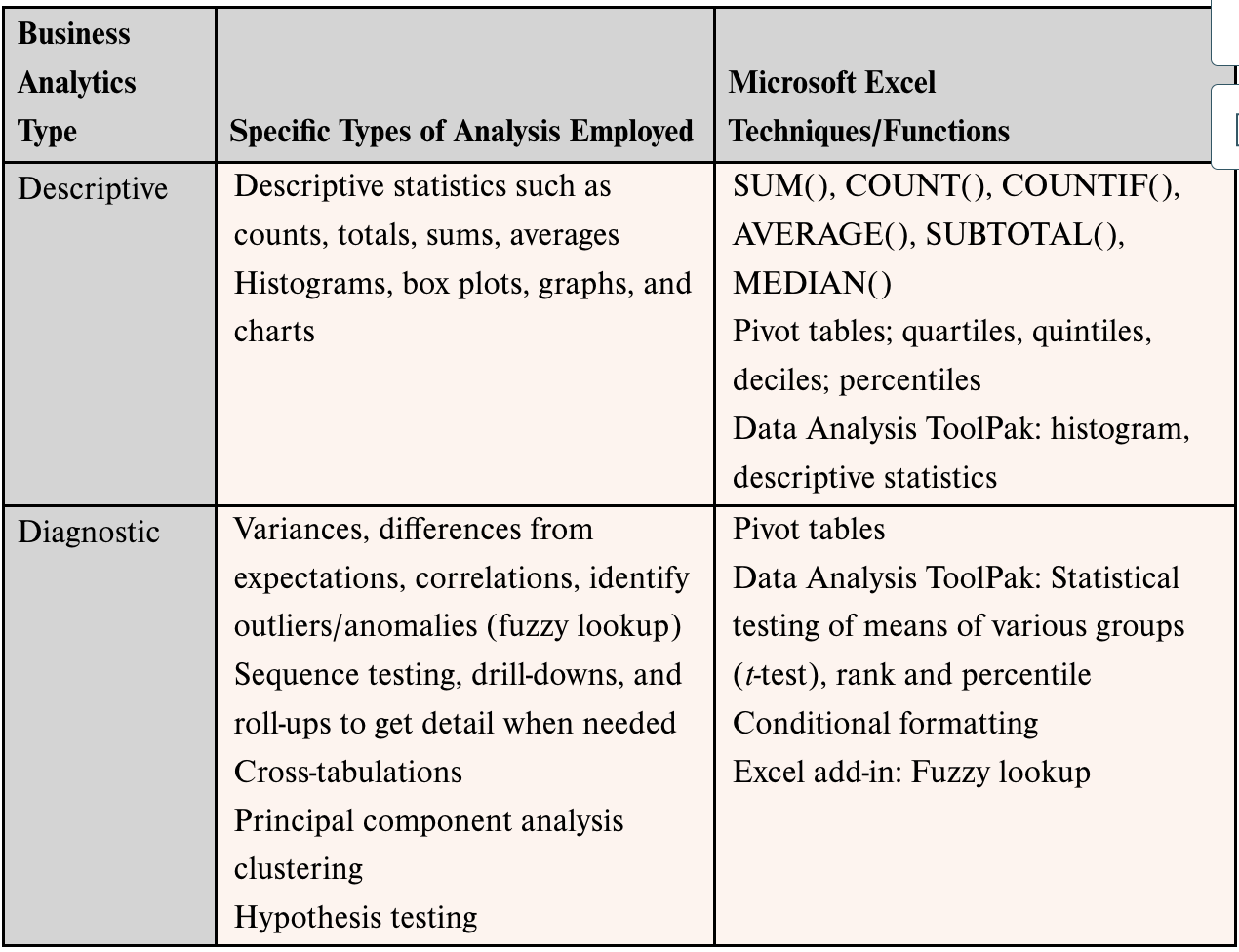
Descriptive Analytics Techniques
Counts: Show how frequently an event or process occurs
Total, sums, averages, subtotals, cross-tabulations: Summarize measures of performance
Minimums, maximums, medians, standard deviations: Summarize measures showing extreme values to help explain what happened
Graphs, histograms, and other visualizations: Summarize visually how often or how much there is of an object or event in comparison to other values
Vertical analysis and horizontal analysis of financial statements
Ratio analyses such as return on assets, return on sales, asset turnover ratios, or debt-to-equity ratios
Diagnostic Analytics
Identifying anomalies and outliers
Important to start by establishing the norm, then investigate to understand why they occurred
Can be mistakes, truth, or fraud
Techniques
Cash/Bank Reconciliation: Reconcile bank acct with financial records
Benford’s Law: Principle that in any large, randomly produced set of natural numbers, there is an expected distribution of the first or leading digit.
Smaller values occur more frequently than larger ones
Duplicates
Fuzzy Matching: Potential equivalents without exact fit
Sequence Check: Technique to determine if key number field in record is in the correct order
Finding previously unknown linkages, patterns, or relationships between variables
Performing drill-down detailed analytics: Evaluates a greater level of detail in the data to gain insight
Performing statistical analyses
Techniques
Correlation: Extent to which variables are related to each other
Regression: Assessment of how a specific outcome is related to specific inputs
Hypothesis Testing: Statistical test of an assumption or theory