Fossils and Geological Time
Definition of Fossils
Fossils are defined as preserved plants and animals whose remains have been buried. The process of fossilization is critical to understanding the history of life on Earth.
The main points regarding fossils include:
Soft Parts Decomposition: The soft biological tissues of organisms tend to decompose quickly or can be consumed by scavengers shortly after death, making soft-tissue fossils exceptionally rare.
Hard Parts Burial: For fossilization to occur, the hard parts, such as skeletons and shells, must be quickly buried to prevent decomposition.
Rarity of Fossils: Due to theses aforementioned factors, fossils are very rare in geological records.
Fossilization Processes
Fossilization encompasses various processes through which the remains of organisms become preserved.
The primary processes of fossilization discussed include:
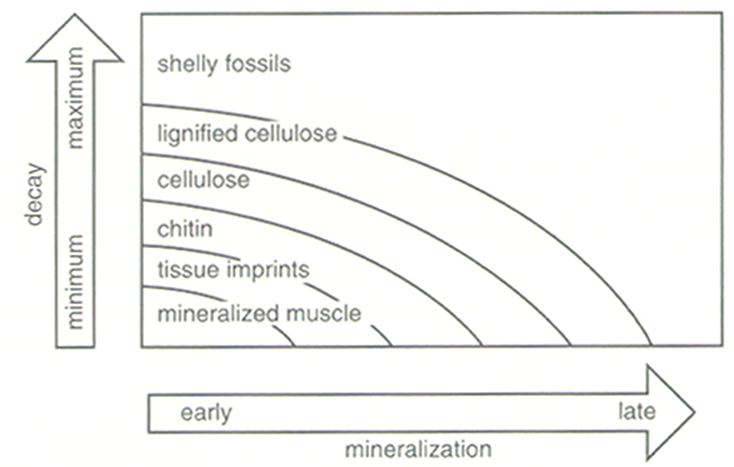
Mineralization
Definition: Mineralization is a process where organic materials are gradually replaced with minerals. This typically applies to fossilized bones or teeth, whereby the original material is replaced atom by atom.
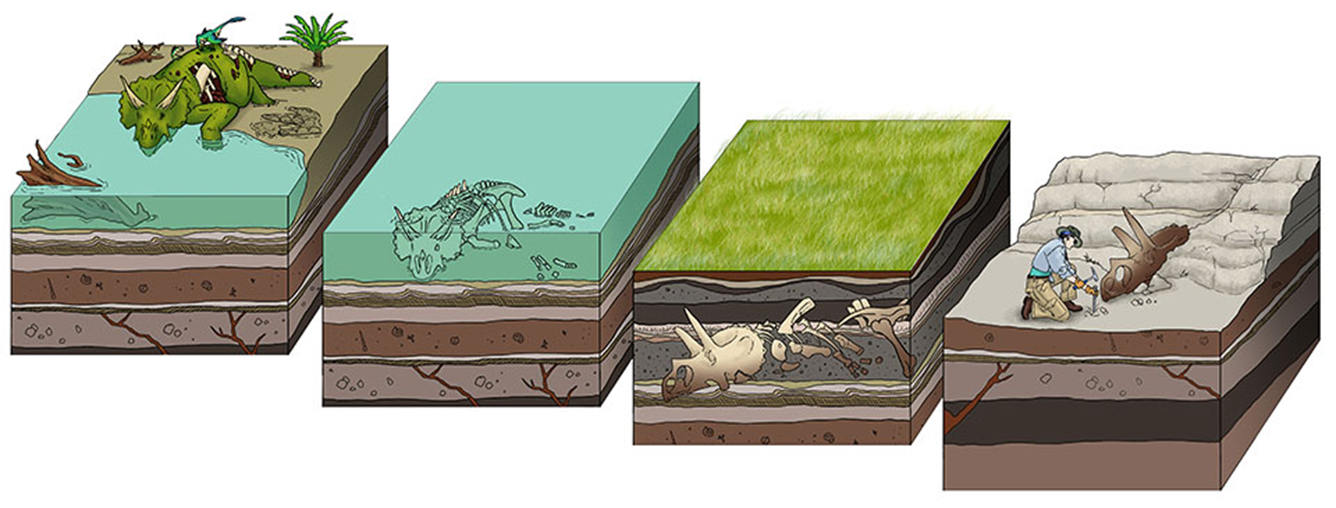
When an organism dies, it must be rapidly buried by sediment in order to become a fossil. Otherwise, it would be decomposed by other organisms.
Sediment continues to accumulate over time, building up layers over the skeleton.
Eventually the sediment containing the bones turns to rock.
The bones are chemically changed and hardened by minerals in the rock. The minerals enter empty spaces in the bones and wood.
The fossils are only exposed if erosion events occur or digging of course. This is the most common type of fossil.
Historical Reference: The concept of mineralization dates back to studies from 1898 and continues to be explored in the present (2014-2023).
Replacement – "Petrification"
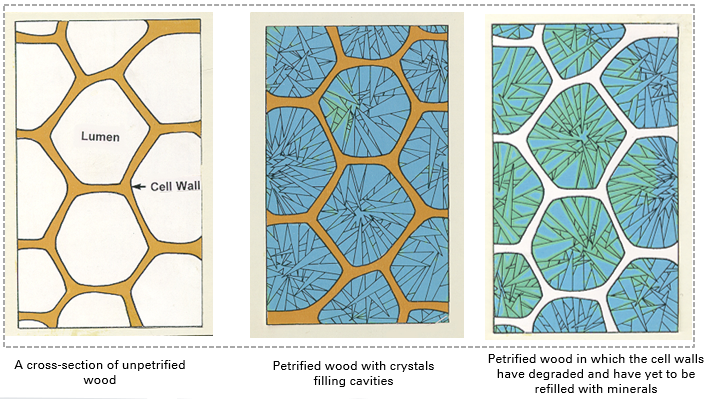
Definition: Replacement, often referred to as petrification, is the specific process where materials, usually plant matter, are turned into stone.
This is achieved through the infiltration of water carrying mineral particles, which fill cavities without altering the original shape of the material.
Mechanism: The dead organic material, such as wood, becomes saturated with mineral-laden water.
The porous structure of wood allows water-borne particles to move and eventually replace the original organic material with minerals, resulting in petrified wood, which may contain crystals filling cavities or show degradation in cell walls.
Moulds and Casts
Process Description: The process begins with an organism dying and being buried. Following this, the organic material gradually dissolves, leaving an open space that mirrors the structure of the organism.
Formation of Moulds and Casts: Sediments and minerals then fill this open space, forming a cast that takes the shape of the original organism, while the open space itself is referred to as a mould. This type of fossilization allows for a three-dimensional representation of past life forms.
Compression
When remains are compressed by high pressure, an imprint is left behind.
This most commonly occurs to leaves and ferns.
A feature of all fossilisation
Relative Dating
Determining the age of fossils is crucial in the study of geology and palaeontology. There are two primary methods of dating fossils:
Relative Dating
Biostratigraphy:
This technique involves placing fossils within a temporal context by assessing their stratigraphic positions in rock layers. It elucidates the chronological sequence of biological development across geological eras.
Geomagnetic reversal
A change in the position of magnetic north and magnetic south
Iron particles float in molten rock and orient themselves to Earth’s magnetic field.
When the rock solidifies, the iron becomes trapped in position, indicating the magnetic field at the time.
Multiple layers are used to observe the record of polarity, which is connected to time. Paleomagnetism itself cannot tell time.

Geological Time Scale
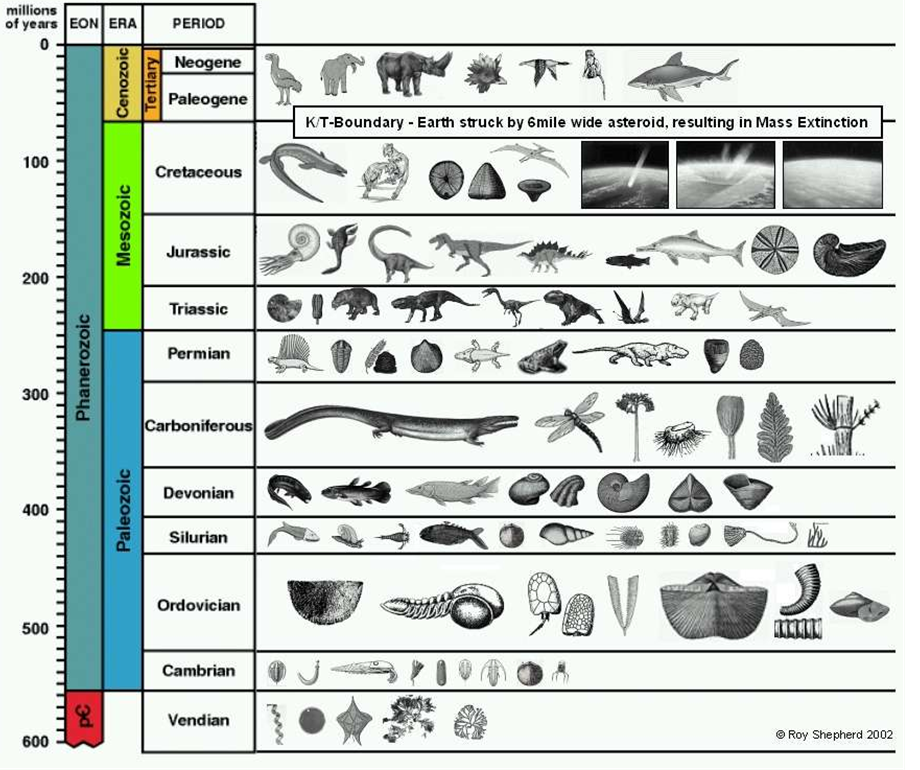
Fossils are often categorized within a structured framework that includes Eons, Eras, and Periods. The geological timescale includes:
Cenozoic Era: Divided into the Tertiary (Neogene and Paleogene periods).
Mesozoic Era: Comprises Triassic, Jurassic, and Cretaceous periods.
Paleozoic Era: Encompasses various periods such as Permian, Carboniferous, Devonian, Silurian, Ordovician, and Cambrian.
K/T Boundary Event: A notable event in the fossil record is marked by the K/T boundary, where Earth was struck by a six-mile-wide asteroid that led to a significant mass extinction.
Absolute Dating
This method provides an actual age or time frame for fossils using the decay rates of radioactive isotopes. Key isotopes relevant for dating include:
Carbon Isotopes:
Atoms are made of protons (positive), neutrons (neutral) and electrons (negative). Protons and neutrons make up the central mass in the nucleus.
For every element in the periodic table, the number of protons is always the same, but the number of neutrons and electrons can change. Isotopes are the same atom but different number of neutrons, defined by the sum of the protons and neutrons.
Most isotopes are stable, but a few aren’t.
Carbon-14 for example is unstable so decays, or breaks down, over time.
When they breakdown they release energy (radiation) which changes the number of protons and/or neutrons.
By measuring the amount of the new (daughter) isotope formed, we can calculate the age of a substance composed of the isotope. The rate (speed) of decay for many unstable isotopes has been measured.
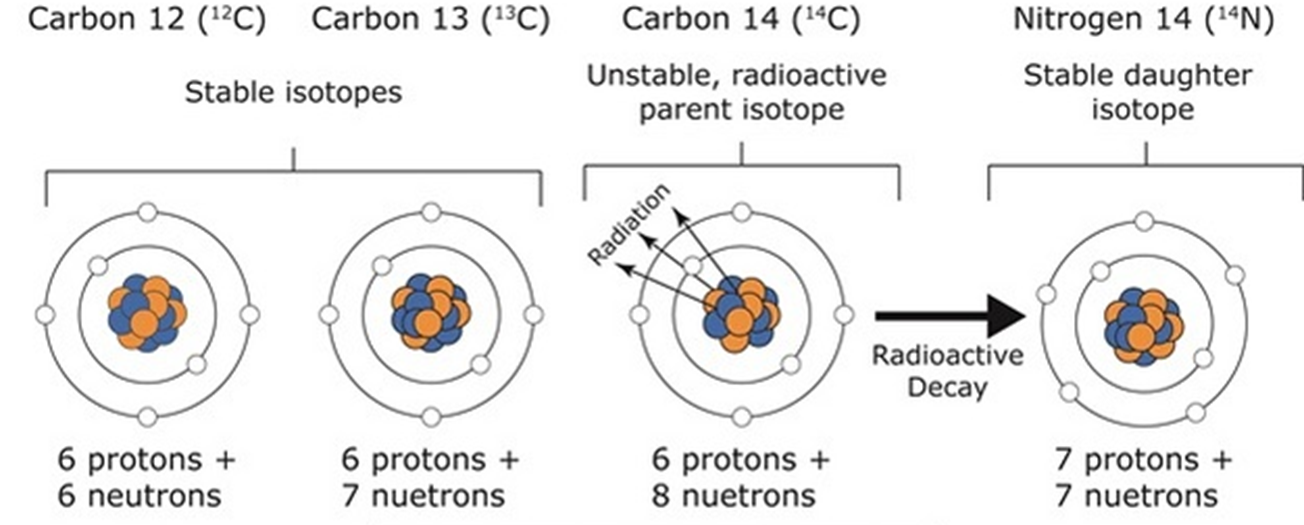
Half-Life Concept: The half-life is defined as the amount of time it takes for a parent isotope to decay by half into its daughter isotope. Different elements have varied half-lives, complicating but also enriching the dating process.
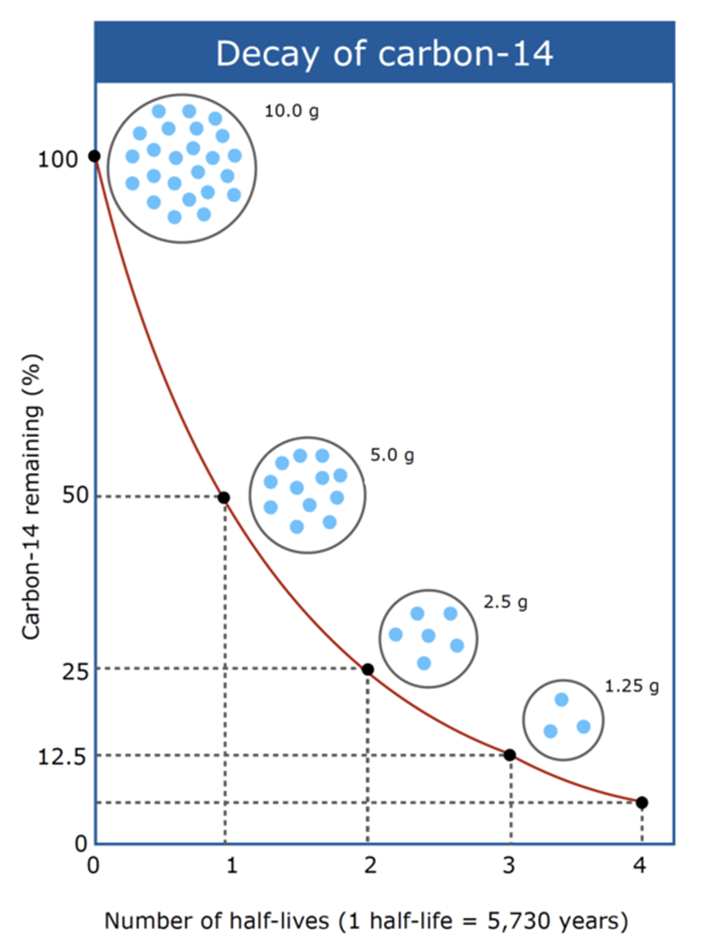
Common Isotope Decay Series: The following isotopes and their decay rates are significant in fossil dating:
Carbon-14 to Nitrogen-14; half-life of about 5,370 years.
Potassium-40 to Argon-40; half-life of approximately 1.31 billion years.
Uranium-235 to Lead-207; half-life of about 704 million years.
Uranium-238 to Lead-206; half-life of roughly 4.47 billion years.
Thorium-232 to Lead-208; half-life of around 14 billion years.
Rubidium-87 to Strontium-87; half-life of 48.8 billion years.
Samarium-147 to Neodymium-143; half-life of 106 billion years.
Lutetium-176 to Hafnium-176; half-life of 35.9 billion years.
Uranium Series Dating
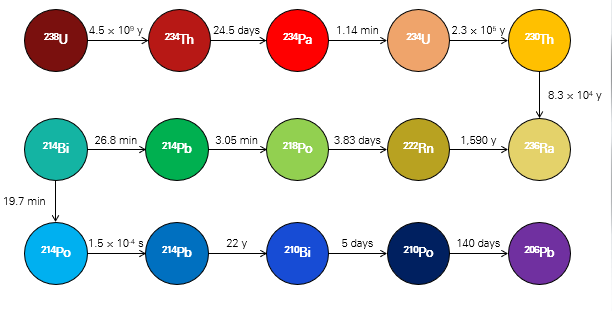
Another important aspect is uranium series dating, which involves a complex radioactive decay series beginning with uranium-238:
The series includes numerous isotopes such as 234Th, 234Pa, 230Th, and 206Pb, each with its half-lives ranging from several minutes to billions of years.