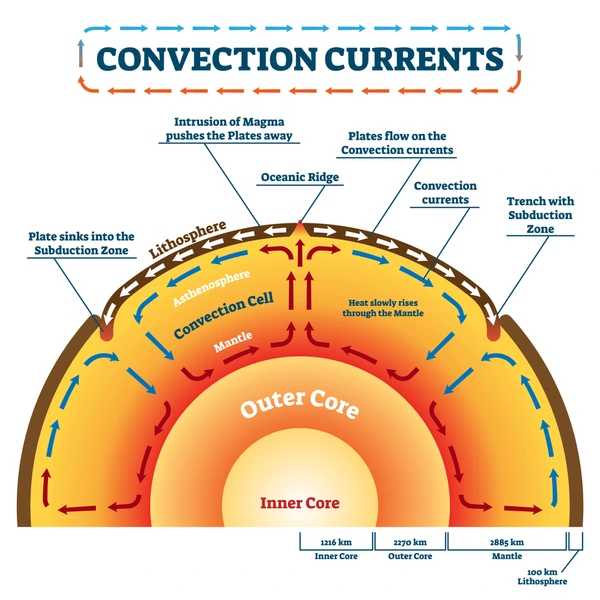
Earths layers + plate boundaries
Earth is made up of layers and there are tectonic plates sitting on top of those layers that move around and meet with each other. This notes page will sum up what we have learnt about this as of 12/25.
Earth is made up of three layers: the crust, the mantle and the core.
THE CRUST
The crust is the thinnest outermost layer of earth - only at around 5 - 70km thick. It is made up of two different types of solid crust; oceanic and continental. The way these plates interact with each other are very important in regards to the formation of earthquakes and volcanos, but we will come to that later.
THE MANTLE
The mantle is 2900km thick making it the thickest layer of earth, it also makes up 84% of earths volume. The mantle is a semi liquid layer of molten magma - made of magnesium, iron, silicone and oxygen. The temperature is around 1000 - 3700 degrees c.
THE CORE
Earths core is at the very centre of earth where its is extremely hot. Earths core is sometimes separated into 2 sections, the inner core and the outer core. The outer core is made of liquid iron and nickel, they are liquid as the temperatures are extremely hot ( around 4400 degrees c ) and it is 2300 km thick. However, earths inner core is even hotter - at around 6000 degrees c. This layer is only made of iron but this time it is solid metal. This is not because it is not hot enough as we know it is hotter, this is because the pressure is so strong there it forces all of the particles together - making earths inner core a giant ball of solid metal. This layer is smaller however, around 1220km which is 70% of the size of earth’s moon.
There are 4 types of plate boundary - constructive, destructive, collision and conservative
CONSTRUCTIVE
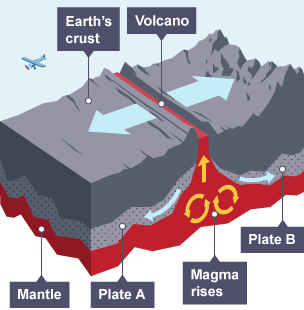
A constructive plate boundary involves 2 crusts of the same type moving away from each other. This might seem confusing but remember it like they are constructing a volcano - as this is what they are usually known for forming. As two plates move away from each other it leaves a gap in then crust for magma from the mantle to seep through to the surface creating volcanos.
DESTRUCTIVE
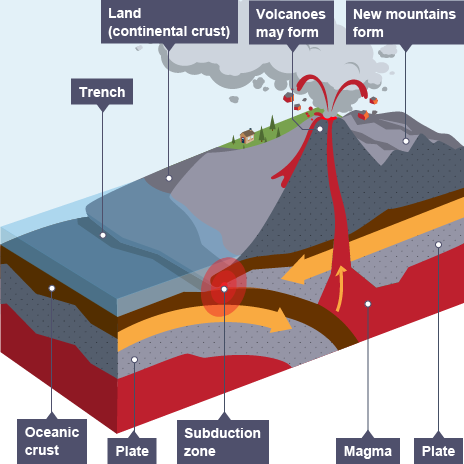
A destructive plate boundary requires 1 ocean crust and 1 continental crust moving towards each other. When they meet the denser oceanic plate will subduct below the lighter continental plate. This process can form deep sea trenches such as the Mariana Trench. These can also form powerful earthquakes and tsunamis due to the build up of friction as these plates move past each other and when it is released it sends shock waves through the sea/earth. I thought this video was very helpful:
COLLISION
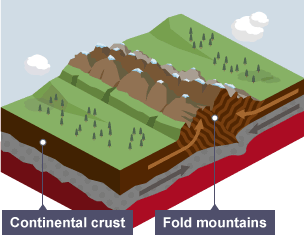
A collision plate boundary involves 2 continental crusts moving towards each other, crashing into to each other and smashing upwards. This can process can create mountains such as the Himalayas in Nepal. When these plate boundaries crash into each other they can send shock waves causing powerful earthquakes.
CONSERVATIVE
A conservative plate boundary also involves 2 continental crusts however they slide against each other, in the same direction or opposite. These crusts can get stuck next to each other causing a build up of tension, the release of which can make earthquakes. An example of this would be the San Andreas fault.
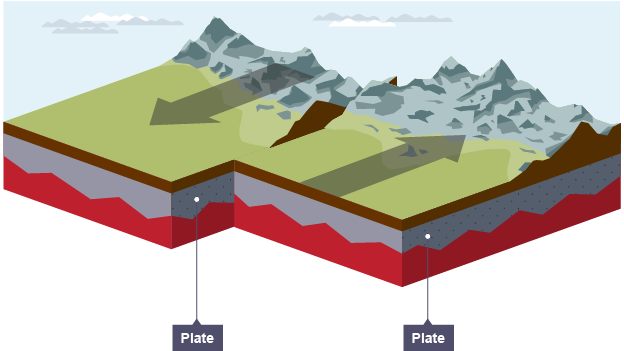
But how do crusts actually move and come into contact with each other?
The movement of Earth’s crust is driven by something called convection currents. Remember how the mantle is filled with semi- molten magma? Well the magma at the bottom of the mantle ( closest to earths core ) is the hottest. As it heats up it rises nearer the top of the mantle, imagine at this points it sticks to a piece of crust. But then, now that it’s further away from the mantle it cools and starts to move in one direction and down. This drags the crust it was near with it - causing it to move.