Night Notes
The People of the Holocaust — Night, Ch. 1
a. victims (some of whom are survivors): one who has been physically or emotionally targeted/harmed by another
b. resisters: Jews who fought back against their Nazi oppressor
c. perpetrator: someone who does something that is morally wrong or criminal
d. collaborator: one who cooperates with an enemy that is occupying one’s country
e. bystander: one who is present at an event or who knows about its occurrence without participating in it
f. upstander: a person who speaks or acts in support of an individual or cause, particularly someone who intervenes on behalf of a person being attacked or bullied
g. rescuer: a person who saves someone from a dangerous or difficult situation
h. liberators: allied soldiers who freed nazi death and concentration camps
Note: The “Big Three” allies were the U.S, UK, and Soviet Union
Night, Ch. 4
Resistance: the refusal to accept or comply
the three main categories of resistance in the context of the Holocaust are:
→armed resistance (involving weapons or using an object/one’s body as a weapon)
→ spiritual/cultural resistance (preservation of culture or faith education, art, literature)
→unarmed/passive resistance (smuggling, hiding, workplace sabotage, defying Nazi order)
Resisters Name | Type of Resistance | How did the person resist? |
Man From Block 37 | Unarmed/Passive | Stealing Soup |
Young Boy From Warsaw | Unarmed/Passive | Shouting Curses at the Germans |
Angel Boy Pipel | Spiritual/Cultural | Talking About the Jewish Faith |
Young French Girl | Unarmed/Passive | Talking in German, Offering Elie Sympathy |
Elie | Unarmed/Passive | Getting out of his gold crown removal |
Oberkapo/Pipel | Armed | Smuggling Weapons |
People Who Acted Kindly — Night, Ch. 5
doctor:
reassures elie he will make a full recovery in 2 weeks
offers elie’s dad a spot in the infirmary to be with elie
elie:
shares bread with his father
elie’s dad:
offers elie his “inheritance” (knife and spoon)
yossi and tibi:
supported one another, as well as elie during the selection
kapo:
gives elie an easy job the day his father is selected
blockaltaste:
offers double rations of bread and extra clothing before the death march
Should Elie Have Fasted on Yom Kippur?
Why Yes?
It is a sacred Jewish holiday
It could rebuild his connection with God after everything that has happened
He believes there is still a God and not fasting will make him angrier
It would give him a new religious start, and cleanse his sins
Why No?
Elie has lost his faith in God
If Elie fasted, he could have died
Elie’s father forbids him to fast
Should Elie and his Father Have Stayed at the Infirmary as the Red Army Neared?
Why Yes?
Both Elie and his Father are injured
Higher chance of surviving in the infirmary
They would have had access to all of the resources in the infirmary
Why No?
They had no way of knowing what would happen if they remained
choiceless choice: a term coined by Lawrence Langer to describe the no-win situations faced by Jews during the Holocaust
How do Words Take on new Meanings in Night
evacuation (generally): leaving an area of danger
evacuation (night): forced removal of any evidence of the Nazi’s crime, including the Jews
euphemism: polite or agreeable words or phrases that are used to replace words that may be unpleasant or offensive
Catchup Day — Night
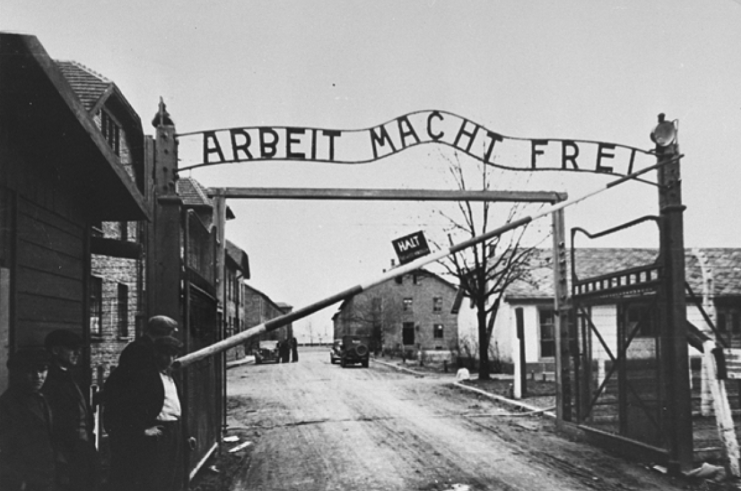
**arbeit macht frei →”work will set you free”
Essential Question:
Why were Jewish people targeted during the Holocaust?
a. antisemitism — hatred for jews
Night, Ch. 6-9
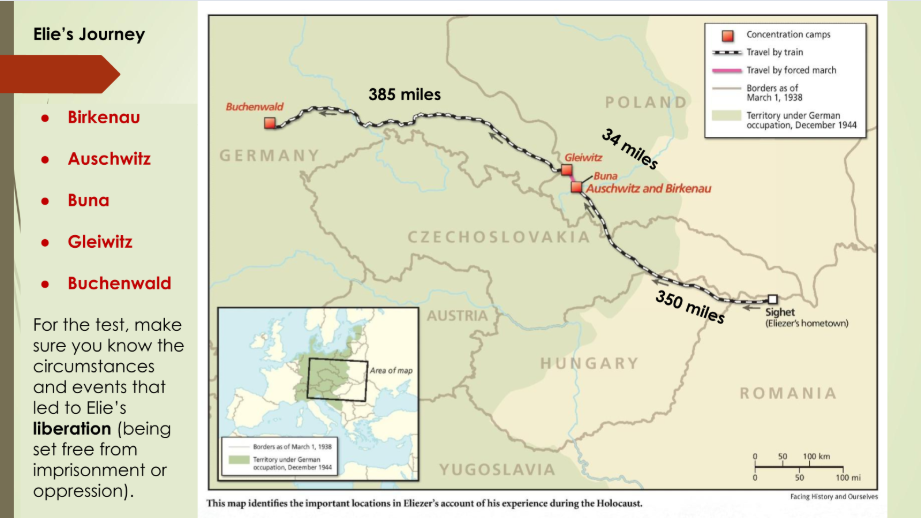
**Auschwitz was located in Poland, and Buchenwald is located in Germany
Mrs. Schachter has a premonition on the train to Auschwitz
Night Essay Notes
a.) when a quote intro flows seamlessly into a quote, there is no need for a comma before the quote
b.) when a quote intro is introducing the quote, include a comma before the quote
c.) remain in consistent tense (whether that is past or present)
d.) outside of direct quotes, you may refer to the protagonist as Wiesel OR Elie (just be consistent
e.) generally, avoid the word “states” to introduce a quote
f.) other words/phrases to avoid
→”thing” words
→ contractions
→seems to
→very
→really
→many
→This shows/This quote shows
→This illustrates/This quote illustrates
→ Cliche/Informal statements
g.) capitalize proper nouns
→Holocaust
→ Jewish/JEw
→ God
→ Nazi/Nazis
→ Final Solution
h.) citations for prose and poetry differ
Prose: “That night, the soup tasted of corpses” (Wiesel 65).
Poetry: “Roses are red / Violets are blue” (Spenser, lines 1-2)
i.) memoirs have a narrator and subjects/people. poems have a speaker and may have characters